U.S. Nuclear Power waning: A history of Failures

See on Scoop.itGreen & Sustainable News

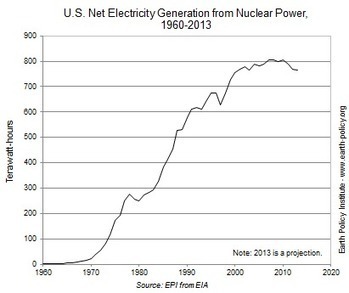
By J. Matthew RoneyNuclear power generation in the United States is falling. After increasing rapidly since the 1970s, electricity generation at U.S. nuclear plants began to grow more slowly in the…

Duane Tilden‘s insight:

>Of the 253 reactors that were ordered by 1978, 121 were canceled either before or during construction, according to the Union of Concerned Scientists’ David Lochbaum. Nearly half of these were dropped by 1978. The reactors that were completed—the last of which came online in 1996—were over budget three-fold on average.

By the late 1990s, 28 reactors had permanently closed before their 40-year operating licenses expired. […]

In 2012, the U.S. Nuclear Regulatory Commission (NRC) approved four new reactors for construction, two each at the Vogtle plant in Georgia and the Summer plant in South Carolina. These reactors are all of the same commercially untested design, purportedly quicker to build than previous plants. Both projects benefit from fairly new state laws that shift the economic risk to ratepayers. These “advanced cost recovery” laws, also passed in Florida and North Carolina, allow utilities to raise their customers’ rates to pay for new nuclear plants during and even before construction—regardless of whether the reactors are ever finished.

Construction at both sites began in March 2013. Even as the first concrete was poured at the $14-billion Vogtle project, it was reportedly 19 months behind schedule and more than $1 billion over budget. The Summer project, a $10 billion endeavor, also quickly ran into problems. […] With these delays, the earliest projected completion date for any of these reactors is some time in late 2017. […]

This year has also already witnessed the permanent shutdown of four reactors totaling 3.6 gigawatts of capacity. The first to fall was Duke’s Crystal River reactor in Florida. Although the plant was licensed to run until 2016, Duke decided to close it rather than pay for needed repairs. Then Dominion Energy’s 39-year-old Kewaunee reactor in Wisconsin closed, citing competition from low gas prices. It had recently been approved to operate through 2033. And in June, Southern California Edison shuttered its two San Onofre reactors after 18 months of being offline due to a leak in a brand new steam generator. These retirements leave the United States with 100 reactors, averaging 32 years in operation. (France is second, with 58 reactors.)

More closures will soon follow, particularly among the roughly half of U.S. reactors in so-called merchant areas […]

Dealing with nuclear waste is another expensive proposition. Over the past 30 years, the U.S. government has spent some $15 billion trying to approve a central repository for nuclear waste, and for most of that time the only site under consideration has been Nevada’s Yucca Mountain. Amid concerns about the site’s safety and its extreme unpopularity in Nevada, the Obama administration has moved to abandon the project entirely and explore other options.

A federal appeals court ruled in August 2013 that the NRC must resume reviewing the site’s suitability. In the meantime, the waste keeps accumulating. The 75,000 tons of waste now stored at 80 temporary sites in 35 states is projected to double by 2055. […]

See on grist.org
Call for Energy Efficient Air-Conditioning with Technological Development

See on Scoop.itGreen Building Design – Architecture & Engineering

Innovations could cut the growing amount of energy used for air-conditioning and refrigeration

Duane Tilden‘s insight:

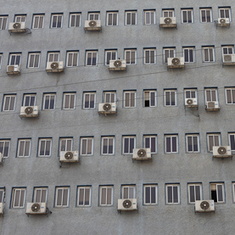
>Conventional air conditioners employ refrigerants such as chlorofluorocarbons to absorb heat from the room to be cooled. That heat is then expelled outside, requiring electrically powered pumps and compressors.

One idea to conserve energy is to replace coolant fluids and gases—which are often super-powered greenhouse gases capable of trapping more than 1,000 times more heat than CO2—with solid materials, such as bismuth telluride.

A new device from Sheetak, developed in part with ARPA-E funding, uses electricity to change a thermoelectric solid to absorb heat, and could lead to cheaper air conditioners or refrigerators.

Such refrigerators, which lack moving parts and are therefore less likely to break down, can be lifesavers in remote, rural areas for keeping medicines cool or food fresh.<

See on www.scientificamerican.com

Proliferation of wireless devices and networks detrimental to environment

See on Scoop.itGreen & Sustainable News

Cloud computing should be driving sustainable development, but its turning us into energy consuming monsters, write Stuart Newstead and Howard Williams

Duane Tilden‘s insight:

>There is a familiarity and comfort in our almost-everywhere connection to always-on communications networks and to the ever-increasing array of services they deliver us. We don’t just consume these network services directly, they give us what economists call “options” – options to connect, options to seek out new services, options to find new information. Clearly we don’t use this network services 24/7, but we value highly the options for instantaneous and simultaneous access at any time.

Cloud-based applications – those stored and managed by massive data centres run by the likes of Amazon, Google, Facebook or Apple – are providing step changes in the financial and environmental efficiency of delivering these services. But the centralising power of the cloud has its corollary in the dispersing effect of wireless networks and devices.

In wireless networks and devices we see fragmentation, duplication and a fundamental shift from mains power and green sources of energy to battery powered always-on devices. In environmental terms here lies the rub. Rather than the “aggregation of marginal gains” (the Sir Dave Brailsford strategy that has propelled success in British cycling), in which lots of tiny improvements add up to a large visible improvement, we are witnessing the aggregation of environmental disadvantages from billions of low-powered but fundamentally energy-inefficient antennas and devices providing the ‘last metre’ connectivity to global networks.

Wireless networks and devices, technologies that should drive sustainable development, are turning into energy-consuming monsters.<

See on www.theguardian.com

Hot Rocks: Canada Sits Atop Massive Geothermal Resource – Renewable Energy

See on Scoop.itGreen & Sustainable News

September 2011 Report by the Geological Survey of Canada suggests 100 projects could provide much of the country’s power needs…

Duane Tilden‘s insight:

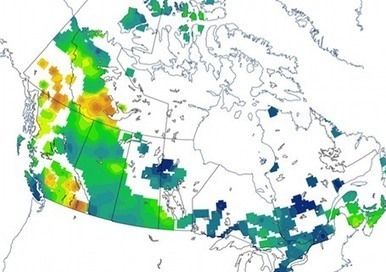
“Canada’s in-place geothermal power exceeds one million times Canada’s current electrical consumption,” the report notes, though also stating most of that available power could not actually be produced. “Environmental impacts of geothermal development are relatively minor compared to other energy developments, however there are still key issues to be addressed….Geothermal installations have the potential to displace other more costly and environmentally damaging technologies.”

There is at least 5000 megawatts of available geothermal power in various parts of British Columbia, Alberta, and the Yukon. What’s more, the report’s authors write, the cost of delivering geothermal power is expected to rival the costs of coal within 15 years or so. The limitations of developing the huge geothermal resource have a lot to do with location: Some of the most promising areas are far away from load centers, and the costs of developing huge transmission corridors to bring the power to where it is needed would make such projects unfeasible. Still, there is enough located in accessible areas to make a big difference.

See on spectrum.ieee.org

Jobs for the Future: Energy Efficiency creates Employment — ECEEE

See on Scoop.itGreen & Sustainable News

Energy efficiency initiatives create jobs, and normally very good jobs.  Recent analysis shows that between 17 and 19 net jobs can be created for every million euros spent.

Duane Tilden‘s insight:

>Jobs to improve energy efficiency in all end-use sectors are of high value.  Many require technical qualifications, such as engineering or architectural degrees.  Many require re-training from existing jobs. There will be a demand for financial specialists, construction engineers, behaviour specialists, project managers, auditors, data base managers, policy analysts and the like.  And these jobs are available to all, regardless of age or gender.

The hard work of creating these jobs begins once the Directive is finally approved.  The long-term policy framework needs to be in place and the funding and implementation strategy need to be well developed. But in the longer term, opportunity is knocking at the door, and it deserves a welcome mat.<

See on www.eceee.org

Fukushima leaks will keep fisheries closed indefinately

See on Scoop.itGreen & Sustainable News

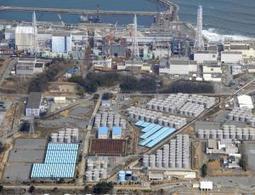
Some Japanese fisheries face a long-term threat from the steady trickle of radioactive water from the stricken Fukushima Daiichi nuclear plant

Duane Tilden‘s insight:

>Last month the plant’s owner, Tepco, finally admitted what many had suspected – that the plant was leaking. Now Japan’s Nuclear Regulatory Authority is calling the situation an emergency, and says Tepco’s plans to stop the leak are unlikely to work.

The problem is that groundwater is entering the damaged reactor buildings, picking up radioactive elements like caesium and seeping out to sea. Tepco has spent months pumping the water to the surface and storing it in tanks, and sinking wells to lower the water table.

[…] Given that Tepco is unlikely to stem the leaks from Fukushima any time soon, the fishing ban could continue for a long time. “People ask when will it be safe, and we can’t answer that,” says Buesseler. “The only thing you can do is stop the source, and that’s a huge engineering challenge.”<

See on www.newscientist.com

UK Energy Minister defends fracking comments

See on Scoop.itGreen & Sustainable News

Energy minister Michael Fallon defends comments about fracking, in which he appeared to suggest the process would affect those living near drilling sites.

Duane Tilden‘s insight:

>Mr Fallon said fracking would only be allowed if “absolutely safe”.

In an exchange with the BBC Mr Fallon confirmed he had made the remarks but said the newspaper report had “completely misconstrued a light hearted remark”.

He said “no fracking will be allowed in the Weald unless it is absolutely safe and the environment is fully protected”.

[…]

But demonstrators from across the UK have gathered in the area saying they fear test drilling could lead to the search for shale gas and fracking at the site.

In a separate development, Cuadrilla chief executive Francis Egan revealed he had received an anonymous email saying the company would receive “pipe bombs delivered by express mail to its premises” unless the company ceased its activities in the UK.

“Fracking kills and so do we,” the message said.<

See on www.bbc.co.uk

A Republican Case for Climate Action

See on Scoop.itGreen & Sustainable News

By WILLIAM D. RUCKELSHAUS, LEE M. THOMAS, WILLIAM K. REILLY and CHRISTINE TODD WHITMAN Published: August 1, 2013The United States must move now on substantive steps to curb climate change, at home and internationally.

Duane Tilden‘s insight:

>Mr. Obama’s plan is just a start. More will be required. But we must continue efforts to reduce the climate-altering pollutants that threaten our planet. The only uncertainty about our warming world is how bad the changes will get, and how soon. What is most clear is that there is no time to waste.<

See on www.nytimes.com

Bakken Oil: North Dakota flaring burns 4 times Total National Consumption (2011 figure)

See on Scoop.itGreen & Sustainable News

NEW YORK (Reuters) – Oil drillers in North Dakota’s Bakken shale fields are allowing nearly a third of the natural gas they drill to burn off into the air, with a value of more than $100 million per month,…

Duane Tilden‘s insight:

An alarming state of affairs.  As per the article the flared Natural gas in North Dakota is reported to be 266,000,000,000 cfd (cubic feet per day) flared methane or 2750 x 10(9) cu m/year.

According to Wiki the 2011 US annual consumption for natural gas was 689.9 x 10(9) cu m, so apparently Bakken is actually burning 4 times the total 2011 national requirements.

>Roughly 29 percent of natural gas extracted in North Dakota was flared in May, down from an all-time high of 36 percent in September 2011. But the volume of natural gas produced has nearly tripled in that timeframe to about 900,000 million cubic feet per day, boosting flaring in the state to roughly 266,000 million cubic feet per day, according to North Dakota state and Ceres data.<

See on www.reuters.com

Companies Fined for Greenhouse Gas (GHG) Emissions Reporting Errors | The National Law Review

See on Scoop.itGreen & Sustainable News

Nine companies were issued fines by the California Air Resources Board (ARB) for violating the State of California’s Mandatory Greenhouse Gas Reporting rule. The ARB adopted the reporting rule in 2007.

Duane Tilden‘s insight:

>The companies cited for violations were not concentrated in one industry sector.  Sources receiving fines included a refinery, a biomass generating plant, an oil and gas production company, a utility company, a lime manufacturing company, and a cement company, among others. <

See on www.natlawreview.com