The Obama Administration Proposes $8 Billion in Loans for ‘Clean’ Fossil Fuel Technologies

See on Scoop.itGreen & Sustainable News

As part of President Obama’s new energy initiative, the U.S. Department of Energy has proposed $8 billion in loan guarantees for fossil fuel technology projects that are able to reduce the country’s greenhouse gas emissions.

Duane Tilden‘s insight:

> […]the U.S. Department of Energy has proposed $8 billion in loan guarantees for fossil fuel technologies to reduce the country’s greenhouse gas emissions. The proposal would fund schemes such as waste heat recovery and carbon dioxide capture, however it has unsurprisingly received criticism as it would draw focus away from green technology projects such as renewable energy and electric vehicles.

Speaking about the new proposal, Energy Secretary Ernest Moniz stated:  “Coal and fossil fuels still provide 80% of our energy and 70% of electricity, and they will remain an important part of our future, as the president noted.”<

See on inhabitat.com
The Amazing Energy Race

See on Scoop.itGreen & Sustainable News

The United States is falling behind. To catch up, we need to reorder our priorities, find cleaner and smarter fuels and develop new technologies.

Duane Tilden‘s insight:

>“In reducing coal’s historic dominance, the president is formalizing a market trend that was already taking shape,” remarked Andy Karsner, who was an assistant secretary of energy in the last Bush administration. His bigger message, though, was “no matter where you find yourself on the political spectrum, it’s useful for the nation to discuss, debate and consider a strategy for climate change. The consequences of inaction are potentially greater than all the other noise out there.”<

See on www.nytimes.com

China opens city-sized shopping mall, with fake sun

See on Scoop.itGreen & Sustainable News

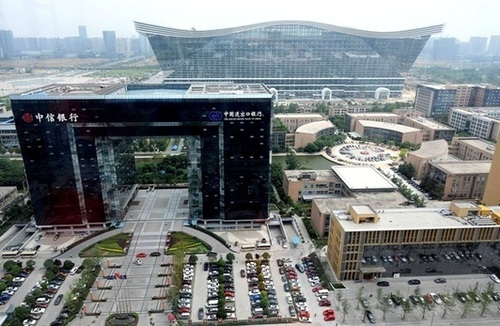
If you don’t care about authenticity, the New Century Global Center has everything you could want, including an artificial Mediterranean village. Read this article by Tim Hornyak on CNET.

Duane Tilden‘s insight:

>The New Century Global Center building opened recently in Chengu, a city of more than 14 million people in southwest China’s Sichuan province. It’s described as “the world’s largest standalone structure” by Chinese officials and is 328 feet high, 1,640 feet long, and 1,312 feet wide.

While Boeing’s plant in Everett, Wash., is the world’s biggest building by volume, the Chinese mall seems to be tops in floor space. Almost the area of Monaco, its 420 acres of floor space could fit nearly three Pentagons, four Vatican Cities, or 20 Sydney Opera Houses.

The cavernous structure will feature a mix of retail outlets, a 14-screen movie theater, a university complex, offices, hotels, a water park called Paradise Island, a skating rink that’s big enough to host international competitions, a pirate ship, 15,000 parking spots, and even a fake Mediterranean village.<

See on news.cnet.com

Changes in the Electrical and Micro Grid

See on Scoop.itGreen & Sustainable News

Microgrids are becoming a worldwide phenomenon. Currently an estimated $4.5 billion market in the US alone with 1,459 MW online and 1,122 MW in planning or development, the microgrid market is expected to continue to grow as the world demands ever more electricity usage and the grid struggles to keep up. The truth is that the traditional grid was not built to cope with the extraordinary level and fluctuations of present-day demand, and microgrids present the perfect solution. The question (to the utilities) is whether we are ready to embrace the change and adapt.

See on theenergycollective.com

Solar Energy and Community Projects

See on Scoop.itGreen & Sustainable News

What does it take to cook up a community solar project? A dash of crowdfunding, a pinch of grassroots outreach, and a generous helping of persistence. That’s the word from San Francisco nonprofits RE-volv and Everybody Solar.

See on theenergycollective.com

European Food and Drink Industry Heads Towards Zero Fossil CO2 Emissions – Food Processing Technology

See on Scoop.itGreen Energy Technologies & Development

Campden BRI and the University of Newcastle upon Tyne are co-operating with organisations from Austria, Germany, Poland and Spain in an EU project to help the European food and beverage industry improve energy efficiency and reduce fossil carbon…

See on www.foodprocessing-technology.com

10 Ways Twitter Will Change American Business – TIME

See on Scoop.itTwitter & Social Media

Microblogging platform Twitter has 32 million users, an increase from about 2 million a year ago, according to research mentioned in the Wall Street Journal. Some Internet measurement services show…

See on www.time.com

Fire Industry Protocol – are you in the loop? – BSEE – Building Services and Environmental Engineer

See on Scoop.itGreen Building Operations – Systems & Controls, Maintenance & Commissioning

Three decades ago, the protocol debate in building automation systems (BAS) did not exist. Every element of a BAS, from the sensors to the control devices…

See on www.bsee.co.uk

Concern about emissions trading scheme affecting the impact of renewables

See on Scoop.itGreen & Sustainable News

Deep problems in Europe’s carbon trading scheme – its flagship climate change policy – are set to cancel out over 700m tonnes of emissions saved through renewable energy and energy efficiency efforts, according to a new report.

The study, by carbon trading thinktank Sandbag, found that a huge oversupply of carbon pollution permits means many are being banked to enable emissions after 2020, when efforts to tackle global warming should be intensifying. These emissions, nearly equivalent to Germany’s annual carbon pollution, will cancel out efforts made in other areas to cut carbon.

The report also warns that Europe’s emissions trading scheme (ETS) is a “global dumping ground” for “dubious” carbon permits created by projects around the world.

See on energyindemand.com

Robots inspect cables

See on Scoop.itGreen Energy Technologies & Development

The bearer cables and tethers of bridges, elevators, and cable cars are exposed to high levels of stress. For this reason, their functional reliability must be monitored on a regular basis. A new robot recognizes fissures before they pose a danger.

See on phys.org