Amager Resource Center Copenhagen, Designed by Bjarke Ingels Group (BIG)

The waste-to-energy plant in Copenhagen was selected as a citation winner in the 62nd Annual Progressive Architecture Awards.

Source: www.architectmagazine.com

“BIG won the competition for the 1.02 million-square-foot Amager Resource Center with this widely touted scheme, which promises to turn a waste-to-energy plant into a popular attraction. By integrating a ski slope into the roof and a rock-climbing wall up one face, the architects build upon the project’s location: a part of Copenhagen on the island of Amager that has become a destination for extreme sports enthusiasts, thanks to its parks, beaches, dunes, and a lagoon for kayaking and windsurfing.  At 100 meters tall, the center will be one of the city’s tallest landmarks when completed—and a striking example of building-as-landscape. Indeed, the client has taken to calling it the Amager Bakke, or Amager Hill.”

See on Scoop.itGreen Building Design – Architecture & Engineering

Duke’s maligned handling of toxic coal ash is claimed typical for industry

Over 200 contaminations and spills document water contamination and deformed fish near coal ash sites.

Source: www.utilitydive.com

>” Duke Energy faces criminal charges and a $100 million fine for a 2014 spill of 39,000 tons of coal ash into North Carolina’s Dan River but environmental activists say its mishandling of coal ash waste is not atypical of the coal industry.  […] EPA released a final ruling on handling coal ash last December but both utility industry and environmental groups were dissatisfied. It creates requirements and standards for the management of coal combustion residuals (CCRs or coal ash) under Subtitle D of the federal Resource Conservation and Recovery Act (RCRA). That subtitle governs solid waste. There is not yet adequate data, the EPA said, to justify managing coal ash under Subtitle C of RCRA, which pertains to hazardous waste.

“Coal ash is a toxic soup of heavy metals,” said NC WARN Energy Expert Nancy LaPlaca. “Pretending it is not hazardous waste is outrageous.”

Utilities are “pleased” that the EPA found it did not have adequate information to regulate coal as hazardous waste, explained Schiff, Hardin Partner/Utilities Counsel Josh More. But “EPA is pretty explicit this is not their final determination.” It failed, he added, because “it is a self-implementing program.”  […]”<


See on Scoop.itGreen & Sustainable News

Vanadium Flow Battery Competes With Lithium and Lead-Acid at Grid Scale

The company claims LCOE [Levelized Cost of Energy] is less than half the cost of any other battery technology available.

Source: www.greentechmedia.com

>”[…]

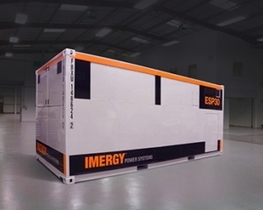
Imergy Power Systems just introduced its third-generation vanadium flow battery, claiming it offers a low-cost, high-performance energy storage solution for large-scale applications, including peak demand management, frequency regulation and the integration of intermittent renewable energy sources.

The ESP250 has an output power capability of 250 kilowatts and 1 megawatt of energy storage capacity. It’s suited for both short- and long-duration storage, with available energy ranging from two to 12 hours of output duration. The 40-foot batteries (each about the size of two shipping containers) are designed to be deployed individually or linked together for larger-scale projects. […]

Where Imergy has been able to edge out its competitors is on material cost. Vanadium is abundant but expensive to extract from the ground. Imergy has developed a unique chemistry that allows it to use cheaper, recycled resources of vanadium from mining slag, fly ash and other environmental waste.

With this chemistry, the levelized cost of energy for Imergy’s batteries is less than half of any other battery on the market right now, according to Hennessy. Vanadium flow batteries are orders of magnitude cheaper than lithium-ion batteries on a lifetime basis because they can be 100 percent cycled an unlimited number of times, whereas lithium-ion batteries wear down with use, according to the firm. Despite the compelling cost claims from Imergy, lithium-ion has been the predominant energy storage technology being deployed at this early point of the market. And very few flow batteries are currently providing grid services.

Imergy’s capital costs are lower than every other battery technology except lead-acid, Hennessy added. But he believes the company can hit that mark (roughly $200 per kilowatt-hour) by the end of the year by outsourcing contracts to manufacturing powerhouse Foxconn Technology Group in China. Delivery of the ESP250 is targeted for summer of 2015.

At this price, Imergy says the ESP250 offers an affordable alternative to peaker plants and can help utilities avoid investing more capital in the grid. Some might disagree with the claim that grid-scale storage can compete with fast-start turbines and natural gas prices below $3 per million Btu. But according to Hennessy, it all comes down to the application. Batteries can’t compete with gas at the 50-megawatt scale, but they can compete with gas at the distribution level.

“Batteries that are distributed have a huge advantage over gas, because when you buy gas down at the low end, you’re paying a lot more than $3 to $4 per MMBtu, because you’ve got to pay for all the transmission down to the small end,” he said.

Demand for cost-effective energy storage is growing as intermittent renewables become cheaper and come on-line in higher volumes. GTM Research anticipates the solar-plus-storage market to grow from $42 million in 2014 to more than $1 billion by 2018.

Imergy sees a ripe market in the Caribbean, parts of Africa and India, Hawaii and other places where the LCOE for solar-plus-storage is already competitive. As costs continue to fall, New York, California and Texas will also become attractive markets.”<


See on Scoop.itGreen Energy Technologies & Development

Comments on Improving EPA’s Proposed Clean Power Plan

The summer deadline is approaching for finalizing the Environmental Protection Agency’s first-ever limits on dangerous carbon pollution from the nation’s power plants, and opponents are ratcheting up their complaints….

Source: www.huffingtonpost.com

“> […] Some 1500 mostly coal- and gas-fired power plants spew out more than two billion tons of heat-trapping carbon dioxide each year — 40 percent of the nation’s total. The vast majority of the millions of public comments submitted last fall express strong support for the Clean Power Plan, which as proposed last June starts in 2020 and ramps emissions down gradually over the next decade.

But big coal polluters and their political allies have big megaphones.

Many hope to kill the proposal outright. But for others the back-up agenda is to get the standards weakened and delayed past 2020. Their comments and speeches read like Armageddon is coming if power plants have to start limiting their carbon pollution in 2020 — five years from now. Republican members of the Senate environment committee banged that drum over and over at a hearing last week. As on so many issues, they hope endless repetition will make their story seem true.

The truth is that the standards and timeline EPA proposed last June are quite modest and readily achievable. They can be met without any threat to the reliability of electric power. A new report from the highly respected Brattle Group shows that states can meet the EPA’s proposal “while maintaining the high level of electric reliability enjoyed by U.S. electricity customers.” […]

The plan as proposed in June sets state-by-state targets that, on an overall national basis, would cut power plants’ carbon pollution by 26 percent by 2020 and 30 percent by 2030, when compared to 2005 levels.

We found that with three specific improvements – I’ll describe them below – the plan could achieve 50 percent more carbon pollution reductions (36 percent by 2020 and 44 percent by 2030).

Here are the three factors:

First, the costs of clean energy are falling dramatically, and EPA’s June proposal was based on out of date cost and performance data for renewable electricity and efficiency energy. An NRDC issue brief published last fall details how sharply the cost and performance of energy efficiency and renewable energy have improved. When we factored in up-to-date data, our analysis shows that the Clean Power Plan’s state-by-state targets as proposed in June 2014 can be met at a net savings to Americans of $1.8-4.3 billion in 2020 and $6.4-9.4 billion in 2030. More reliance on energy efficiency and renewables will also create hundreds of thousands of good-paying jobsthat can’t be shipped overseas.

The lower cost of clean energy technologies opens the door to getting substantially more carbon pollution reductions from the nation’s largest emitters.

We also took two other specific improvements into account:

In an October 2014 notice seeking further public comment, EPA explained that the formula it had used to calculate state targets in the June 2014 proposal did not correctly account for the emission reductions made by renewables and energy efficiency. The formula did not fully account for the reduction in generation at coal and gas power plants that occurs when additional renewables are added to the grid and when businesses and homeowners reduce how much electricity they need by improving the efficiency of our buildings, appliances, and other electricity-using equipment. NRDC corrected the formula in our updated analysis to capture the full emission reduction associated with ramping up renewables and efficiency.EPA also asked for comment on an approach to better balancing state targets by adopting a minimum rate of transition from older high-emitting generation to lower-emitting sources. NRDC analyzed state targets that include conversion of 20 percent of coal generation in 2012 to natural gas generation over the period between 2020 and 2029.

These three factors — updating the cost and performance data for renewables and efficiency, correcting the target-setting formula, and including a minimum rate of transition from higher- to lower-emitting plants — produce the substantial additional carbon pollution reductions in our analysis, all at very reasonable costs. […]”<


See EPA’s Clean Power Plan:  http://www2.epa.gov/carbon-pollution-standards/clean-power-plan-proposed-rule


See on Scoop.itGreen & Sustainable News

US Utilities #1 Priority is to Replace and Modernize Old Grid Infrastructure

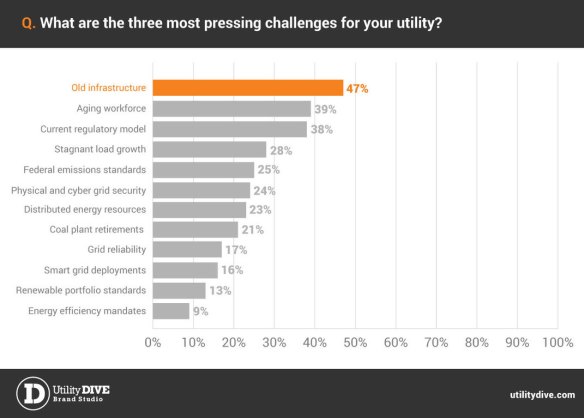
The State of the Electric Utility 2015 survey revealed that aging infrastructure is what troubles industry players most.

Source: www.utilitydive.com

>” Utility executives identified aging infrastructure as the number one challenge facing the electric industry, […] easily topping an aging workforce, regulatory models and stagnant load growth. In response, the industry is spending hundreds of billions to replace and upgrade infrastructure, rushing to meet consumer demand for higher quality power enabled by construction of a more modern grid.

“The last few years there’s been more of an emphasis on transmission and distribution, and the driver there has been the advent of all these new technologies that are trying to connect with the grid,” said Richard McMahon, Jr., vice president of energy supply and finance for the Edison Electric Institute, the electric utility trade organization. “There are also a lot of customer-driven desires utilities are trying to facilitate. There’s a lot of spending on metering automation, as well as at the distribution level, distribution transformers to accommodate distributed generation.”

Today’s grid may not be up to the task of reliably integrating high levels of renewables, distributed energy resources, and smart grid technologies, Utility Dive found. The American Society of Civil Engineers (ASCE) gave U.S. energy infrastructure a barely passing grade of D+ in 2013, at stark odds with the sophisticated grid management required by the rapid acceleration of utility-scale renewables, distributed resources and two-way devices.

“Distributed energy cannot be a profit center without the modernized grid infrastructure that’s needed for grid integration,” Utility Dive concluded in the report. […]

Outages on the rise

The American Society of Civil Engineers report that gave U.S. infrastructure a barely-passing grade pointed out that aging equipment “has resulted in an increasing number of intermittent power disruptions, as well as vulnerability to cyber attacks.”

Significant power outages rose to more than 300 in 2011, up from about 75 in 2007, and the report found many transmission and distribution outages have been attributed to system operations failures, though from 2007 to 2012 water was the primary cause of major outages.

“While 2011 had more weather-related events that disrupted power, overall there was a slightly improved performance from the previous years,” the report said. “Reliability issues are also emerging due to the complex process of rotating in new energy sources and ‘retiring’ older infrastructure.

ASCE said that for now, the United States has sufficient capacity to meet demands, but from 2011 through 2020 demand for electricity in all regions is expected to increase 8% or 9%. The report forecasts that the U.S. will add 108 GW of generation by 2016.

“After 2020, capacity expansion is forecast to be a greater problem, particularly with regard to generation, regardless of the energy resource mix,” the report said. “Excess capacity, known as planning reserve margin, is expected to decline in a majority of regions, and generation supply could dip below resource requirements by 2040 in every area except the Southwest without prudent investments.” […]”<

See on Scoop.itGreen & Sustainable News

Power plant closures quench demand for Pennsylvania’s coal

More than 100 coal-fired power plants nationwide either plan to shut down or already closed their doors in 2014, as the market responds to stricter environmental regulations, cheap natural gas and lackluster electricity demand growth, according to a survey done by the Energy Information Administration. Behind all those closures sit coal mines — many of them in Appalachia — coping with the loss of customers for the fuel that reigned supreme for many decades. Click the image above for a more detai

Source: powersource.post-gazette.com

>” […] More than 17 million tons of coal from Appalachia went to plants slated to shut down in 2013 alone, the latest full year for which such data are available. And the impact is likely to be even bigger, since the EIA’s list of recent or coming closures doesn’t include generators planning a transition from burning coal to burning natural gas.

Companies have been bracing for this change for years, but many have indicated that it’s coming faster and blunter than expected, driven in part by a slew of environmental regulations.

“That’s an unprecedented change to America’s power system in what constitutes the blink of an eye in energy markets — creating enormous potential for market disruptions, supply shortages and rate spikes,” Deck Slone, senior vice president of strategy and public policy at St. Louis-based Arch Coal, wrote in December.

Like its peers, Arch’s stock price reflects the gloom. At $1.30 per share, Tuesday’s closing price represented a one-year low. Virginia-based coal producer Alpha Natural Resources’ also saw its 52-week bottom at $1.13.  […]

Central Appalachian coal mines stand to be big losers in the transition away from coal, Mr. Cosgrove wrote in November. That includes the historically prolific supplies in Virginia, southern West Virginia and eastern Kentucky.

“Falling demand may hasten mine closings in the region, where coal production has dropped 32 percent since 2009,” he wrote.

Some companies have been bracing for the fall for years.  […]

Between 2012 and 2014, Alpha idled 64 mines, reduced its shipments in the eastern part of the country by 28 percent and got rid of more than 4,000 employees.  […]

The situation looks worse for suppliers such as Virginia-based James River Coal Co., which is in the middle of a restructuring, and Virginia-based James C. Justice Co., which has shed a significant portion of its mine portfolio in recent years. The producers stand to lose 28 percent and 48 percent of shipments, respectively, from mines serving affected plants.

For decades, contracts between coal companies and utilities have included force majeure clauses, according to Mr. Cardwell, who has reviewed hundreds of contracts and negotiated dozens during his 18-year tenure as a coal buyer for a Kentucky utility.

Such clauses typically protect power plants from having to take delivery of coal they no longer need if the power plant is prevented from running by some new environmental regulation or another unforeseen circumstance.

Yet lawsuits seem inevitable following current and projected mine closures. “I have a feeling that there’s going to be pretty significant litigation in the future,” Mr. Cardwell said.

One issue that may arise as power plants claim that environmental regulations pushed them out of business is how much of a role competition from cheap natural gas played in their decision either to shut down or use a different fuel.

Gas is all the rage at the moment. The commodity is trading at around $3 per million British thermal units, or Btus, down from more than $13 in the summer of 2008, towards the beginning of the shale revolution in Appalachia.

That’s why some operators, like Consol Energy, now boast flexibility in their contracts with utilities. Consol has refocused its company on a growing shale gas business, retaining only a handful of coal mines.

According to James McCaffrey, senior vice president of marketing at Consol, who spoke at Platts’ Coal Marketing Days in Downtown in September, “Customers want to flip between coal and gas.”

He said the company was actively negotiating a deal where a utility could choose its fuel depending on its preference.

“That’s a good marketing approach: ‘I’ll give you Btus, you tell me how you want them,’ ” Mr. Cardwell said. […]”<

See on Scoop.itGreen & Sustainable News

Michigan’s Consumers Energy to retire 9 coal plants by 2016

New EPA regulations are an opportunity to modernize the generating fleet, according to a Consumers Energy official.

Source: www.utilitydive.com

>”[…] Consumers Energy will shutter nine coal plants in Michigan as EPA air pollution regulations make them unprofitable to operate, MLive reports. And the Michigan utility won’t be the only one. A wave of coal retirements will roll across the Midwest by early 2016, shuttering more than 60 generating plants, a Consumers official told the “Greening of the Great Lakes” weekly radio program.In addition to the regulations under the Clean Power Plan and other EPA programs, Consumers says many of the nine coal plants were built in the 1950s and are simply at the end of their productive lives.  […]

Last year Consumers Energy announced it had selected AMEC to run the utility’s decommissioning program for the planned retirement of seven operating units at the utility’s three oldest coal-fired generating plants. Though there is still uncertainty over just what impact a slate of EPA regulations will have, Consumers last year said the power plants being decommissioned have an average operating life-span of more than 60 years and collectively represented approximately 950 MW of electric capacity.

The Supreme Court has agreed to hear a challenge to the EPA’s Mercury and Air Toxics Standard, but as it stands the regulations could apply to 1,400 generators at more than 600 of the nation’s largest power plants.

Federal regulators believe the tighter controls could prevent up to 11,000 premature deaths each year by limiting mercury, particulate matter, and other harmful pollutants it says are hazardous to public health.”<

See on Scoop.itGreen & Sustainable News

Renewable Energy Provides Half of New US Generating Capacity in 2014

According to the latest “Energy Infrastructure Update” report from the Federal Energy Regulatory Commission’s (FERC) Office of Energy Projects, renewable energy sources (i.e., biomass, geothermal, hydroelectric, solar, wind) provided nearly half (49.81 percent – 7,663 MW) of new electrical generation brought into service during 2014 while natural gas accounted for 48.65 percent (7,485 MW).


Image source:  http://usncre.org/

Source: www.renewableenergyworld.com

>” […] By comparison, in 2013, natural gas accounted for 46.44 percent (7,378 MW) of new electrical generating capacity while renewables accounted for 43.03 percent (6,837 MW). New renewable energy capacity in 2014 is 12.08 percent more than that added in 2013.

New wind energy facilities accounted for over a quarter (26.52 percent) of added capacity (4,080 MW) in 2014 while solar power provided 20.40% (3,139 MW). Other renewables — biomass (254 MW), hydropower (158 MW), and geothermal (32 MW) — accounted for an additional 2.89 percent.

For the year, just a single coal facility (106 MW) came on-line; nuclear power expanded by a mere 71MW due to a plant upgrade; and only 15 small “units” of oil, totaling 47 MW, were added.

Thus, new capacity from renewable energy sources in 2014 is 34 times that from coal, nuclear and oil combined — or 72 times that from coal, 108 times that from nuclear, and 163 times that from oil.

Renewable energy sources now account for 16.63 percent of total installed operating generating capacity in the U.S.: water – 8.42 percent, wind – 5.54 percent, biomass – 1.38 percent, solar – 0.96 percent, and geothermal steam – 0.33 percent.  Renewable energy capacity is now greater than that of nuclear (9.14 percent) and oil (3.94 percent) combined.

Note that generating capacity is not the same as actual generation. Generation per MW of capacity (i.e., capacity factor) for renewables is often lower than that for fossil fuels and nuclear power. According to the most recent data (i.e., as of November 2014) provided by the U.S. Energy Information Administration, actual net electrical generation from renewable energy sources now totals a bit more than 13.1 percent of total U.S. electrical production; however, this figure almost certainly understates renewables’ actual contribution significantly because EIA does not fully account for all electricity generated by distributed renewable energy sources (e.g., rooftop solar).

Can there any longer be doubt about the emerging trends in new U.S. electrical capacity? Coal, oil, and nuclear have become historical relics and it is now a race between renewable sources and natural gas with renewables taking the lead.”<

See on Scoop.itGreen & Sustainable News

Why Demand Response will shape the future of Energy

Matching supply to demand is crucial when it comes to energy — and this concept can help us do it.

Source: www.mnn.com

>” […] Our energy grid is not designed to put out a steady amount of energy throughout the day. Rather, it is designed to crank up or wind down depending on the amount of energy that’s being demanded by the markets.

That means there’s a baseload of generation that’s always on — churning out steady amounts of relatively cheap, dependable power night and day. This has typically been made up of coal and nuclear plants, which can produce large amounts of power but can’t be made to cycle up and down efficiently in the face of fluctuating demand. On top of the baseload, you have an increasing amount of intermittent sources as the world transitions to renewable energy technologies like wind and solar. And then, on top of these intermittent sources are so-called “peaking” plants, often running on natural gas and sometimes diesel or even jet fuel. These can be deployed at very short notice, when there’s either unusually high demand or when another source isn’t available (e.g. the sun isn’t shining enough for solar), but are expensive, inefficient and disproportionately polluting.  One of the most effective ways to meet this challenge also happens to be the simplest — reward people for not using energy when it’s in highest demand.

An old idea whose time has come
Demand response, as it is known by those in the industry, is really not all that new. Many utilities have offered cheaper electricity rates for off-peak hours, encouraging consumers to shift their habits and reduce the pressure on the peak. Similarly, energy producers around the world have partnered with energy-hungry industries to ask them to power down at times of high demand. What’s new, however, is an ever more sophisticated array of technologies, meaning more people can participate in demand response schemes with less disruption to their daily lives. […]

A more sophisticated approach
On the commercial side, demand response has been a strategy for some time because it took very little infrastructure to implement — just an energy-hungry business ready and willing to cut its consumption in times of need, and able to educate its workforce about how and why to do so. Here too, however, the concept is becoming a lot more sophisticated and scalable as technology allows us to better communicate between producers and consumers, and to coordinate the specific needs of the grid. And as distributed energy storage becomes more commonplace, consumers may not even have to modulate their overall use — but rather allow the utility to switch them to battery power when grid supply is constrained. […]

A huge potential to cut peak demand
A report from federal regulators suggests that U.S. demand response capacity had the potential to shave 29GW off of peak demand in 2013, representing a 9.9 percent increase over 2012. When the U.K.’s National Grid, which manages the nation’s transmission infrastructure, put out a call for companies willing to cut consumption at key times, over 500 different sites came forward. The combined result was the equivalent of 300MW of power that can be removed from the grid at times of need. And constrained by its rapid growth of renewables following the Fukushima disaster, Japan is now looking at shoring up its grid by starting a national demand response program in 2016. […]”<

See on Scoop.itGreen Energy Technologies & Development

Determining the True Cost (LCOE) of Battery Energy Storage

The true cost of energy storage depends on the so-called LCOE = Round-trip efficiency + maintenance costs + useful life of the energy system

Source: www.triplepundit.com

By Anna W. Aamone

“With regard to [battery] energy storage systems, many people erroneously think that the only cost they should consider is the initial – that is, the cost of generating electricity per kilowatt-hour. However, they are not aware of another very important factor.

This is the so-called LCOE, levelized cost of energy(also known as cost of electricity by source), which helps calculate the price of the electricity generated by a specific source. The LCOE also includes other costs associated with producing or storing that energy, such as maintenance and operating costs, residual value, the useful life of the system and the round-trip efficiency. […]

Batteries and round-trip efficiency

[…] due to poor maintenance, inefficiencies or heat, part of the energy captured in the battery is released … or rather, lost. The idea of round-trip efficiency is to determine the overall efficiency of a system (in that case, batteries) from the moment it is charged to the moment the energy is discharged. In other words, it helps to calculate the amount of energy that gets lost between charging and discharging (a “round trip”).

[…] So, as it turns out, using batteries is not free either. And it has to be added to the final cost of the energy storage system.

Maintenance costs

[…] An energy storage system requires regular check-ups so that it operates properly in the years to come. Note that keeping such a system running smoothly can be quite pricey. Some batteries need to be maintained more often than others. Therefore when considering buying an energy storage system, you need to take into account this factor. […]

Useful life of the energy system

Another important factor in determining the true cost of energy storage is a system’s useful life. Most of the time, this is characterized by the number of years a system is likely to be running. However, when it comes to batteries, there is another factor to take into account: use. […]

More often than not, the life of a battery depends on the number of charge and discharge cycles it goes through. Imagine a battery has about 10,000 charge-discharge cycles. When they are complete, the battery will wear out, no matter if it has been used for two or for five years.

[…] [However] flow batteries can be charged and discharged a million times without wearing out. Hence, cycling is not an issue with this type of battery, and you should keep this in mind before selecting an energy storage system. Think twice about whether you want to use batteries that wear out too quickly because their useful life depends on the number of times they are charged and discharged. Or would you rather use flow batteries, the LCOE of which is much lower than that of standard batteries?

So, what do we have so far?

LCOE = Round-trip efficiency + maintenance costs + useful life of the energy system.

These are three of the most important factors that determine the LCOE. Make sure you consider all the factors that determine the true cost of energy storage systems before you buy one.

Image credit: Flickr/INL”

See on Scoop.itGreen Energy Technologies & Development