Keystone XL Pipeline Climate Backgrounder

Pembina Institute Backgrounder, January 2013

Source: www.documentcloud.org

>”The climate implications of the proposed Keystone XL oilsands pipeline

by Nathan Lemphers

At a Glance Canada’s oilsands industry is growing quickly, with plans to nearly triple production from 1.8 to 5.2 million barrels a day by 2030.

To realize this substantial growth, pipelines to export markets are essential. TransCanada’s Keystone XL pipeline from the oilsands to a new market on the U.S. Gulf Coast is the most significant proposal awaiting approval. If built, Keystone XL will be a key driver for oilsands growth.

Other alternatives to ship oilsands to the west or east coast of Canada will, for the short to medium term, play a less dominant role in accelerating oilsands development.  These other proposals are smaller in pipeline capacity than Keystone XL, are in the very early stages of development, or face major public opposition. Regardless of whether other oilsands transport options move ahead, approval of Keystone XL will lead to substantial expansion of oilsands production and therefore an increase in global greenhouse gas emissions.

Filling Keystone XL with oilsands will cause a 36 per cent increase from current oilsands production, for which the higher upstream emissions alone will be equivalent to the annual emissions from 6.3 coal-fired power plants or over 4.6 million cars. This value will be higher when the additional emissions from upgrading and refining in the U.S. are considered.

In the absence of a credible plan for responsible development of the oilsands, including mitigating GHG emissions growth to a level that would allow Canada to meet its international climate commitments, the United States should not go ahead with the proposed Keystone XL pipeline.

[…]”<

See on Scoop.itGreen & Sustainable News

Commodity Copper Price Forecast Drops on Rising Dollar, Falling Oil

Copper prices will fall next year as a strengthening U.S. dollar and weaker oil prices push down marginal production costs, according to Goldman Sachs Group

Source: www.hellenicshippingnews.com

>” […]

Copper for delivery in three months on the London Metal Exchange fell 0.3 percent to $6,682 a ton at 12:44 p.m. in Shanghai. Prices are down 9.2 percent this year and headed for a second annual decline.

The bank said prices could fall below its estimates to average $5,600 a ton if China’s state stockpiling agency stops buying copper. The State Reserve Bureau will buy 500,000 tons of refined copper this year and 200,000 tons in 2015, supporting prices at around $6,200 to $6,300 a ton, according to the bank

The U.S. dollar’s rise will reduce marginal costs of copper mine production as 83 percent of operating costs are in local producing-country currencies, the bank said in the report. The Bloomberg Dollar Spot Index, which measures the greenback against a basket of 10 peers, is up 7.5 percent this year.

Lower energy and labor expenses, as well as the cost of equipment such as steel needed to grind copper ore and mining explosives, point to declining production costs over the next six to 12 months, the bank said. Brent crude, the global oil benchmark, has fallen 29 percent this year.

The bank lowered its six-month price forecast to $6,200 a ton from $6,600 and its 12-month outlook to $6,000 a ton from $6,200.”<

See on Scoop.itGreen & Sustainable News

Will Falling oil prices cause oil sands shut-downs in Alberta?

Alberta Premier Jim Prentice says his province’s oil companies are not facing closures, even as prices approach $70 a barrel.

Source: www.ctvnews.ca

>””We don’t see oilsands operations shutting down,” Prentice told CTV’s Question Period in an interview that aired Sunday. “These are massive capital investments that have been built on a 50-year time horizon.”

Crude oil prices have dramatically fallen since June, when prices reached this year’s high of $107.54 USD per barrel of West Texas Intermediate crude oil. On Friday, WTI oil was about $75.70 per barrel.

[…]

The report said falling oil prices have been caused by large supply, low demand, and strong U.S. dollar. In order for the price to stabilize, “further oil price drops would likely be needed for supply to take a hit — or for demand growth to get a lift,” it said.

Analysts suggest that once prices fall below $72 a barrel, companies will begin to face serious financial consequences, and that some may be forced to close. But Prentice said Albertan oilsands companies are expected to survive the continuing drop in prices, even if they reach that $72 threshold.

Conservative Alberta MP Kevin Sorenson, the minister of state for finance, disagrees, saying falling oil prices could hurt employment numbers.

“We know that if oil prices continue to fall … in the long term that’s going to be very difficult,” Sorenson told Question Period. “It’s not so much that $70 is the plateau, but if it continued to fall, we could expect that there would be job losses.”

Though Prentice was more optimistic about the “resilience” of Albertan companies, he also said falling prices are cause for concern.

“I don’t want to underestimate the importance of this. The low-price environment has a significant implication for all of us,” Prentice said.

The premier said new projects may need to be postponed, and that the Albertan government must be prepared to control spending and budgeting.

According to the Alberta government’s budget website, if oil prices drop even $1 per barrel over 12 months, it can result in more than $200 million less in revenue for the province.

[…]

But Alberta’s provincial government factors all these variables into their economic forecasts.

“People need to be aware it’s a time for fiscal prudence. It’s a time for caution,” Prentice said Sunday. “And it’s a time to control what we can control, which is our public expenditures.” “<

Read more: http://www.ctvnews.ca/politics/falling-oil-prices-won-t-cause-shut-downs-in-alberta-prentice-1.2104374#ixzz3JXBPxTA3

See on Scoop.itGreen & Sustainable News

CAN NYC REDUCE ITS CARBON FOOTPRINT 90% BY 2050?

“The building sector is the source of 75 percent of New York City’s greenhouse gas emissions. 90 by 50’s modeling of eight typical building types shows that heating and cooling loads can be reduced through retrofit measures to a point where all thermal loads can be met by heat pumps, eliminating building fuel use. The resulting electric energy used in 2050, supplied by carbon-free sources, will be slightly more than today’s, while peak demand will increase significantly. “

RO Engineers & Architects's avatarRO Engineers & Architects

In an article by urban green council,

“The building sector is the source of 75 percent of New York City’s greenhouse gas emissions. 90 by 50’s modeling of eight typical building types shows that heating and cooling loads can be reduced through retrofit measures to a point where all thermal loads can be met by heat pumps, eliminating building fuel use. The resulting electric energy used in 2050, supplied by carbon-free sources, will be slightly more than today’s, while peak demand will increase significantly. “

How will we meet this goal when there are a number of behavioral, institutional and infrustructural issues?

Let’s name a few…..

  1. The NYC subway still has outdated lighting with T12 with magnetic ballasts
  2. A large # of residential buildings the tenants leave their window a/c units installed year round which results in heat loss
  3. Alternate side parking- numerous places throughout the city people sit and idle their…

View original post 174 more words

California’s PG&E Takes Grid Energy Storage to the Distribution Substation

California’s utilities are building a 1.3-gigawatt energy storage system, one piece at a time.

Source: www.greentechmedia.com

>” […] PG&E’s solicitation (PDF) is one of the first rounds from the 74 megawatts of storage projects the utility is set to announce by December. That, in turn, is part of the first procurement round for the state’s 1.3-gigawatt mandate for storage by 2021, which is requiring PG&E, Southern California Edison, and San Diego Gas & Electric to sign up about 200 megawatts of cost-effective grid storage by year’s end.

[…]

Some of these projects will be aggregating distributed, behind-the-meter batteries to help solve local grid needs. But PG&E’s substation RFO is aimed strictly at utility-owned and -operated battery systems — which makes sense, because PG&E is justifying its cost by showing how much it saves by not building or upgrading new substations.

[…]

PG&E’s cost-benefit calculation for these projects is fairly straightforward — subtract the cost of upgrading the substation from the cost of the battery system. Still, the duty cycle being asked of these energy storage systems (ESS) is pretty severe, according to the RFO:

“[T]his is defined as discharging the ESS from 100% state of charge (SOC) at guaranteed maximum power for the guaranteed discharge duration, then charging it to back to 100% SOC and subsequently discharging it at guaranteed maximum power for half of the guaranteed discharge duration, and finally charging it back to 100% SOC during the course of a single day. The ESS shall be capable of performing the guaranteed site specific duty cycle for up to 365 days per year excluding time for planned maintenance and/or forced outages.”

[…]

Asset or investment deferral of this kind is actually a significant route to market for existing battery-based grid storage systems, with projects around the world allowing stressed-out substations to keep operating for years longer by cushioning the peaks with stored battery power. In fact, PG&E has a 2-megawatt project in Vacaville that’s serving that purpose for a transmission substation.

But the new projects are some of the first targeting the medium- and low-voltage distribution grid, where the rules for batteries are different. California regulators are asking the state’s big utilities to come up with ways to value distributed energy assets — solar panels, batteries, plug-in vehicles, smart thermostats and other grid-edge systems — in their multi-billion-dollar, multi-year distribution grid investment plans.

PG&E didn’t disclose how much investment it’s hoping to defer with these new projects, or how much it planned to pay for them. But the numbers could be significant. In New York City, utility Consolidated Edison is proposing a plan to replace $1 billion in substation upgrades with a mix of energy efficiency, demand response, and distributed energy resources like rooftop solar and energy storage.”<

See on Scoop.itGreen Energy Technologies & Development

Energy executive quits NEB, blasts Kinder Morgan review as ‘fraudulent,’

Marc Eliesen has withdrawn as an intervenor in the federal government’s review of Kinder Morgan’s Trans Mountain pipeline and oil tanker expansion project, detailing his reasons for quitting in a scathing 1,500 word letter to the National Energy Board.

Source: thetyee.ca

>” […] Given the Board’s lack of objectivity it is not surprising that out of the approximately 2000 questions not answered by Trans Mountain that Intervenors called on the Board to compel answers, only 5 per cent were allowed by the Board and 95 per cent were rejected.

The Board had stated that the elimination of cross-examination of the Proponent’s evidence can be evaluated through the two scheduled Information Requests. But we have a Kafkaesque outcome. Trans Mountain refuses to answer questions and the Board does not compel them to do so.

6. The Province of British Columbia stated that “Trans Mountain’s failure to file the evidence requested by the Province in Information Request No. 1 denies the Board, the Province and other Intervenors access to the information required to fully understand the risk posed by the Project, how Trans Mountain proposes to mitigate such risk and Trans Mountain’s ability to effectively respond to a spill related to the Project.”

The Province of British Columbia has the responsibility for undertaking due diligence on behalf of the public trust of British Columbians. The 80 questions Trans Mountain refused to answer — which the Province believed important enough to ask the Board for assistance and compel Trans Mountain to answer — were denied by the Board.

The Board has sided with Trans Mountain dismissing the Province of BC’s need for answers in pursuit of its duty to British Columbians. The NEB’s bias in support of the Proponent is reflecting poorly on the Province of BC in that it is unable to obtain necessary answers to conduct its due diligence. Accordingly, it raises the question as how it is possible for the Province of BC to continue to participate in this hearing process. The Province should cancel the Equivalency Agreement with the NEB on this project and undertake its own environmental assessment as the only meaningful way in which it will be able to effectively obtain the answers it seeks.

The National Energy Board is not fulfilling its obligation to review the Trans Mountain Expansion Project objectively. Accordingly it is not only British Columbians, but all Canadians that cannot look to the Board’s conclusions as relevant as to whether or not this project deserves a social license. Continued involvement in the process endorses this sham and is not in the public interest.

Yours truly,

Marc Eliesen “<

– See more at: http://thetyee.ca/Blogs/TheHook/2014/11/03/VIEW-energy-exec-blasts-Kinder-Morgan-quits/#sthash.lOr1uyt5.dpuf

See on Scoop.itGreen & Sustainable News

The financial case for energy efficiency

“The report, Building the Future, has piled pressure on Ministers to act to fix Britain’s badly insulated homes. The report shows that a much more ambitious energy efficiency investment programme would pay for itself and significantly boost the UK economy.

The programme would add £13.9 billion annually to the UK economy by 2030, with GDP boosted by £3.20 for every £1 invested by the Government. A national scheme to make homes super-energy efficient would result in £8.6 billion in energy savings per year by 2030, an average energy saving of £372 per household. After taking into account loan repayments this would result in £4.95 billion in financial savings per year for Britain’s households.”

Energy Storage Technologies Will Replace Utilities Gas Fired Turbine Peaker Plants

“Power grids need extra generating capacity to work properly. For example, about 20 percent of New York State’s generation fleet runs less than 250 hours a year. Because they don’t run much, “peaker plants” are by design the cheapest and least efficient fossil generators.”

Source: www.renewableenergyworld.com

>”[…] As has happened with solar PV, the costs for multi-hour energy storage are about to undergo a steep decline over the next 2 to 3 years. This cost trend will disrupt the economic rationale for gas-fired simple cycle combustion turbines (CTs) in favor of flexible zero emissions energy storage. This will be especially true for storage assets owned and operated by vertical utilities and distributed near utility substations.

Simple cycle gas-fired CTs have been a workhorse utility asset for adding new peaker capacity for decades. But times and technologies change, and the power grid’s long love affair with gas-fired CTs is about to be challenged by multi-hour energy storage. Flow batteries that utilize a liquid electrolyte are especially cost-effective because the energy they store can be easily and inexpensively increased just by adding more electrolyte.

CTs cost from $670 per installed kilowatt to more than twice that much for CT’s located in urban areas. But the economics of peaking capacity must also reflect the benefits side of the cost/benefit equation. Distributed storage assets can deliver both regional (transmission) and local (distribution) level energy balancing services using the same storage asset. This means the locational value and capacity use factor for distributed storage can be significantly higher compared to CTs operated on a central station basis.

[…]

The disruptive potential of energy storage as a substitute for simple cycle CTs has been recognized. For example, Arizona Public Service (APS) and the Residential Utility Consumer Office (RUCO) recently filed a proposed settlement which, if approved, would require that at least 10% of any new peaker capacity now being planned as simple cycle combustion turbines would instead need to be energy storage — as long as the storage meets the cost effectiveness and reliability criteria of any CTs being proposed.

[…]

Lower cost solar PV and its rising penetration in all market segments will have a profoundly disruptive effect on utility operations and the utility cost-of-service business model. This has already started to happen. Storage offers a way for utilities to replace lost revenues premised on margins from kilowatt-hour energy sales by placing energy storage into the rate based and earning low-risk regulated returns.”<

See on Scoop.itGreen Energy Technologies & Development

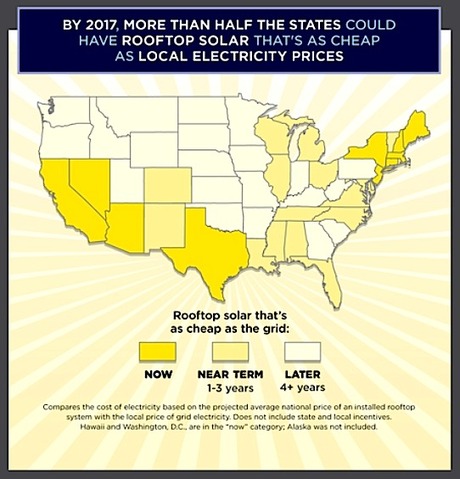
Grid Parity Is Accelerating the US Solar Revolution

“Solar PV installations in the U.S. increased an impressive 485% from 2010 to 2013, and by early 2014, there were more than 480,000 systems in the country. That’s 13,400 MW, enough to power about 2.4 million typical American homes.”


Source: www.pvsolarreport.com

>” […] You can definitely see a correlation between electricity price and amount of solar installed, though there are exceptions. Kansas, for example, has fairly high grid prices but little solar — a testament to the fact that good policy is also a key ingredient in promoting solar. And Alaska is not exactly highly populated. For the most part, though, solar is flourishing in states with high electricity rates.

In some states like California, already one of the most expensive places for electricity in the country, residential rates will soon be going up further. Customers in the PG&E service area are looking at a 3.8% increase in electricity bills. Overall, electricity prices in the U.S. have been rising rapidly. According to the Energy Information Administration, in the first half of 2014, U.S. retail residential electricity prices went up 3.2% from the same period last year — the highest year-over-year growth since 2009. […]

The fact is, solar and other renewables just keep getting cheaper. We’ve noticed a number of stories debating this recently, many in reaction to an Economist article on how expensive wind and solar really are. But as Amory Lovins points out, the reality is that renewables are getting cheaper all the time, regardless of anyone’s arguments.

What does this mean? It means that grid parity is coming sooner than you might think […]”<

See on Scoop.itGreen Energy Technologies & Development

Solar Energy Storage Added to Eight California Schools

Burton School District, in the heart of California’s sun-drenched San Joaquin Valley, will also house combined solar and energy storage systems[…]

Source: www.pvsolarreport.com

>”In the commercial sector, the cost of energy storage is now low enough that businesses are finding it a useful addition to solar. Generally, businesses’ peak energy consumption is when electricity is most expensive, which makes energy storage especially useful.

As the cost of energy storage continues to decline, large solar companies have been integrating it into their product offerings to complement a solar system. […]

The district will install solar and DemandLogic to generate and store its own clean, renewable electricity at eight schools. This will be the largest combined solar and energy storage installation SolarCity has undertaken to date. It will allow the district schools to reduce energy costs by using stored electricity to lower peak demand.

SolarCity will install the district’s solar systems and battery storage at eight elementary and middle schools, as well as additional solar generation at a district office. The solar installations will total more than 1.4 MW of capacity, with storage providing an additional 360 kW (720 kWh) of power to reduce peak demand. The new solar systems are expected to save the district more than $1 million over the life of the contracts, and the DemandLogic battery storage systems could save thousands more on demand charges each year.

[…]

The new SolarCity systems are expected to generate 2,300 MWh of solar energy annually, and enough over the life of the contract to power more than 4,000 homes for a year. The solar systems will also offset over 43 million pounds of carbon dioxide and save more than 203 million gallons of water, an especially important environmental benefit in the drought-stricken valley. The entire storage project is expected to be completed by May 2015.”<

See on Scoop.itGreen Energy Technologies & Development