The “fuel” that’s helping America fight climate change isn’t natural gas

Ivy Main's avatarPower for the People VA

You’ve heard the good news on climate: after a century or more of continuous rise, U.S. CO2 emissions have finally begun to decline, due largely to changes in the energy sector. According to the Energy Information Agency (EIA), energy-related CO2 emissions in 2015 were 12% below their 2005 levels. The EIA says this is “because of the decreased use of coal and the increased use of natural gas for electricity generation.”

Is the EIA right in making natural gas the hero of the CO2 story? Hardly. Sure, coal-to-gas switching is real. But take a look at this graph showing the contributors to declining carbon emissions. Natural gas displacement of coal accounts for only about a third of the decrease in CO2 emissions.

Courtesy of the Sierra Club Beyond Coal Campaign, using data from the Energy Information Agency. Courtesy of the Sierra Club Beyond Coal Campaign, using data from the Energy Information Agency.

By far the biggest driver of the declining emissions is energy efficiency. Americans…

View original post 746 more words

Urbane Legends

Is Climate Change an Urban Legend?

usissuescom's avatarUS Issues

By Willis Eschenbach – Re-Blogged From http://www.WattsUpWithThat.com

So we were sitting around the fire at the fish camp on the Colombia a few days ago, and a man said “Did you hear about the scientific study into meat preservatives?” We admitted our ignorance, and he started in. The story was like this:

“A few years ago there was a study done by some University, I can’t remember which one, but it was a major one. What they did was to examine the corpses of people who had died in Siberia, and those that had died in Washington State. Now of course the people in Siberia weren’t eating meat preservatives during their lives, and the Washington people were eating them. And when they dug up the graves and looked at the bodies, guess what they found?” 

the killer in the back seatUrban Legend: The Killer In The Back Seat SOURCE 

View original post 1,264 more words

There Are 9.93 Million More Government Workers Than Manufacturing Workers

Robert Gore's avatarSTRAIGHT LINE LOGIC

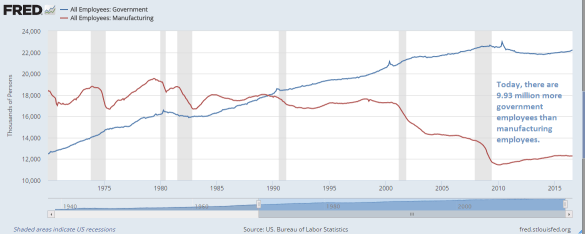
An interesting chart from Anthony B. Sanders at davidstockmanscontracorner.com:

The August jobs report was filled with some interest factoids, like there are now 9.93 million government workers than there are manufacturing workers.

That is a ratio of 1.81 government workers for every manufacturing worker.

Such was not always the case. But a variety of factors such as labor cost differentials, EPA regulations and taxes had led to manufacturing jobs to be sent overseas.

Now a 1.81 government to manufacturing employment ratio is called OVERHEAD. And you wonder why high paying manufacturing jobs are fleeing to other countries?

http://davidstockmanscontracorner.com/there-are-9-93-million-more-government-workers-than-manufacturing-workers/

View original post

Thermoelectric Materials: Converting Heat to Electricity

When we think of using electricity one of the prevalent uses is to provide a heat source.  We see this in our everyday lives as ranges and ovens, microwaves, kettles, hot water tanks, baseboard heaters, as well as other applications.  So how about reversing the process and capturing heat and directly converting to electricity, is this possible?  As it happens there is a classification of materials which have a property called a thermoelectric effect.

Boosting energy efficiency is an important element of the transition to a sustainable energy system. There are big savings to be made. For example, less than half the energy content of diesel is actually used to power a diesel truck. The rest is lost, mostly in the form of heat. Many industrial processes also deal with the problem of excessive .

That’s why many research teams are working to develop that can convert waste heat into energy. But it’s no easy task. To efficiently convert heat to electricity, the materials need to be good at conducting electricity, but at the same time poor at conducting heat. For many materials, that’s a contradiction in terms.

“One particular challenge is creating thermoelectric materials that are so stable that they work well at high temperatures,” says Anders Palmqvist, professor of materials chemistry, who is conducting research on thermoelectric materials. (1)

2dthermoelec.jpg

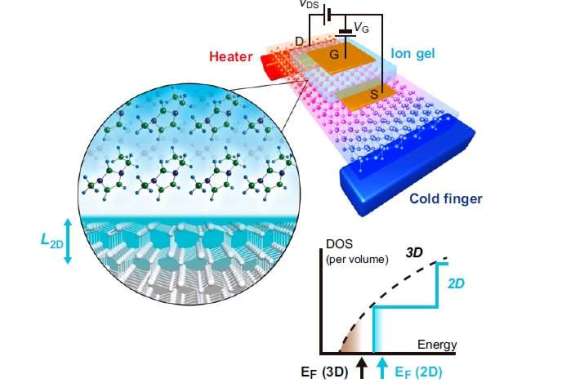
Image 1:  The enlarged illustration (in the circle) shows a 2D electron gas on the surface of a zinc oxide semiconductor. When exposed to a temperature difference, the 2D region exhibits a significantly higher thermoelectric performance compared to that of bulk zinc oxide. The bottom figure shows that the electronic density of states distribution is quantized for 2D and continuous for 3D materials. Credit: Shimizu et al. ©2016 PNAS

The thermoelectric effect is not as efficient as converting electricity to heat, which is generally 100% efficient.  However, with waste energy streams even a small conversion rate may return a significant flow of usable electricity which would normally go up a stack or out a tailpipe.

The large amount of waste heat produced by power plants and automobile engines can be converted into electricity due to the thermoelectric effect, a physics effect that converts temperature differences into electrical energy. Now in a new study, researchers have confirmed theoretical predictions that two-dimensional (2D) materials—those that are as thin as a single nanometer—exhibit a significantly higher thermoelectric effect than three-dimensional (3D) materials, which are typically used for these applications.

The study, which is published in a recent issue of the Proceedings of the National Academy of Sciences by Sunao Shimizu et al., could provide a way to improve the recycling of into useful energy.

Previous research has predicted that 2D materials should have better thermoelectric properties than 3D materials because the electrons in 2D materials are more tightly confined in a much smaller space. This confinement effect changes the way that the electrons can arrange themselves. In 3D materials, this arrangement (called the density of states distribution) is continuous, but in 2D materials, this distribution becomes quantized—only certain values are allowed. At certain densities, the quantization means that less energy is required to move electrons around, which in turn increases the efficiency with which the material can convert heat into . (2)


Related Articles:

References:

  1. http://phys.org/news/2016-06-track-electricity.html#jCp
  2. http://phys.org/news/2016-06-electricity-dimensions.html#jCp

Why I did not upgrade to Windows 10

especial_windows_10_button-664x374

I am so happy to see those nag messages disappear from my computer, you know the ones reminding you that your period of time to upgrade to Windows 10 will expire on July 31?   Now that we are in August one less thing popping up that bothers me.

The question being do I upgrade or not?  And friends and family who look to me for advice on such issues want to know what I am doing and why.  Intuitively I felt that upgrading was unwise likely do to past experiences with O/S upgrades and backward compatibility of existing hardware and external devices.

Coolpix 995

For example, I own an older Nikon digital camera, Coolpix 995, which is a newer version of my first digital camera, a Coolpix 990.  Getting software that works for this camera for versions of Windows newer than XP has currently been a challenge.  Driver’s are not available for Windows Vista, 7 and definitely not for Window’s 10.  So such is likely for any devices I currently own.

Also, I like to buy used equipment at bargain prices.  I have learned through my own experience that electronic equipment has a short shelf life and prices drop quickly as newer versions of equipment enter the market.  By creating obsolescence in software, hardware becomes prematurely unusable due to compatibility issues.  When this occurs the current solution is usually to discard the item and buy a new replacement.

HP8530W_Elitebook

Another thing besides compatibility and premature obsolescence is extra work and other unknown issues which will inevitably arise from the upgrade.  I have an ‘Elitebook’ HP 8530 W laptop computer with Window’s 7 for my business and personal use, which I purchased for a bargain on Ebay.  I have spent a lot of time setting it up to work properly, I have no need to upgrade the software.

Let someone else figure it all out, then maybe in a couple of years I will buy a more powerful model at a lower price with Windows 10 or the current version already installed.   So I did not upgrade, and I am okay with that.


Energy Efficiency Financing for Existing Buildings in California

Much of our efforts to reduce carbon emissions involves fairly complicated and advanced technologies. Whether it’s solar panels, batteries, flywheels, or fuel cells, these technologies have typically required public support to bring them to scale at a reasonable price, along with significant regulatory or legal reforms to accommodate these new ways of doing old things, […]

To recommend policies to boost this capital market financing for energy retrofits, UC Berkeley and UCLA Law are today releasing a new report “Powering the Savings:How California Can Tap the Energy Efficiency Potential in Existing Commercial Buildings.” The report is the 17th in the two law schools’ Climate Change and Business Research Initiative, generously supported by Bank of America since 2009.

The report describes ways that California could unlock more private investment in energy efficiency retrofits, particularly in commercial buildings.  This financing will flow if there’s a predictable, long-term, measured and verified amount of savings that can be directly traced to energy efficiency measures.  New software and methodologies can now more accurately perform this task.  They establish a building’s energy performance baseline, calibrating for a variety of factors, such as weather, building use, and occupancy changes.  That calibrated or “dynamic” baseline can then form the basis for calculating the energy savings that occur due specifically to efficiency improvements.

But the state currently lacks a uniform, state-sanctioned methodology and technology standard, so utilities are reluctant to base efficiency incentives or programs without regulatory approval to use these new methods.  The report therefore recommends that energy regulators encourage utilities to develop aggressive projects based on these emerging metering technologies that can ultimately inform a standard measurement process and catalyze “pay-for-performance” energy efficiency financing, with utilities able to procure energy efficiency savings just like they were a traditional generation resource. […]

via Solving The Energy Efficiency Puzzle — Legal Planet

It takes money to make money: getting money to flow into energy efficiency projects

Solar Energy on Reservoirs, Brownfields and Landfills

One of the downsides to large-scale solar power is finding space suitable for the installation of a large area of PV panels or mirrors for CSP.  These are long-term installations, and will have impact on the land and it’s uses.  There are potential objections to committing areas of undeveloped or pristine land to solar power. 

Solar Energy on Reservoirs:

Floating arrays have been installed on surfaces such as water reservoirs as these “land areas” are already committed to a long-term purpose.  Solar power is considered a good synchronistic fit, and most recently work was completed in England seeing “23,000 solar panels on the Queen Elizabeth II reservoir at Walton-on-Thames”.   (1)

Water utilities are the first to see the benefit of solar panel installations as the power generated is generally consumed by the utilities operations for  water treatment and pumping.  This of course offsets demand requirements from the electrical utility and reduces operating costs with a ROI from the installation.  Possible government or other industry incentives and subsidies may enhance benefits.  Last year a 12,000 panel system was installed on a reservoir near Manchester (UK) and was the second of it’s kind in Britain, dwarfing the original installation of 800 panels.  (2)  (3)
Solar Array on Reservoir Japan MjcxMzAwOQ

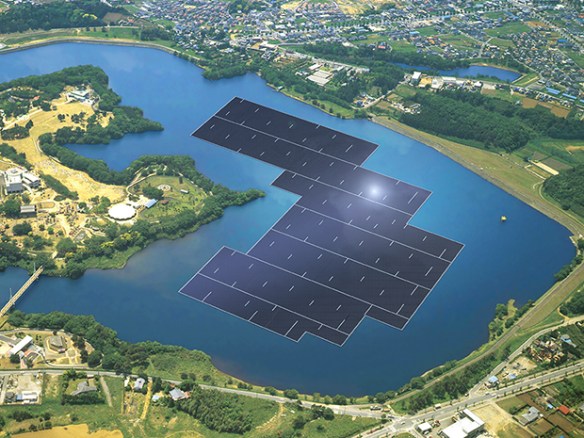
Image #1:  World’s largest floating array of PV Solar Panels in Japan (4)

Currently Japan has the most aggressive expansion plans for reservoir installations, with the most recent being the world’s largest of it’s kind.  Recent changes in energy policies and the ongoing problems associated with Nuclear Power has propelled Japan into aggressively seeking alternative forms of energy.

The 13.7-megawatt power station, being built for Chiba Prefecture’s Public Enterprise Agency, is located on the Yamakura Dam reservoir, 75 kilometers east of the capital. It will consist of some 51,000 Kyocera solar modules covering an area of 180,000 square meters, and will generate an estimated 16,170 megawatt-hours annually. That is “enough electricity to power approximately 4,970 typical households,” says Kyocera. That capacity is sufficient to offset 8,170 tons of carbon dioxide emissions a year, the amount put into the atmosphere by consuming 19,000 barrels of oil.” 

“[…]“Due to the rapid implementation of solar power in Japan, securing tracts of land suitable for utility-scale solar power plants is becoming difficult,” Toshihide Koyano, executive officer and general manager of Kyocera’s solar energy group told IEEE Spectrum. “On the other hand, because there are many reservoirs for agricultural use and flood-control, we believe there’s great potential for floating solar-power generation business.”

He added that Kyocera is currently working on developing at least 10 more projects and is also considering installing floating installations overseas.” (4)

Solar Energy on Brownfields:

A Brownfield is defined generally by the EPA  (5)

A brownfield is a property, the expansion, redevelopment, or reuse of which may be complicated by the presence or potential presence of a hazardous substance, pollutant, or contaminant. It is estimated that there are more than 450,000 brownfields in the U.S. Cleaning up and reinvesting in these properties increases local tax bases, facilitates job growth, utilizes existing infrastructure, takes development pressures off of undeveloped, open land, and both improves and protects the environment.

Solar Brownfield 1 D6A13-0092.jpg

Image #2:  6-MW solar PV array on the site of the former Palmer Metropolitan Airfield (6)

Traditionally most solar projects have been built on “Greenfields”, however, on further analysis it makes far more sense to install solar on “Brownfields”.

The U.S. is home to more than 450,000 brownfields – unused property that poses potential environmental hazards. Eyesores as well as potential health and safety threats, brownfield sites reduce urban property values. Rehabilitating them pays off, and in more ways than one, according to a July, 2014 National Bureau of Economic Research (NBER) working paper entitled, ¨The Value of Brownfield Remediation.¨ […]

NBER researchers determined that remediation increased the value of individual brownfield sites $3,917,192, with a median value of $2,117,982. That compares to an estimated per-site cost of $602,000. In percentage terms across the study’s nationally representative sample, EPA-supported clean-ups resulted in property price increases of between 4.9% and 32.2%. (6)

In another example where a Brownfield remediation effort has payed off utilizing a Solar Power upgrade is at the Philadelphia Navy Yard according to a June 2011 report by Dave Levitan (7) where it says:

“The Navy Yard solar array is just one of a growing number of projects across the U.S. that fall into the small category of energy ideas that appear to have little to no downside: turning brownfields — or sites contaminated

Every solar project that rises from an industrial wasteland is one that won’t be built on pristine land.

or disturbed by previous industrial activity — into green energy facilities. Among the successfully completed brown-to-green projects are a wind farm at the former Bethlehem Steel Mill in Lackawanna, New York; a concentrating solar photovoltaic array on the tailings pile of a former molybdenum mine in Questa, New Mexico; solar panels powering the cleanup systems at the Lawrence Livermore National Laboratory’s Superfund site in northern California; and the U.S. Army’s largest solar array atop a former landfill in Fort Carson, Colorado.”

Solar Energy on Landfills:

Building solar power projects on top of closed off landfills appears to be a good idea, however, there are additional considerations and requirements which must be met which would exceed those of a normal type of undisturbed geology.

Construction and ongoing operation of the plant must never break, erode or otherwise impair the functioning integrity of the landfill final closure system (including any methane gas management system) already in place.”  (8) […]

A-Simple-Guide-to-Building-Photovoltaic-Projects-on-Landfills-and-Other-...-copy-3-291x300

Image #3:  Prescriptive Landfill Capping System

In general, the features of a conventional “Subtitle D” final protection barrier cover system on USA waste sites are shown in the illustration above and include the following layers added on top of a waste pile:

  1. First, a foundation Layer – usually soil—covers the trash to fill and grade the area and protect the liner.
  2. Then typically a geomembrane liner or a compacted clay layer .is spread over the site to entomb the waste mass in a water impermeable enclosure.
  3. A drainage layer (i.e. highly transmissive sands or gravels or a manufactured “Geonet”) is next added– especially in areas with heavy rainfall and steeper slopes. This is to prevent the sodden top layers of dirt from slipping off the impermeable barrier (a.k.a. a landslide).
  4. Next, typically 18 inches of soil is added as a “protection layer.”
  5. Finally, an “erosion layer” of soil – typically 6 inches of dirt of sufficient quality to support plant growth (grasses, etc., etc.) which the waste industry calls a “vegetative layer.”

Solar-landfill-table-lo-res

Image #4:  Established Solar Energy Projects on Closed Landfills (9)

As of 2013 we can see that there already have been a number of solar installations and that this number is still growing through to the present as more municipalities seek ways to convert their closed landfills into a renewable resource and asset.

Summary of Solar Energy Project Types by Site

A greenfield site is defined as an area of agricultural or forest land, or some other undeveloped site earmarked for commercial development or industrial projects.  This is compared to a brownfield site which is generally unsuitable for commercial development or industrial projects due to the presence of some hazardous substance, pollutant or contaminant.

While a water reservoir is not a contaminated site, it is generally rendered useless for most purposes, however provides an ideal site for locating solar panels as they provide relatively large areas of unobstructed sun.  Also reservoirs provide water cooling which enhances energy efficiency and PV performance.  Uncovered reservoirs can be partially covered by floating arrays of PV panels, of modest to large sizes in the 16 MW range.  Installations can be found throughout the world, including England and most recently Japan where interest in alternative energy sources is growing rapidly.

A brownfield site is considered ideal for the location of a solar plant as a cost-effective method of an otherwise useless body of land, such as a decommissioned mine, quarry, or contaminated site.  A landfill is one form of brownfield site which could be suitable for the installation of solar power where provision has been made to protect the cap on the landfill.  Municipalities have been showing growing interest in landfill solar as a means to offset operational costs.

Abbreviations:

PV – Photo Voltaic

CSP – Concentrated Solar Power

ROI – Return On Investment

UK – United Kingdom

NBER – National Bureau of Economic Research

EPA – Environmental Protection Agency

References:

  1. http://www.theguardian.com/environment/2016/feb/29/worlds-biggest-floating-solar-farm-power-up-outside-london
  2. http://www.telegraph.co.uk/finance/newsbysector/energy/11954334/United-Utilities-floats-3.5m-of-solar-panels-on-reservoir.html
  3. http://www.telegraph.co.uk/news/earth/energy/solarpower/11110547/Britains-first-floating-solar-panel-project-installed.html
  4. http://spectrum.ieee.org/energywise/energy/renewables/japan-building-worlds-largest-floating-solar-power-plant
  5. https://www.epa.gov/brownfields/brownfield-overview-and-definition
  6. http://microgridmedia.com/massachusetts-pv-project-highlights-benefits-of-solar-brownfields/
  7. http://e360.yale.edu/feature/brown_to_green_a_new_use_for_blighted_industrial_sites/2419/
  8. http://solarflexrack.com/a-simple-guide-to-building-photovoltaic-projects-on-landfills-and-other-waste-heaps/
  9. http://www.crra.org/pages/Press_releases/2013/6-3-2013_CRRA_solar_cells_on_Hartford_landfill.htm

Supercritical CO2 Used For Solar Battery Power System

“GE has announced it is working on a way to use CO2 pollution to make new types of solar batteries that could each power up to 100,000 homes. CO2 is the main contributor to climate change, and is released into the atmosphere when coal is processed at power plants. Currently environmental procedures mean that some CO2 from these plants is captured and stored, so it’s not released back into the atmosphere. But the question has always been: What do you do with the stored gas?” (1)


dodge-sco23 supercritical CO2 turbine

Figure #1:  Comparison of 10 MWe Turbines (2)

What are the Benefits of Supercritical CO2?  With the transition from steam generation to using Supercritical CO2 as a working fluid, we seen large gains in energy efficiency conversion, coupled with significant size (footprint) reduction of turbomachines.  Other benefits include sequestering CO2 from the environment and reducing GHG emissions.   Also, this system can be utilized to capture energy from other heat sources including waste heat streams and co-generation applications. 

Supercritical CO2 image comparison

Figure 2:  Relative size  comparison of steam, helium and supercritical CO2 turbomachinery for Generation IV Nuclear Reactors (3)

What is Supercritical CO2?  “[…] Supercritical CO2 is a fluid state of carbon dioxide where it is held above its critical pressure and critical temperature which causes the gas to go beyond liquid or gas into a phase where it acts as both simultaneously. Many fluids can achieve supercritical states and supercritical steam has been used in power generation for decades. Supercritical CO2 has many unique properties that allow it to dissolve materials like a liquid but also flow like a gas. sCO2 is non-toxic and non-flammable and is used as an environmentally-friendly solvent for decaffeinating coffee and dry-cleaning clothes.

dodge-sco211 supercritical CO2 2

Figure 3:  CO2 phase diagram illustrating supercritical region. (4)

The use of sCO2 in power turbines has been an active area of research for a number of years, and now multiple companies are bringing early stage commercial products to market. The attraction to using sCO2 in turbines is based on its favorable thermal stability compared to steam which allows for much higher power outputs in a much smaller package than comparable steam cycles. CO2 reaches its supercritical state at moderate conditions and has excellent fluid density and stability while being less corrosive than steam.  The challenges in using sCO2 are tied to identifying the best materials that can handle the elevated temperatures and pressures, manufacturing turbo machinery, valves, seals, and of course, costs. […] ”  (2)

How will this work?

“[…] The design has two main parts. The first one collects heat energy from the sun and stores it in a liquid of molten salt. “This is the hot side of the solution,” Sanborn says. The other component uses surplus electricity from the grid to cool a pool of liquid CO2 so that it becomes dry ice.

During power generation, the salt releases the heat to expand the cold CO2 into a supercritical fluid, a state of matter where it no longer has specific liquid and gas phases. It allows engineers to make the system more efficient.

The supercritical fluid will flow into an innovative CO2 turbine called the sunrotor, which is based on a GE steam turbine design. Although the turbine can fit on an office shelf (see image above) it can generate as much as 100 megawatts of “fast electricity” per installed unit—enough to power 100,000 U.S. homes.

Sanborn believes that a large-scale deployment of the design would be able to store “significant amounts” of power —— and deliver it back to the grid when needed. “We’re not talking about three car batteries here,” he says. “The result is a high-efficiency, high-performance renewable energy system that will reduce the use of fossil fuels for power generation.”

He says the system could be easily connected to a solar power system or a typical gas turbine. The tanks and generators could fit on trailers. His goal is to bring the cost to $100 per megawatt-hour, way down from the $250 it costs to produce the same amount in a gas-fired power plant. “It is so cheap because you are not making the energy, you are taking the energy from the sun or the turbine exhaust, storing it and transferring it,” says Sanborn.

The process is also highly efficient, Sanborn says, yielding as much as 68 percent of the stored energy back to the grid. The most efficient gas power plants yield 61 percent. The team is now building a conceptual design, which Sanborn believes could take five to 10 years to get from concept to market. […]” (5)

Read more at:

1.  https://duanetilden.com/2013/10/29/supercritical-co2-refines-cogeneration-for-industry/

2. https://duanetilden.com/2013/10/29/supercritical-co2-turbine-for-power-production-waste-heat-energy-recovery/

3. https://duanetilden.com/2013/10/29/waste-heat-recovery-using-supercritical-co2-turbines-to-create-electrical-power/

4. https://duanetilden.com/2015/04/23/doe-invests-in-super-critical-carbon-dioxide-turbine-research-to-replace-steam-for-electric-power-generators/


References:

  1. http://www.fastcompany.com/3057630/fast-feed/ge-is-working-on-a-way-to-turn-co2-pollution-into-solar-batteries
  2. http://breakingenergy.com/2014/11/24/supercritical-carbon-dioxide-power-cycles-starting-to-hit-the-market/
  3. http://large.stanford.edu/courses/2014/ph241/dunham1/
  4. https://commons.wikimedia.org/wiki/File:Carbon_dioxide_pressure-temperature_phase_diagram.svg
  5. http://www.vanguardngr.com/2016/03/ge-report-this-scientist-has-turned-the-tables-on-greenhouse-gas-using-co2-to-generate-clean-electricity/


Is Utility-Scale Solar Power the Economic Choice to Residential Solar Power?

Originally published on Solar Love. A new study has concluded that utility-scale solar PV systems across the US are “significantly” more cost effective than rooftop solar PV systems. Sp…

Sourced through Scoop.it from: cleantechnica.com

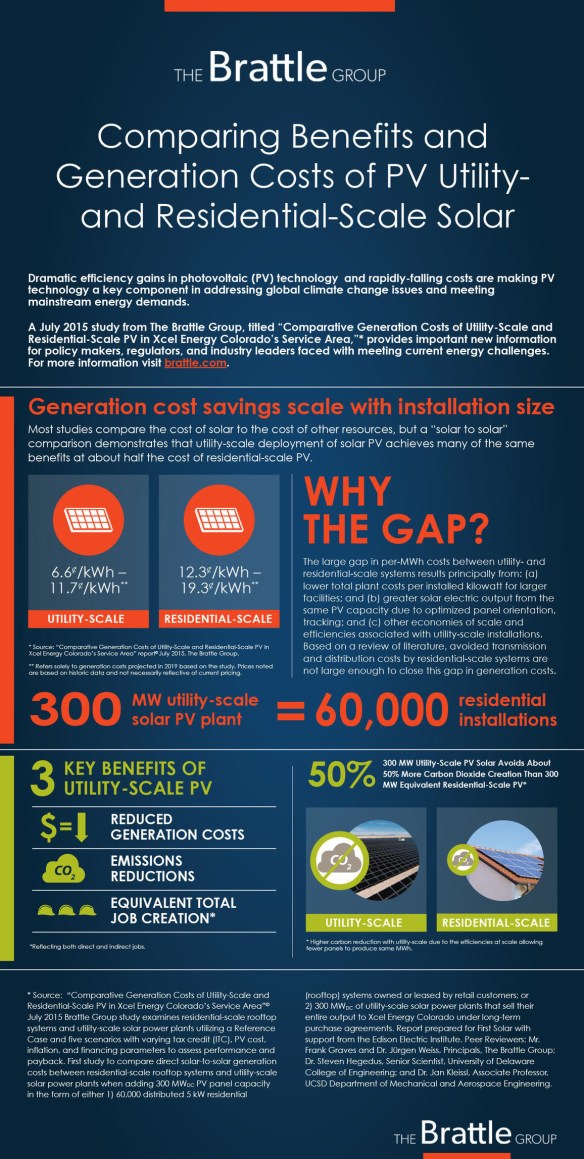
“[…] the study, conducted by economists at global consulting firm The Brattle Group, found that utility-scale solar PV systems were more cost effective at achieving the economic and policy benefits of PV solar than rooftop or residential-scale solar was.

The study, Comparative Generation Costs of Utility-Scale and Residential-Scale PV in Xcel Energy Colorado’s Service Area, published Monday, is the first of its kind to study a “solar on solar” comparison.

“Over the last decade, solar energy costs for both rooftop and bulk-power applications have come down dramatically,” said Dr. Peter Fox-Penner, Brattle principal and co-author of the study. “But utility-scale solar will remain substantially less expensive per kWh generated than rooftop PV. In addition, utility-scale PV allows everyone access to solar power. From the standpoint of cost, equity, and environmental benefits, large-scale solar is a crucial resource.”

The study yielded two key findings:

  1. The generation cost of energy from 300 MW of utility-scale PV solar is roughly 50% the cost per kWh of the output from an equivalent 300 MW of 5kW residential-scale systems when deployed on the Xcel Energy Colorado system, and utility-scale solar remains more cost effective in all scenarios considered in the study.
  2. In that same setting, 300 MW of PV solar deployed in a utility-scale configuration also avoids approximately 50% more carbon emissions than an equivalent amount of residential-scale PV solar. […]

The report itself was commissioned by American thin-film photovoltaic manufacturer and utility scale developer First Solar with support from Edison Electric Institute, while Xcel Energy Colorado provided data and technical support. Specifically, the report examined the comparative customer-paid costs of generating power from equal amounts of utility-scale and residential/rooftop-scale solar PV panels in the Xcel Energy Colorado system.

A reference case and five separate scenarios with varying degrees of investment tax credit, PV cost, inflation, and financing parameters were used to yield the report’s results.

The specifics of the study’s findings, which imagined a 2019 Xcel Energy Colorado system, are as follows:

  • utility-scale PV power costs ranged from $66/MWh to $117/MWh (6.6¢/kWh to 11.7¢/kWh) across the five scenarios
  • residential-scale PV power costs were well up, ranging from $123/MWh to $193/MWh (12.3¢/kWh to 19.3¢/kWh) for a typical residential-scale system owned by the customer
  • the costs for leased residential-scale systems were even larger and between $140/MWh and $237/MWh (14.0¢/kWh to 23.7¢/kWh)
  • the generation cost difference between the utility- and residential-scale systems owned by the customer ranged from 6.7¢/kWh to 9.2¢/kWh solar across the scenarios

The authors of the report put these figures into perspective, including the national average for retail all-in residential electric rates in 2014, which were 12.5¢/kWh.  […]”

See on Scoop.itGreen Energy Technologies & Development