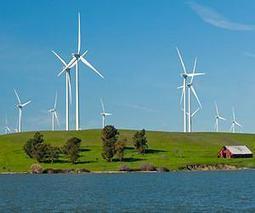
EPA sets terms for New Power Plant carbon emissions

See on Scoop.itGreen & Sustainable News

Frances Beinecke: We’re already paying the costs of climate change. The new power plant emissions standards could not be more timely

Duane Tilden‘s insight:

>The carbon standards announced Friday by Gina McCarthy, administrator of the US Environmental Protection Agency, will set reasonable limits on carbon pollution from the power plants of tomorrow, those that are yet to be built.<

See on www.theguardian.com

State’s First Fracking Regulation Will Go Into Effect Next Year

See on Scoop.itGreen & Sustainable News

By Sharon Bernstein SACRAMENTO, Calif., Sept 20 (Reuters) – California’s first regulations on fracking and related oil production practices will go into effect next year in the most populous U.S.

Duane Tilden‘s insight:

>State Senator Fran Pavely, a Democrat who represents the Los Angeles suburb of Agoura Hills and was the author of the new law, said the regulations would stop oil companies from fracking in the state without full disclosure of their methods.

“Oil companies will not be allowed to frack or acidize in California unless they test the groundwater, notify neighbors and list each and every chemical on the Internet,” Pavely said. “This is a first step toward greater transparency, accountability and protection of the public and the environment.”

Opposing the measure along with the environmentalists was the oil industry, which said the new law could make it difficult for California to reap the benefits offered by development of the Monterey Shale, including thousands of new jobs, increased tax revenue, and higher incomes for residents.

The law “could create conditions that will make it difficult to continue to provide a reliable supply of domestic petroleum energy for California,” said Catherine Reheis-Boyd, president of the Western State Petroleum Association, which represents oil companies in California.<

See on www.huffingtonpost.com

Ex-Halliburton Official Charged With Destroying Evidence In Gulf Oil Spill Disaster

See on Scoop.itGreen & Sustainable News

The the latest twist in an ongoing legal battle following the explosion that killed 11 people and resulted in the largest oil spill in U.S. history.

Duane Tilden‘s insight:

>Attorney General Eric Holder said in a statement: “Halliburton and one of its managers have now been held criminally accountable for their misconduct, underscoring our continued commitment to ensuring that the victims of this tragedy obtain justice, and to safeguarding the integrity of relevant evidence.”

U.S. District Judge Jane Triche Milazzo of the Eastern District of Louisiana also noted that Halliburton self-reported the misconduct and cooperated with the investigation. Badalamenti was charged with a “bill of information,” which often means that the defendant is cooperating with prosecutors.

Rig owner Transocean and BP were both criminally charged for the disaster, but Halliburton was not — these charges are just related to the post-spill review.

Even though the spill happened more than three years ago, residents in the area still feel the effects. The 170,000 workers hired to help clean up the oil spill are at an increased risk of getting cancer, leukemia, and other serious illnesses. And on Thursday, BP sued the state of Louisiana to block its order to remove abandoned anchors the company used to deploy oil spill booms during cleanup efforts.<

See on thinkprogress.org

DOE awards $30M to develop utility cybersecurity tools

See on Scoop.itGreen & Sustainable News

The Department of Energy today awarded $30 million to a 11 security vendors to develop technology the agency says will better protect nation’s electric grid, oil and gas infrastructure from cyber-attack.

Duane Tilden‘s insight:

>The projects, which will combine power system engineering and cybersecurity, will include testing of the new products to demonstrate their effectiveness and interoperability, the DOE said. […]

While the DOE’s investment is welcomed, a survey of U.S. utilities in May shows what many utilities are up against. That survey called “Electric Grid Vulnerability,” said more than a dozen utilities said cyberattacks were daily or constant. The survey was commissioned by U.S. Democratic Representatives Edward J. Markey and Henry A. Waxman who are members of the U.S. House Energy and Commerce Subcommittee.<

See on www.computerworld.com

Energy from tides and currents: Arranging underwater Tidal Sails

See on Scoop.itGreen & Sustainable News

In the long sprint to find new sources of clean, low-cost power, slow and steady might win the race — the slow-moving water of currents and tides, that is.

Duane Tilden‘s insight:

>The system, developed by a Norwegian company called Tidal Sails AS, consists of a string of submerged blades or sails, connected via wire ropes, angled into the oncoming current. The rushing current generates large lift forces in the sails, and as they are pushed along through a continuous loop, they drive a generator to produce electricity. […]

In their analysis, the researchers found that the maximum amount of power could be generated using blades with a chord length (the width of the blade at a given distance along its length) equal to the separation between each individual blade, that are positioned at about a 79 degree angle relative to the oncoming current, and that move at a speed about one and half times faster than the current.<

See on www.sciencedaily.com

UK government rejects current Severn tidal barrage plans

See on Scoop.itGreen & Sustainable News

Ministers say major changes must be made to the scheme if it is to be revived and given serious consideration

Duane Tilden‘s insight:

>Concerns over the impact of such a barrage on marine life played a major part in the rejection, with the government agreeing with MPs that better studies were needed to establish the effects on fish.

The response was: “It is for the developers to do the necessary work to prove that their design is ‘fish-friendly’ and will not jeopardise the UK’s obligations under the water framework directive and habitats directive. Such studies will need to take account of the wide variation in vulnerability of different fish species arising from to their different morphology, physiology and behaviour.”

The government said Hafren would need to provide much more detailed, credible evidence of the proposal, including a study of the environmental impacts and information on turbines, as well as information on allaying fears of flooding that could be worsened by any barrage. The coalition said it would consider the proposal further if this information was provided, but added that legal hurdles would mean the consortium’s current proposals were likely to be subject to delay.

Ministers reiterated their view that there should be no firm commitments of public financial support – in the form of the “strike price” of a premium for low-carbon power that has been confirmed for wind power and is expected soon for nuclear energy – for tidal barrage schemes until 2019 at the earliest.<

See on www.theguardian.com

Water Energy Nexus: A Literature Review

See on Scoop.itGreen Energy Technologies & Development

Water-Energy Nexus: A Literature Review provides readers with an overview and analysis of the policy, scientific and technical research on the connections between water and energy. This review is a comprehensive survey of the literature from the academic, government and nonprofit sectors, organized around the water and energy life cycles.  It examines research and policy from energy use across the water and wastewater sectors, as well as water across the various components of the energy sector.
See on waterinthewest.stanford.edu

The Dark Side of Efficiency

zsturm's avatarInnovation in Business, Energy, and Environment

By Peter Brooks

In at least three of the cases we have studied so far (Maersk, Groom, Wal-Mart) efficiency was the one thing everyone seemed to agree on.  Investments in greater resource efficiency (energy, water, space) that cost less than future benefits are no-brainers; a company can save money while also preserving precious, finite resources (to say nothing of the safety, regulatory, aesthetic, and morale benefits of finding and fixing inefficiencies) and that is unequivocally a good thing.

Unfortunately there is a dark side to efficiency: it can be more destructive to the environment and speed the withdrawal and consumption of natural resources than if the investment were never made.  In the late 19th century, an English economist, William Jevons, made the startling discovery that technological improvements that increased the efficiency of coal-burning, led to an increased consumption of coal.  To put it another way, greater efficiency was used…

View original post 473 more words

Stanford Scientists Analyse Life Cycle Costs of Energy Storage vs Curtailment for Renewables

See on Scoop.itGreen Energy Technologies & Development

Stanford CA (SPX) Sep 17, 2013 –
Renewable energy holds the promise of reducing carbon dioxide emissions. But there are times when solar and wind farms generate more electricity than is needed by consumers.

Duane Tilden‘s insight:

>”We calculated how much energy is used over the full lifecycle of the battery – from the mining of raw materials to the installation of the finished device,” Barnhart said. “Batteries with high energetic cost consume more fossil fuels and therefore release more carbon dioxide over their lifetime. If a battery’s energetic cost is too high, its overall contribution to global warming could negate the environmental benefits of the wind or solar farm it was supposed to support.”

For this study, he and his colleagues calculated the energetic cost of grid-scale photovoltaic solar cells and wind turbines.

“Both wind turbines and photovoltaics deliver more energy than it takes to build and maintain them,” said GCEP postdoctoral scholar Michael Dale, a co-author of the study. “However, our calculations showed that the overall energetic cost of wind turbines is much lower than conventional solar panels, which require lots of energy, primarily from fossil fuels, for processing silicon and fabricating other components.” […]

To find out, the researchers compared the energetic cost of curtailing solar and wind power, versus the energetic cost of grid-scale storage. Their calculations were based on a formula known as “energy return on investment” – the amount of energy produced by a technology, divided by the amount of energy it takes to build and maintain it.

Using that formula, the researchers found that the amount of energy required to create a solar farm is comparable to the energy used to build each of the five battery technologies. “Using batteries to store solar power during periods of low demand would, therefore, be energetically favorable,” Dale said.

The results were quite different for wind farms. The scientists found that curtailing wind power reduces the energy return on investment by 10 percent. But storing surplus wind-generated electricity in batteries results in even greater reductions – from about 20 percent for lithium-ion batteries to ?more than 50 percent for lead-acid.<

See on www.solardaily.com

Revisiting The North American Hydropower Opportunity

See on Scoop.itGreen Energy Technologies & Development

It is no secret that many renewable energy advocates are not in favor of large hydropower.

Duane Tilden‘s insight:

>[…] there exists a threat that is even more worrisome to endangered species, a threat that has the potential to cause destructive flooding and destroy ecosystems: climate change.  […]

Perhaps that’s why in May of this year, the World Bank reversed its stance on large-scale hydropower. Whereas the major international development bank was once a staunch opponent of large-scale hydro, recognition that developing regions like Africa and Southeast Asia desperately need power have forced it to reconsider.  The world needs energy to lift people out of poverty and building more fossil fuel-fired electricity plants will only serve to exacerbate the problems already associated with climate change. Hydropower is an answer.

Maybe it is time for the renewable energy industry to take a second look at hydropower development. The clean energy it can provide is a vast improvement over the dirty energy we get from fossil fuels. Hydropower already meets about 8 percent of U.S. electricity demand and with improved technologies that already exist the National Hydropower Association (NHA) estimates that we can double the amount of energy we get from hydropower without building any more dams.<

See on www.renewableenergyworld.com