U.S. Tidal Energy Project requires Proximity Standard

See on Scoop.itGreen Energy Technologies & Development

A planned tidal energy project off the coast of Washington state in the US has come under fire over the lack of a standard defining how close such projects can be to existing underwater cables.

Duane Tilden‘s insight:

>There is currently no U.S. standard for the distance tidal energy projects need to be from other subsea installations. The Federal Communications Commission has stated that neither it nor FERC has the expert guidance necessary to make an informed decision about what a safe separation distance would be. The FCC has charged an advisory committee, the Communications Security, Reliability and Interoperability Council (CSRIC), to work with the industry to develop guidance, delegating a special submarine cable working group to address the issue.

Distance guidelines do exist for offshore wind turbines in the U.S. The FCC and industry groups have suggested that these standards, which require 500 metres between offshore wind turbines and submarine cables, should be used in this case.

In its comment to the FERC, Pacific Crossing invoked a UK guideline, Subsea Cables UK Guideline number 6, which recommends proximity limits of 200-400 metres from an existing subsea structure for marine energy development. The North American Submarine Cable Association has urged U.S. regulatory agencies to apply the UK guidelines to all U.S. marine energy projects, including tidal energy projects.<

See on www.renewableenergyworld.com

Greening Coal Power with CO2-eating Microalgae as a Biofuel Feedstock

See on Scoop.itGreen Energy Technologies & Development

Successful microalgae-to-biodiesel conversion has been the goal of some renewable energy researchers for more than two decades.

Duane Tilden‘s insight:

>To that end, Algae.Tec has signed a deal with Macquarie Generation, Australia’s largest electricity generator, to put an “algae carbon capture and biofuels” production facility next to a coal-fired power station in Australia’s Hunter Valley. Macquarie Generation, which operates the Sydney-area 2640 MW Bayswater Power Station, will feed waste CO2 into an enclosed algae growth system. […]

Projections are for the first year of production to hit 100,000 tons of algae biomass; half of which would be converted to an estimated 60 million liters of biodiesel. One sea-land container would generate 250 tons of biomass per annum, said the company, which would be harvested on a continuous basis. […]

Stroud projects that some 75 percent of his company’s income will come from biodiesel. The remaining 25 percent of Algae.Tec’s income will hinge on the sale of the microalgae’s leftover biomass for animal feed.<

See on www.renewableenergyworld.com

Surplus fossil fuels expected to exceed carbon budget

See on Scoop.itGreen & Sustainable News

It won’t be difficult to blow by the 1-trillion ton threshold based on the amount of fossil fuels still in the ground. As Amy Myers Jaffe remarks, “scarcity will not be the force driving a shift to alternative energy. Climate and energy policy initiatives will have to take into consideration the possibility of oil and gas surpluses and lower fossil fuel prices.”

Duane Tilden‘s insight:

>The lesson here is that the economics are still in favor of producing fossil fuels. The cyclical nature of energy prices suggests that higher prices will spur development of technologies to reach more difficult energy deposits. This doesn’t mean that oil and natural gas prices will be low for the rest of time, but it does reflect how high energy prices in the 2000s led not only to funding and research in alternative fuels (particularly biofuels), but also in oil and gas technologies. This investment coupled with decades of U.S. government and academic research proved fruitful with the combination of horizontal drilling and hydraulic fracturing becoming a deployable technology.

We have now entered a period of energy surplus where we produce energy from “unconventional sources” using technological breakthroughs like horizontal drilling and hydraulic fracturing in places like North Dakota, south Texas, Lousiana, and Pennsylvannia. (and soon to be California?).<

See on blogs.scientificamerican.com

GE seeks to Clean up Fracking’s Dirty Water Problem

See on Scoop.itGreen & Sustainable News

GE has demonstrated technology aimed at addressing one of the biggest challenges with fracking: water pollution.

Duane Tilden‘s insight:

>Concerns about water pollution and other environmental issues related to fracking have led some places, including France and New York State, to block the process. As fracking increases in dry areas and places that lack adequate treatment and disposal options, pressure to block it could grow.

“Water-treatment technology is going to become more and more critical as the industry moves forward,” says Amy Myers Jaffe, executive director of energy and sustainability at the University of California at Davis, and a new member of a GE environmental advisory board. She says the continued use of fracking depends on the “industry getting its act together to do it in an environmentally sustainable way.”

Better water-treatment options could change the way oil and gas producers operate by making it economical to treat water at fracking sites instead of trucking it long distances to large water-treatment facilities or disposal wells. The technology is specifically targeted to places such as the Marcellus shale, one of the largest sources of shale gas in the U.S., where wastewater is far too salty for existing on-site treatment options (see “Can Fracking Be Cleaned Up?” and “Using Ozone to Clean Up Fracking”).

Each fracking well can require two to five million gallons of fresh water, which is pumped underground at high pressure to fracture rock and release trapped oil and gas. Much of that water flows back out, carrying with it the toxic chemicals used to aid the fracking process, as well as toxic materials flushed from the fractured rock.

Producers currently reuse much of that water, but that involves first storing it in artificial ponds, which can leak, and then diluting it, a step that consumes millions of gallons of fresh water. Eventually they can’t reuse the water any more so they need to ship it, often over long distances, to specialized treatment and disposal locations. Transporting the wastewater is expensive, and it comes with a risk of spills. At disposal sites, the wastewater is injected deep underground in a process that can cause earthquakes.

The new technology would make it unnecessary to dilute the wastewater, or transport it for treatment or disposal. […]<

See on www.technologyreview.com

Bloomberg predicts: Solar to add more megawatts than wind in 2013

See on Scoop.itGreen Energy Technologies & Development

Bloomberg New Energy Finance predicts that for the first time more new solar power capacity — compared to wind — will be added to the world’s global energy infrastructure this year.

Duane Tilden‘s insight:

>In an BNEF’s analysts forecast 36.7GW of new photovoltaic capacity this year, compared to 33.8 GW of new onshore wind farms, and  1.7 GW of offshore wind.

In 2012, wind — onshore and offshore — added 46.6 GW, while PV added 30.5GW, record figures in both cases. But in 2013, a slowdown in the world’s two largest wind markets, China and the US, is opening the way for the rapidly growing PV market to overtake wind.

“The dramatic cost reductions in PV, combined with new incentive regimes in Japan and China, are making possible further, strong growth in volumes,” said Jenny Chase, head of solar analysis at Bloomberg New Energy Finance. “Europe is a declining market, because many countries there are rapidly moving away from incentives, but it will continue to see new PV capacity added.”<

See on www.renewableenergymagazine.com

BP battles for billions in latest Gulf Oil Spill pollution trial

See on Scoop.itGreen & Sustainable News

HOUSTON/LONDON (Reuters) – BP will battle to hold down fines that could hit $18 billion in a new phase of the Gulf of Mexico trial that will rule on how much oil it spilled in 2010 and judge its efforts…

Duane Tilden‘s insight:

>POLLUTION FINES

BP says 3.26 million barrels leaked from the well during the nearly three months it took to cap the blowout at the Deepwater Horizon rig; the U.S. government says it was 4.9 million. Both those totals include 810,000 barrels that were collected during clean-up and which Barbier has agreed to exclude.

This month, BP’s lawyers questioned the government’s figure. “United States experts employ unproven methods that require significant assumptions and extrapolations in lieu of … available data and other evidence,” they said in a filing.

They have also sought to convince Barbier that if the company is to be found guilty, it should amount to only “negligence” and not “gross negligence” – a crucial distinction since the latter carries much higher maximum penalties.

Under the Clean Water Act, negligence can be punished with a maximum fine of $1,100 for each barrel of oil spilled; a gross negligence verdict carries a potential $4,300 per barrel fine.

If the court judged the spill to have been 4.09 million barrels – the government estimate less oil recovered – the price of negligence could reach $4.5 billion. Gross negligence, in the costliest scenario, could run to $17.6 billion.<

See on www.reuters.com

Algae Biofuel Emits at Least 50% Less Carbon than Petroleum Fuels

See on Scoop.itGreen Energy Technologies & Development

Algae-derived biofuel can reduce life cycle CO2 emissions by 50 to 70 percent compared to petroleum fuels, and is approaching a similar Energy Return on Investment (EROI) as conventional petroleum according to a new peer-reviewed paper published in…

Duane Tilden‘s insight:

>The study entitled Pilot-scale data provide enhanced estimates of the life cycle energy and emissions profile of algae biofuels produced via hydrothermal liquefaction (HTL) is the first to analyze data from a commercial-scale algae-to-energy farm. Researchers examined field data from Sapphire Energy facilities in Las Cruces and Columbus, New Mexico.

Researchers at the Pacific Northwest National Laboratory recently concluded that 14 percent of land in the continental United States, or the combined area of Texas and New Mexico, could be used to grow and produce algae for conversion into transportation fuels. In 2008, the U.S. Department of Energy found that for algae fuel to completely replace petroleum in the United States it would need roughly 30,000 square kilometers of land, or half the area of South Carolina, so the potential is certainly there for a massive transition from dirty oil-based transportation fuels to cleaner burning domestic green crude from algae.<


See on inhabitat.com

U.S. Nuclear Power Closures Signal Wider Problems for Industry

See on Scoop.itGreen & Sustainable News

A string of plant closures, project cancellations and other setbacks has raised new doubts about the future of nuclear power in the United States, but there’s disagreement about whether the retrenchment will be limited and temporary or the…

Duane Tilden‘s insight:

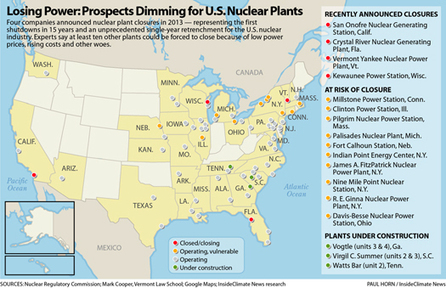
>The blows to nuclear power’s prospects have come on many fronts, but it was the surprising spurt of plant closures that laid bare the industry’s worsening plight. The plant shutdowns are the first to hit the U.S. nuclear power market in 15 years, and the retirements don’t bode well for many of the nation’s 99 remaining power reactors.

Analysts say economic woes make at least 10 other plants vulnerable enough to follow suit. Almost all of those are among the nation’s 47 “merchant” nuclear plants, which, unlike regulated plants, operate in open markets and have to beat out other power suppliers to win customers and long-term supply contracts. The especially vulnerable facilities cited by analysts are at greater risk for closure because their power is too expensive to sell profitably in wholesale markets or because their output is too small or too unreliable to support rising operating and retrofit costs.<

See on insideclimatenews.org

Robotic Technologies Applied to Solar Energy Market – Installation and Maintenance

See on Scoop.itGreen Building Design – Architecture & Engineering

Mountain View CA (SPX) Sep 20, 2013 – … robotic technologies deliver revolutionary installation and cleaning services at highly competitive prices … for building and maintenance of utility-scale solar plants..

Duane Tilden‘s insight:

>The typical installation process for utility-scale projects is similar to that of a small-scale, 20-panel, residential installation. Despite incremental improvements to the process, a 200,000-panel installation has retained many of the characteristics of a 20-panel installation.

They are both labor-intensive, and require repetitive bolt-tightening and glass-hauling. While these are minor flaws in a 20-panel system, they create significant inefficiencies in 20,000- or 200,000-panel systems.

Alion Energy has plugged the shortcomings of the current installation methods by changing the materials and design used in the mounting structure as well as by automating the installation. By combining robotic installation technology with established construction practices, Alion Energy has built a system twice as fast and 75 percent more labor-efficient that lowers solar electricity’s levelized cost of energy (LCOE) to compete with traditional energy sources.<

See on www.solardaily.com

World Record Solar Cell with 44.7 Percent Efficiency (news)

See on Scoop.itGreen Energy Technologies & Development

Freiburg, Germany – The Fraunhofer Institute for Solar Energy Systems ISE, Soitec, CEA-Leti and the Helmholtz Center Berlin jointly announced on late Monday having achieved a new world record for the conversion of sunlight into electricity using a new solar cell structure with four solar subcells. …

Duane Tilden‘s insight:

>These solar cells are used in concentrator photovoltaics (CPV), a technology which achieves more than twice the efficiency of conventional PV power plants in sun-rich locations. The terrestrial use of so-called III-V multi-junction solar cells, which originally came from space technology, has prevailed to realize highest efficiencies for the conversion of sunlight to electricity. In this multi-junction solar cell, several cells made out of different III-V semiconductor materials are stacked on top of each other. The single subcells absorb different wavelength ranges of the solar spectrum.<

See on renewable-energy-industry.com