Connecticut Storm Proofing with Micro-Grid Developments

See on Scoop.itGreen Energy Technologies & Development
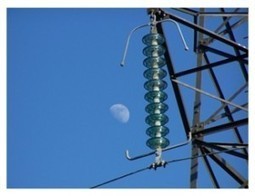
Press Release Gov. Dannel P. Malloy announced Oct. 30 that nine towns that are part of a pilot microgrid program, including Windham and Storrs, are eligible for additional funding.

Duane Tilden‘s insight:

>A pilot microgrid program, administered by the state Department of Energy and Environmental Protection, was created under Public Act 12-148 to increase the safety and quality of life for Connecticut residents during electric grid outage situations.

Microgrids provide electricity to critical facilities and town centers on a 24/7, daily basis. They will also include a system of “trips” and “transfers” to isolate the microgrid and provide power within its network even when there is a large-scale outage.

The first round of the program awarded $18 million in grants to microgrid projects in Bridgeport, Fairfield, Groton, Hartford, Middletown, Storrs/Mansfield, Windham and Woodbridge as part of the Governor’s Storm Legislation.

Those projects are expected to become operational over the course of the next 18 months, with the first projects slated to come online in early 2014. […]

“Our first-in-the-nation microgrid program is an essential tool to help minimize hardships to our residents and businesses when severe storms occur. We all know that it is not a question of if, but when the next super storm will strike, and it is essential we do everything we can to be prepared,” Gov. Malloy said.

Commenting on the additional funding, DEEP Commissioner Daniel C. Esty said, “It is essential to public safety that power be maintained to critical facilities and town centers even when the electric grid is down… Connecticut and the northeast continue to experience more severe and more frequent storms, so it is vital that the state aggressively pursues the development of microgrids statewide so that we are in a better position to provide critical services to the state’s residents and businesses.”<

See on mansfield.htnp.com

The China Water Crisis: A Global Catastrophe or Wasteful Use?

See on Scoop.itGreen & Sustainable News

Learn how the China water crisis will have significant impact on the balance of the world if not reversed, and how you can help, in this WaterFilters.NET post.

Duane Tilden‘s insight:

>The New York Times reports:

Beijing has placed its faith in monumental feats of engineering to slake the north’s growing thirst. The South-North Water Transfer eventually aims to pipe 45 cubic kilometers of water annually northward along three routes in eastern, central and western China. All three pose enormous technical challenges: The eastern and central routes will be channeled under the Yellow River, while the western route entails pumping water over part of the Himalayan mountain range.

The estimated cost of $65 billion is almost certainly too low, and doesn’t include social and ecological impacts. Construction has already displaced hundreds of thousands, and issues the like possible increases in transmission of water-borne diseases have not been properly studied. But Beijing’s calculus is political: It is easier to increase the quantity of water resources, at whatever cost, rather than allocate a limited supply between competing interests.  […]

A recent article by The Economist states:

“The Chinese government would do better to focus on demand, reducing consumption of water in order to make better use of limited supplies. Water is too cheap in most cities, usually costing a tenth of prices in Europe. Such mispricing results in extravagance. Industry recycles too little water; agriculture wastes too much. Higher water prices would raise costs for farms and factories, but that would be better than spending billions on shipping water round the country.”

Economically supporting Chinese regions and corporations that commit to better water usage and sustainability practices may help to change the mindset of many within this nation’s government or industries.  In turn, this could lead them towards exploring more realistic initiatives experiencing success in other parts of the world.<

See on blog.waterfilters.net

Utilizing Renewable Energy Tax Incentives to Finance First Nations Energy Projects

See on Scoop.itGreen & Sustainable News

Duane Tilden‘s insight:

>We recommend that a tribe use a request for proposal (RFP) or other competitive process to identify an appropriate taxable development partner, so that they can obtain the best available proposal for the renewable energy project and the best value for the 30% investment tax credit and potentially depreciation. Under the RFP strategy, the tribe would make taxable developers aware of its renewable energy development plans, as well as potentially its willingness to pay for a portion of the renewable energy project.

The RFP would request the taxable developers to provide their best proposals regarding the development and financing of the renewable energy facilities, including proposals regarding:

The overall cost of the renewable energy facilities.The particular equipment to be installed and the warranties on that equipment.The developer’s willingness to limit the amount of the financial contribution by the tribe.The developer’s willingness to limit, in time and amount, any payments by the tribe for energy from or for leasing the renewable energy facilities.

The tribe could then select the taxable development partner that provides the best financial and other terms. A potential result of the RFP process could likely be that if the tribe is willing and able to pay for one half of the renewable energy facilities, a taxable developer might be willing to finance the rest of the facilities. Even if the developer does not share any of the value of the depreciation, it may be willing to at least provide the tribe full value for the investment tax credit. This would mean that there would be only 20% of the project cost to be paid over time. This could be accomplished by having the tribe pay a reduced rate for electricity for a period of at least five years (to avoid any recapture of the tax credits under IRS rules), and then for the developer, once it is made whole on its investment, to turn the facilities over to the tribe, potentially free of charge.

This transfer could be accomplished by allowing the tribe to use its 50% contribution to the LLC to purchase the taxable developer’s interest in the LLC, and for the tribe to have the right to purchase this interest based upon the renewable energy facilities’ value under a theoretical removal and sale of the facilities. Thus, under this scenario, the tribe’s initial capital outlay for the renewable energy facilities would be reduced by half, and the tribe would be able to receive reduced-priced energy for an interim period of time and then obtain full ownership of the renewable energy facilities.<

See on www.gklaw.com

Supercritical CO2 refines cogeneration for Industry

See on Scoop.itGreen Energy Technologies & Development

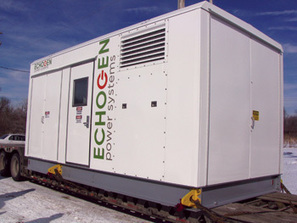
The first production unit of the EPS100 7.5 MWe heat engine is completing factory checkout tests at Dresser-Randbtd…

Duane Tilden‘s insight:

>Energy-intensive manufacturing

In an increasingly competitive environment, manufacturers are seeking to cut their costs. Fluctuating energy prices often channel this investment into cost-effective energy-saving technologies and practices that will reduce operating costs while maintaining or increasing product quality and yield.

Energy-efficient technologies often bring other benefits, such as higher productivity or environmental gains, reducing the regulatory ‘burden’. Waste heat can be captured from many industrial processes through waste heat recovery technology. […]

Waste heat recovery represents the greatest opportunity for reducing energy loss in these industries while simultaneously reducing their carbon footprint and associated greenhouse emissions with improved overall energy production efficiency.[…]

The outlook for scCO2

Supercritical CO2 heat engines are scalable across a broad system size range, from 250 kWe to 45 MWe and above, with net electrical output to support the widest possible variety of industrial and utility-scale applications.

The sCO2 Cycle is thermal source neutral − suitable with a wide range of heat sources from 200°C to 500°C with efficiencies up to 30%. New energy production can be offset with recovered energy without increasing greenhouse emissions while improving overall energy production efficiency. The scCO2 heat engine can add up to 35% more power to simple-cycle gas turbines, 10–15% more power to reciprocating engines, and can significantly improve the energy efficiency and bottom line performance at steel mills, cement kilns, glass furnaces and other fuel-fired industrial processes by converting previously wasted exhaust and flue gas energy into usable electricity.

Alex Kacludis is an Application Engineer at EPS LLC; www.echogen.com

See on www.cospp.com

Supercritical CO2 turbine for Power Production & Waste Heat Energy Recovery

See on Scoop.itGreen Building Design – Architecture & Engineering

A former scientist at Sandia National Lab is bringing the technology to market

Duane Tilden‘s insight:

>Because of its physical properties as a liquid, it has become a target fluid of opportunity to run turbines and thus make electricity. Steven Wright, Ph.D., who recently retired from Sandia National Laboratory (SNL), has set up a consulting company called Critical Energy LLC to bring this technology to a commercial level.

The objective of using supercritical CO2 (S-CO2) in a Brayton-Cycle turbine is to make it much more efficient in the transfer of heat. Wright points out that a steam turbine is about 33% efficient, but that an S-CO2 turbine could be as high as 48% efficient, a significant increase.

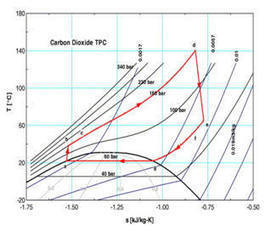
A closed loop supercritical CO2 system has the density of a liquid, but many of the properties of a gas. A turbine running on it, “is basically a jet engine running on a hot liquid,” says Wright.

“There is a tremendous amount of scientific and industrial interest in S-CO2 for power generation. All heat sources are involved…<

See on theenergycollective.com

Waste Heat Recovery using Supercritical CO2 turbines to create Electrical Power

See on Scoop.itGreen Building Design – Architecture & Engineering

Working fluids with relatively low critical temperature and pressure can be compressed directly to their supercritical pressures and heated to their supercritical state before expansion so as to obtain a better thermal match with the heat source.

Duane Tilden‘s insight:

>Chen et al. [1-3] did a comparative study of the carbon dioxide supercritical power cycle and compared it with an organic Rankine cycle using R123 as the working fluid in a waste heat recovery application. It shows that a CO2 supercritical power cycle has higher system efficiency than an ORC when taking into account the behavior of the heat transfer between the heat source and the working fluid. The CO2 cycle shows no pinch limitation in the heat exchanger. Zhang et al.  [4-11] has also conducted research on the supercritical CO2 power cycle. Experiments revealed that the CO2 can be heated up to 187℃ and the power generation efficiency was 8.78% to 9.45% [7] and the COP for the overall outputs from the cycle was 0.548 and 0.406, respectively, on a typical summer and winter day in Japan [5].

Organic fluids like isobutene, propane, propylene, difluoromethane and R-245fa [12] have also been suggested for supercritical Rankine cycle. It was found that supercritical fluids can maximize the efficiency of the system. However, detailed studies on the use of organic working fluids in supercritical Rankine cycles have not been widely published.

There is no supercritical Rankine cycle in operation up to now. However, it is becoming a new direction due to its advantages in thermal efficiency and simplicity in configuration.<

See on www.eng.usf.edu

Manufacturer’s Energy Efficient Heat Recovery Unit Runs High in Energy Awards

See on Scoop.itGreen Building Design – Architecture & Engineering

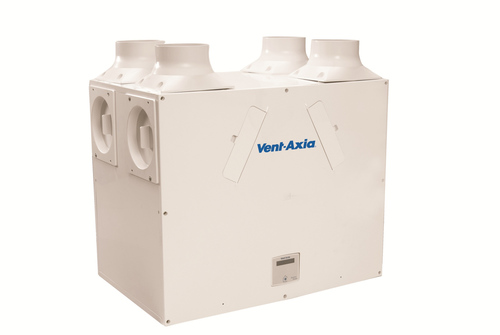
Vent-Axia has made the final shortlist in the prestigious Energy Awards 2013, which recognise and reward companies leading the way in reducing carbon emissions. Vent-Axia’s Lo-Carbon Kinetic Plus E…

Duane Tilden‘s insight:

>Consuming as little as 20W, the Kinetic Plus E only costs around £20 a year to run, offering 94% thermal efficiency and potentially recovering 10 or 20 times more energy than it costs to operate. This offers homeowners an attractive cost saving as we enter the winter months and rising fuel costs.<

See on kirhammond.wordpress.com

What Actually Happens As We Move Away From Coal as an Energy Source?

New York to Retrofit 250,000 Streetlights With Energy-Saving LED Bulbs

See on Scoop.itGreen Energy Technologies & Development

The phaseout is part of a long-term plan to reduce greenhouse gas emissions by 30 percent by 2017 and, Mayor Michael R. Bloomberg said, would save taxpayers money.

Duane Tilden‘s insight:

>The news conference was on Eastern Parkway in Brooklyn, where lights have already been replaced, expecting to save more than $70,000 and nearly 248,000 kilowatt-hours a year in energy. Unlike standard lights, which last six years, LED bulbs can burn for 20 years before they need to be replaced, the administration said, and the project is expected to save $14 million a year in energy and maintenance costs. […]

“People tend to like them,” she said. “It’s clear. It’s bright. It really does a good job in providing fresher light.” The project is estimated to cost $76.5 million.

The project is the first to receive financing through the Accelerated Conservation and Efficiency initiative or “ACE,” the administration said, a $100 million competitive program that the Department of Citywide Administrative Services created to expedite such sustainability projects.<

See on www.nytimes.com

2015 IECC energy code raises requirements for efficiency, lighting controls, advanced HVAC in existing buildings

See on Scoop.itGreen Building Design – Architecture & Engineering

By Brianna Crandall, October 23, 2013—Hearings to finalize the 2015 International Energy Conservation Code (IECC) wrapped up in Atlantic City recently with big wins for higher efficiency requirements in existing buildings, controls for lighting and daylighting hardware and HVAC equipment specifications, according to a news release from the New Buildings Institute (NBI),

Duane Tilden‘s insight:

>The IECC is reviewed and updated every three years and serves as the model energy code for states and local jurisdictions across the country. The last version is the 2012 IECC.

In the United States, buildings account for about 40% of the energy consumed and 38% of all CO2 emissions, according to the U.S. Green Building Council. Cost-effective measures that cut the energy used by buildings represent a critical strategy to help building owners save money and curb the impacts of climate change, notes NBI.

“The updates related to existing and historic buildings clarify and further extend the code’s impact on the current building stock and will mean large energy savings growing over time,” said Jim Edelson, NBI senior manager of codes and policy. “Taken together, the approved code changes represent the most significant code revisions for energy consumption of existing buildings since the 1970s.”<

See on www.fmlink.com