Unknown's avatar

About duanetilden

Engineer, Entrepreneur, Blogger, Farmer, Traveler and Nature Lover. I love music, quotes and blog about Green Building & Energy.

Why China Is Being Flooded With Oil: Billions In Underwater OPEC Loans Repayable In Crude, by Tyler Durden

“When the price of oil was above $100, many of the less developed oil exporting OPEC members decided to capitalize on the high price and cash out by taking loans using the precious liquid as collateral … However, few oil exporters anticipated such an acute oil plunge in such as short time span, which resulted in the value of the collateral tumbling by 70%, and now find themselves have to repay the original loan by remitting as much as three times more oil!”

Robert Gore's avatarSTRAIGHT LINE LOGIC

Here’s one of the dumber borrower schemes out there, and a bunch of clueless governments in oil producing countries are at the heart of it: borrow money and agree to pay back the equivalent amount in barrels of oil, not using the market value of oil at the time the deals are struck, but at the time the loans must be repaid. So loans incurred when oil was above $100 a barrel now must be repaid with oil that is only valued at $40-$50 a barrel, meaning debtors must repay 2 to 3 times the amount of oil they would have had oil prices stayed high. The Chinese, the creditor on the other side of these transactions, receive a lot more oil, but they’re running out of storage and refinery capacity. From Tyler Durden at zerohedge.com:

When the price of oil was above $100, many of the less developed oil…

View original post 406 more words

PV Panel Energy Conversion Efficiency Rankings

The purpose of this brief is to investigate into the types of solar panel systems with a look at their theoretical maximum Energy Conversion Efficiency both in research and the top 20 manufactured commercial PV panels. 

PVeff(rev160420)

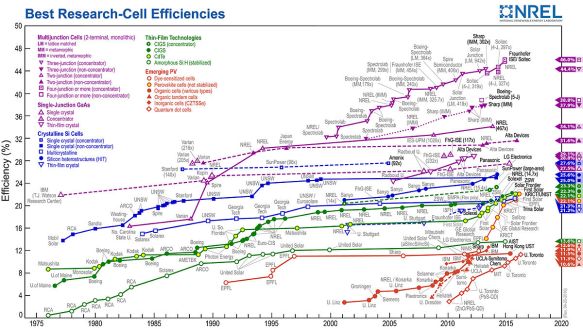
Figure 1:  Reported timeline of solar cell energy conversion efficiencies since 1976 (National Renewable Energy Laboratory) (1)

Solar panel efficiency refers to the capacity of the panel to convert sunlight into electricity.   “Energy conversion efficiency is measured by dividing the electrical output by the incident light power.” (1)  There is a theoretical limit to the efficiency of a solar cell of “86.8% of the amount of in-coming radiation. When the in-coming radiation comes only from an area of the sky the size of the sun, the efficiency limit drops to 68.7%.”

Figure 1 shows that there has been considerable laboratory research and data available on the various configurations of photo-voltaic solar cells and their energy conversion efficiency from 1976 to date.  One major advantage is that as PV module efficiency increases the amount of material  or area required (system size) to maintain a specific nominal output of electricity will generally decrease.

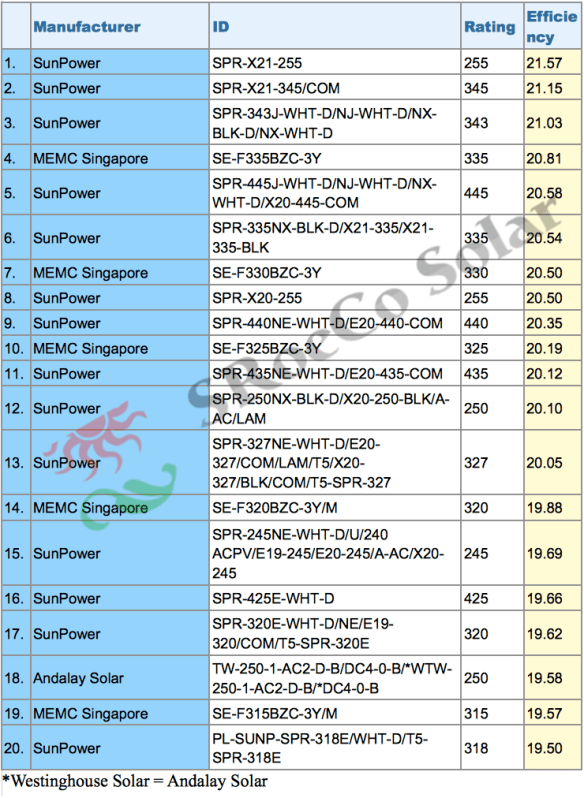
Of course, not all types of systems and technologies are economically feasible at this time for mainstream production.  The top 20 PV solar cells are listed in Figure 2 below with their accompanying measured energy efficiency.

top-20-most-efficient-solar-panels-chart

Figure 2:  Table of the top 20 most efficient solar panels on the North American Market (2)

Why Monocrystalline Si Panels are more Efficient:

Current technology has the most efficient solar PV modules composed of monocrystalline silicon.  Lower efficiency panels are composed of polycrystalline silicon and are generally about 13 to 16% efficient.  This lower efficiency is attributed to higher occurrences of defects in the crystal lattice which affects movement of electrons.  These defects can be imperfections and impurities, as well as a result of the number of grain boundaries present in the lattice.  A monocrystal by definition has only grain boundaries at the edge of the lattice.  However a polycrystalline PV module is full of grain boundaries which present additional discontinuities in the crystalline lattice; impeding electron flow thus reducing conversion efficiency. (3) (4)

Other Factors that can affect Solar Panel Conversion Efficiency in Installations (5):

Direction and angle of your roof 
Your roof will usually need to be South, East or West facing and angled between 10 and 60 degrees to work at its peak efficiency.

Shade
The less shade the better. Your solar panels will have a lower efficiency if they are in the shade for significant periods during the day.

Temperature
Solar panel systems need to be installed a few inches above the roof in order to allow enough airflow to cool them down.  Cooler northern climates also improve efficiency to partially compensate for lower intensity.

Time of year
Solar panels work well all year round but will produce more energy during summer months when the sun is out for longer.  In the far northern regions the sun can be out during the summer for most of the day, conversely during the winter the sun may only be out for a few hours each day.

Size of system
Typical residential solar panel systems range from 2kW to 4kW. The bigger the system the more power you will be able to produce.  For commercial and larger systems refer to a qualified consultant.


References:

  1. https://en.wikipedia.org/wiki/Solar_cell_efficiency
  2. http://sroeco.com/solar/top-20-efficient-solar-panels-on-the-market/
  3. http://energyinformative.org/best-solar-panel-monocrystalline-polycrystalline-thin-film/
  4. http://www.nrel.gov/docs/fy11osti/50650.pdf
  5. http://www.theecoexperts.co.uk/which-solar-panels-are-most-efficient

Solar Energy on Reservoirs, Brownfields and Landfills

One of the downsides to large-scale solar power is finding space suitable for the installation of a large area of PV panels or mirrors for CSP.  These are long-term installations, and will have impact on the land and it’s uses.  There are potential objections to committing areas of undeveloped or pristine land to solar power. 

Solar Energy on Reservoirs:

Floating arrays have been installed on surfaces such as water reservoirs as these “land areas” are already committed to a long-term purpose.  Solar power is considered a good synchronistic fit, and most recently work was completed in England seeing “23,000 solar panels on the Queen Elizabeth II reservoir at Walton-on-Thames”.   (1)

Water utilities are the first to see the benefit of solar panel installations as the power generated is generally consumed by the utilities operations for  water treatment and pumping.  This of course offsets demand requirements from the electrical utility and reduces operating costs with a ROI from the installation.  Possible government or other industry incentives and subsidies may enhance benefits.  Last year a 12,000 panel system was installed on a reservoir near Manchester (UK) and was the second of it’s kind in Britain, dwarfing the original installation of 800 panels.  (2)  (3)
Solar Array on Reservoir Japan MjcxMzAwOQ

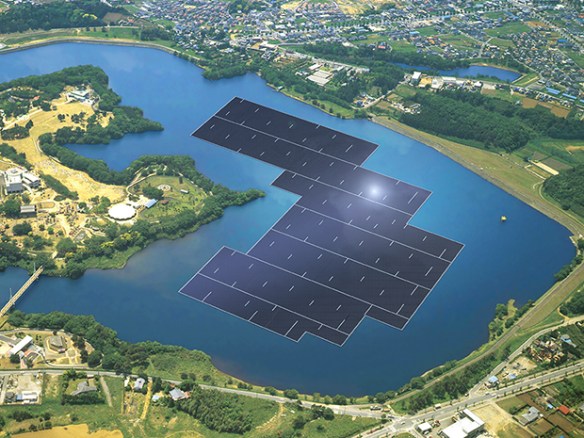
Image #1:  World’s largest floating array of PV Solar Panels in Japan (4)

Currently Japan has the most aggressive expansion plans for reservoir installations, with the most recent being the world’s largest of it’s kind.  Recent changes in energy policies and the ongoing problems associated with Nuclear Power has propelled Japan into aggressively seeking alternative forms of energy.

The 13.7-megawatt power station, being built for Chiba Prefecture’s Public Enterprise Agency, is located on the Yamakura Dam reservoir, 75 kilometers east of the capital. It will consist of some 51,000 Kyocera solar modules covering an area of 180,000 square meters, and will generate an estimated 16,170 megawatt-hours annually. That is “enough electricity to power approximately 4,970 typical households,” says Kyocera. That capacity is sufficient to offset 8,170 tons of carbon dioxide emissions a year, the amount put into the atmosphere by consuming 19,000 barrels of oil.” 

“[…]“Due to the rapid implementation of solar power in Japan, securing tracts of land suitable for utility-scale solar power plants is becoming difficult,” Toshihide Koyano, executive officer and general manager of Kyocera’s solar energy group told IEEE Spectrum. “On the other hand, because there are many reservoirs for agricultural use and flood-control, we believe there’s great potential for floating solar-power generation business.”

He added that Kyocera is currently working on developing at least 10 more projects and is also considering installing floating installations overseas.” (4)

Solar Energy on Brownfields:

A Brownfield is defined generally by the EPA  (5)

A brownfield is a property, the expansion, redevelopment, or reuse of which may be complicated by the presence or potential presence of a hazardous substance, pollutant, or contaminant. It is estimated that there are more than 450,000 brownfields in the U.S. Cleaning up and reinvesting in these properties increases local tax bases, facilitates job growth, utilizes existing infrastructure, takes development pressures off of undeveloped, open land, and both improves and protects the environment.

Solar Brownfield 1 D6A13-0092.jpg

Image #2:  6-MW solar PV array on the site of the former Palmer Metropolitan Airfield (6)

Traditionally most solar projects have been built on “Greenfields”, however, on further analysis it makes far more sense to install solar on “Brownfields”.

The U.S. is home to more than 450,000 brownfields – unused property that poses potential environmental hazards. Eyesores as well as potential health and safety threats, brownfield sites reduce urban property values. Rehabilitating them pays off, and in more ways than one, according to a July, 2014 National Bureau of Economic Research (NBER) working paper entitled, ¨The Value of Brownfield Remediation.¨ […]

NBER researchers determined that remediation increased the value of individual brownfield sites $3,917,192, with a median value of $2,117,982. That compares to an estimated per-site cost of $602,000. In percentage terms across the study’s nationally representative sample, EPA-supported clean-ups resulted in property price increases of between 4.9% and 32.2%. (6)

In another example where a Brownfield remediation effort has payed off utilizing a Solar Power upgrade is at the Philadelphia Navy Yard according to a June 2011 report by Dave Levitan (7) where it says:

“The Navy Yard solar array is just one of a growing number of projects across the U.S. that fall into the small category of energy ideas that appear to have little to no downside: turning brownfields — or sites contaminated

Every solar project that rises from an industrial wasteland is one that won’t be built on pristine land.

or disturbed by previous industrial activity — into green energy facilities. Among the successfully completed brown-to-green projects are a wind farm at the former Bethlehem Steel Mill in Lackawanna, New York; a concentrating solar photovoltaic array on the tailings pile of a former molybdenum mine in Questa, New Mexico; solar panels powering the cleanup systems at the Lawrence Livermore National Laboratory’s Superfund site in northern California; and the U.S. Army’s largest solar array atop a former landfill in Fort Carson, Colorado.”

Solar Energy on Landfills:

Building solar power projects on top of closed off landfills appears to be a good idea, however, there are additional considerations and requirements which must be met which would exceed those of a normal type of undisturbed geology.

Construction and ongoing operation of the plant must never break, erode or otherwise impair the functioning integrity of the landfill final closure system (including any methane gas management system) already in place.”  (8) […]

A-Simple-Guide-to-Building-Photovoltaic-Projects-on-Landfills-and-Other-...-copy-3-291x300

Image #3:  Prescriptive Landfill Capping System

In general, the features of a conventional “Subtitle D” final protection barrier cover system on USA waste sites are shown in the illustration above and include the following layers added on top of a waste pile:

  1. First, a foundation Layer – usually soil—covers the trash to fill and grade the area and protect the liner.
  2. Then typically a geomembrane liner or a compacted clay layer .is spread over the site to entomb the waste mass in a water impermeable enclosure.
  3. A drainage layer (i.e. highly transmissive sands or gravels or a manufactured “Geonet”) is next added– especially in areas with heavy rainfall and steeper slopes. This is to prevent the sodden top layers of dirt from slipping off the impermeable barrier (a.k.a. a landslide).
  4. Next, typically 18 inches of soil is added as a “protection layer.”
  5. Finally, an “erosion layer” of soil – typically 6 inches of dirt of sufficient quality to support plant growth (grasses, etc., etc.) which the waste industry calls a “vegetative layer.”

Solar-landfill-table-lo-res

Image #4:  Established Solar Energy Projects on Closed Landfills (9)

As of 2013 we can see that there already have been a number of solar installations and that this number is still growing through to the present as more municipalities seek ways to convert their closed landfills into a renewable resource and asset.

Summary of Solar Energy Project Types by Site

A greenfield site is defined as an area of agricultural or forest land, or some other undeveloped site earmarked for commercial development or industrial projects.  This is compared to a brownfield site which is generally unsuitable for commercial development or industrial projects due to the presence of some hazardous substance, pollutant or contaminant.

While a water reservoir is not a contaminated site, it is generally rendered useless for most purposes, however provides an ideal site for locating solar panels as they provide relatively large areas of unobstructed sun.  Also reservoirs provide water cooling which enhances energy efficiency and PV performance.  Uncovered reservoirs can be partially covered by floating arrays of PV panels, of modest to large sizes in the 16 MW range.  Installations can be found throughout the world, including England and most recently Japan where interest in alternative energy sources is growing rapidly.

A brownfield site is considered ideal for the location of a solar plant as a cost-effective method of an otherwise useless body of land, such as a decommissioned mine, quarry, or contaminated site.  A landfill is one form of brownfield site which could be suitable for the installation of solar power where provision has been made to protect the cap on the landfill.  Municipalities have been showing growing interest in landfill solar as a means to offset operational costs.

Abbreviations:

PV – Photo Voltaic

CSP – Concentrated Solar Power

ROI – Return On Investment

UK – United Kingdom

NBER – National Bureau of Economic Research

EPA – Environmental Protection Agency

References:

  1. http://www.theguardian.com/environment/2016/feb/29/worlds-biggest-floating-solar-farm-power-up-outside-london
  2. http://www.telegraph.co.uk/finance/newsbysector/energy/11954334/United-Utilities-floats-3.5m-of-solar-panels-on-reservoir.html
  3. http://www.telegraph.co.uk/news/earth/energy/solarpower/11110547/Britains-first-floating-solar-panel-project-installed.html
  4. http://spectrum.ieee.org/energywise/energy/renewables/japan-building-worlds-largest-floating-solar-power-plant
  5. https://www.epa.gov/brownfields/brownfield-overview-and-definition
  6. http://microgridmedia.com/massachusetts-pv-project-highlights-benefits-of-solar-brownfields/
  7. http://e360.yale.edu/feature/brown_to_green_a_new_use_for_blighted_industrial_sites/2419/
  8. http://solarflexrack.com/a-simple-guide-to-building-photovoltaic-projects-on-landfills-and-other-waste-heaps/
  9. http://www.crra.org/pages/Press_releases/2013/6-3-2013_CRRA_solar_cells_on_Hartford_landfill.htm

Energy Efficiency Sector Ranks #1 in Job Growth by DOE


UNEP-Green-Economy-employment-energy-550x242

Figure 1:  Projected Job Growth by Sectors – Green Economy Report, 2011 (1)

WASHINGTON – The U.S. Department of Energy today released the agency’s first annual analysis of how changes in America’s energy profile are affecting national employment in multiple energy sectors. By using a combination of existing energy employment data and a new survey of energy sector employers, the inaugural U.S. Energy and Employment Report (USEER) provides a broad view of the national current energy employment landscape.

USEER examines four sectors of the economy — electric power generation and fuels; transmission, wholesale distribution, and storage; energy efficiency; and motor vehicles — which cumulatively account for almost all of the United States’ energy production and distribution system and roughly 70 percent of U.S. energy consumption. By looking at such a wide portion of the energy economy, USEER can provide the public and policy makers with a clearer picture of how changes in energy technology, systems, and usage are affecting the economy and creating or displacing jobs.

Some key findings of the report include:

3.64 million Americans work in traditional energy industries, including production, transmission, distribution, and storage.
Of these, 600,000 employees contribute to the production of low-carbon electricity, including renewable energy, nuclear energy and low emission natural gas.
An additional 1.9 million Americans are employed, in whole or in part, in energy efficiency.
Roughly 30 percent of the 6.8 million employees in the U.S. construction industry work on energy or building energy efficiency projects.

A copy of the full report is available HERE.

The report also found several energy industries with projected increases in new jobs. Responding to the USEER survey of employers, the energy efficiency sector predicted hiring rates of 14 percent in 2016, or almost 260,000 new hires. Projected hiring rates were at 5 percent within the electric power generation and fuels sector, reflecting overall growth despite a loss of employment in 2015 in the oil and natural gas extraction sectors. Transmission, wholesale distribution, and storage firms anticipate 4 percent employment growth in 2016. Solar energy firms predicted 15 percent job growth over the next year.

Yet even as the report found the opportunity for job growth in many energy sectors, over 70 percent of all employers surveyed found it “difficult or very difficult” to hire new employees with needed skills.

“The transformation of our energy system and the growth of energy efficiency technologies are creating opportunities for thousands of new jobs, especially in energy efficiency and solar,” said David Foster, Senior Advisor on Energy and Industrial Policy at the Department of Energy.  “This report gives an important snapshot of energy employment in America, and subsequent reports will provide better information to guide policies and priorities that create new jobs, appropriately train workers, and promote a successful national energy policy.” …” (1)

“…As a rule of thumb, investment in renewable energy and energy efficiency generate about 3 times the amount of jobs that other energy related investments create (gas, oil, coal, nuclear). Average numbers of jobs created per million euro invested (3CSEP):

  • Building retrofits: 17
  • Renewable energy: 15
  • Coal: 7
  • Oil and gas: 5

[…] (2)

poschen_chart2.jpg

Figure 2:  Job Generators Comparison Chart (3)

“[…] While much of the debate on climate change and employment has focused on renewables, another and more significant source of jobs from decarbonization has received much less attention. Substantial efficiency gains are technically feasible and economically viable in industry, housing, transportation, and services. Businesses can make a profit and households can enjoy real savings. And spending the surplus on things other than fossil energy will boost an economy’s employment.

For example, the United States is a diversified economy that imports substantial amounts of equipment for renewables. A recent study carefully considered economy-wide effects of reducing emissions by 40 percent by 2030 through a mix of clean energy and energy efficiency (Pollin and others, 2014). It concluded that $200 billion a year in investment would generate a net gain of about 2.7 million jobs: 4.2 million in environmental goods and service sectors and their supply chains but 1.5 million lost in the shrinking fossil- and energy-intensive sectors. The net gain of 2.7 million jobs would reduce the unemployment rate in the 2030 U.S. labor market by about 1.5 percentage points—for example, from 6.5 percent to 5 percent. The authors consider this a conservative estimate; for example, it does not take into account the 1.2 to 1.8 million jobs likely gained from reinvested savings.

Other studies show similar results. A review of 30 studies covering 15 countries and the European Union as a whole found appreciable actual or potential net gains in employment (Poschen, 2015). Most studies considering emission targets in line with the ambitions announced for a Paris agreement in December find net gains on the order of 0.5 to 2.0 percent of total employment, or 15 million to 60 million additional jobs. In emerging market economies such as Brazil, China, Mauritius, and South Africa, green investment was found to accelerate economic growth and employment generation when compared with business as usual. Several studies suggest that more ambitious climate targets would generate greater gains in employment (for a discussion of particular countries, see Poschen, 2015). […]” (3)

References:

(1)  http://bit.ly/1RsVAdc

(2) http://1.usa.gov/1Tby7lt

(3) http://bit.ly/1RlUaV8


Leading Energy Storage Tech for Renewable Energy

ElectricityStorage

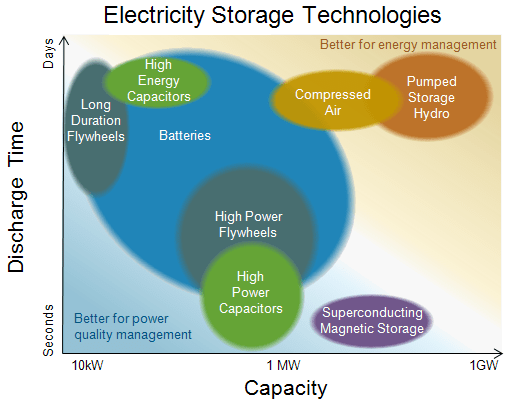
Image Source:  U.S. Energy Information Administration (1)

Summary

“It doesn’t always rain when you need water, so we have reservoirs – but we don’t have the same system for electricity,” says Jill Cainey, director of the UK’s Electricity Storage Network.

[…] Big batteries, whose costs are plunging, are leading the way. But a host of other technologies, from existing schemes like splitting water to create hydrogen,compressing air in underground caverns, flywheels and heated gravel pits, to longer term bets like supercapacitors and superconducting magnets, are also jostling for position.

In the UK, the first plant to store electricity by squashing air into a liquid is due to open in March, while the first steps have been taken towards a virtual power station comprised of a network of home batteries.

“We think this will be a breakthrough year,” says John Prendergast at RES, a UK company that has 80MW of lithium-ion battery storage operational across the world and six times more in development, including its first UK project at a solar park near Glastonbury. “All this only works if it reduces costs for consumers and we think it does,” he says.

Energy storage is important for renewable energy not because green power is unpredictable – the sun, wind and tides are far more predictable than the surge that follows the end of a Wimbledon tennis final or the emergency shutdown of a gas-fired power plant. Storage is important because renewable energy is intermittent: strong winds in the early hours do not coincide with the peak demand of evenings. Storage allows electricity to be time-shifted to when it is needed, maximising the benefits of windfarms and solar arrays. (2)


References

(1) http://1.usa.gov/1UOayAh

(2) http://bit.ly/1UOaJvs

Supercritical CO2 Used For Solar Battery Power System

“GE has announced it is working on a way to use CO2 pollution to make new types of solar batteries that could each power up to 100,000 homes. CO2 is the main contributor to climate change, and is released into the atmosphere when coal is processed at power plants. Currently environmental procedures mean that some CO2 from these plants is captured and stored, so it’s not released back into the atmosphere. But the question has always been: What do you do with the stored gas?” (1)


dodge-sco23 supercritical CO2 turbine

Figure #1:  Comparison of 10 MWe Turbines (2)

What are the Benefits of Supercritical CO2?  With the transition from steam generation to using Supercritical CO2 as a working fluid, we seen large gains in energy efficiency conversion, coupled with significant size (footprint) reduction of turbomachines.  Other benefits include sequestering CO2 from the environment and reducing GHG emissions.   Also, this system can be utilized to capture energy from other heat sources including waste heat streams and co-generation applications. 

Supercritical CO2 image comparison

Figure 2:  Relative size  comparison of steam, helium and supercritical CO2 turbomachinery for Generation IV Nuclear Reactors (3)

What is Supercritical CO2?  “[…] Supercritical CO2 is a fluid state of carbon dioxide where it is held above its critical pressure and critical temperature which causes the gas to go beyond liquid or gas into a phase where it acts as both simultaneously. Many fluids can achieve supercritical states and supercritical steam has been used in power generation for decades. Supercritical CO2 has many unique properties that allow it to dissolve materials like a liquid but also flow like a gas. sCO2 is non-toxic and non-flammable and is used as an environmentally-friendly solvent for decaffeinating coffee and dry-cleaning clothes.

dodge-sco211 supercritical CO2 2

Figure 3:  CO2 phase diagram illustrating supercritical region. (4)

The use of sCO2 in power turbines has been an active area of research for a number of years, and now multiple companies are bringing early stage commercial products to market. The attraction to using sCO2 in turbines is based on its favorable thermal stability compared to steam which allows for much higher power outputs in a much smaller package than comparable steam cycles. CO2 reaches its supercritical state at moderate conditions and has excellent fluid density and stability while being less corrosive than steam.  The challenges in using sCO2 are tied to identifying the best materials that can handle the elevated temperatures and pressures, manufacturing turbo machinery, valves, seals, and of course, costs. […] ”  (2)

How will this work?

“[…] The design has two main parts. The first one collects heat energy from the sun and stores it in a liquid of molten salt. “This is the hot side of the solution,” Sanborn says. The other component uses surplus electricity from the grid to cool a pool of liquid CO2 so that it becomes dry ice.

During power generation, the salt releases the heat to expand the cold CO2 into a supercritical fluid, a state of matter where it no longer has specific liquid and gas phases. It allows engineers to make the system more efficient.

The supercritical fluid will flow into an innovative CO2 turbine called the sunrotor, which is based on a GE steam turbine design. Although the turbine can fit on an office shelf (see image above) it can generate as much as 100 megawatts of “fast electricity” per installed unit—enough to power 100,000 U.S. homes.

Sanborn believes that a large-scale deployment of the design would be able to store “significant amounts” of power —— and deliver it back to the grid when needed. “We’re not talking about three car batteries here,” he says. “The result is a high-efficiency, high-performance renewable energy system that will reduce the use of fossil fuels for power generation.”

He says the system could be easily connected to a solar power system or a typical gas turbine. The tanks and generators could fit on trailers. His goal is to bring the cost to $100 per megawatt-hour, way down from the $250 it costs to produce the same amount in a gas-fired power plant. “It is so cheap because you are not making the energy, you are taking the energy from the sun or the turbine exhaust, storing it and transferring it,” says Sanborn.

The process is also highly efficient, Sanborn says, yielding as much as 68 percent of the stored energy back to the grid. The most efficient gas power plants yield 61 percent. The team is now building a conceptual design, which Sanborn believes could take five to 10 years to get from concept to market. […]” (5)

Read more at:

1.  https://duanetilden.com/2013/10/29/supercritical-co2-refines-cogeneration-for-industry/

2. https://duanetilden.com/2013/10/29/supercritical-co2-turbine-for-power-production-waste-heat-energy-recovery/

3. https://duanetilden.com/2013/10/29/waste-heat-recovery-using-supercritical-co2-turbines-to-create-electrical-power/

4. https://duanetilden.com/2015/04/23/doe-invests-in-super-critical-carbon-dioxide-turbine-research-to-replace-steam-for-electric-power-generators/


References:

  1. http://www.fastcompany.com/3057630/fast-feed/ge-is-working-on-a-way-to-turn-co2-pollution-into-solar-batteries
  2. http://breakingenergy.com/2014/11/24/supercritical-carbon-dioxide-power-cycles-starting-to-hit-the-market/
  3. http://large.stanford.edu/courses/2014/ph241/dunham1/
  4. https://commons.wikimedia.org/wiki/File:Carbon_dioxide_pressure-temperature_phase_diagram.svg
  5. http://www.vanguardngr.com/2016/03/ge-report-this-scientist-has-turned-the-tables-on-greenhouse-gas-using-co2-to-generate-clean-electricity/


US Solar Growth Predicted to Double to 16 GW for 2016

Solar 2016

Image Credit:  GTM Research / SEIA U.S. Solar Market Insight
Source Credit:  March 9 (SeeNews)  by

“[…] The market will be driven by the utility-scale segment, which will account for 74% of annual installations following a rush to take advantage of the federal Investment Tax Credit (ITC) that was initially set to expire at the end of this year. The residential and commercial markets are also expected to see strong growth in 2016, though.

With the ITC now extended, state-level drivers and risks will move to the forefront in 2016, says the US Solar Market Insight Report 2015, published in conjunction with the Solar Energy Industries Association (SEIA).

In 2017, the US solar market is expected to shrink to 10 GW due to the pull-in of utility demand in 2016. “But between 2018 and 2020, the extension of the ITC will reboot market growth for utility PV and support continued growth in distributed solar as a growing number of states reach grid parity,” said GTM Research senior analyst Cory Honeyman. […]”
Source Link:  http://bit.ly/1LdMdRB

City of Burnaby Calls for NEB Panel Suspension over Kinder Morgan Pipeline

The Trans Mountain pipeline expansion project has failed to gain social licence from the provincial government, or any Lower Mainland municipality or First Nation, and the National Energy Board (. . .

Sourced through Scoop.it from: www.burnabynow.com

See on Scoop.itGreen & Sustainable News

“[…] In a fiery double-barrel blast, Gregory McDade, legal counsel for the City of Burnaby, fired one barrel at Kinder Morgan Inc., the company behind the expansion project, and the other at the NEB panel itself.

Citing Prime Minister Justin Trudeau’s promise to overhaul the NEB, which he criticized for becoming politicized, McDade said, “Burnaby should not be the last victim of a flawed process.

“The City of Burnaby calls upon this panel to suspend these hearings,” McDade said. “We call upon this panel to reset the process in a way that keeps faith with the public trust that the prime minister of Canada has claimed he has.”

McDade quoted Trudeau, who said, “Governments grant permits, but only communities grant permission.”

“Let me be clear, this pipeline does not have community permission,” McDade said. “Not from the community of Burnaby, nor from any of the Lower Mainland municipalities, nor from the public or the Government of British Columbia.” […]

The Trans Mountain pipeline was originally built in the 1950s and fed a number of B.C. refineries that made gasoline, diesel and jet fuel for domestic use.

The Chevron plant in Burnaby, where the pipeline terminates, is the only refinery left in the Lower Mainland. As it stands, it has to compete with other companies for the oil that moves from the pipeline.

A twinning of the pipeline would triple its carrying capacity. But that’s by no means a guarantee that the Chevron refinery will necessarily have access to more oil. Of the 890,000 barrels per day an expanded pipeline would move, 707,500 barrels are spoken for by 13 shippers in offtake agreements, with the oil destined for refineries outside of Canada.

“This is not a pipeline, I say, to bring oil to the Lower Mainland to supply local industry, to bring us gasoline, as the pipeline was in the 1950s,” McDade said. “This is a pipeline solely for export. No benefits to B.C. at all, but all the burdens and all the risk are borne here.”

Of the 49 interveners making oral presentations at the Burnaby public hearings, 19 are B.C. First Nations, including three key Lower Mainland groups – the Squamish, Musqueam and Tsleil-Waututh – all of whom are opposed to the project.

The expanded pipeline would increase oil tanker traffic to 34 per month from the current five. Musqueam Councillor Morgan Guerin said on Jan. 19 that the wake caused by tankers means small fishing vessels would have to stop every time a tanker goes by.

The Musqueam would view that as a potential infringement of their aboriginal rights to fish – a right that was affirmed in the landmark Sparrow case. […]”


DOE’s 3 Year $220M Grid Modernization Plan

With 88 projects from coast to coast, it might be the biggest grid edge R&D effort ever. Here’s how the money is going to be spent.

Sourced through Scoop.it from: www.greentechmedia.com

“[…] The Grid Modernization Multi-Year Program Plan will bring a consortium of 14 national laboratories together with more than 100 companies, utilities, research organizations, state regulators and regional grid operators. The scope of this work includes integrating renewable energy, energy storage and smart building technologies at the edges of the grid network, at a much greater scale than is done today.

That will require a complicated mix of customer-owned and utility-controlled technology, all of which must be secured against cyberattacks and extreme weather events. And at some point, all of this new technology will need to become part of how utilities, grid operators, regulators, ratepayers and new energy services providers manage the economics of the grid.

DOE has already started releasing funds to 10 “pioneer regional partnerships,” or “early-stage, public-private collaborative projects […]  The projects range from remote microgrids in Alaska and grid resiliency in New Orleans, to renewable energy integration in Vermont and Hawaii, and scaling up to statewide energy regulatory overhauls in California and New York. Others are providing software simulation capabilities to utilities and grid operators around the country, or looking at ways to tie the country’s massive eastern and western grids into a more secure and efficient whole.

Another six “core” projects are working on more central issues, like creating the “fundamental knowledge, metrics and tools we’re going to need to establish the foundation of this effort,” he said (David Danielson).  Those include technology architecture and interoperability, device testing and validation, setting values for different grid services that integrated distributed energy resources (DERs) can provide, and coming up with the right sensor and control strategy to balance costs and complexity.

Finally, the DOE has identified six “cross-cutting” technology areas that it wants to support, Patricia Hoffman, assistant secretary of DOE’s Office of Electricity Delivery and Energy Reliability, noted in last week’s conference call. Those include device and integrated system testing, sensing and measurement, system operations and controls, design and planning tools, security and resilience, and institutional support for the utilities, state regulators and regional grid operators that will be the entities that end up deploying this technology at scale.

Much of the work is being driven by the power grid modernization needs laid out in DOE’s Quadrennial Energy Review, which called for $3.5 billion in new spending to modernize and strengthen the country’s power grid, while the Quadrennial Technology Review brought cybersecurity and interoperability concerns to bear.[…]

DOE will hold six regional workshops over the coming months to provide more details, Danielson said. We’ve already seen one come out this week — the $18 million in SunShot grants for six projects testing out ways to bring storage-backed solar power to the grid at a cost of less than 14 cents per kilowatt-hour.

“We can’t look at one attribute of the grid at a time,” he said. “We’re not just looking for a secure grid — we’re looking for an affordable grid, a sustainable grid, a resilient grid.” And one that can foster renewable energy and greenhouse gas reduction at the state-by-state and national levels. […]

See on Scoop.itGreen Energy Technologies & Development

Ski resorts and climate change

Cam Walker's avatarMountain Journal

As climate change bears down on us, winters become ever more erratic. This impacts on the economic viability of ski resorts and the jobs of people who rely on them.  In their quest to remain commercially viable, most ski resorts are adopting the double edged strategy of claiming a space in the ‘green season’ tourism market while also investing in snow making technology. A small number are also showing leadership in terms of grappling with the actual problem of climate change. Sadly, no Australian resorts are in this category.

View original post 942 more words