Clean Power Plan Seen as Historic Opportunity to Modernize the Electrical Grid

Following the launch of the Clean Power Plan, concerns were raised about how adding renewable energy to the grid would affect reliability. According to a new report […] compliance is unlikely to materially affect reliability.


image source:  http://phys.org/news/2010-10-electric-grid.html

Source: domesticfuel.com

>”[…] Report lead author Jurgen Weiss PhD, senior researcher and lead author said that while the North American Electric Reliability Corporation (NERC) focused on concerns about the feasibility of achieving emissions standards with the technologies used to set the standards, they did not address several mitigating factors. These include:

The impact of retiring older, inefficient coal plants, due to current environmental regulations and market trends, on emissions rates of the remaining fleet;Various ways to address natural gas pipeline constraints; andEvidence that that higher levels of variable renewable energy sources can be effectively managed.

“With the tools currently available for managing an electric power system that is already in flux, we think it unlikely that compliance with EPA carbon rules will have a significant impact on reliability,” reported Weiss.

In November 2014, NERC issued an Initial Reliability Review in which it identified elements of the Clean Power Plan that could lead to reliability concerns. Echoed by some grid operators and cited in comments to EPA submitted by states, utilities, and industry groups, the NERC study has made reliability a critical issue in finalizing, and then implementing, the Clean Power Plan. These concerns compelled AEE to respond to the concerns by commissioning the Brattle study.

“We see EPA’s Clean Power Plan as an historic opportunity to modernize the U.S. electric power system,” said Malcolm Woolf, Senior Vice President for Policy and Government Affairs for Advanced Energy Economy, a business association. “We believe that advanced energy technologies, put to work by policies and market rules that we see in action today, will increase the reliability and resiliency of the electric power system, not reduce it.  […]”<

See on Scoop.itGreen Energy Technologies & Development

US Utilities #1 Priority is to Replace and Modernize Old Grid Infrastructure

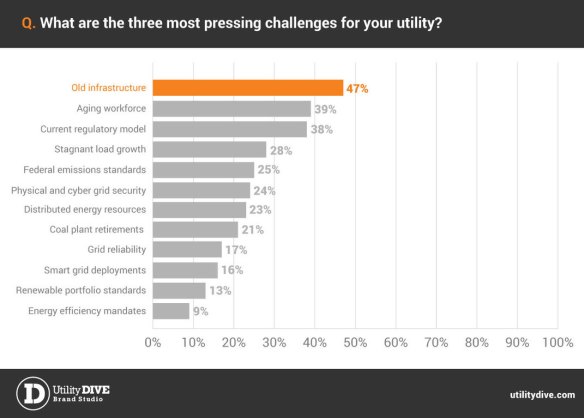
The State of the Electric Utility 2015 survey revealed that aging infrastructure is what troubles industry players most.

Source: www.utilitydive.com

>” Utility executives identified aging infrastructure as the number one challenge facing the electric industry, […] easily topping an aging workforce, regulatory models and stagnant load growth. In response, the industry is spending hundreds of billions to replace and upgrade infrastructure, rushing to meet consumer demand for higher quality power enabled by construction of a more modern grid.

“The last few years there’s been more of an emphasis on transmission and distribution, and the driver there has been the advent of all these new technologies that are trying to connect with the grid,” said Richard McMahon, Jr., vice president of energy supply and finance for the Edison Electric Institute, the electric utility trade organization. “There are also a lot of customer-driven desires utilities are trying to facilitate. There’s a lot of spending on metering automation, as well as at the distribution level, distribution transformers to accommodate distributed generation.”

Today’s grid may not be up to the task of reliably integrating high levels of renewables, distributed energy resources, and smart grid technologies, Utility Dive found. The American Society of Civil Engineers (ASCE) gave U.S. energy infrastructure a barely passing grade of D+ in 2013, at stark odds with the sophisticated grid management required by the rapid acceleration of utility-scale renewables, distributed resources and two-way devices.

“Distributed energy cannot be a profit center without the modernized grid infrastructure that’s needed for grid integration,” Utility Dive concluded in the report. […]

Outages on the rise

The American Society of Civil Engineers report that gave U.S. infrastructure a barely-passing grade pointed out that aging equipment “has resulted in an increasing number of intermittent power disruptions, as well as vulnerability to cyber attacks.”

Significant power outages rose to more than 300 in 2011, up from about 75 in 2007, and the report found many transmission and distribution outages have been attributed to system operations failures, though from 2007 to 2012 water was the primary cause of major outages.

“While 2011 had more weather-related events that disrupted power, overall there was a slightly improved performance from the previous years,” the report said. “Reliability issues are also emerging due to the complex process of rotating in new energy sources and ‘retiring’ older infrastructure.

ASCE said that for now, the United States has sufficient capacity to meet demands, but from 2011 through 2020 demand for electricity in all regions is expected to increase 8% or 9%. The report forecasts that the U.S. will add 108 GW of generation by 2016.

“After 2020, capacity expansion is forecast to be a greater problem, particularly with regard to generation, regardless of the energy resource mix,” the report said. “Excess capacity, known as planning reserve margin, is expected to decline in a majority of regions, and generation supply could dip below resource requirements by 2040 in every area except the Southwest without prudent investments.” […]”<

See on Scoop.itGreen & Sustainable News

Apple to Invest $2 Billion in Solar Farm Powered Data Center Renovation in Arizona

Apple plans to invest $2 billion to build a data center in Arizona in the location where its failed sapphire manufacturing facility exists, the state announced Monday.

Source: blogs.wsj.com

“> […] The company plans to employ 150 full-time Apple staff at the Mesa, Arizona, facility, which will serve as a command center for its global network of data centers. In addition to the investment for the data center, Apple plans to build a solar farm capable of producing 70-megawatts of energy to power the facility.

Apple’s investment is expected to create up to 500 construction jobs as well, the state said.

Apple said it expects to start construction in 2016 after GT Advanced Technologies Inc., the company’s sapphire manufacturing partner, clears out of the 1.3 million square foot site. The $2 billion investment is in addition to the $1 billion that Apple had earmarked to build scratch-resistant sapphire screens at the same location.

The investment comes a few months after GTAT filed for bankruptcy protection in October, citing problems with the Arizona facility. Shortly after its bankruptcy filing, GTAT said it planned to lay off more than 700 employees in Arizona.

In October 2013, Apple had agreed to build a sapphire factory in Mesa that GTAT was going to operate. At the time, Apple had said the new factory was going to create 2,000 jobs and move an important part of its supply chain to the U.S.

However, the project struggled to produce a consistent level of sapphire at the quality demanded by Apple. In the end, Apple did not use sapphire from the facility for its latest iPhones. After GTAT’s bankruptcy, Apple has said it was seeking ways to preserve the jobs lost at the Mesa facility.

Arizona’s governor said the state did not provide additional financial incentives to keep Apple in the state. For the original investment in 2013, Arizona provided $10 million to Apple to sweeten the deal for the company.”<

See on Scoop.itGreen & Sustainable News

North Dakota Bill Introduced to Minimize Natural Gas Waste from Oil Wells

North Dakota’s Senate is considering legislation that would drastically cut the time oil companies can burn off and waste natural gas from an oil well.

Source: www.pennenergy.com

>”[…] Democratic Sen. Connie Triplett is sponsoring the bill that would require companies to begin paying royalties and taxes on natural gas within 14 days after an oil well begins production. Companies are given a year at present.

Triplett and others told the Senate Energy and Natural Resources Committee on Friday that mineral owners and the state are being shortchanged because revenue on the wasted gas is not immediately being collected.

North Dakota Petroleum Council President Ron Ness says the industry has invested $13 billion to capture the gas. But he says there is still a challenge obtaining permission to place gas pipelines in some areas.”<


See on Scoop.itGreen & Sustainable News

Power plant closures quench demand for Pennsylvania’s coal

More than 100 coal-fired power plants nationwide either plan to shut down or already closed their doors in 2014, as the market responds to stricter environmental regulations, cheap natural gas and lackluster electricity demand growth, according to a survey done by the Energy Information Administration. Behind all those closures sit coal mines — many of them in Appalachia — coping with the loss of customers for the fuel that reigned supreme for many decades. Click the image above for a more detai

Source: powersource.post-gazette.com

>” […] More than 17 million tons of coal from Appalachia went to plants slated to shut down in 2013 alone, the latest full year for which such data are available. And the impact is likely to be even bigger, since the EIA’s list of recent or coming closures doesn’t include generators planning a transition from burning coal to burning natural gas.

Companies have been bracing for this change for years, but many have indicated that it’s coming faster and blunter than expected, driven in part by a slew of environmental regulations.

“That’s an unprecedented change to America’s power system in what constitutes the blink of an eye in energy markets — creating enormous potential for market disruptions, supply shortages and rate spikes,” Deck Slone, senior vice president of strategy and public policy at St. Louis-based Arch Coal, wrote in December.

Like its peers, Arch’s stock price reflects the gloom. At $1.30 per share, Tuesday’s closing price represented a one-year low. Virginia-based coal producer Alpha Natural Resources’ also saw its 52-week bottom at $1.13.  […]

Central Appalachian coal mines stand to be big losers in the transition away from coal, Mr. Cosgrove wrote in November. That includes the historically prolific supplies in Virginia, southern West Virginia and eastern Kentucky.

“Falling demand may hasten mine closings in the region, where coal production has dropped 32 percent since 2009,” he wrote.

Some companies have been bracing for the fall for years.  […]

Between 2012 and 2014, Alpha idled 64 mines, reduced its shipments in the eastern part of the country by 28 percent and got rid of more than 4,000 employees.  […]

The situation looks worse for suppliers such as Virginia-based James River Coal Co., which is in the middle of a restructuring, and Virginia-based James C. Justice Co., which has shed a significant portion of its mine portfolio in recent years. The producers stand to lose 28 percent and 48 percent of shipments, respectively, from mines serving affected plants.

For decades, contracts between coal companies and utilities have included force majeure clauses, according to Mr. Cardwell, who has reviewed hundreds of contracts and negotiated dozens during his 18-year tenure as a coal buyer for a Kentucky utility.

Such clauses typically protect power plants from having to take delivery of coal they no longer need if the power plant is prevented from running by some new environmental regulation or another unforeseen circumstance.

Yet lawsuits seem inevitable following current and projected mine closures. “I have a feeling that there’s going to be pretty significant litigation in the future,” Mr. Cardwell said.

One issue that may arise as power plants claim that environmental regulations pushed them out of business is how much of a role competition from cheap natural gas played in their decision either to shut down or use a different fuel.

Gas is all the rage at the moment. The commodity is trading at around $3 per million British thermal units, or Btus, down from more than $13 in the summer of 2008, towards the beginning of the shale revolution in Appalachia.

That’s why some operators, like Consol Energy, now boast flexibility in their contracts with utilities. Consol has refocused its company on a growing shale gas business, retaining only a handful of coal mines.

According to James McCaffrey, senior vice president of marketing at Consol, who spoke at Platts’ Coal Marketing Days in Downtown in September, “Customers want to flip between coal and gas.”

He said the company was actively negotiating a deal where a utility could choose its fuel depending on its preference.

“That’s a good marketing approach: ‘I’ll give you Btus, you tell me how you want them,’ ” Mr. Cardwell said. […]”<

See on Scoop.itGreen & Sustainable News

Michigan’s Consumers Energy to retire 9 coal plants by 2016

New EPA regulations are an opportunity to modernize the generating fleet, according to a Consumers Energy official.

Source: www.utilitydive.com

>”[…] Consumers Energy will shutter nine coal plants in Michigan as EPA air pollution regulations make them unprofitable to operate, MLive reports. And the Michigan utility won’t be the only one. A wave of coal retirements will roll across the Midwest by early 2016, shuttering more than 60 generating plants, a Consumers official told the “Greening of the Great Lakes” weekly radio program.In addition to the regulations under the Clean Power Plan and other EPA programs, Consumers says many of the nine coal plants were built in the 1950s and are simply at the end of their productive lives.  […]

Last year Consumers Energy announced it had selected AMEC to run the utility’s decommissioning program for the planned retirement of seven operating units at the utility’s three oldest coal-fired generating plants. Though there is still uncertainty over just what impact a slate of EPA regulations will have, Consumers last year said the power plants being decommissioned have an average operating life-span of more than 60 years and collectively represented approximately 950 MW of electric capacity.

The Supreme Court has agreed to hear a challenge to the EPA’s Mercury and Air Toxics Standard, but as it stands the regulations could apply to 1,400 generators at more than 600 of the nation’s largest power plants.

Federal regulators believe the tighter controls could prevent up to 11,000 premature deaths each year by limiting mercury, particulate matter, and other harmful pollutants it says are hazardous to public health.”<

See on Scoop.itGreen & Sustainable News

Leaked HSBC Files from Swiss Bank lead to Tax Evasion and Money Laundering charges

Data in massive cache of leaked secret bank account files lift lid on questionable practices at subsidiary of one of world’s biggest financial institutions

Source: www.theguardian.com

Video:  Guardian explains case against HSBC

>”[…]  The Guardian’s evidence of a pattern of misconduct at HSBC in Switzerland is supported by the outcome of recent court cases in the US and Europe. The bank was named in the US as a co-conspirator for handing over “bricks” of $100,000 a time to American surgeon Andrew Silva in Geneva, so that he could illegally post cash back to the US.

Another US client, Sanjay Sethi, pleaded guilty in 2013 to cheating the US tax authorities. He was one of a group of convicted HSBC clients. The prosecution said an HSBC banker promised “the undeclared account would allow [his] assets to grow tax-free, and bank secrecy laws in Switzerland would allow Sethi to conceal the existence of the account”.

In France, an HSBC manager, Nessim el-Maleh, was able to run a cash pipeline in which plastic bags full of currency from the sale of marijuana to immigrants in the Paris suburbs were collected. The cash was then taken round to HSBC’s respectable clients in the French capital. Bank accounts back in Switzerland were manipulated to reimburse the drug dealers.

HSBC is already facing criminal investigations and charges in France, Belgium, the US and Argentina as a result of the leak of the files, but no legal action has been taken against it in Britain.

Former tax inspector Richard Brooks tells BBC Panorama in a programme to be aired on Monday night: “I think they were a tax avoidance and tax evasion service. I think that’s what they were offering.

“There are very few reasons to have an offshore bank account, apart from just saving tax. There are some people who can use an … account to avoid tax legally. For others it’s just a way to keep money secret.”

The Labour party said: “Tax avoidance and evasion harms every taxpayer in Britain, and undermines public services like the NHS. What is truly shocking is that HMRC were made fully aware of these practices back in 2010 but since then very little has been done.””<

See on Scoop.itSocial Media, Crypto-Currency, Security & Finance

Facebook Traffic and Influence Jumps on Mobile Devices

Thanks to its efforts to slash ‘dark social’ links, Facebook’s measurable influence, especially on mobile, has skyrocketed.

Source: venturebeat.com

>”We all know Facebook is huge, and drives incredible amounts of traffic. But thanks to its recent efforts to uncloak the sources of content with no known referrer, we now know that the numbers are bigger than anyone believed.

According to a report issued today by Bitly, the world’s leading link shortener, Facebook has largely solved the problem of so-called “dark social” links — those that have no referrer data and can’t be measured by web analytics tools — and as a result, the social network’s influence skyrocketed during the fourth quarter.

In the report, Bitly wrote that Facebook’s influence jumped 8.6 percent during the fourth quarter overall and 30.2 percent on mobile. That doesn’t mean Facebook’s influence actually grew that much — it means that clicks formerly attributed to “dark social” are now being correctly counted as Facebook’s clicks. Given that Facebook’s major push in recent quarters has been to expand its reach on mobile and give its marketing partners more ways to monetize their content, this is solid evidence that strategy is working.

“Everybody knows Facebook is big, and everyone knows Facebook is driving a significant volume of traffic,” Bitly CEO Mark Josephson told VentureBeat. “But in Q4, they solved a significant part of dark social — traffic or referrers that marketers or publishers don’t know where it’s coming from. … Facebook is bigger than people think they are.”

Bitly’s in a position to know of what it speaks. The company shortens 600 million links a month that generate 8 billion clicks from a billion users worldwide. […]

But those radical drops in dark social links are reflected in Bitly’s latest data showing the strength of Facebook’s overall influence — and that its users are quickly moving from the desktop to mobile. While its influence on mobile exploded 30.2 percent, links coming from the Facebook on the desktop were down 19.8 percent in the fourth quarter.

Others have noticed similar drops in dark social links. Last month, Chartbeat, a service that measures web sites’ traffic, noted a substantial drop in links with no referrers, especially on mobile.

Last week, Facebook reported its fourth quarter earnings, and said that of its 1.39 billion monthly active users, 1.19 billion used the company’s mobile tools, up 26 percent from the same time a year ago. […]”<

More informati

See on Scoop.itSocial Media, Bitcoin & Finance

Hospital Retrofits Heating and Domestic-Hot-Water Systems For Substantial Energy Savings

At Holton Community Hospital in rural Holton, Kan., two cast-iron atmospheric boilers and three gas-fired water heaters that had been in place for nearly 20 years were operating inefficiently.

Source: hpac.com

>” […] Based on the boiler-plate outputs and firing rates of the existing boilers and domestic water heaters at design conditions and outputs, three Knight XL heating boilers with inputs of 500,000 Btuh, two 119-gal. Squire indirect water heaters, and a 119-gal. buffer tank were selected. […]

On one of the Knight XL heating boilers, a Grundfos MAGNA3 variable-speed circulator pump was installed. The boiler controls the speed of the pump using the built-in Smart System. When the boiler modulates down, the pump slows to maintain a constant temperature rise across the heat exchanger at all times. Reducing pump revolutions reduces power consumption tremendously.

Monitoring equipment was placed on both the lead boiler and the member boiler not dedicated to domestic water. The lead boiler had the MAGNA3 40-80 F variable-speed circulator pump, while the member boiler used the UPS 43-100 F constant-speed circulator pump.

For analysis, the team compared two similar days, March 20 and 21, at a time when only the two monitored boilers would be running. At that time, domestic water use would be unlikely, reducing the chance the third boiler would fire and affect the measured values.Figure 1 shows the power consumed by the constant-speed circulator and the variable-speed circulator when each was the lead.

Lochinvar Chart2_AMD

FIGURE 1. Pump power consumption.


Pump-speed modulation resulted in significant energy savings. The MAGNA3 reached a maximum power usage of 270 W, but slowed to a minimum of just over 50 W, while the UPS ran at a continuous 365 W. Over the course of the hour, the MAGNA3 averaged 156 W.

With Smart System, the boiler adjusts the flow through its heat exchanger to control delta-T as well as system median temperature. Delta-T across the boiler is constant, resulting in enhanced building comfort, increased heat transfer, and electricity savings.

In January 2014, Holton Community Hospital spent a total of $1,207.31 on gas and electricity. In comparison, the hospital’s gas and electricity bills for January 2013 were $2,805.41—more than twice as much. […]”<

See on Scoop.itGreen Building Operations – Systems & Controls, Maintenance & Commissioning

Renewable Energy Provides Half of New US Generating Capacity in 2014

According to the latest “Energy Infrastructure Update” report from the Federal Energy Regulatory Commission’s (FERC) Office of Energy Projects, renewable energy sources (i.e., biomass, geothermal, hydroelectric, solar, wind) provided nearly half (49.81 percent – 7,663 MW) of new electrical generation brought into service during 2014 while natural gas accounted for 48.65 percent (7,485 MW).


Image source:  http://usncre.org/

Source: www.renewableenergyworld.com

>” […] By comparison, in 2013, natural gas accounted for 46.44 percent (7,378 MW) of new electrical generating capacity while renewables accounted for 43.03 percent (6,837 MW). New renewable energy capacity in 2014 is 12.08 percent more than that added in 2013.

New wind energy facilities accounted for over a quarter (26.52 percent) of added capacity (4,080 MW) in 2014 while solar power provided 20.40% (3,139 MW). Other renewables — biomass (254 MW), hydropower (158 MW), and geothermal (32 MW) — accounted for an additional 2.89 percent.

For the year, just a single coal facility (106 MW) came on-line; nuclear power expanded by a mere 71MW due to a plant upgrade; and only 15 small “units” of oil, totaling 47 MW, were added.

Thus, new capacity from renewable energy sources in 2014 is 34 times that from coal, nuclear and oil combined — or 72 times that from coal, 108 times that from nuclear, and 163 times that from oil.

Renewable energy sources now account for 16.63 percent of total installed operating generating capacity in the U.S.: water – 8.42 percent, wind – 5.54 percent, biomass – 1.38 percent, solar – 0.96 percent, and geothermal steam – 0.33 percent.  Renewable energy capacity is now greater than that of nuclear (9.14 percent) and oil (3.94 percent) combined.

Note that generating capacity is not the same as actual generation. Generation per MW of capacity (i.e., capacity factor) for renewables is often lower than that for fossil fuels and nuclear power. According to the most recent data (i.e., as of November 2014) provided by the U.S. Energy Information Administration, actual net electrical generation from renewable energy sources now totals a bit more than 13.1 percent of total U.S. electrical production; however, this figure almost certainly understates renewables’ actual contribution significantly because EIA does not fully account for all electricity generated by distributed renewable energy sources (e.g., rooftop solar).

Can there any longer be doubt about the emerging trends in new U.S. electrical capacity? Coal, oil, and nuclear have become historical relics and it is now a race between renewable sources and natural gas with renewables taking the lead.”<

See on Scoop.itGreen & Sustainable News