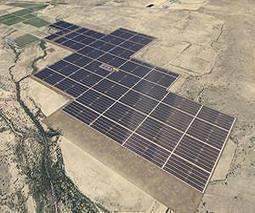
Bloomberg predicts: Solar to add more megawatts than wind in 2013

See on Scoop.itGreen Energy Technologies & Development
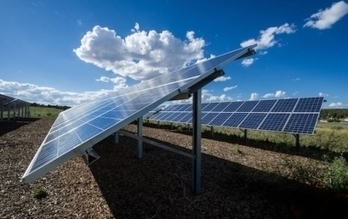
Bloomberg New Energy Finance predicts that for the first time more new solar power capacity — compared to wind — will be added to the world’s global energy infrastructure this year.

Duane Tilden‘s insight:

>In an BNEF’s analysts forecast 36.7GW of new photovoltaic capacity this year, compared to 33.8 GW of new onshore wind farms, and  1.7 GW of offshore wind.

In 2012, wind — onshore and offshore — added 46.6 GW, while PV added 30.5GW, record figures in both cases. But in 2013, a slowdown in the world’s two largest wind markets, China and the US, is opening the way for the rapidly growing PV market to overtake wind.

“The dramatic cost reductions in PV, combined with new incentive regimes in Japan and China, are making possible further, strong growth in volumes,” said Jenny Chase, head of solar analysis at Bloomberg New Energy Finance. “Europe is a declining market, because many countries there are rapidly moving away from incentives, but it will continue to see new PV capacity added.”<

See on www.renewableenergymagazine.com

Greening the Internet: Sustainable Web Design

See on Scoop.itTwitter & Social Media

Do you know your website’s carbon footprint? Or how to lower it?

Duane Tilden‘s insight:

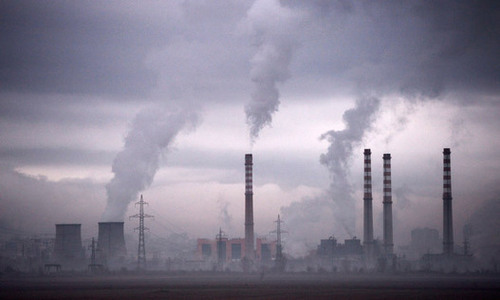
>A growing number of industries are trying to reduce or at least curtail carbon footprints and energy use. Emissions standards have been set for the automotive, construction, and even telecommunications industries. Yet the internet’s carbon footprint is growing out of control: a whopping 830 million tons of CO2 annually, which is bigger than that of the entire aviation industry. That amount is set to double by 2020.

It is time for web designers to join the cause.

Right now, at least 332 million tons of CO2—40 percent of the internet’s total footprint—falls at least partially under the responsibility of people who make the web. It needn’t be that large, but with our rotating carousels, high-res images, and more, we have been designing increasingly energy-demanding websites for years, […]<

See on alistapart.com

Algae Biofuel Emits at Least 50% Less Carbon than Petroleum Fuels

See on Scoop.itGreen Energy Technologies & Development

Algae-derived biofuel can reduce life cycle CO2 emissions by 50 to 70 percent compared to petroleum fuels, and is approaching a similar Energy Return on Investment (EROI) as conventional petroleum according to a new peer-reviewed paper published in…

Duane Tilden‘s insight:

>The study entitled Pilot-scale data provide enhanced estimates of the life cycle energy and emissions profile of algae biofuels produced via hydrothermal liquefaction (HTL) is the first to analyze data from a commercial-scale algae-to-energy farm. Researchers examined field data from Sapphire Energy facilities in Las Cruces and Columbus, New Mexico.

Researchers at the Pacific Northwest National Laboratory recently concluded that 14 percent of land in the continental United States, or the combined area of Texas and New Mexico, could be used to grow and produce algae for conversion into transportation fuels. In 2008, the U.S. Department of Energy found that for algae fuel to completely replace petroleum in the United States it would need roughly 30,000 square kilometers of land, or half the area of South Carolina, so the potential is certainly there for a massive transition from dirty oil-based transportation fuels to cleaner burning domestic green crude from algae.<


See on inhabitat.com

Robotic Technologies Applied to Solar Energy Market – Installation and Maintenance

See on Scoop.itGreen Building Design – Architecture & Engineering

Mountain View CA (SPX) Sep 20, 2013 – … robotic technologies deliver revolutionary installation and cleaning services at highly competitive prices … for building and maintenance of utility-scale solar plants..

Duane Tilden‘s insight:

>The typical installation process for utility-scale projects is similar to that of a small-scale, 20-panel, residential installation. Despite incremental improvements to the process, a 200,000-panel installation has retained many of the characteristics of a 20-panel installation.

They are both labor-intensive, and require repetitive bolt-tightening and glass-hauling. While these are minor flaws in a 20-panel system, they create significant inefficiencies in 20,000- or 200,000-panel systems.

Alion Energy has plugged the shortcomings of the current installation methods by changing the materials and design used in the mounting structure as well as by automating the installation. By combining robotic installation technology with established construction practices, Alion Energy has built a system twice as fast and 75 percent more labor-efficient that lowers solar electricity’s levelized cost of energy (LCOE) to compete with traditional energy sources.<

See on www.solardaily.com

Climate change & Global warming: IPCC issues warning to Governments

See on Scoop.itGreen & Sustainable News

Call to ‘stop dithering about fossil fuel cuts’ as expert panel warns entire globe is affected

Duane Tilden‘s insight:

>The scientists’ warning – the most comprehensive and convincing yet produced by climate scientists – comes at a time when growing numbers of people are doubting the reality of global warming. Last week, the UK Energy Research Centre (UKERC) published a survey showing that the proportion of British people who do not think the world’s climate is changing has almost quadrupled since 2005.

Asked if they thought Earth’s climate was changing, 5% of respondents said “no” in 2005, a figure that rose to 11% last year and reached 19% this year.

But as the IPCC report underlines, scientists are becoming more and more certain that climate change poses a real danger to the planet.

Many believe the disconnection between popular belief and scientific analysis has been engineered by “deniers” explicitly opposed to the lifestyle changes – including restrictions on fossil fuel burning – that might be introduced in the near future.

“There are attempts by some politicians and lobbyists to confuse and mislead the public about the scientific evidence that human activities are driving climate change and creating huge risks,” said Stern.

“But the public should be wary of those who claim they know for certain that unmanaged climate change would not be dangerous. For they are not only denying 200 years of strong scientific evidence – the overwhelming view of the world’s scientific academies and over 95% of scientific papers on the subject – but they are often harbouring vested interests or rigid ideologies as well.”

The report will be discussed this week by political leaders meeting in Stockholm. The study – the work of more than 200 scientists – outlines the physical changes that are likely to affect Earth’s climate this century.<

See on www.theguardian.com

India’s First LEED’s Green Building targets “Net Zero” with High Efficiency Solar Power

See on Scoop.itGreen Building Design – Architecture & Engineering

New Delhi, India (SPX) Sep 19, 2013 – SunPower has announced that Swadeshi Civil Infrastructure has completed the installation of a 930-kilowatt (kW) SunPower solar system on the rooftop of the Indira Paryavaran Bhavan building…

Duane Tilden‘s insight:

>The state-of-the art landmark will be India’s first net zero energy building. Its design emphasizes conservation featuring trees to reduce adverse environmental impact, adequate natural light and shaded landscaped areas to reduce ambient temperature.

The building is targeted to achieve Platinum from the Leadership in Energy and Environmental Design green building rating system, known as LEED INDIA. It also is expected to receive a five star Green Rating for Integrated Habitat Assessment from the rating system developed by the Energy and Resource Institute and supported by the Ministry of New and Renewable Energy, the nodal ministry of Indian government.<

See on www.solardaily.com

Global Warming – Paused or Peaked? – draft U.N. report

See on Scoop.itGreen & Sustainable News

OSLO (Reuters) – A “hiatus” in global warming so far this century is partly caused by natural variations in a chaotic climate and is unlikely to last, a draft United Nations report by leading climate scientists says.

Duane Tilden‘s insight:

>The fact that temperatures have risen more slowly in the past 15 years despite rising emissions of greenhouse gases has emboldened sceptics who challenge the evidence for man-made climate change and question the need for urgent action.

But the IPCC draft reports do not project any long-term respite. Instead, they forecast a resumption in the warming trend that is likely to cause ever more heatwaves, droughts, floods and rising sea levels. […]

“There are a number of explanations (for the hiatus), any one of which might be correct,” said professor Myles Allen of Oxford University, who contributed to the IPCC draft. “That is very different from saying:’We have no idea what’s going on’.”

The drafts say that a reduction in warming for 1998-2012 compared to 1951-2012 is “due in roughly equal measure” to natural variations in the climate and factors such as “volcanic eruptions and the downward phase of the current solar cycle.”<

See on news.yahoo.com

Energy from tides and currents: Arranging underwater Tidal Sails

See on Scoop.itGreen & Sustainable News

In the long sprint to find new sources of clean, low-cost power, slow and steady might win the race — the slow-moving water of currents and tides, that is.

Duane Tilden‘s insight:

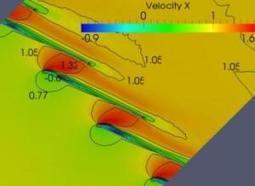
>The system, developed by a Norwegian company called Tidal Sails AS, consists of a string of submerged blades or sails, connected via wire ropes, angled into the oncoming current. The rushing current generates large lift forces in the sails, and as they are pushed along through a continuous loop, they drive a generator to produce electricity. […]

In their analysis, the researchers found that the maximum amount of power could be generated using blades with a chord length (the width of the blade at a given distance along its length) equal to the separation between each individual blade, that are positioned at about a 79 degree angle relative to the oncoming current, and that move at a speed about one and half times faster than the current.<

See on www.sciencedaily.com

Water Energy Nexus: A Literature Review

See on Scoop.itGreen Energy Technologies & Development

Water-Energy Nexus: A Literature Review provides readers with an overview and analysis of the policy, scientific and technical research on the connections between water and energy. This review is a comprehensive survey of the literature from the academic, government and nonprofit sectors, organized around the water and energy life cycles.  It examines research and policy from energy use across the water and wastewater sectors, as well as water across the various components of the energy sector.
See on waterinthewest.stanford.edu

Revisiting The North American Hydropower Opportunity

See on Scoop.itGreen Energy Technologies & Development

It is no secret that many renewable energy advocates are not in favor of large hydropower.

Duane Tilden‘s insight:

>[…] there exists a threat that is even more worrisome to endangered species, a threat that has the potential to cause destructive flooding and destroy ecosystems: climate change.  […]

Perhaps that’s why in May of this year, the World Bank reversed its stance on large-scale hydropower. Whereas the major international development bank was once a staunch opponent of large-scale hydro, recognition that developing regions like Africa and Southeast Asia desperately need power have forced it to reconsider.  The world needs energy to lift people out of poverty and building more fossil fuel-fired electricity plants will only serve to exacerbate the problems already associated with climate change. Hydropower is an answer.

Maybe it is time for the renewable energy industry to take a second look at hydropower development. The clean energy it can provide is a vast improvement over the dirty energy we get from fossil fuels. Hydropower already meets about 8 percent of U.S. electricity demand and with improved technologies that already exist the National Hydropower Association (NHA) estimates that we can double the amount of energy we get from hydropower without building any more dams.<

See on www.renewableenergyworld.com