World Record Solar Cell with 44.7 Percent Efficiency (news)

See on Scoop.itGreen Energy Technologies & Development

Freiburg, Germany – The Fraunhofer Institute for Solar Energy Systems ISE, Soitec, CEA-Leti and the Helmholtz Center Berlin jointly announced on late Monday having achieved a new world record for the conversion of sunlight into electricity using a new solar cell structure with four solar subcells. …

Duane Tilden‘s insight:

>These solar cells are used in concentrator photovoltaics (CPV), a technology which achieves more than twice the efficiency of conventional PV power plants in sun-rich locations. The terrestrial use of so-called III-V multi-junction solar cells, which originally came from space technology, has prevailed to realize highest efficiencies for the conversion of sunlight to electricity. In this multi-junction solar cell, several cells made out of different III-V semiconductor materials are stacked on top of each other. The single subcells absorb different wavelength ranges of the solar spectrum.<

See on renewable-energy-industry.com

Energy Management – Determining Load Factor to Maximize Control

See on Scoop.itGreen Building Operations – Systems & Controls, Maintenance & Commissioning

Understanding load factor is an important component to energy management and learning how to take control of your electricity use.

Duane Tilden‘s insight:

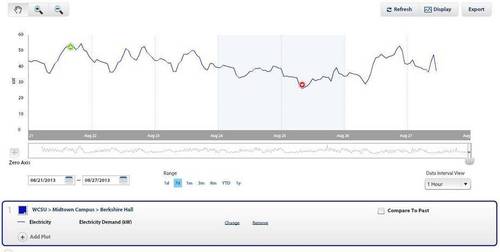
>Load factor is a ratio or percentage of the consistency of your electricity consumption – in other words, load factor is a way to answer the “how ‘spikey’ is your load?” question. The easiest way to understand your own load factor is by looking at your real-time energy data. Not only will your energy data indicate your load factor, but it will also highlight other important aspects of your electricity use over time that will enable you to make smarter energy management decisions.

While looking at your real-time energy data is the best way to accurately get your load factor, you can approximate it from your utility bill information. To manually find out your load factor, divide your total consumption (in kWh) by the number of hours in your billing period. Then, divide the result by your peak demand during the billing period, and the number you compute is your load factor. A load factor closer to 1, or 100%, indicates that you are using energy more evenly or consistently over time. It might also mean you are reducing your peak demand or otherwise avoiding spikes.<

See on energysmart.enernoc.com

Debunking the Renewables “Disinformation Campaign”

See on Scoop.itGreen & Sustainable News

Misleading coverage fuels policy uncertainty and doubt, reducing investment security and industry development. Disinformation hurts the industry and retards its—and our nation’s—progress

Duane Tilden‘s insight:

The Fox Business example is not a singular incident. Some mainstream media around the world have a tendency to publish misinformed or, worse, systematically and falsely negative stories about renewable energy. Some of those stories’ misinformation looks innocent, due to careless reporting, sloppy fact checking, and perpetuation of old myths. But other coverage walks, or crosses, the dangerous line of a disinformation campaign—a persistent pattern of coverage meant to undermine renewables’ strong market reality. This has become common enough in mainstream media that some researchers have focused their attention on this balance of accurate and positive coverage vs. inaccurate and negative coverage.

Tim Holmes, researcher for the U.K.’s Public Interest Research Centre (PIRC), points out press coverage is important because it can influence not only “what people perceive and believe” but also “what politicians think they believe.” […]

The disinformation campaign about job creation is not limited to Europe. A Cato Institute article claimed that if people believe a commitment to renewables will fuel job growth “we’re in a lot of trouble.” Yet in 2012 alone, more than 110,000 new U.S. clean-energy direct jobs were created, and in 2010, the U.S. had more jobs in the “clean economy” than in the fossil-fuel industries. The Bureau of Labor Statistics reportsthat direct employment in May 2012 totaled 181,580 for oil and gas extraction, 87,520 for coal mining, and 93,200 for iron and steel production. BLS doesn’t similarly classify solar or wind jobs, but reputable analysts have determined from bottom-up industry surveys that in September 2012, for example, the U.S. had 119,016 direct solar jobs (89 percent full-time, the rest at least half-time), up 27 percent in two years—more than in steel-making or coal-mining. Had you heard that before? Why not?

THE COST OF DISINFORMATION

The sad truth is that the debate on clean and renewable energy is unbalanced, and seldom by accident. The CCGroup’s study showed that only 10 percent of articles focusing on renewables even contained comment from a spokesperson from the renewable energy industry. This violates basic journalistic standards. Renewables must be a part of their own conversation. Much of the conversation on renewables is misinformed and misrepresented. And when bad news does happen, says ACORE president and retired U.S. Navy Vice Admiral Dennis McGinn, opponents of renewables are pushing it “as if it’s the only news. They are dominating the conversation through misrepresentation, exaggeration, distraction, and millions of dollars in lobbying and advertising.”<

See on blog.rmi.org

Creating Value: Energy Retrofits for Buildings

See on Scoop.itGreen & Sustainable News

Buildings in the U.S. consume[…] 42 percent of the nation’s primary energy and 72 percent of its electricity. Much of that energy is needlessly wasted through inefficient design and operation.

Duane Tilden‘s insight:

>Rather than examine energy costs in isolation, our approach assesses how energy and sustainability improvements add value to all parts of a property or company. This approach is not revolutionary, but rather more comprehensive, applying industry-accepted valuation methods to the full set of retrofit value contributions, including saved energy costs, health and productivity benefits, reputation and leadership, and risk reduction.

Energy investment (and resultant property outcomes) should be treated as one of many factors that influence value, including location, tenant mix, quality of design, and more. Evaluating retrofits within the broader context of property/company value enables a logical, defensible calculation and assessment of a deep retrofit’s relative contribution to value. Previous attempts to value energy retrofits have ignored retrofits’ value contributions and overlooked standard approaches to valuing properties and companies.<

See on www.rmi.org

Net Metering And Rooftop Solar For The Utility Of The Future

See on Scoop.itGreen Energy Technologies & Development

Net metering makes small-scale renewable energy, such as rooftop solar panels, more affordable by crediting the “distributed generation” owners for the excess energy they produce.

Duane Tilden‘s insight:

>Why the new focus on net metering?  The cost for rooftop solar panels has fallen 80% since 2008, including 20% in 2012 alone.  Installed rooftop solar energy has increased by 900% between 2000 and 2011.  As consumers install more rooftop solar panels and net meter them, utility revenues will decrease.

Net metering policies vary from state-to-state, including the amount of the payback for excess energy.  The most favorable policy for distributed generation owners is an excess energy credit equal to the full retail energy rate consumers pay for energy, i.e. the amount consumers are charged for using energy.  Most states use this measure.  However, utilities claim this prevents them from recovering their full costs and overpays distributed generation owners, unfairly shifting costs to other consumers.  Utilities say the credit should be equal to the utilities’ wholesale energy cost at the time of day when excess energy flows back to the grid.

Despite attempts by utilities to change net metering policies, state regulators are keeping these policies intact.  Earlier this month, the Idaho Public Utilities Commission rejected Idaho Power’s request to pay less than the full retail rate and to impose higher charges on net metering consumers.  Last month, the Louisiana Public Service Commission rejected similar requests by Louisiana utilities.  More recently, Arizona Public Service Company raised the issue in a ne[…]<

See on blogs.edf.org

Fluorescent Dye Boosts Solar Cell Efficiency by a Whopping 38 Percent

See on Scoop.itGreen Energy Technologies & Development

Squaraine dye helps to improve light absorption, recycle electron and enhance the light to energy conversion in solar cells, increasing efficiency by a whopping 38 percent.

Duane Tilden‘s insight:

>The Yale researchers relied on Förster resonance energy transfer (FRET), a well-known biochemical mechanism, to achieve this radical new energy conversion rate.

“In this type of solar cell—FRET-based heterojunction polymer solar cells—extra energy is able to migrate from one molecule to another over long distances. The dye, which is highly absorbent in the near-infrared region, both broadens the spectral absorption of solar cells and enhances electricity transmission,” Physorg explains.<

See on inhabitat.com

KW17 | IHS: Solar PV energy storage market to grow to USD 19 billion in 2017 – SolarServer

See on Scoop.itGreen Energy Technologies & Development

IHS Inc. (Englewood, Colorado, US) has released a new report which predicts that the market for energy storage to accompany solar photovoltaic (PV) generation will grow more than 100% annually to 7 GW in 2017, representing USD 19 billion in value.

Duane Tilden‘s insight:

Due to the energy storage subsidy, IHS expects Germany to play a leading role, as it did in the larger PV industry. The company predicts that 70% of installed storage in 2013 will be located in Germany.

IHS expects that if the program proves successful, other nations will pass similar subsidies. …

Market for storage with utility-scale PV as well

IHS also expects that storage will be used in larger PV systems, as connection requirements for PV become increasingly demanding. The company forecasts that utility-scale PV with storage will grow to more than 2 GW annually by 2017, led by Asia and the Americas.

See on www.solarserver.com

International Battery and Energy Storage Alliance Founded – Solar Novus Today

See on Scoop.itGreen Energy Technologies & Development

IPVEA and EuPD Research form International Battery and Energy Storage Alliance

Duane Tilden‘s insight:

The newly founded alliance plans to support and enable cooperation between companies from the fields of solar energy production, electrical energy storage and smart grid technologies. Together, the members of the International Battery and Energy Storage Alliance (IBESA) will create access to professional resources, market intelligence, new networks, and emerging markets. Over 70 members of the International PV Equipment Association (IPVEA) will immediately benefit from this strong partnership.

Alongside companies in the photovoltaic, battery and solar storage sectors, IBESA is also a valuable partner for energy providers, municipal utilities, installers, consulting firms and banks. …

Interested companies can contact the International Battery and Energy Storage Alliance directly in order to become members.

See on www.solarnovus.com

And now, for printed energy storage – with solar : Renew Economy

See on Scoop.itGreen Building Design – Architecture & Engineering

Australia’s Dyesol teams up with a developer of printed energy storage technology to create self-powering indoor devices.

Duane Tilden‘s insight:

Australian solar dye technology develop DyeSol and created a new venture with Singapore based Printed Power to develop combined energy generation and printed energy storage devices designed for the commercial building market.

See on reneweconomy.com.au

California’s Secret To Green Jobs And A Thriving Clean Economy? It’s Policy.

See on Scoop.itGreen & Sustainable News

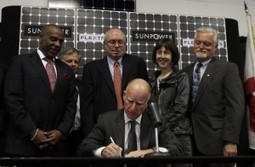
Gov. Jerry Brown signs bill requiring California utilities to get a third of their power from renewable sources, the country’s most aggressive clean energy standard (AP Photo)

Duane Tilden‘s insight:

Green jobs are growing four times faster than the rate of all other jobs nationwide, with the majority happening in California according to the Bureau of Labor Statistics. EDF’s analysis of California’s clean economy finds that jobs in core sectors like energy efficiency, renewable energy, clean transportation, and advanced storage and materials have not only remained resilient during the worst of the Great Recession (2008-2010), they outpaced all other job growth and grew 109 percent from 1995 to 2010.

Green jobs are also good jobs in California. They are diverse, across a wide range of education-level and skills, and almost half of all jobs in the clean economy don’t require a college degree according to the Brookings Institution. On average, green jobs offer a higher median wage and career advancement opportunities. An analysis by Philip Romero, the former Dean of CSU Los Angeles College of Business and Economics finds that “workers command wages with a 50-to-100 percent premium over the average job,” and estimates that the overall clean economy will grow “by at least 60-to-100 percent” by the late 2030’s.

See on thinkprogress.org