Virtual Energy Audits: The Next Big Thing in Buildings?

See on Scoop.itGreen Building Operations – Systems & Controls, Maintenance & Commissioning

Virtual energy audits use software to collect meter data, weather information, etc. and algorithms to develop energy efficiency recommendations.

Duane Tilden‘s insight:

>The goal of any energy audit is to identify savings by analyzing data, determining how and where a building is using energy, and then providing operational and capital energy efficiency measures that improve overall performance.

A traditional ASHRAE Level II Audit includes a manual inspection of data related to a facility’s Building Envelope, Lighting, Heating, Ventilation, and Air Conditioning (HVAC), Domestic Hot Water (DHW), Plug Loads, and Compressed Air and Process Uses (for manufacturing, service, or processing facilities). Analysis is conducted to quantify baseloads and account for seasonal variation. A Level II Audit will also include an evaluation of lighting, air quality, temperature, ventilation, humidity, and other conditions that may affect energy performance and occupant comfort. The process also includes detailed discussions with the building owners, managers, and tenants – there is a lot you can learn just by talking to people about what they think is working and not, what the financial objectives of the organization are, and how that should feed into the recommendations.  […]

Ok, I get it: So what’s a virtual energy audit?

Essentially a virtual energy audit is much like a traditional audit: the goal is to synthesize a whole bunch of data and come up with a list of recommendations that are going to deliver you the biggest bang for your buck. Unlike a detailed ASHRAE Level II audit, it’s better to think of virtual audits as delivering against the 80/20 rule. For a lot less physical effort, it’s going to get you about 80% of the detailed insights that a traditional ASHRAE Level II energy audit would deliver. And for many organizations, that’s OK – because their biggest, most obvious energy hogs are the ones driving the biggest bills at the end of the month.<

See on energysmart.enernoc.com
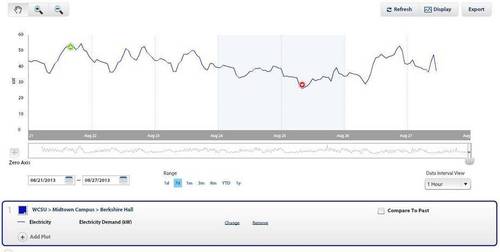
Monitoring Motivates Less Electricity Use

See on Scoop.itGreen & Sustainable News

Researchers found that families that were simply told they were in a study to track electricity use reduced electricity use more than 2.5 percent.

Duane Tilden‘s insight:

>The general phenomenon is called the Hawthorne effect: study subjects change their behavior because they’re being observed. So researchers collaborated with a utility to test for the Hawthorne effect in electricity use.

They monitored almost 5,600 randomly selected households. Half received a postcard saying that their energy use would be monitored for a month for research purposes. They also got four follow-up reminder postcards over the month. They received no other information, instructions or incentives.

The control group monitored for the study got no notifications. That group continued using the same amount of electricity. But the families being tracked reduced energy use 2.7 percent. And when the study period ended, their energy use shot back up. The report is in the Proceedings of the National Academy of Sciences. [Daniel Schwartz et al., The Hawthorne effect and energy awareness]<

See on www.scientificamerican.com

Energy Management – Determining Load Factor to Maximize Control

See on Scoop.itGreen Building Operations – Systems & Controls, Maintenance & Commissioning

Understanding load factor is an important component to energy management and learning how to take control of your electricity use.

Duane Tilden‘s insight:

>Load factor is a ratio or percentage of the consistency of your electricity consumption – in other words, load factor is a way to answer the “how ‘spikey’ is your load?” question. The easiest way to understand your own load factor is by looking at your real-time energy data. Not only will your energy data indicate your load factor, but it will also highlight other important aspects of your electricity use over time that will enable you to make smarter energy management decisions.

While looking at your real-time energy data is the best way to accurately get your load factor, you can approximate it from your utility bill information. To manually find out your load factor, divide your total consumption (in kWh) by the number of hours in your billing period. Then, divide the result by your peak demand during the billing period, and the number you compute is your load factor. A load factor closer to 1, or 100%, indicates that you are using energy more evenly or consistently over time. It might also mean you are reducing your peak demand or otherwise avoiding spikes.<

See on energysmart.enernoc.com

Detroit Completes One of Nation’s Largest LED Parking Garage Retrofits – WSJ.com

See on Scoop.itGreen Building Design – Architecture & Engineering
Sixty-one Acres of LED Lighting will reduce garage energy-use by 80 percent; Entire property by 7 percent

Duane Tilden‘s insight:

>LED technology is one of the highest performing, currently available methods of lighting. Energy savings of 50 to 80 percent are common when compared to the lamps that are typically used in garages. LED lamps also have much longer operating lives, resulting in fewer materials and transportation resources needed over time. The MGM Grand Detroit LED retrofit, will save enough electricity to power more than 350 average homes per year. […]

Earlier this year, the company initiated a program to install 1,600 induction technology lighting fixtures covering 160 acres of open lot parking area at its resorts in Las Vegas. These lamps are ideal for the hot Las Vegas climate and will have an operating life of up to 20 years. An estimated 2.7 million kWh will be saved annually following the project’s completion.

Additionally, MGM Resorts recently announced the planned installation of one of the largest rooftop solar photovoltaic arrays in the world at the Mandalay Bay Resort Convention Center. The 6.2-megawatt installation will be MGM Resorts’ first commercial solar project in the United States and will generate enough electricity to power the equivalent of 1,000 homes.<

See on online.wsj.com

Industrial Energy Management – Contolling Demand & Energy Usage

See on Scoop.itGreen Energy Technologies & Development

Demand-control technology supports multiple approaches for taming energy costs without sacrificing production efficiency.

Duane Tilden‘s insight:

>Navigant Research argues that efficient energy management will soon be as important as product quality in determining manufacturers’ competitive position within their respective industries. That importance, according to Navigant, is reflected in the compound annual growth rate for industrial energy management software and services.

At its current growth rate, the global market for industrial energy management solutions will nearly double over the next 7 years, going from $11.3 billion in 2013 to $22.4 billion in 2020… <

See on www.plantengineering.com

Debunking the Renewables “Disinformation Campaign”

See on Scoop.itGreen & Sustainable News

Misleading coverage fuels policy uncertainty and doubt, reducing investment security and industry development. Disinformation hurts the industry and retards its—and our nation’s—progress

Duane Tilden‘s insight:

The Fox Business example is not a singular incident. Some mainstream media around the world have a tendency to publish misinformed or, worse, systematically and falsely negative stories about renewable energy. Some of those stories’ misinformation looks innocent, due to careless reporting, sloppy fact checking, and perpetuation of old myths. But other coverage walks, or crosses, the dangerous line of a disinformation campaign—a persistent pattern of coverage meant to undermine renewables’ strong market reality. This has become common enough in mainstream media that some researchers have focused their attention on this balance of accurate and positive coverage vs. inaccurate and negative coverage.

Tim Holmes, researcher for the U.K.’s Public Interest Research Centre (PIRC), points out press coverage is important because it can influence not only “what people perceive and believe” but also “what politicians think they believe.” […]

The disinformation campaign about job creation is not limited to Europe. A Cato Institute article claimed that if people believe a commitment to renewables will fuel job growth “we’re in a lot of trouble.” Yet in 2012 alone, more than 110,000 new U.S. clean-energy direct jobs were created, and in 2010, the U.S. had more jobs in the “clean economy” than in the fossil-fuel industries. The Bureau of Labor Statistics reportsthat direct employment in May 2012 totaled 181,580 for oil and gas extraction, 87,520 for coal mining, and 93,200 for iron and steel production. BLS doesn’t similarly classify solar or wind jobs, but reputable analysts have determined from bottom-up industry surveys that in September 2012, for example, the U.S. had 119,016 direct solar jobs (89 percent full-time, the rest at least half-time), up 27 percent in two years—more than in steel-making or coal-mining. Had you heard that before? Why not?

THE COST OF DISINFORMATION

The sad truth is that the debate on clean and renewable energy is unbalanced, and seldom by accident. The CCGroup’s study showed that only 10 percent of articles focusing on renewables even contained comment from a spokesperson from the renewable energy industry. This violates basic journalistic standards. Renewables must be a part of their own conversation. Much of the conversation on renewables is misinformed and misrepresented. And when bad news does happen, says ACORE president and retired U.S. Navy Vice Admiral Dennis McGinn, opponents of renewables are pushing it “as if it’s the only news. They are dominating the conversation through misrepresentation, exaggeration, distraction, and millions of dollars in lobbying and advertising.”<

See on blog.rmi.org

Creating Value: Energy Retrofits for Buildings

See on Scoop.itGreen & Sustainable News

Buildings in the U.S. consume[…] 42 percent of the nation’s primary energy and 72 percent of its electricity. Much of that energy is needlessly wasted through inefficient design and operation.

Duane Tilden‘s insight:

>Rather than examine energy costs in isolation, our approach assesses how energy and sustainability improvements add value to all parts of a property or company. This approach is not revolutionary, but rather more comprehensive, applying industry-accepted valuation methods to the full set of retrofit value contributions, including saved energy costs, health and productivity benefits, reputation and leadership, and risk reduction.

Energy investment (and resultant property outcomes) should be treated as one of many factors that influence value, including location, tenant mix, quality of design, and more. Evaluating retrofits within the broader context of property/company value enables a logical, defensible calculation and assessment of a deep retrofit’s relative contribution to value. Previous attempts to value energy retrofits have ignored retrofits’ value contributions and overlooked standard approaches to valuing properties and companies.<

See on www.rmi.org

Smart Grid: Utility sued due to Smart Meter opt-out program

See on Scoop.itGreen Energy Technologies & Development

Smart Grid – BC Hydro offered customers who didn’t want to participate in its smart meter program the choice of opting out in mid-July. But that didn’t protect the utility from a lawsuit

Duane Tilden‘s insight:

>Just days after BC Hydro finally agreed to an opt-out program for smart meters, a customer is suing the utility for installing a smart meter last year even though she didn’t want one on her property. […]

The suit claims the installations caused the plaintiff “emotional distress,” because it “interfered with the quiet enjoyment of her property,” which she used to host yoga and meditation retreats. Opponents of smart meters believe the devices’ radio waves have health risks. The lawsuit further alleges that BC Hydro unlawfully leveraged its monopoly powers by imposing a smart meter on the plaintiff.

[…] The utility says that smart meters only broadcast several times a day, and that living next to a smart meter for 20 years would expose a resident to the same level of radiation as a 30-minute cell phone call.<

See on www.smartgridnews.com

Integration: Net-zero energy design | Consulting-Specifying Engineer

See on Scoop.itGreen Building Design – Architecture & Engineering

-ASHRAE has a goal: net-zero energy for all new buildings by 2030. What do engineers need to know to achieve this goal on their projects?

Duane Tilden‘s insight:

>As net-zero energy and low-energy design projects become more prevalent, engineers must be prepared to collaborate with all members of a project team including architects, energy specialists, lighting designers, builders, and owners in order to accomplish net-zero energy goals with little to no cost premium. Is this possible today or will it take another 10 or more years to get there?

There are many examples of completed projects demonstrating that not only is this possible, but it has been done in all regions of the country using readily available building products and common construction methods. So what’s the secret? It’s all about the design.<

See on www.csemag.com

UK Shopping Centre goes zero Waste to landfill in a year

See on Scoop.itGreen & Sustainable News

As a new member of the National Recycling Star scheme, Clifton Down Shopping Centre received the Gold award for its recycling and waste management efforts and in recognition of its success in diverting all of its waste from landfill.

Duane Tilden‘s insight:

>The transformation in the centre’s waste management began with a full site audit to identify areas of poor practise within both its waste management and energy efficiency operations.  […]

As the shopping centre began to look at improving its waste management plan, it asked its tenants to start flat packing their waste cardboard, so it can be sent to the centre’s onsite compactor. Pre-flat packing waste cardboard has allowed the centre to double the amount of cardboard that can be collected by its waste contractor Smiths, while saving space in the services yard. This has cut the number of collections required, helping to save fuel consumption and CO2 emissions. All general waste produced by the shopping centre is sent to New Earth Solution’s mechanical biological treatment (MBT) facility at Avonmouth.

Clifton Down Shopping Centre has also been working to reduce its environmental impact by tackling its energy efficiency. New LED light fittings have been installed throughout the shopping centre, significantly reducing energy consumption and cost. The centre previously used old halogen lighting which consumed 14,994kW per annum, compared with the replacement LED lighting which consumes 2,998kW – an 80 per cent reduction. […]

The centre has also installed seasonal sensitive automatic doors at both entrances. These are programmed to close more quickly during winter months to minimise heat lose. This is switched during summer with doors remaining open for longer, allowing for cooler air to circulate the building. New electricity, water and gas monitors have been installed throughout the centre to measure consumption and identify areas of potential savings.<

See on www.e2bpulse.com