Waste to Energy – Incinerator Operations threaten Community recycling programs

See on Scoop.itGreen Building Design – Architecture & Engineering
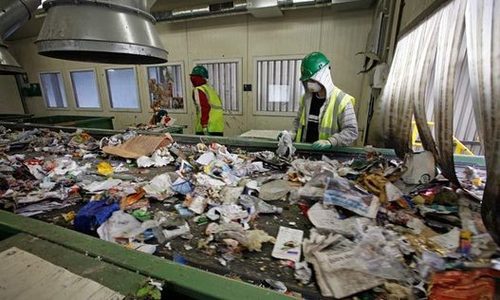
Rise in number of plants burning waste may be disincentive to greener methods of disposal

Duane Tilden‘s insight:

>Experts said the use of incinerators had consequences for recycling as local authorities were forced to divert waste to feed the plants. “The choice to invest in thermal treatment can hold back recycling efforts,” Adam Baddeley, principal consultant at Eunomia, said. “At one level, the money invested in such plant simply isn’t available to put into building recycling plants or collection infrastructure. And once you’ve built an incinerator or gasifier, there’s a strong incentive to keep it fed with waste, even if that means keeping on collecting as ‘black bag’ rubbish, material that would be economically practicable to collect separately for recycling.”

Charmian Larke, technical adviser for Cornwall Waste Forum, which unsuccessfully opposed a large incinerator in the south-west, questioned the planning process that resulted in incinerators being approved. “Some of them [planning officers] have spent their entire careers trying to get this incinerator so they are wedded to the idea,” Larke said. “But if the council members understood how bad these contracts were, the officers would lose their jobs.”

Larke claimed that many of the incinerators were built in poorer areas. “There’s a feeling that people who are downtrodden have a harder time getting their act together to object, and hence it’s easier to place nasty things next to them.”<

See on www.theguardian.com

Drilling Companies Cheating Landowners and Government Out of Royalty Payments

See on Scoop.itGreen & Sustainable News

Don Feusner ran dairy cattle on his 370-acre slice of northern Pennsylvania until he could no longer turn a profit by farming.

Duane Tilden‘s insight:

>Like every landowner who signs a lease agreement to allow a drilling company to take resources off his land, Feusner is owed a cut of what is produced, called a royalty.

In 1982, in a landmark effort to keep people from being fleeced by the oil industry, the federal government passed a law establishing that royalty payments to landowners would be no less than 12.5 percent of the oil and gas sales from their leases.

From Pennsylvania to North Dakota, a powerful argument for allowing extensive new drilling has been that royalty payments would enrich local landowners, lifting the economies of heartland and rural America. The boom was also supposed to fill the government’s coffers, since roughly 30 percent of the nation’s drilling takes place on federal land.

Over the last decade, an untold number of leases were signed, and hundreds of thousands of wells have been sunk into new energy deposits across the country.

But manipulation of costs and other data by oil companies is keeping billions of dollars in royalties out of the hands of private and government landholders, an investigation by ProPublica has found.

An analysis of lease agreements, government documents and thousands of pages of court records shows that such underpayments are widespread. Thousands of landowners like Feusner are receiving far less than they expected based on the sales value of gas or oil produced on their property. In some cases, they are being paid virtually nothing at all.

In many cases, lawyers and auditors who specialize in production accounting tell ProPublica energy companies are using complex accounting and business arrangements to skim profits off the sale of resources and increase the expenses charged to landowners.<

See on insideclimatenews.org

MHI Completes Acquisition of Pratt & Whitney Power Systems

See on Scoop.itGreen Energy Technologies & Development

Tokyo, May 20, 2013 – Mitsubishi Heavy Industries, Ltd. (MHI) has completed its acquisition of Pratt & Whitney Power Systems, the small and medium-size gas turbine business unit of Pratt & Whitney (P&W), an aeroengine manufacturer.

Duane Tilden‘s insight:

>MHI has traditionally focused its gas turbine business on large-capacity, high-efficiency systems. With the addition of PWPS’s small and medium-size aero-derivative engines, MHI has expanded its power generation product portfolio and is able to offer customers a full product lineup.

PWPS’s aero-derivative gas turbines are highly acclaimed, especially for their emergency power generation applications, compact design, and rapid start-up time. More than 1,700 aero-derivative turbines have been delivered worldwide. Significant growth is anticipated in applications that require a flexible power source complementary to a renewable-energy power source. Robust market demand is also expected as small power sources for applications in emerging markets. PWPS’s main product has been the 30MW (megawatt) class machine. The company is developing an innovative 60MW class model, which is expected to significantly boost PWPS’s market share.

Turboden’s ORC turbines have the capability to generate power or supply hot water using a relatively low-temperature heat source such as biomass, factory waste heat or geothermal energy. The company has sold more than 300 units in 20 countries, primarily in Europe. In Japan, increasing opportunities are emerging to use ORC technology in biomass and geothermal applications, and MHI plans to significantly increase sales in those expanding markets.

MHI and P&W have been in a collaborative relationship in aeroengine production for many years. After the acquisition of PWPS, MHI will continue to collaborate with P&W in the supply of engine parts for gas turbines and development of new machines.<

See on www.mhi.co.jp

Energy Efficiency Methods in the Cement industry – Part 1: Organic Rankine Cycle

See on Scoop.itGreen Energy Technologies & Development

Thomas B. Gibbons takes a look at the Conventional Rankine Cycle’s application in the cement sector

Duane Tilden‘s insight:

>The first major waste heat recovery (WHR) system in a cement plant was the 15 MW unit installed by Kawasaki Heavy Industries for Taiheiyo Cement in 1982. This was a conventional Rankine Cycle using heat from both the kiln and the clinker cooler. As the benefits became generally recognised within the industry, WHR units, the vast majority of which involved the conventional Rankine Cycle, were installed to provide up to about 30% of the power requirements of the plant. The main sources of waste heat were the exhaust from both the preheater and the clinker cooler and, in some of the developing countries where power outages are not unusual, the WHR system may be the only source of reliable power available to the plant operator.

Improvement in the overall efficiency of cement manufacture has resulted in lower exhaust gas temperatures and this development has provided opportunities for alternative technologies, notably the Organic Rankine Cycle (ORC) and the Kalina Cycle, which are more effective in recovering waste heat from lower temperature gases.<

See on www.worldcement.com

Applied Thermodynamics: Organic Rankine cycle – Wikipedia

See on Scoop.itGreen Energy Technologies & Development

Duane Tilden‘s insight:

We have all seen the Rankine Cycle engine, most typically as the inefficient steam locomotive.  The modern efficient designs use turbines to convert heat energy from two reservoirs of different temperatures to mechanical energy.

The Organic Rankine Cycle engine uses a fluid – vapor phase change other than water/steam and a wide range of compounds are available including proprietory mixtures.  These mixtures allow for the conversion to mechanical energy in a wide range of applications and temperatures.  Two such applications would be waste heat to energy and geothermal energy systems.

See on en.wikipedia.org

Hot Rocks: Canada Sits Atop Massive Geothermal Resource – Renewable Energy

See on Scoop.itGreen & Sustainable News

September 2011 Report by the Geological Survey of Canada suggests 100 projects could provide much of the country’s power needs…

Duane Tilden‘s insight:

“Canada’s in-place geothermal power exceeds one million times Canada’s current electrical consumption,” the report notes, though also stating most of that available power could not actually be produced. “Environmental impacts of geothermal development are relatively minor compared to other energy developments, however there are still key issues to be addressed….Geothermal installations have the potential to displace other more costly and environmentally damaging technologies.”

There is at least 5000 megawatts of available geothermal power in various parts of British Columbia, Alberta, and the Yukon. What’s more, the report’s authors write, the cost of delivering geothermal power is expected to rival the costs of coal within 15 years or so. The limitations of developing the huge geothermal resource have a lot to do with location: Some of the most promising areas are far away from load centers, and the costs of developing huge transmission corridors to bring the power to where it is needed would make such projects unfeasible. Still, there is enough located in accessible areas to make a big difference.

See on spectrum.ieee.org

Lockheed Martin Pioneers Ocean Thermal Energy in China – Engineers

See on Scoop.itGreen Energy Technologies & Development

A 10-megawatt ocean thermal energy conversion plant is under way

Duane Tilden‘s insight:

>[…] the company has been working on OTEC since the 1970s, and the technology hasn’t changed drastically since then. OTEC systems make use of the temperature differential in tropical areas between warm surface water and cold deep water. In most systems, ammonia, which has a very low boiling point, passes through a heat exchanger containing the warm water. The ammonia is vaporized and used to turn a turbine, and then it’s cycled past the cold water to recondense. This is a renewable energy technology with the rare capacity to supply base-load power, as water temperatures are fairly stable.

The ammonia passes through a closed loop, while the water comes and goes through massive pipes. The project in China may pump cold water up from a depth of about 1000 meters, using a pipe that’s 4 meters across. Varley says that some of the infrastructure can be borrowed from the offshore drilling industry: “We showed them our requirements for the platform, and they yawned and said, ‘Is that all you got?’ ” he says. “But then we showed them the pipe.” Attaching the massive pipe to a relatively small floating platform creates unusual stresses, Varley says. Lockheed also had to find materials for the pipes and the heat exchangers that could withstand the harsh marine environment.<

See on spectrum.ieee.org

Industrial Energy Management – Contolling Demand & Energy Usage

See on Scoop.itGreen Energy Technologies & Development

Demand-control technology supports multiple approaches for taming energy costs without sacrificing production efficiency.

Duane Tilden‘s insight:

>Navigant Research argues that efficient energy management will soon be as important as product quality in determining manufacturers’ competitive position within their respective industries. That importance, according to Navigant, is reflected in the compound annual growth rate for industrial energy management software and services.

At its current growth rate, the global market for industrial energy management solutions will nearly double over the next 7 years, going from $11.3 billion in 2013 to $22.4 billion in 2020… <

See on www.plantengineering.com

Debunking the Renewables “Disinformation Campaign”

See on Scoop.itGreen & Sustainable News

Misleading coverage fuels policy uncertainty and doubt, reducing investment security and industry development. Disinformation hurts the industry and retards its—and our nation’s—progress

Duane Tilden‘s insight:

The Fox Business example is not a singular incident. Some mainstream media around the world have a tendency to publish misinformed or, worse, systematically and falsely negative stories about renewable energy. Some of those stories’ misinformation looks innocent, due to careless reporting, sloppy fact checking, and perpetuation of old myths. But other coverage walks, or crosses, the dangerous line of a disinformation campaign—a persistent pattern of coverage meant to undermine renewables’ strong market reality. This has become common enough in mainstream media that some researchers have focused their attention on this balance of accurate and positive coverage vs. inaccurate and negative coverage.

Tim Holmes, researcher for the U.K.’s Public Interest Research Centre (PIRC), points out press coverage is important because it can influence not only “what people perceive and believe” but also “what politicians think they believe.” […]

The disinformation campaign about job creation is not limited to Europe. A Cato Institute article claimed that if people believe a commitment to renewables will fuel job growth “we’re in a lot of trouble.” Yet in 2012 alone, more than 110,000 new U.S. clean-energy direct jobs were created, and in 2010, the U.S. had more jobs in the “clean economy” than in the fossil-fuel industries. The Bureau of Labor Statistics reportsthat direct employment in May 2012 totaled 181,580 for oil and gas extraction, 87,520 for coal mining, and 93,200 for iron and steel production. BLS doesn’t similarly classify solar or wind jobs, but reputable analysts have determined from bottom-up industry surveys that in September 2012, for example, the U.S. had 119,016 direct solar jobs (89 percent full-time, the rest at least half-time), up 27 percent in two years—more than in steel-making or coal-mining. Had you heard that before? Why not?

THE COST OF DISINFORMATION

The sad truth is that the debate on clean and renewable energy is unbalanced, and seldom by accident. The CCGroup’s study showed that only 10 percent of articles focusing on renewables even contained comment from a spokesperson from the renewable energy industry. This violates basic journalistic standards. Renewables must be a part of their own conversation. Much of the conversation on renewables is misinformed and misrepresented. And when bad news does happen, says ACORE president and retired U.S. Navy Vice Admiral Dennis McGinn, opponents of renewables are pushing it “as if it’s the only news. They are dominating the conversation through misrepresentation, exaggeration, distraction, and millions of dollars in lobbying and advertising.”<

See on blog.rmi.org

Creating Value: Energy Retrofits for Buildings

See on Scoop.itGreen & Sustainable News

Buildings in the U.S. consume[…] 42 percent of the nation’s primary energy and 72 percent of its electricity. Much of that energy is needlessly wasted through inefficient design and operation.

Duane Tilden‘s insight:

>Rather than examine energy costs in isolation, our approach assesses how energy and sustainability improvements add value to all parts of a property or company. This approach is not revolutionary, but rather more comprehensive, applying industry-accepted valuation methods to the full set of retrofit value contributions, including saved energy costs, health and productivity benefits, reputation and leadership, and risk reduction.

Energy investment (and resultant property outcomes) should be treated as one of many factors that influence value, including location, tenant mix, quality of design, and more. Evaluating retrofits within the broader context of property/company value enables a logical, defensible calculation and assessment of a deep retrofit’s relative contribution to value. Previous attempts to value energy retrofits have ignored retrofits’ value contributions and overlooked standard approaches to valuing properties and companies.<

See on www.rmi.org