Energy from tides and currents: Arranging underwater Tidal Sails

See on Scoop.itGreen & Sustainable News

In the long sprint to find new sources of clean, low-cost power, slow and steady might win the race — the slow-moving water of currents and tides, that is.

Duane Tilden‘s insight:

>The system, developed by a Norwegian company called Tidal Sails AS, consists of a string of submerged blades or sails, connected via wire ropes, angled into the oncoming current. The rushing current generates large lift forces in the sails, and as they are pushed along through a continuous loop, they drive a generator to produce electricity. […]

In their analysis, the researchers found that the maximum amount of power could be generated using blades with a chord length (the width of the blade at a given distance along its length) equal to the separation between each individual blade, that are positioned at about a 79 degree angle relative to the oncoming current, and that move at a speed about one and half times faster than the current.<

See on www.sciencedaily.com

UK government rejects current Severn tidal barrage plans

See on Scoop.itGreen & Sustainable News

Ministers say major changes must be made to the scheme if it is to be revived and given serious consideration

Duane Tilden‘s insight:

>Concerns over the impact of such a barrage on marine life played a major part in the rejection, with the government agreeing with MPs that better studies were needed to establish the effects on fish.

The response was: “It is for the developers to do the necessary work to prove that their design is ‘fish-friendly’ and will not jeopardise the UK’s obligations under the water framework directive and habitats directive. Such studies will need to take account of the wide variation in vulnerability of different fish species arising from to their different morphology, physiology and behaviour.”

The government said Hafren would need to provide much more detailed, credible evidence of the proposal, including a study of the environmental impacts and information on turbines, as well as information on allaying fears of flooding that could be worsened by any barrage. The coalition said it would consider the proposal further if this information was provided, but added that legal hurdles would mean the consortium’s current proposals were likely to be subject to delay.

Ministers reiterated their view that there should be no firm commitments of public financial support – in the form of the “strike price” of a premium for low-carbon power that has been confirmed for wind power and is expected soon for nuclear energy – for tidal barrage schemes until 2019 at the earliest.<

See on www.theguardian.com

Water Energy Nexus: A Literature Review

See on Scoop.itGreen Energy Technologies & Development

Water-Energy Nexus: A Literature Review provides readers with an overview and analysis of the policy, scientific and technical research on the connections between water and energy. This review is a comprehensive survey of the literature from the academic, government and nonprofit sectors, organized around the water and energy life cycles.  It examines research and policy from energy use across the water and wastewater sectors, as well as water across the various components of the energy sector.
See on waterinthewest.stanford.edu

Stanford Scientists Analyse Life Cycle Costs of Energy Storage vs Curtailment for Renewables

See on Scoop.itGreen Energy Technologies & Development

Stanford CA (SPX) Sep 17, 2013 –
Renewable energy holds the promise of reducing carbon dioxide emissions. But there are times when solar and wind farms generate more electricity than is needed by consumers.

Duane Tilden‘s insight:

>”We calculated how much energy is used over the full lifecycle of the battery – from the mining of raw materials to the installation of the finished device,” Barnhart said. “Batteries with high energetic cost consume more fossil fuels and therefore release more carbon dioxide over their lifetime. If a battery’s energetic cost is too high, its overall contribution to global warming could negate the environmental benefits of the wind or solar farm it was supposed to support.”

For this study, he and his colleagues calculated the energetic cost of grid-scale photovoltaic solar cells and wind turbines.

“Both wind turbines and photovoltaics deliver more energy than it takes to build and maintain them,” said GCEP postdoctoral scholar Michael Dale, a co-author of the study. “However, our calculations showed that the overall energetic cost of wind turbines is much lower than conventional solar panels, which require lots of energy, primarily from fossil fuels, for processing silicon and fabricating other components.” […]

To find out, the researchers compared the energetic cost of curtailing solar and wind power, versus the energetic cost of grid-scale storage. Their calculations were based on a formula known as “energy return on investment” – the amount of energy produced by a technology, divided by the amount of energy it takes to build and maintain it.

Using that formula, the researchers found that the amount of energy required to create a solar farm is comparable to the energy used to build each of the five battery technologies. “Using batteries to store solar power during periods of low demand would, therefore, be energetically favorable,” Dale said.

The results were quite different for wind farms. The scientists found that curtailing wind power reduces the energy return on investment by 10 percent. But storing surplus wind-generated electricity in batteries results in even greater reductions – from about 20 percent for lithium-ion batteries to ?more than 50 percent for lead-acid.<

See on www.solardaily.com

Revisiting The North American Hydropower Opportunity

See on Scoop.itGreen Energy Technologies & Development

It is no secret that many renewable energy advocates are not in favor of large hydropower.

Duane Tilden‘s insight:

>[…] there exists a threat that is even more worrisome to endangered species, a threat that has the potential to cause destructive flooding and destroy ecosystems: climate change.  […]

Perhaps that’s why in May of this year, the World Bank reversed its stance on large-scale hydropower. Whereas the major international development bank was once a staunch opponent of large-scale hydro, recognition that developing regions like Africa and Southeast Asia desperately need power have forced it to reconsider.  The world needs energy to lift people out of poverty and building more fossil fuel-fired electricity plants will only serve to exacerbate the problems already associated with climate change. Hydropower is an answer.

Maybe it is time for the renewable energy industry to take a second look at hydropower development. The clean energy it can provide is a vast improvement over the dirty energy we get from fossil fuels. Hydropower already meets about 8 percent of U.S. electricity demand and with improved technologies that already exist the National Hydropower Association (NHA) estimates that we can double the amount of energy we get from hydropower without building any more dams.<

See on www.renewableenergyworld.com

Boston Leads Ranking of Energy-Efficient U.S. Cities by ACEEE

See on Scoop.itGreen & Sustainable News

A new ranking highlights Boston’s achievements in conserving energy as the Senate debates a bipartisan energy efficiency bill.

Duane Tilden‘s insight:

>ACEEE graded 34 cities for their efforts in five areas: buildings, transportation, energy and water utility programs, local government operations, and community-wide initiatives.  […]

The cities’ leap forward in energy-efficiency efforts has been a stark contrast to the slow movement on Capitol Hill, where the Energy Savings and Industrial Competitiveness Act of 2013, authored by Sen. Jeanne Shaheen (D-New Hampshire) and Sen. Rob Portman (R-Ohio) has been struggling to move forward.

The bill, […] would require the federal government—the nation’s single largest energy consumer—to update government buildings to improve energy efficiency, institute electricity-saving measures for government computers, and make it easier for agencies to switch to electric and natural-gas-powered vehicles. It also would provide training for workers in how to build more energy-efficient buildings for the private sector, and help finance private-sector renovations for energy efficiency. […]<

See on news.nationalgeographic.com

Japan to Switch Off Nuclear Power, With No Firm Date for Re-Start: Sci Am

See on Scoop.itGreen & Sustainable News

Japan is set to be nuclear power-free, for just the third time in more than four decades, and with no firm date for re-starting an energy source that has provided about 30 percent of electricity to the world’s third-largest economy.

Duane Tilden‘s insight:

>Kansai Electric Power Co’s 1,180 MW Ohi No.4 reactor is scheduled to be disconnected from the power grid late on Sunday and then shut for planned maintenance. It is the only one of Japan’s 50 reactors in operation after the nuclear industry came to a virtual halt following the March 2011 Fukushima disaster.

Japan last went without nuclear power in May-June 2012 – the first shutdown since 1970 – a year after a massive earthquake and tsunami triggered reactor meltdowns and radiation leaks at the Fukushima facility. The country’s nuclear reactors provided close to a third of the electricity to keep the $5 trillion economy going before the Fukushima disaster, and utilities have had to spend billions of dollars importing oil, gas and coal to make up for the shortfall. […]


IMPORT BILL

Japan consumes about a third of the world’s liquefied natural gas (LNG) production, and will likely boost LNG demand to record levels over the next couple of years. LNG imports rose 4.4 percent in volume to a record 86.87 million tonnes, and 14.9 percent in value to a record 6.21 trillion yen ($62.1 billion) in the year through March.

Imports are likely to rise to around 88 million tonnes this year and around 90 million tonnes in the year to March 2015, according to projections by the Institute of Energy Economics Japan based on a mid-scenario that 16 reactors will be back on-line by March 2015.<

See on www.scientificamerican.com

Coal Power: One Percent Of U.S. Power Plants Produce 12 % Of U.S. Carbon Emissions

See on Scoop.itGreen & Sustainable News

The disproportionate greenhouse impact of a small portion of U.S. power plants shows how damaging inefficiency and inertia can be.

Duane Tilden‘s insight:

>That one percent is actually 50 plants, all of them coal-fired. In fact, America’s single dirtiest power plant — Georgia Power’s Plant Scherer — dumped over 21 million metric tons (MMT) of carbon dioxide into the atmosphere in 2011. That’s more than all the energy-related emissions produced by the state of Maine that year.

And the disproportionate contribution of the dirtiest plants to greenhouse gas emissions continues on down the scale: in 2011, half of all the power sector’s carbon emissions came from the 100 dirtiest plants (98 of which are coal-fired). And 90 percent of all those emissions came from just the 500 dirtiest power plants. That’s out of almost 6,000 electricity generating facilities — renewable and fossil-fuel-powered alike — in the country.<

See on thinkprogress.org

Scottish Power should not sponsor fuel poverty conference, say campaigners

See on Scoop.itGreen & Sustainable News

Fuel Poverty Action says energy company with £712m profits ‘whilst people froze in their homes’ is not appropriate sponsor

Duane Tilden‘s insight:

>Scottish Power came under particular fire this summer when its annual report revealed a doubling of annual pre-tax profits to £712m barely months after it had hiked its gas and electricity prices by 7%. The same report also showed that Scottish Power had paid a dividend of £890m to its parent company, Iberdrola, and given a £129,000 bonus to chief corporate officer Keith Anderson, taking his total pay for 2012 to over half a million pounds.

Fuel Poverty Action accused Scottish Power at the time of “making a killing” while Citizens Advice also expressed concern that there were “too many families forced to choose between heating or eating” and urged companies to put customers before shareholders.<

See on www.theguardian.com

U.S. Nuclear Power waning: A history of Failures

See on Scoop.itGreen & Sustainable News

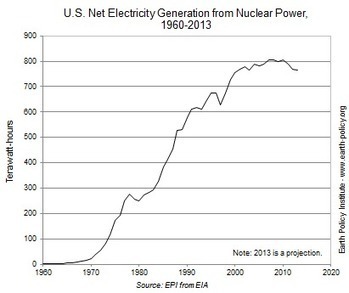
By J. Matthew RoneyNuclear power generation in the United States is falling. After increasing rapidly since the 1970s, electricity generation at U.S. nuclear plants began to grow more slowly in the…

Duane Tilden‘s insight:

>Of the 253 reactors that were ordered by 1978, 121 were canceled either before or during construction, according to the Union of Concerned Scientists’ David Lochbaum. Nearly half of these were dropped by 1978. The reactors that were completed—the last of which came online in 1996—were over budget three-fold on average.

By the late 1990s, 28 reactors had permanently closed before their 40-year operating licenses expired. […]

In 2012, the U.S. Nuclear Regulatory Commission (NRC) approved four new reactors for construction, two each at the Vogtle plant in Georgia and the Summer plant in South Carolina. These reactors are all of the same commercially untested design, purportedly quicker to build than previous plants. Both projects benefit from fairly new state laws that shift the economic risk to ratepayers. These “advanced cost recovery” laws, also passed in Florida and North Carolina, allow utilities to raise their customers’ rates to pay for new nuclear plants during and even before construction—regardless of whether the reactors are ever finished.

Construction at both sites began in March 2013. Even as the first concrete was poured at the $14-billion Vogtle project, it was reportedly 19 months behind schedule and more than $1 billion over budget. The Summer project, a $10 billion endeavor, also quickly ran into problems. […] With these delays, the earliest projected completion date for any of these reactors is some time in late 2017. […]

This year has also already witnessed the permanent shutdown of four reactors totaling 3.6 gigawatts of capacity. The first to fall was Duke’s Crystal River reactor in Florida. Although the plant was licensed to run until 2016, Duke decided to close it rather than pay for needed repairs. Then Dominion Energy’s 39-year-old Kewaunee reactor in Wisconsin closed, citing competition from low gas prices. It had recently been approved to operate through 2033. And in June, Southern California Edison shuttered its two San Onofre reactors after 18 months of being offline due to a leak in a brand new steam generator. These retirements leave the United States with 100 reactors, averaging 32 years in operation. (France is second, with 58 reactors.)

More closures will soon follow, particularly among the roughly half of U.S. reactors in so-called merchant areas […]

Dealing with nuclear waste is another expensive proposition. Over the past 30 years, the U.S. government has spent some $15 billion trying to approve a central repository for nuclear waste, and for most of that time the only site under consideration has been Nevada’s Yucca Mountain. Amid concerns about the site’s safety and its extreme unpopularity in Nevada, the Obama administration has moved to abandon the project entirely and explore other options.

A federal appeals court ruled in August 2013 that the NRC must resume reviewing the site’s suitability. In the meantime, the waste keeps accumulating. The 75,000 tons of waste now stored at 80 temporary sites in 35 states is projected to double by 2055. […]

See on grist.org