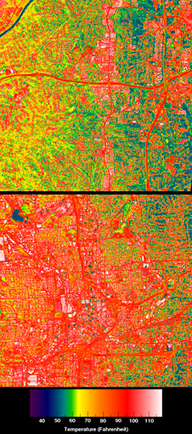
Monitoring Motivates Less Electricity Use

See on Scoop.itGreen & Sustainable News

Researchers found that families that were simply told they were in a study to track electricity use reduced electricity use more than 2.5 percent.

Duane Tilden‘s insight:

>The general phenomenon is called the Hawthorne effect: study subjects change their behavior because they’re being observed. So researchers collaborated with a utility to test for the Hawthorne effect in electricity use.

They monitored almost 5,600 randomly selected households. Half received a postcard saying that their energy use would be monitored for a month for research purposes. They also got four follow-up reminder postcards over the month. They received no other information, instructions or incentives.

The control group monitored for the study got no notifications. That group continued using the same amount of electricity. But the families being tracked reduced energy use 2.7 percent. And when the study period ended, their energy use shot back up. The report is in the Proceedings of the National Academy of Sciences. [Daniel Schwartz et al., The Hawthorne effect and energy awareness]<

See on www.scientificamerican.com
Supply of Renewable Wind Power Surges in Texas with some Plant Closures

See on Scoop.itGreen & Sustainable News

Market Upheaval In the U.S., hydraulic fracturing techniques used to drill shale have produced a flood of cheap natural gas. That, combined with the growth in wind and tepid customer demand, is upending power markets, leading to plant closures and bankruptcy for some generator owners.

Duane Tilden‘s insight:

>Traditional power companies across the U.S. and Europe are struggling to compete in wholesale markets with newer generators supplying subsidized wind and solar energy. In Texas, wind has more than doubled in the past six years and now makes up 13 percent of the state’s generation capacity.[…]

Falling Prices – Electricity prices for 2014 also have fallen. The on-peak North Texas power price for next year has dropped 19 percent since reaching a peak on May 23, according to data compiled by Bloomberg.

During a heat wave in the first week of August, ample wind supplies served to keep a lid on prices that would’ve normally spiked from the higher demand, NRG Chief Executive Officer David Crane said during a call with investors on Aug. 9. “Wind energy reduces electricity prices and that is good for consumers,” said Michael Goggin, an analyst for the American Wind Energy Association, an industry trade group. “Wind energy has no fuel costs, allowing it to replace more expensive and polluting sources of energy.”

Once complete, Oncor’s power lines will be part of a system that can eventually deliver about 18,500 megawatts of wind power, nearly double the amount now available in Texas and 25 percent of the state’s current generation capacity.<

See on www.renewableenergyworld.com

Proliferation of wireless devices and networks detrimental to environment

See on Scoop.itGreen & Sustainable News

Cloud computing should be driving sustainable development, but its turning us into energy consuming monsters, write Stuart Newstead and Howard Williams

Duane Tilden‘s insight:

>There is a familiarity and comfort in our almost-everywhere connection to always-on communications networks and to the ever-increasing array of services they deliver us. We don’t just consume these network services directly, they give us what economists call “options” – options to connect, options to seek out new services, options to find new information. Clearly we don’t use this network services 24/7, but we value highly the options for instantaneous and simultaneous access at any time.

Cloud-based applications – those stored and managed by massive data centres run by the likes of Amazon, Google, Facebook or Apple – are providing step changes in the financial and environmental efficiency of delivering these services. But the centralising power of the cloud has its corollary in the dispersing effect of wireless networks and devices.

In wireless networks and devices we see fragmentation, duplication and a fundamental shift from mains power and green sources of energy to battery powered always-on devices. In environmental terms here lies the rub. Rather than the “aggregation of marginal gains” (the Sir Dave Brailsford strategy that has propelled success in British cycling), in which lots of tiny improvements add up to a large visible improvement, we are witnessing the aggregation of environmental disadvantages from billions of low-powered but fundamentally energy-inefficient antennas and devices providing the ‘last metre’ connectivity to global networks.

Wireless networks and devices, technologies that should drive sustainable development, are turning into energy-consuming monsters.<

See on www.theguardian.com

Reshaping Corporations: Can Divestment Work?

See on Scoop.itGreen & Sustainable News

With enough collective action, mass divestment campaigns can be effective in creating social change. 

Duane Tilden‘s insight:

>To be effective, a huge amount of money must be withdrawn from a company. Where boycotting unites individual buyers to have impact, individual stockowners aren’t likely to make a huge enough hit with divestment or negative investing for a corporation to take notice. Institutional owners, though, could impact a company or industry because collectively they control vast amounts. 

The Fossil Fuel Divestment Campaign

The current student campaign to divest from fossil fuels is interesting. For example, Harvard has $30 billion in endowment while Yale has $16.7 billion.

While it’s clearly not all in one company or industry, what kind of impact could university endowments have if they withdrew from fossil fuel companies and allied industries? By my count, there are well over a hundred campaigns at universities around the nation, and there are additional groups working to get towns and communities to join the fight. As a collective action, the potential for these divestment campaigns is fascinating to ponder.

Mass Divestment Creates Cultural Change

Perhaps the most important thing divestment shares with boycotting is publicity.  The attention that a mass divestment can bring to an issue could be profound. The student fossil fuels divestment effort is garnering national media attention, and rather than fizzling out seems to be gaining momentum. This attention could be as effective as actual divestment for dealing with climate change and fossil fuel issues. 

As Cecelie Counts wrote in January, divestment was just one tool used to combat apartheid and bring change in South Africa. I don’t know if there will be mass divestment among universities, but I suspect that this campaign will be successful in the long run because it’s educating a generation and could create the cultural change necessary to pursue long-term alternatives, change policy and pressure energy companies to adapt.<

See on csrwire.sharedby.co

Detroit Completes One of Nation’s Largest LED Parking Garage Retrofits – WSJ.com

See on Scoop.itGreen Building Design – Architecture & Engineering
Sixty-one Acres of LED Lighting will reduce garage energy-use by 80 percent; Entire property by 7 percent

Duane Tilden‘s insight:

>LED technology is one of the highest performing, currently available methods of lighting. Energy savings of 50 to 80 percent are common when compared to the lamps that are typically used in garages. LED lamps also have much longer operating lives, resulting in fewer materials and transportation resources needed over time. The MGM Grand Detroit LED retrofit, will save enough electricity to power more than 350 average homes per year. […]

Earlier this year, the company initiated a program to install 1,600 induction technology lighting fixtures covering 160 acres of open lot parking area at its resorts in Las Vegas. These lamps are ideal for the hot Las Vegas climate and will have an operating life of up to 20 years. An estimated 2.7 million kWh will be saved annually following the project’s completion.

Additionally, MGM Resorts recently announced the planned installation of one of the largest rooftop solar photovoltaic arrays in the world at the Mandalay Bay Resort Convention Center. The 6.2-megawatt installation will be MGM Resorts’ first commercial solar project in the United States and will generate enough electricity to power the equivalent of 1,000 homes.<

See on online.wsj.com

Air Conditioning the World stresses Global Energy Supply

See on Scoop.itGreen Building Design – Architecture & Engineering

The United States currently uses more energy for air- conditioning than all other countries combined—a sobering statistic from Stan Cox of the Land Institute in Salina, Kansas.

Duane Tilden‘s insight:

>According to the U.S. Energy Information Administration, 87 percent of American households are equipped with air-conditioning, and the United States expends about 185 billion kilowatt hours of energy annually on residential cooling.  […]

Rapid increases in the ownership of air conditioners are already occurring in many developing countries. According to research by McNeil and Letschert, the percentage of urban Chinese households with an air conditioner jumped from less than 1 percent in 1990 to 62 percent in 2003. In 2010 alone, 50 million air-conditioning units were sold in China.  […]

[…] eight countries have the potential to exceed the United States’ yardstick of high air-conditioning usage, because of their warm climates and significant populations. Furthermore, the top three could surpass the United States by substantial amounts: India, China, and Indonesia by factors of 14, 5.2, and 3.1, respectively, if they adopt American standards of cooling.

[…] Several institutions have recently made major technical advances in the design of more energy-efficient air conditioners. For example, developments at the National Renewable Energy Laboratory suggest that efficiency improvements of 20 to 70 percent are possible compared to current models of air conditioners. Changes in housing design and urban planning are also needed […]<

See on www.americanscientist.org

Quantitative Analysis of Factors Contributing to Urban Heat Island Intensity

See on Scoop.itGreen Building Design – Architecture & Engineering

Ryu, Young-Hee, Jong-Jin Baik, 2012: Quantitative Analysis of Factors Contributing to Urban Heat Island Intensity. J. Appl. Meteor. Climatol., 51, 842–854.

Duane Tilden‘s insight:

>This study identifies causative factors of the urban heat island (UHI) and quantifies their relative contributions to the daytime and nighttime UHI intensities using a mesoscale atmospheric model that includes a single-layer urban canopy model. A midlatitude city and summertime conditions are considered. Three main causative factors are identified: anthropogenic heat, impervious surfaces, and three-dimensional (3D) urban geometry. Furthermore, the 3D urban geometry factor is subdivided into three subfactors: additional heat stored in vertical walls, radiation trapping, and wind speed reduction. To separate the contributions of the factors and interactions between the factors, a factor separation analysis is performed. In the daytime, the impervious surfaces contribute most to the UHI intensity. The anthropogenic heat contributes positively to the UHI intensity, whereas the 3D urban geometry contributes negatively. In the nighttime, the anthropogenic heat itself contributes most to the UHI intensity, although it interacts strongly with other factors. The factor that contributes the second most is the impervious-surfaces factor. The 3D urban geometry contributes positively to the nighttime UHI intensity. Among the 3D urban geometry subfactors, the additional heat stored in vertical walls contributes most to both the daytime and nighttime UHI intensities. Extensive sensitivity experiments to anthropogenic heat intensity and urban surface parameters show that the relative importance and ranking order of the contributions are similar to those in the control experiment.

Keywords: Urban meteorology

Received: May 7, 2011;<

See on journals.ametsoc.org

NASA – Ecosystem, Vegetation Affect Intensity of Urban Heat Island Effect

See on Scoop.itGreen Building Design – Architecture & Engineering

NASA researchers studying have found that the intensity of the “heat island” created by a city depends on the ecosystem it replaced and on the regional climate.

Duane Tilden‘s insight:

I have measured the heat island effect in the Greater Vancouver area, specifically Metrotown, Burnaby to be in the order of 6 deg C, during a late summer evening.

>”The placement and structure of cities — and what was there before — really does matter,” said Marc Imhoff, biologist and remote sensing specialist at NASA’s Goddard Space Flight Center in Greenbelt, Md. “The amount of the heat differential between the city and the surrounding environment depends on how much of the ground is covered by trees and vegetation. Understanding urban heating will be important for building new cities and retrofitting existing ones.”

Goddard researchers including Imhoff, Lahouari Bounoua, Ping Zhang, and Robert Wolfe presented their findings on Dec. 16 in San Francisco at the Fall Meeting of the American Geophysical Union.

Scientists first discovered the heat island effect in the 1800s when they observed cities growing warmer than surrounding rural areas, particularly in summer. Urban surfaces of asphalt, concrete, and other materials — also referred to as “impervious surfaces” — absorb more solar radiation by day. At night, much of that heat is given up to the urban air, creating a warm bubble over a city that can be as much as 1 to 3°C (2 to 5°F) higher than temperatures in surrounding rural areas.

The impervious surfaces of cities also lead to faster runoff from land, reducing the natural cooling effects of water on the landscape. More importantly, the lack of trees and other vegetation means less evapotranspiration — the process by which trees “exhale” water. Trees also provide shade, a secondary cooling effect in urban landscapes.

Using instruments from NASA’s Terra and Aqua satellites, as well as the joint U.S. Geological Survey-NASA satellite Landsat, researchers created land-use maps distinguishing urban surfaces from vegetation. The team then used computer models to assess the impact of urbanized land on energy, water, and carbon balances at Earth’s surface. <

See on www.nasa.gov

U.S. Geothermal Inc. Announced Final Completion of Neal Hot Springs Power Plant

See on Scoop.itGreen Energy Technologies & Development

BOISE, IDAHO, Aug 01, 2013 (Marketwired via COMTEX) — U.S. Geothermal Inc., (nyse mkt:HTM) CA:GTH -1.96% a leading renewable energy company focused on the development, production, and sale of electricity from geothermal energy, announced () that Final Completion of the 22 megawatt (net) Neal Hot Springs Project has been achieved.

Duane Tilden‘s insight:

>The Neal Hot Springs Project was the first geothermal project to obtain a loan guarantee under the DOE’s Title XVII loan guarantee program, which was created by the Energy Policy Act of 2005 to support the deployment of innovative clean energy technologies. The DOE loan guarantee, guarantees a loan from the U.S. Treasury’s Federal Financing Bank. The project was authorized for a loan guarantee of up to $96.8 million.

The Neal Hot Springs project deployed a first of its kind binary cycle process, utilizing a supercritical cycle that uses R134a refrigerant as the working fluid, as well as pre-fabricated modular construction of major plant components. […]

The project is selling electricity to Idaho’s largest utility, Idaho Power Company, under a previously signed 25-year power purchase agreement for up to 25 megawatts of power per year. Beginning in 2012, the base energy price is $96 per MW Hour and escalates annually. The calculated 25-year levelized price is $117.65 per MW hour.<

See on www.marketwatch.com

Waste to Energy – Incinerator Operations threaten Community recycling programs

See on Scoop.itGreen Building Design – Architecture & Engineering

Rise in number of plants burning waste may be disincentive to greener methods of disposal

Duane Tilden‘s insight:

>Experts said the use of incinerators had consequences for recycling as local authorities were forced to divert waste to feed the plants. “The choice to invest in thermal treatment can hold back recycling efforts,” Adam Baddeley, principal consultant at Eunomia, said. “At one level, the money invested in such plant simply isn’t available to put into building recycling plants or collection infrastructure. And once you’ve built an incinerator or gasifier, there’s a strong incentive to keep it fed with waste, even if that means keeping on collecting as ‘black bag’ rubbish, material that would be economically practicable to collect separately for recycling.”

Charmian Larke, technical adviser for Cornwall Waste Forum, which unsuccessfully opposed a large incinerator in the south-west, questioned the planning process that resulted in incinerators being approved. “Some of them [planning officers] have spent their entire careers trying to get this incinerator so they are wedded to the idea,” Larke said. “But if the council members understood how bad these contracts were, the officers would lose their jobs.”

Larke claimed that many of the incinerators were built in poorer areas. “There’s a feeling that people who are downtrodden have a harder time getting their act together to object, and hence it’s easier to place nasty things next to them.”<

See on www.theguardian.com