Clean Energy rebranded by DOE to Combined Heat and Power (CHP)

See on Scoop.itGreen Energy Technologies & Development

In a move that had been in the works for a while, the U.S. Department of Energy recently announced that its Clean Energy Application Centers have been rebranded as CHP Technical Assistance Partnerships, or CHP TAPs.

Duane Tilden‘s insight:

>The CHP TAPs maintain the same regional offices that existed under the former Clean Energy Application Centers:

  1. Pacific (California, Nevada);
  2. Southwest (Arizona, Colorado, New Mexico, Oklahoma, Texas, Utah, Wyoming);
  3. Northwest (Idaho, Montana, Oregon, Washington);
  4. Midwest (Illinois, Indiana, Iowa, Kansas, Michigan, Minnesota, Missouri, Nebraska, North Dakota, Ohio, South Dakota);
  5. Southeast (Alabama, Arkansas, Florida, Georgia, Kentucky, Louisiana, Mississippi, North Carolina, South Carolina, Tennessee);
  6. Mid-Atlantic (Delaware, Maryland, New Jersey, Pennsylvania, Virginia, West Virginia); and
  7. Northeast (Connecticut, Maine, Massachusetts, New Hampshire, New York, Rhode Island, Vermont).

With the new energy in these programs, now is the time to take advantage of the expertise offered by the Department of Energy and its CHP TAPs. Industrial users, municipalities, hospitals, college campuses and other large users of energy need to review and understand the significant benefits of CHP, district energy and waste heat capture technologies.<

See on www.natlawreview.com
Supercritical CO2 refines cogeneration for Industry

See on Scoop.itGreen Energy Technologies & Development

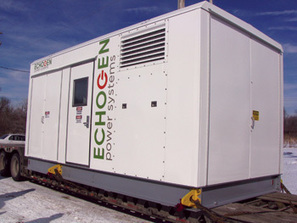
The first production unit of the EPS100 7.5 MWe heat engine is completing factory checkout tests at Dresser-Randbtd…

Duane Tilden‘s insight:

>Energy-intensive manufacturing

In an increasingly competitive environment, manufacturers are seeking to cut their costs. Fluctuating energy prices often channel this investment into cost-effective energy-saving technologies and practices that will reduce operating costs while maintaining or increasing product quality and yield.

Energy-efficient technologies often bring other benefits, such as higher productivity or environmental gains, reducing the regulatory ‘burden’. Waste heat can be captured from many industrial processes through waste heat recovery technology. […]

Waste heat recovery represents the greatest opportunity for reducing energy loss in these industries while simultaneously reducing their carbon footprint and associated greenhouse emissions with improved overall energy production efficiency.[…]

The outlook for scCO2

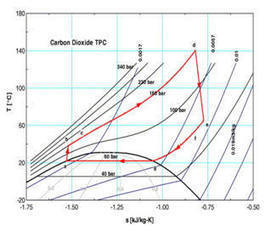
Supercritical CO2 heat engines are scalable across a broad system size range, from 250 kWe to 45 MWe and above, with net electrical output to support the widest possible variety of industrial and utility-scale applications.

The sCO2 Cycle is thermal source neutral − suitable with a wide range of heat sources from 200°C to 500°C with efficiencies up to 30%. New energy production can be offset with recovered energy without increasing greenhouse emissions while improving overall energy production efficiency. The scCO2 heat engine can add up to 35% more power to simple-cycle gas turbines, 10–15% more power to reciprocating engines, and can significantly improve the energy efficiency and bottom line performance at steel mills, cement kilns, glass furnaces and other fuel-fired industrial processes by converting previously wasted exhaust and flue gas energy into usable electricity.

Alex Kacludis is an Application Engineer at EPS LLC; www.echogen.com

See on www.cospp.com

Supercritical CO2 turbine for Power Production & Waste Heat Energy Recovery

See on Scoop.itGreen Building Design – Architecture & Engineering

A former scientist at Sandia National Lab is bringing the technology to market

Duane Tilden‘s insight:

>Because of its physical properties as a liquid, it has become a target fluid of opportunity to run turbines and thus make electricity. Steven Wright, Ph.D., who recently retired from Sandia National Laboratory (SNL), has set up a consulting company called Critical Energy LLC to bring this technology to a commercial level.

The objective of using supercritical CO2 (S-CO2) in a Brayton-Cycle turbine is to make it much more efficient in the transfer of heat. Wright points out that a steam turbine is about 33% efficient, but that an S-CO2 turbine could be as high as 48% efficient, a significant increase.

A closed loop supercritical CO2 system has the density of a liquid, but many of the properties of a gas. A turbine running on it, “is basically a jet engine running on a hot liquid,” says Wright.

“There is a tremendous amount of scientific and industrial interest in S-CO2 for power generation. All heat sources are involved…<

See on theenergycollective.com

Waste Heat Recovery using Supercritical CO2 turbines to create Electrical Power

See on Scoop.itGreen Building Design – Architecture & Engineering

Working fluids with relatively low critical temperature and pressure can be compressed directly to their supercritical pressures and heated to their supercritical state before expansion so as to obtain a better thermal match with the heat source.

Duane Tilden‘s insight:

>Chen et al. [1-3] did a comparative study of the carbon dioxide supercritical power cycle and compared it with an organic Rankine cycle using R123 as the working fluid in a waste heat recovery application. It shows that a CO2 supercritical power cycle has higher system efficiency than an ORC when taking into account the behavior of the heat transfer between the heat source and the working fluid. The CO2 cycle shows no pinch limitation in the heat exchanger. Zhang et al.  [4-11] has also conducted research on the supercritical CO2 power cycle. Experiments revealed that the CO2 can be heated up to 187℃ and the power generation efficiency was 8.78% to 9.45% [7] and the COP for the overall outputs from the cycle was 0.548 and 0.406, respectively, on a typical summer and winter day in Japan [5].

Organic fluids like isobutene, propane, propylene, difluoromethane and R-245fa [12] have also been suggested for supercritical Rankine cycle. It was found that supercritical fluids can maximize the efficiency of the system. However, detailed studies on the use of organic working fluids in supercritical Rankine cycles have not been widely published.

There is no supercritical Rankine cycle in operation up to now. However, it is becoming a new direction due to its advantages in thermal efficiency and simplicity in configuration.<

See on www.eng.usf.edu

U.S. Tidal Energy Project requires Proximity Standard

See on Scoop.itGreen Energy Technologies & Development

A planned tidal energy project off the coast of Washington state in the US has come under fire over the lack of a standard defining how close such projects can be to existing underwater cables.

Duane Tilden‘s insight:

>There is currently no U.S. standard for the distance tidal energy projects need to be from other subsea installations. The Federal Communications Commission has stated that neither it nor FERC has the expert guidance necessary to make an informed decision about what a safe separation distance would be. The FCC has charged an advisory committee, the Communications Security, Reliability and Interoperability Council (CSRIC), to work with the industry to develop guidance, delegating a special submarine cable working group to address the issue.

Distance guidelines do exist for offshore wind turbines in the U.S. The FCC and industry groups have suggested that these standards, which require 500 metres between offshore wind turbines and submarine cables, should be used in this case.

In its comment to the FERC, Pacific Crossing invoked a UK guideline, Subsea Cables UK Guideline number 6, which recommends proximity limits of 200-400 metres from an existing subsea structure for marine energy development. The North American Submarine Cable Association has urged U.S. regulatory agencies to apply the UK guidelines to all U.S. marine energy projects, including tidal energy projects.<

See on www.renewableenergyworld.com

Greening Coal Power with CO2-eating Microalgae as a Biofuel Feedstock

See on Scoop.itGreen Energy Technologies & Development

Successful microalgae-to-biodiesel conversion has been the goal of some renewable energy researchers for more than two decades.

Duane Tilden‘s insight:

>To that end, Algae.Tec has signed a deal with Macquarie Generation, Australia’s largest electricity generator, to put an “algae carbon capture and biofuels” production facility next to a coal-fired power station in Australia’s Hunter Valley. Macquarie Generation, which operates the Sydney-area 2640 MW Bayswater Power Station, will feed waste CO2 into an enclosed algae growth system. […]

Projections are for the first year of production to hit 100,000 tons of algae biomass; half of which would be converted to an estimated 60 million liters of biodiesel. One sea-land container would generate 250 tons of biomass per annum, said the company, which would be harvested on a continuous basis. […]

Stroud projects that some 75 percent of his company’s income will come from biodiesel. The remaining 25 percent of Algae.Tec’s income will hinge on the sale of the microalgae’s leftover biomass for animal feed.<

See on www.renewableenergyworld.com

Surplus fossil fuels expected to exceed carbon budget

See on Scoop.itGreen & Sustainable News

It won’t be difficult to blow by the 1-trillion ton threshold based on the amount of fossil fuels still in the ground. As Amy Myers Jaffe remarks, “scarcity will not be the force driving a shift to alternative energy. Climate and energy policy initiatives will have to take into consideration the possibility of oil and gas surpluses and lower fossil fuel prices.”

Duane Tilden‘s insight:

>The lesson here is that the economics are still in favor of producing fossil fuels. The cyclical nature of energy prices suggests that higher prices will spur development of technologies to reach more difficult energy deposits. This doesn’t mean that oil and natural gas prices will be low for the rest of time, but it does reflect how high energy prices in the 2000s led not only to funding and research in alternative fuels (particularly biofuels), but also in oil and gas technologies. This investment coupled with decades of U.S. government and academic research proved fruitful with the combination of horizontal drilling and hydraulic fracturing becoming a deployable technology.

We have now entered a period of energy surplus where we produce energy from “unconventional sources” using technological breakthroughs like horizontal drilling and hydraulic fracturing in places like North Dakota, south Texas, Lousiana, and Pennsylvannia. (and soon to be California?).<

See on blogs.scientificamerican.com

U.S. Nuclear Power Closures Signal Wider Problems for Industry

See on Scoop.itGreen & Sustainable News

A string of plant closures, project cancellations and other setbacks has raised new doubts about the future of nuclear power in the United States, but there’s disagreement about whether the retrenchment will be limited and temporary or the…

Duane Tilden‘s insight:

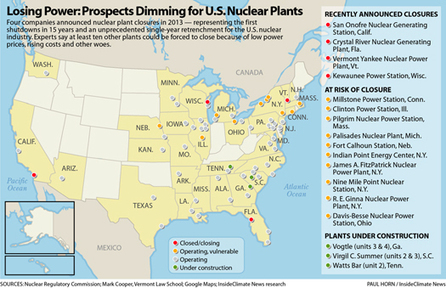
>The blows to nuclear power’s prospects have come on many fronts, but it was the surprising spurt of plant closures that laid bare the industry’s worsening plight. The plant shutdowns are the first to hit the U.S. nuclear power market in 15 years, and the retirements don’t bode well for many of the nation’s 99 remaining power reactors.

Analysts say economic woes make at least 10 other plants vulnerable enough to follow suit. Almost all of those are among the nation’s 47 “merchant” nuclear plants, which, unlike regulated plants, operate in open markets and have to beat out other power suppliers to win customers and long-term supply contracts. The especially vulnerable facilities cited by analysts are at greater risk for closure because their power is too expensive to sell profitably in wholesale markets or because their output is too small or too unreliable to support rising operating and retrofit costs.<

See on insideclimatenews.org

World Record Solar Cell with 44.7 Percent Efficiency (news)

See on Scoop.itGreen Energy Technologies & Development

Freiburg, Germany – The Fraunhofer Institute for Solar Energy Systems ISE, Soitec, CEA-Leti and the Helmholtz Center Berlin jointly announced on late Monday having achieved a new world record for the conversion of sunlight into electricity using a new solar cell structure with four solar subcells. …

Duane Tilden‘s insight:

>These solar cells are used in concentrator photovoltaics (CPV), a technology which achieves more than twice the efficiency of conventional PV power plants in sun-rich locations. The terrestrial use of so-called III-V multi-junction solar cells, which originally came from space technology, has prevailed to realize highest efficiencies for the conversion of sunlight to electricity. In this multi-junction solar cell, several cells made out of different III-V semiconductor materials are stacked on top of each other. The single subcells absorb different wavelength ranges of the solar spectrum.<

See on renewable-energy-industry.com

EPA sets terms for New Power Plant carbon emissions

See on Scoop.itGreen & Sustainable News

Frances Beinecke: We’re already paying the costs of climate change. The new power plant emissions standards could not be more timely

Duane Tilden‘s insight:

>The carbon standards announced Friday by Gina McCarthy, administrator of the US Environmental Protection Agency, will set reasonable limits on carbon pollution from the power plants of tomorrow, those that are yet to be built.<

See on www.theguardian.com