U.S. Nuclear Power waning: A history of Failures

See on Scoop.itGreen & Sustainable News

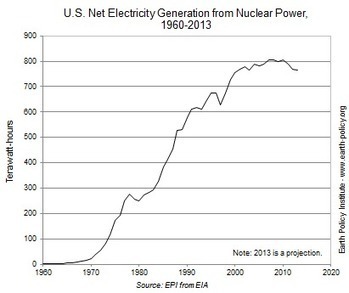
By J. Matthew RoneyNuclear power generation in the United States is falling. After increasing rapidly since the 1970s, electricity generation at U.S. nuclear plants began to grow more slowly in the…

Duane Tilden‘s insight:

>Of the 253 reactors that were ordered by 1978, 121 were canceled either before or during construction, according to the Union of Concerned Scientists’ David Lochbaum. Nearly half of these were dropped by 1978. The reactors that were completed—the last of which came online in 1996—were over budget three-fold on average.

By the late 1990s, 28 reactors had permanently closed before their 40-year operating licenses expired. […]

In 2012, the U.S. Nuclear Regulatory Commission (NRC) approved four new reactors for construction, two each at the Vogtle plant in Georgia and the Summer plant in South Carolina. These reactors are all of the same commercially untested design, purportedly quicker to build than previous plants. Both projects benefit from fairly new state laws that shift the economic risk to ratepayers. These “advanced cost recovery” laws, also passed in Florida and North Carolina, allow utilities to raise their customers’ rates to pay for new nuclear plants during and even before construction—regardless of whether the reactors are ever finished.

Construction at both sites began in March 2013. Even as the first concrete was poured at the $14-billion Vogtle project, it was reportedly 19 months behind schedule and more than $1 billion over budget. The Summer project, a $10 billion endeavor, also quickly ran into problems. […] With these delays, the earliest projected completion date for any of these reactors is some time in late 2017. […]

This year has also already witnessed the permanent shutdown of four reactors totaling 3.6 gigawatts of capacity. The first to fall was Duke’s Crystal River reactor in Florida. Although the plant was licensed to run until 2016, Duke decided to close it rather than pay for needed repairs. Then Dominion Energy’s 39-year-old Kewaunee reactor in Wisconsin closed, citing competition from low gas prices. It had recently been approved to operate through 2033. And in June, Southern California Edison shuttered its two San Onofre reactors after 18 months of being offline due to a leak in a brand new steam generator. These retirements leave the United States with 100 reactors, averaging 32 years in operation. (France is second, with 58 reactors.)

More closures will soon follow, particularly among the roughly half of U.S. reactors in so-called merchant areas […]

Dealing with nuclear waste is another expensive proposition. Over the past 30 years, the U.S. government has spent some $15 billion trying to approve a central repository for nuclear waste, and for most of that time the only site under consideration has been Nevada’s Yucca Mountain. Amid concerns about the site’s safety and its extreme unpopularity in Nevada, the Obama administration has moved to abandon the project entirely and explore other options.

A federal appeals court ruled in August 2013 that the NRC must resume reviewing the site’s suitability. In the meantime, the waste keeps accumulating. The 75,000 tons of waste now stored at 80 temporary sites in 35 states is projected to double by 2055. […]

See on grist.org

Virtual Energy Audits: The Next Big Thing in Buildings?

See on Scoop.itGreen Building Operations – Systems & Controls, Maintenance & Commissioning

Virtual energy audits use software to collect meter data, weather information, etc. and algorithms to develop energy efficiency recommendations.

Duane Tilden‘s insight:

>The goal of any energy audit is to identify savings by analyzing data, determining how and where a building is using energy, and then providing operational and capital energy efficiency measures that improve overall performance.

A traditional ASHRAE Level II Audit includes a manual inspection of data related to a facility’s Building Envelope, Lighting, Heating, Ventilation, and Air Conditioning (HVAC), Domestic Hot Water (DHW), Plug Loads, and Compressed Air and Process Uses (for manufacturing, service, or processing facilities). Analysis is conducted to quantify baseloads and account for seasonal variation. A Level II Audit will also include an evaluation of lighting, air quality, temperature, ventilation, humidity, and other conditions that may affect energy performance and occupant comfort. The process also includes detailed discussions with the building owners, managers, and tenants – there is a lot you can learn just by talking to people about what they think is working and not, what the financial objectives of the organization are, and how that should feed into the recommendations.  […]

Ok, I get it: So what’s a virtual energy audit?

Essentially a virtual energy audit is much like a traditional audit: the goal is to synthesize a whole bunch of data and come up with a list of recommendations that are going to deliver you the biggest bang for your buck. Unlike a detailed ASHRAE Level II audit, it’s better to think of virtual audits as delivering against the 80/20 rule. For a lot less physical effort, it’s going to get you about 80% of the detailed insights that a traditional ASHRAE Level II energy audit would deliver. And for many organizations, that’s OK – because their biggest, most obvious energy hogs are the ones driving the biggest bills at the end of the month.<

See on energysmart.enernoc.com

Are current batteries cost effective for wind and solar power storage on the grid?

See on Scoop.itGreen Energy Technologies & Development

Renewable energy holds the promise of reducing carbon dioxide emissions. But there are times when solar and wind farms generate more electricity than is needed by consumers.

Duane Tilden‘s insight:

>”We calculated how much energy is used over the full lifecycle of the battery – from the mining of raw materials to the installation of the finished device,” Barnhart said. “Batteries with high energetic cost consume more fossil fuels and therefore release more carbon dioxide over their lifetime. If a battery’s energetic cost is too high, its overall contribution to global warming could negate the environmental benefits of the wind or solar farm it was supposed to support.” […]

In addition to batteries, the researchers considered other technologies for storing renewable energy, such as pumped hydroelectric storage, which uses surplus electricity to pump water to a reservoir behind a dam. Later, when demand for energy is high, the stored water is released through turbines in the dam to generate electricity. […]

Storage is not the only way to improve grid reliability. “Energy that would otherwise be lost during times of excess could be used to pump water for irrigation or to charge a fleet of electric vehicles, for example,” Dale said.

See on phys.org

Monitoring Motivates Less Electricity Use

See on Scoop.itGreen & Sustainable News

Researchers found that families that were simply told they were in a study to track electricity use reduced electricity use more than 2.5 percent.

Duane Tilden‘s insight:

>The general phenomenon is called the Hawthorne effect: study subjects change their behavior because they’re being observed. So researchers collaborated with a utility to test for the Hawthorne effect in electricity use.

They monitored almost 5,600 randomly selected households. Half received a postcard saying that their energy use would be monitored for a month for research purposes. They also got four follow-up reminder postcards over the month. They received no other information, instructions or incentives.

The control group monitored for the study got no notifications. That group continued using the same amount of electricity. But the families being tracked reduced energy use 2.7 percent. And when the study period ended, their energy use shot back up. The report is in the Proceedings of the National Academy of Sciences. [Daniel Schwartz et al., The Hawthorne effect and energy awareness]<

See on www.scientificamerican.com

Coal Power Plants to be retired – Duke Energy Settles Edwardsport air permit Dispute

See on Scoop.itGreen & Sustainable News

Duke Energy Corp. said it reached a settlement with the a handful of environmental and activist organizations over outstanding issues with the.

Duane Tilden‘s insight:

>The Indiana Department of Environmental Management issued the new Knox County, Ind., plant’s air permits in 2008, and- -under the settlement with the Sierra Club, Citizens Action Coalition, Save the Valley and Valley Watch–they remain approved with no changes. The dispute centered on technical issues surrounding the permits that enabled the company to build and operate the plant, the company said.

The settlement also addresses deadlines for retiring units at Duke’s Wabash River Station in Vigo County, Ind. Prior to the settlement, the company had said it planned to retire four, 1950s-vintage units totaling 350 megawatts at the station by the 2015 federal mercury rule deadline. In the agreement, the company agreed to finish the retirements by the compliance deadline or, if the mercury rule is vacated or delayed, by June 1, 2018, whichever comes first.

Duke also had been exploring converting another unit at the Wabash station to natural gas, and, under the settlement, the company agreed to cease burning coal at that 318-megawatt unit by June 1, 2018. The deadline won’t prevent Duke Energy from converting the unit to natural gas earlier.

The settlement also includes a commitment to pursue additional green energy sources.<

See on www.nasdaq.com

Reshaping Corporations: Can Divestment Work?

See on Scoop.itGreen & Sustainable News

With enough collective action, mass divestment campaigns can be effective in creating social change. 

Duane Tilden‘s insight:

>To be effective, a huge amount of money must be withdrawn from a company. Where boycotting unites individual buyers to have impact, individual stockowners aren’t likely to make a huge enough hit with divestment or negative investing for a corporation to take notice. Institutional owners, though, could impact a company or industry because collectively they control vast amounts. 

The Fossil Fuel Divestment Campaign

The current student campaign to divest from fossil fuels is interesting. For example, Harvard has $30 billion in endowment while Yale has $16.7 billion.

While it’s clearly not all in one company or industry, what kind of impact could university endowments have if they withdrew from fossil fuel companies and allied industries? By my count, there are well over a hundred campaigns at universities around the nation, and there are additional groups working to get towns and communities to join the fight. As a collective action, the potential for these divestment campaigns is fascinating to ponder.

Mass Divestment Creates Cultural Change

Perhaps the most important thing divestment shares with boycotting is publicity.  The attention that a mass divestment can bring to an issue could be profound. The student fossil fuels divestment effort is garnering national media attention, and rather than fizzling out seems to be gaining momentum. This attention could be as effective as actual divestment for dealing with climate change and fossil fuel issues. 

As Cecelie Counts wrote in January, divestment was just one tool used to combat apartheid and bring change in South Africa. I don’t know if there will be mass divestment among universities, but I suspect that this campaign will be successful in the long run because it’s educating a generation and could create the cultural change necessary to pursue long-term alternatives, change policy and pressure energy companies to adapt.<

See on csrwire.sharedby.co

Biofuel Production from Palm oil plantation waste

See on Scoop.itGreen Building Design – Architecture & Engineering

NextFuels to produce biofuels from palm plantation residue – Renewable Energy Magazine, at the heart of clean energy journalism

Duane Tilden‘s insight:

>Edible palm oil has surpassed soybean to become the largest source of cooking oil in the world, accounting for over 50 million tons of oil annually.

While plantation owners have managed to increase the productivity of their land by 15X since the late 80s, the growth of the industry has created a corresponding residue problem. Approximately 4.4 to 6 metric tons of agricultural waste is generated for each metric ton of oil. There are over 1,000 crude palm oil (CPO) mills in Southeast Asia and a single (60 tons per hour) mill can generate 135,000 tons of agricultural residue a year.

NextFuels uses a system called bio-liquefaction that efficiently transforms agricultural biomass to green energy. Biomass is placed into the plant mixed with water. The mixture is then heated to 330-degree Celsius while pressure is increased to 220 bar. Increasing the pressure keeps the water from coming to a boil, which conserves energy.

When cooled, the hydrocarbons form a putty-like substance called GreenCrude. Roughly 25 percent of the GreenCrude can be burned as a solid fuel in industrial boilers. The remaining 75 percent can be converted into a liquid-fuel equivalent to petroleum that is compatible with existing pipelines and vehicles.

The equipment required to convert GreenCrude into liquid fuels, in a process called hydrodeoxygenation, is already installed at most refineries and can… <

See on www.renewableenergymagazine.com

U.S. Geothermal Inc. Announced Final Completion of Neal Hot Springs Power Plant

See on Scoop.itGreen Energy Technologies & Development

BOISE, IDAHO, Aug 01, 2013 (Marketwired via COMTEX) — U.S. Geothermal Inc., (nyse mkt:HTM) CA:GTH -1.96% a leading renewable energy company focused on the development, production, and sale of electricity from geothermal energy, announced () that Final Completion of the 22 megawatt (net) Neal Hot Springs Project has been achieved.

Duane Tilden‘s insight:

>The Neal Hot Springs Project was the first geothermal project to obtain a loan guarantee under the DOE’s Title XVII loan guarantee program, which was created by the Energy Policy Act of 2005 to support the deployment of innovative clean energy technologies. The DOE loan guarantee, guarantees a loan from the U.S. Treasury’s Federal Financing Bank. The project was authorized for a loan guarantee of up to $96.8 million.

The Neal Hot Springs project deployed a first of its kind binary cycle process, utilizing a supercritical cycle that uses R134a refrigerant as the working fluid, as well as pre-fabricated modular construction of major plant components. […]

The project is selling electricity to Idaho’s largest utility, Idaho Power Company, under a previously signed 25-year power purchase agreement for up to 25 megawatts of power per year. Beginning in 2012, the base energy price is $96 per MW Hour and escalates annually. The calculated 25-year levelized price is $117.65 per MW hour.<

See on www.marketwatch.com

Energy Efficiency Methods in the Cement industry – Part 1: Organic Rankine Cycle

See on Scoop.itGreen Energy Technologies & Development

Thomas B. Gibbons takes a look at the Conventional Rankine Cycle’s application in the cement sector

Duane Tilden‘s insight:

>The first major waste heat recovery (WHR) system in a cement plant was the 15 MW unit installed by Kawasaki Heavy Industries for Taiheiyo Cement in 1982. This was a conventional Rankine Cycle using heat from both the kiln and the clinker cooler. As the benefits became generally recognised within the industry, WHR units, the vast majority of which involved the conventional Rankine Cycle, were installed to provide up to about 30% of the power requirements of the plant. The main sources of waste heat were the exhaust from both the preheater and the clinker cooler and, in some of the developing countries where power outages are not unusual, the WHR system may be the only source of reliable power available to the plant operator.

Improvement in the overall efficiency of cement manufacture has resulted in lower exhaust gas temperatures and this development has provided opportunities for alternative technologies, notably the Organic Rankine Cycle (ORC) and the Kalina Cycle, which are more effective in recovering waste heat from lower temperature gases.<

See on www.worldcement.com

Hot Rocks: Canada Sits Atop Massive Geothermal Resource – Renewable Energy

See on Scoop.itGreen & Sustainable News

September 2011 Report by the Geological Survey of Canada suggests 100 projects could provide much of the country’s power needs…

Duane Tilden‘s insight:

“Canada’s in-place geothermal power exceeds one million times Canada’s current electrical consumption,” the report notes, though also stating most of that available power could not actually be produced. “Environmental impacts of geothermal development are relatively minor compared to other energy developments, however there are still key issues to be addressed….Geothermal installations have the potential to displace other more costly and environmentally damaging technologies.”

There is at least 5000 megawatts of available geothermal power in various parts of British Columbia, Alberta, and the Yukon. What’s more, the report’s authors write, the cost of delivering geothermal power is expected to rival the costs of coal within 15 years or so. The limitations of developing the huge geothermal resource have a lot to do with location: Some of the most promising areas are far away from load centers, and the costs of developing huge transmission corridors to bring the power to where it is needed would make such projects unfeasible. Still, there is enough located in accessible areas to make a big difference.

See on spectrum.ieee.org