Utilizing Renewable Energy Tax Incentives to Finance First Nations Energy Projects

See on Scoop.itGreen & Sustainable News

Duane Tilden‘s insight:

>We recommend that a tribe use a request for proposal (RFP) or other competitive process to identify an appropriate taxable development partner, so that they can obtain the best available proposal for the renewable energy project and the best value for the 30% investment tax credit and potentially depreciation. Under the RFP strategy, the tribe would make taxable developers aware of its renewable energy development plans, as well as potentially its willingness to pay for a portion of the renewable energy project.

The RFP would request the taxable developers to provide their best proposals regarding the development and financing of the renewable energy facilities, including proposals regarding:

The overall cost of the renewable energy facilities.The particular equipment to be installed and the warranties on that equipment.The developer’s willingness to limit the amount of the financial contribution by the tribe.The developer’s willingness to limit, in time and amount, any payments by the tribe for energy from or for leasing the renewable energy facilities.

The tribe could then select the taxable development partner that provides the best financial and other terms. A potential result of the RFP process could likely be that if the tribe is willing and able to pay for one half of the renewable energy facilities, a taxable developer might be willing to finance the rest of the facilities. Even if the developer does not share any of the value of the depreciation, it may be willing to at least provide the tribe full value for the investment tax credit. This would mean that there would be only 20% of the project cost to be paid over time. This could be accomplished by having the tribe pay a reduced rate for electricity for a period of at least five years (to avoid any recapture of the tax credits under IRS rules), and then for the developer, once it is made whole on its investment, to turn the facilities over to the tribe, potentially free of charge.

This transfer could be accomplished by allowing the tribe to use its 50% contribution to the LLC to purchase the taxable developer’s interest in the LLC, and for the tribe to have the right to purchase this interest based upon the renewable energy facilities’ value under a theoretical removal and sale of the facilities. Thus, under this scenario, the tribe’s initial capital outlay for the renewable energy facilities would be reduced by half, and the tribe would be able to receive reduced-priced energy for an interim period of time and then obtain full ownership of the renewable energy facilities.<

See on www.gklaw.com

Lord Lawson declares UK’s climate model ‘flawed’

See on Scoop.itGreen & Sustainable News

Lord Lawson is calling for an independent review of the UK’s official climate predictions as he claims the model used to make the projections is “flawed”. Based on research published …

Duane Tilden‘s insight:

>The thinktank claims predictions made by it will “always produce high estimates of future warming” regardless of the data fed into the process.

The HadCM3 model is used for official UK Climate Projections (UKCP09), which provide information to help plan how to adapt to a changing climate. It generates a virtual representation of the global climate such as the greenhouse effect, evaporation of the oceans, rainfall and sunlight. By increasing the greenhouse gases in the model, predictions on how much warmer the planet will become in the future can be made.

The UK’s climate model is also used to help make investment decisions across the public and private sectors and as estimates of future warming generated by the Government’s model are “much higher than those implied by several recent studies”, they are likely to “lead to considerable malinvestments” of public and private funds, GWPF claims.

Andrew Montford, author of the GWPF briefing paper said: “There are potentially billions of pounds being misspent on the basis of these predictions. The Government has little choice but to withdraw them pending a review of the way they are put together.”

The Met Office defended its methods and rubbished the criticism.

The organisation said in a statement: “UKCP09 used a sophisticated method that used both model projections and observations to provide a range of potential future warming which attempts to take in the uncertainties in model parameters. The GWPF article fails to note that UKCP09 also used information from many other climate models and that the projections were independently reviewed prior to publication.”<

See on www.energylivenews.com

Bloomberg predicts: Solar to add more megawatts than wind in 2013

See on Scoop.itGreen Energy Technologies & Development

Bloomberg New Energy Finance predicts that for the first time more new solar power capacity — compared to wind — will be added to the world’s global energy infrastructure this year.

Duane Tilden‘s insight:

>In an BNEF’s analysts forecast 36.7GW of new photovoltaic capacity this year, compared to 33.8 GW of new onshore wind farms, and  1.7 GW of offshore wind.

In 2012, wind — onshore and offshore — added 46.6 GW, while PV added 30.5GW, record figures in both cases. But in 2013, a slowdown in the world’s two largest wind markets, China and the US, is opening the way for the rapidly growing PV market to overtake wind.

“The dramatic cost reductions in PV, combined with new incentive regimes in Japan and China, are making possible further, strong growth in volumes,” said Jenny Chase, head of solar analysis at Bloomberg New Energy Finance. “Europe is a declining market, because many countries there are rapidly moving away from incentives, but it will continue to see new PV capacity added.”<

See on www.renewableenergymagazine.com

U.S. Nuclear Power Closures Signal Wider Problems for Industry

See on Scoop.itGreen & Sustainable News

A string of plant closures, project cancellations and other setbacks has raised new doubts about the future of nuclear power in the United States, but there’s disagreement about whether the retrenchment will be limited and temporary or the…

Duane Tilden‘s insight:

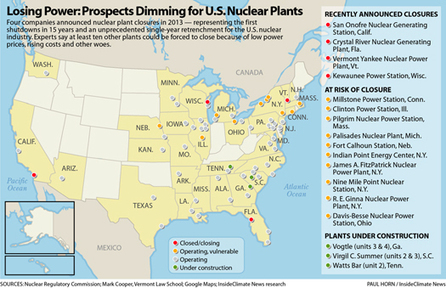
>The blows to nuclear power’s prospects have come on many fronts, but it was the surprising spurt of plant closures that laid bare the industry’s worsening plight. The plant shutdowns are the first to hit the U.S. nuclear power market in 15 years, and the retirements don’t bode well for many of the nation’s 99 remaining power reactors.

Analysts say economic woes make at least 10 other plants vulnerable enough to follow suit. Almost all of those are among the nation’s 47 “merchant” nuclear plants, which, unlike regulated plants, operate in open markets and have to beat out other power suppliers to win customers and long-term supply contracts. The especially vulnerable facilities cited by analysts are at greater risk for closure because their power is too expensive to sell profitably in wholesale markets or because their output is too small or too unreliable to support rising operating and retrofit costs.<

See on insideclimatenews.org

DOE awards $30M to develop utility cybersecurity tools

See on Scoop.itGreen & Sustainable News

The Department of Energy today awarded $30 million to a 11 security vendors to develop technology the agency says will better protect nation’s electric grid, oil and gas infrastructure from cyber-attack.

Duane Tilden‘s insight:

>The projects, which will combine power system engineering and cybersecurity, will include testing of the new products to demonstrate their effectiveness and interoperability, the DOE said. […]

While the DOE’s investment is welcomed, a survey of U.S. utilities in May shows what many utilities are up against. That survey called “Electric Grid Vulnerability,” said more than a dozen utilities said cyberattacks were daily or constant. The survey was commissioned by U.S. Democratic Representatives Edward J. Markey and Henry A. Waxman who are members of the U.S. House Energy and Commerce Subcommittee.<

See on www.computerworld.com

The Dark Side of Efficiency

zsturm's avatarInnovation in Business, Energy, and Environment

By Peter Brooks

In at least three of the cases we have studied so far (Maersk, Groom, Wal-Mart) efficiency was the one thing everyone seemed to agree on.  Investments in greater resource efficiency (energy, water, space) that cost less than future benefits are no-brainers; a company can save money while also preserving precious, finite resources (to say nothing of the safety, regulatory, aesthetic, and morale benefits of finding and fixing inefficiencies) and that is unequivocally a good thing.

Unfortunately there is a dark side to efficiency: it can be more destructive to the environment and speed the withdrawal and consumption of natural resources than if the investment were never made.  In the late 19th century, an English economist, William Jevons, made the startling discovery that technological improvements that increased the efficiency of coal-burning, led to an increased consumption of coal.  To put it another way, greater efficiency was used…

View original post 473 more words

Stanford Scientists Analyse Life Cycle Costs of Energy Storage vs Curtailment for Renewables

See on Scoop.itGreen Energy Technologies & Development

Stanford CA (SPX) Sep 17, 2013 –
Renewable energy holds the promise of reducing carbon dioxide emissions. But there are times when solar and wind farms generate more electricity than is needed by consumers.

Duane Tilden‘s insight:

>”We calculated how much energy is used over the full lifecycle of the battery – from the mining of raw materials to the installation of the finished device,” Barnhart said. “Batteries with high energetic cost consume more fossil fuels and therefore release more carbon dioxide over their lifetime. If a battery’s energetic cost is too high, its overall contribution to global warming could negate the environmental benefits of the wind or solar farm it was supposed to support.”

For this study, he and his colleagues calculated the energetic cost of grid-scale photovoltaic solar cells and wind turbines.

“Both wind turbines and photovoltaics deliver more energy than it takes to build and maintain them,” said GCEP postdoctoral scholar Michael Dale, a co-author of the study. “However, our calculations showed that the overall energetic cost of wind turbines is much lower than conventional solar panels, which require lots of energy, primarily from fossil fuels, for processing silicon and fabricating other components.” […]

To find out, the researchers compared the energetic cost of curtailing solar and wind power, versus the energetic cost of grid-scale storage. Their calculations were based on a formula known as “energy return on investment” – the amount of energy produced by a technology, divided by the amount of energy it takes to build and maintain it.

Using that formula, the researchers found that the amount of energy required to create a solar farm is comparable to the energy used to build each of the five battery technologies. “Using batteries to store solar power during periods of low demand would, therefore, be energetically favorable,” Dale said.

The results were quite different for wind farms. The scientists found that curtailing wind power reduces the energy return on investment by 10 percent. But storing surplus wind-generated electricity in batteries results in even greater reductions – from about 20 percent for lithium-ion batteries to ?more than 50 percent for lead-acid.<

See on www.solardaily.com

Google obtains a Renewable Energy Power Purchase Agreement in Texas

See on Scoop.itGreen Energy Technologies & Development

Duane Tilden‘s insight:

>The structure of this agreement is similar to our earlier commitments in Iowa and Oklahoma. Due to the current structure of the market, we can’t consume the renewable energy produced by the wind farm directly, but the impact on our overall carbon footprint and the amount of renewable energy on the grid is the same as if we could consume it. After purchasing the renewable energy, we’ll retire the renewable energy credits (RECs) and sell the energy itself to the wholesale market. We’ll apply any additional RECs produced under this agreement to reduce our carbon footprint elsewhere.<

See on googleblog.blogspot.ca

Japan to Switch Off Nuclear Power, With No Firm Date for Re-Start: Sci Am

See on Scoop.itGreen & Sustainable News

Japan is set to be nuclear power-free, for just the third time in more than four decades, and with no firm date for re-starting an energy source that has provided about 30 percent of electricity to the world’s third-largest economy.

Duane Tilden‘s insight:

>Kansai Electric Power Co’s 1,180 MW Ohi No.4 reactor is scheduled to be disconnected from the power grid late on Sunday and then shut for planned maintenance. It is the only one of Japan’s 50 reactors in operation after the nuclear industry came to a virtual halt following the March 2011 Fukushima disaster.

Japan last went without nuclear power in May-June 2012 – the first shutdown since 1970 – a year after a massive earthquake and tsunami triggered reactor meltdowns and radiation leaks at the Fukushima facility. The country’s nuclear reactors provided close to a third of the electricity to keep the $5 trillion economy going before the Fukushima disaster, and utilities have had to spend billions of dollars importing oil, gas and coal to make up for the shortfall. […]


IMPORT BILL

Japan consumes about a third of the world’s liquefied natural gas (LNG) production, and will likely boost LNG demand to record levels over the next couple of years. LNG imports rose 4.4 percent in volume to a record 86.87 million tonnes, and 14.9 percent in value to a record 6.21 trillion yen ($62.1 billion) in the year through March.

Imports are likely to rise to around 88 million tonnes this year and around 90 million tonnes in the year to March 2015, according to projections by the Institute of Energy Economics Japan based on a mid-scenario that 16 reactors will be back on-line by March 2015.<

See on www.scientificamerican.com

Scottish Power should not sponsor fuel poverty conference, say campaigners

See on Scoop.itGreen & Sustainable News

Fuel Poverty Action says energy company with £712m profits ‘whilst people froze in their homes’ is not appropriate sponsor

Duane Tilden‘s insight:

>Scottish Power came under particular fire this summer when its annual report revealed a doubling of annual pre-tax profits to £712m barely months after it had hiked its gas and electricity prices by 7%. The same report also showed that Scottish Power had paid a dividend of £890m to its parent company, Iberdrola, and given a £129,000 bonus to chief corporate officer Keith Anderson, taking his total pay for 2012 to over half a million pounds.

Fuel Poverty Action accused Scottish Power at the time of “making a killing” while Citizens Advice also expressed concern that there were “too many families forced to choose between heating or eating” and urged companies to put customers before shareholders.<

See on www.theguardian.com