Glut of Natural gas squeezes biofuel market

See on Scoop.itGreen Energy Technologies & Development
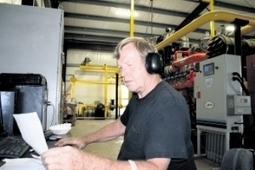
Farm Power Northwest has built five anaerobic digesters in Oregon and Washington in recent years, but the brothers who founded the company say the outlook for new projects has lost its luster.

Duane Tilden‘s insight:

>The Mount Vernon, Wash.-based company, founded by brothers Daryl and Kevin Maas, uses manure from dairy farms to create methane gas, then burns it in generators and sells the resulting electricity to power utilities.

[…]

While power utilities paid up to 9 cents per kilowatt-hour several years ago for digester-produced electricity, the rate has now fallen to 5 cents per kilowatt-hour, said Kevin Maas.

The reason is the price of natural gas — a common fuel for electrical generation — has plummeted as domestic production has skyrocketed. Natural gas is now trading at below $4 per thousand cubic feet, compared with nearly $13 per thousand cubic feet in 2008.

That’s because new technology known as hydraulic fracturing, or fracking, has greatly increased the amount of natural gas that can be economically extracted from the ground.

With the cost of natural gas so much lower, other energy feedstocks like biogas from digesters become less competitive, experts say.<

See on www.capitalpress.com

UK Shopping Centre goes zero Waste to landfill in a year

See on Scoop.itGreen & Sustainable News

As a new member of the National Recycling Star scheme, Clifton Down Shopping Centre received the Gold award for its recycling and waste management efforts and in recognition of its success in diverting all of its waste from landfill.

Duane Tilden‘s insight:

>The transformation in the centre’s waste management began with a full site audit to identify areas of poor practise within both its waste management and energy efficiency operations.  […]

As the shopping centre began to look at improving its waste management plan, it asked its tenants to start flat packing their waste cardboard, so it can be sent to the centre’s onsite compactor. Pre-flat packing waste cardboard has allowed the centre to double the amount of cardboard that can be collected by its waste contractor Smiths, while saving space in the services yard. This has cut the number of collections required, helping to save fuel consumption and CO2 emissions. All general waste produced by the shopping centre is sent to New Earth Solution’s mechanical biological treatment (MBT) facility at Avonmouth.

Clifton Down Shopping Centre has also been working to reduce its environmental impact by tackling its energy efficiency. New LED light fittings have been installed throughout the shopping centre, significantly reducing energy consumption and cost. The centre previously used old halogen lighting which consumed 14,994kW per annum, compared with the replacement LED lighting which consumes 2,998kW – an 80 per cent reduction. […]

The centre has also installed seasonal sensitive automatic doors at both entrances. These are programmed to close more quickly during winter months to minimise heat lose. This is switched during summer with doors remaining open for longer, allowing for cooler air to circulate the building. New electricity, water and gas monitors have been installed throughout the centre to measure consumption and identify areas of potential savings.<

See on www.e2bpulse.com

Innovations in waste water treatment processes to provide clean energy

See on Scoop.itGreen Energy Technologies & Development

The race is on to develop innovative, cost-effective ways to extract value from waste water instead of just dumping it, writes Sadhbh Walshe

Duane Tilden‘s insight:

>In a conventional treatment process, ammonia is converted back into nitrogen gas, a non-harmful gas which can be safely released into the atmosphere. The conversion process is expensive, however, and energy prohibitive.

What the Stanford team do, instead, is to use a less energy-intensive process to convert the ammonia into nitrous oxide (N2O), a powerful substance that is typically used to turbo-boost cars or fire rockets.

Normally, N2O is discouraged from forming because it is a harmful greenhouse gas, but when it is burned along with methane it becomes an energy source that can be used to power the treatment facility. According to Scherson, there is a double energy-saving benefit.

“Our process reduces energy input in nitrogen treatment and then the energy from nitrous oxide can potentially be used to power the plant making it energy neutral or even energy positive.”<

See on www.guardian.co.uk

COGA brings state into lawsuit against Longmont ‘fracking’ ban

See on Scoop.itGreen & Sustainable News

The lawsuit against Longmont&#27;s ban on fracking has now roped in the Colorado Oil and Gas Conservation Commission, the state&#27;s regulatory agency.

Duane Tilden‘s insight:

>Boulder County District Court Judge D.D. Mallard said she would allow the Colorado Oil and Gas Association to bring in the COGCC as an additional plaintiff, a move called “joinder.” In her ruling, Mallard said that while both parties had an interest in seeing the ban overturned, the state agency had aims that would not be adequately represented by COGA, the state’s largest oil and gas industry group.

“COGA’s interest in this case is to overturn the charter amendment so that its members can proceed with oil and gas production using fracking […]

Longmont voters passed the ban on hydraulic fracturing, or “fracking,” last November with about 60 percent in favor. Supporters of the ban say the practice can lead to environmental damage; opponents say the practice is so well-established that a ban on fracking is practically a ban on drilling, and that only the state has the authority to regulate the methods used.<

See on www.timescall.com

Duke U Study Links Hydraulic Fracturing to Ground Water Contamination

See on Scoop.itGreen & Sustainable News

The debate about whether or not fracking can contaminate ground water supplies has been raging for a while now, and a new study by Duke University has found proof

Duane Tilden‘s insight:

>But let us allow Jacksona et. al. to speak for themselves, from the report: “We analyzed 141 drinking waterwells across the Appalachian Plateaus physiographic province of northeastern Pennsylvania, examining natural gas concentrations and isotopic signatures with proximity to shale gas wells. Methane was detected in 82% of drinking water samples, with average concentrations six times higher for homes” less than one kilometer from the fracked natural gas wells. […]

“They found that, on average, methane concentrations were six times higher and ethane concentrations were 23 times higher at homes within a kilometer of a shale gas well.  Propane was detected in 10 samples, all of them from homes within a kilometer of drilling. […]

The ethane and propane data are “particularly interesting,” he noted, “since there is no biological source of ethane and propane in the region […]<

See on oilprice.com

Fracking ban halts first shale gas project in Spain

See on Scoop.itGreen & Sustainable News

A ban on fracking in a northern region of Spain has crimped Repsol SA’s plans to begin drilling for shale gas in the north of Spain.

Duane Tilden‘s insight:

>Spain’s richest shale gas reserves have been determined to exist in the northern region of Cantabria, but back in April the local Cantabrian government  implemented the country’s first fracking ban, worried that such activities may pollute the local sources of drinking water. (Related article: Duke University Study Links Fracking to Ground Water Contamination) […]

Repsol had planned to begin seismic studies, with a view to drilling, in July, but the Cantabrian fracking ban, which prevents all hydraulic fracturing activities within the region’s borders, has put a hold on plans. In truth, it is not fully understood how the ban will affect Repsol, whose Luena project covers 290 square miles, and stretches from Cantabria down to Castille & Leon. Normally when a project extends across two regions or more it is regulated by the national Industry Ministry, not local governments. <

See on www.csmonitor.com

Swansea Bay hydrokinetic project continues moving forward

See on Scoop.itGreen Building Design – Architecture & Engineering

Energy development group Tidal Lagoon Power Limited has reached a significant milestone in the development of a massive hydroelectric power project with the announcement of three design, build and deliver agreements.


Duane Tilden‘s insight:

>[…]According to TLP, the US$966.5 million project will consist of a 6-mile-long, 35-foot-high semi-circular sea wall that will enclose an area west of Swansea Marina.  The wall would be dotted along its length with a number of hydro turbines, giving the project a cumulative capacity of around 250 MW.

Each of TLP’s three partners adds a unique quality to the project’s development, the company said.  Costain will work in developing and managing the schedule for pre-construction and construction phases, developing construction methodology for civil engineering works including turbine and sluice structures, access routes and complex temporary works, including temporary bund for construction turbine housing.

Meanwhile, Atkins will provide engineering design and geotechnical expertise. TLP said this includes “designing both the turbine house and the innovate breakwater bund wall, which uses a combination of giant tubular sand bags protected by armor made up of different sized rocks.”

Last, Van Oord is developing construction methodology suitable for the harsh off-shore conditions in Swansea Bay.  The Swansea is the first tidal lagoon power project envisioned by TLP, which said in May that it is considering a similar project off Wales’ north coast. As much as 10,000 MW of tidal lagoon power potential in the United Kingdom, the group said. […]<

See on www.hydroworld.com

Is Scotland’s Pentland Firth the World’s Best Site for Tidal Power

See on Scoop.itGreen Energy Technologies & Development

Tidal streams could bring large amounts of energy within a decade if government support is available, study says

Duane Tilden‘s insight:

>The world’s best site for tidal power, the Pentland firth, could provide half of Scotland’s electricity, according to the first robust estimate of its potential. The tidal streams, which surge through the firth at five metres per second, could bring large amounts of renewable energy in reach within a decade if enough government support is available, said the Oxford University engineer behind the new study.

From Anglesey to the Severn estuary to Portland Bill, the UK has the greatest potential for generating predictable, clean energy from tidal channels. Turbines are already operating at Strangford Loch in Northern Ireland and prototypes are being tested in the Menai Straits off Anglesey.

But the Pentland firth is the greatest resource. “It is almost certainly the best site for tidal stream power in the world,” said Thomas Adcock, at Oxford University, who led the new work published in the journal Proceedings of the Royal Society A. The water flow is rapid there because the tide shifting from the Atlantic into the North Sea is forced through a narrow eight-mile channel.<

See on www.guardian.co.uk

Three Types of Climate Action for Europe and Central Asia Region

See on Scoop.itGreen Energy Technologies & Development

Under current trajectories, the world is headed toward a world that will be 4 degrees warmer by the end of this century.

Duane Tilden‘s insight:

>[…] However, as we try to show in our recent publication, Growing Green: the Economic Benefits of Climate Action, strategic investment in climate action can benefit these countries in the medium- and long-terms – thus offsetting the negative consequences of these investments.

Above all, countries need to focus on three types of climate action: climate action as aco-benefit, climate action as an investment, and climate action as insurance.

This first area of climate action is simply a co-benefit of policies that make sense even if we were not concerned about climate change. These are things like supporting energy efficiency investments or restoring degraded soils to make agriculture more productive (while also increasing carbon storage in soils).

The second area is what we call climate action as an investment. This gets at the issue of how countries can benefit from greening their economies – doing well by doing good. What we have seen in the last few years is that new firms emerge in countries that have implemented ambitious green policies early and take advantage of the economic opportunities that have sprung from these policies. […]<

See on blogs.worldbank.org

Synthesis of Butanol: Towards a Better Biofuel

See on Scoop.itGreen Energy Technologies & Development

Researchers have developed a catalyst to convert ethanol into butanol with high selectivity, potentially allowing butanol to replace ethanol as a biofuel.

Duane Tilden‘s insight:

>[…] Because manufacturers can prepare ethanol from renewable sources, researchers consider the biofuel a good alternative to standard fossil fuels such as gasoline. Indeed, its production and use have increased remarkably in the last ten years; manufacturers now commonly add ethanol to gasoline fuels.

Despite this increased use, however, ethanol has several disadvantages. It has a lower calorific value than standard gasoline (19.6 vs. 32 MJ/liter); moreover, it is corrosive. For this reason, the maximum amount which can be added to standard gasoline is about 10 %; cars cannot use fuels with higher ethanol amounts without engine modifications.

Butanol: a Better Option

1-Butanol (CH3-CH2-CH2-CH2-OH), an alcohol with a longer chain, could be a better alternative to ethanol. Indeed, it has a higher calorific value (29.2 MJ/liter) and it is much less corrosive; because of this, manufacturers can add it to gasoline in higher proportions without engine modifications, and theoretically it could completely replace the gasoline. Moreover, its octane number is very similar to that of gasoline – 96 vs 91-99.

Despite these characteristics, however, we’re not yet using butanol in cars due to the difficulties in producing the alternative biofuel. […]<

See on www.decodedscience.com