Applying Intelligent Efficiency to the Transportation Sector

A new report from ACEEE, Energy Savings from Information and Communications Technologies in Personal Travel,estimates that aggressively incorporating a handful of ICT strategies could reduce energy consumption in transportation by almost 13% by 2030.

Source: aceee.org

>” […] Intelligent efficiency is the use of information and communications technologies (ICT) to improve the overall productivity and efficiency of a given sector.

In transportation, intelligent efficiency can affect the way we travel by providing us with real-time feedback and information on fuel economy, making it easier for us to use alternatives to driving such as public transit and bicycles, and by moving traffic away from peak travel times and consolidating travelers into fewer vehicles.

[…] The strategies discussed in the report include:

  • Car and bike sharing
  • Real-time transit information
  • In-vehicle feedback
  • Vehicle-to-vehicle communications and driver assist applications
  • ICT-based transportation demand management programs (TDM)

The report aims to provide readers with a sense of the relative magnitude of energy savings possible from these strategies, and is by no means a definitive overall estimate. ICT could be incorporated in many additional ways in the transportation sector. The strategies described here are simply the tip of the iceberg when it comes to implementation. Studies from Europe have shown that reductions could be as high as 26% if we consider the whole universe of strategies and options. […]”<

See on Scoop.itGreen Energy Technologies & Development

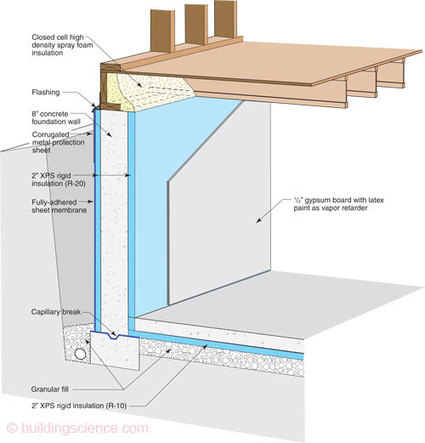
High-R20 Concrete Foundation Construction Diagram – Building Science

This construction strategy has an installed insulation R-value of R-20.

Source: www.buildingscience.com        >” […]


  • Dampproofing
  • 2″ XPS rigid insulation
  • Concrete foundation wall
  • 2″ XPS rigid insulation
  • 2″ XPS rigid sub-slab insulation
  • Gypsum board with vapor retarder paint
  • 2″ XPS rigid insulation under slab

Thermal Control:  This construction strategy has an installed insulation R-value of R-20 and has a predicted annual heating energy loss of 16.7 MBtus.

Moisture Control:  Two inches of XPS on the interior, connected to the thermal break at the slab edge, controls the interior vapor drive and capillary wicking to the interior so there are no moisture related issues from inward vapor diffusion or capillary wicking.

Constructability and Cost:  The interior of the insulated concrete form will require drywall or other thermal barrier to achieve the fire rating required by code. The gypsum board is very easy to attach to the plastic clips designed into the ICF. The drywall should not be painted, if it is not necessary, to allow maximum drying of the concrete. It may be easier and more practical to install a thin framed wall (e.g. 2×3 wood or steel framing) on the interior of the ICF to allow any necessary services to be run in the wall, and potentially more insulation.

Other Considerations:  Because the concrete is installed between two vapor retarding layers, it will take several years for the concrete to dry to equilibrium. Since additional interior vapor control should be avoided, no more than latex paint should be used on the interior surface of the drywall. […]”<


See on Scoop.itGreen Building Design – Architecture & Engineering

Energy Efficiency Key to Reducing Energy Waste and Consumption

Advocates say doing more with less power may be an even more critical weapon in the fight against climate change than renewable technologies.

Source: www.nytimes.com

>” […]

“Some people call energy efficiency low-hanging fruit. I would even say energy efficiency is fruit lying on the ground. We only need to bend over and pick it up.”

Realizing those energy savings would be a huge boon to the climate, ease illness-causing air pollution, reduce many nations’ reliance on fuel imports and increase competitiveness by lowering costs, the advocates say. It creates jobs in fields like upgrading buildings, and is generally cheaper than the alternative of constructing new power plants and buying more energy, they argue. […]”<

See on Scoop.itGreen & Sustainable News

Organic Rankine Cycle (ORC) Heat Recovery Technology For Ships

The company has developed a marine Organic Rankine Cycle (ORC) system for waste heat recovery and power generation that could reduce fuel consumption by up to 10%.

Source: www.motorship.com

“> […] Enertime’s ORC system produces between 500kW and 1MW of electrical power depending on the available amount of heat. The unit is based on a tailor-made axial turbine and is specifically designed to work in the marine environment. The development work has involved shipyards, shipowners and a classification society, says Mr David.

“Compared to a steam power cycle, ORC systems need very low maintenance, display good part-load efficiency, high availability and can be operated without permanent monitoring,” he said. “Daily operation and maintenance can be carried out without specific qualification.”

The ORC system can work with any kind of heat source. The unit can recover heat from a number of different sources singly or in combination including low-temperature jacket cooling from engines, steam or thermal oil systems and pressurised hot water. Exhaust gas from engines or auxiliaries is the main available heat on board ships, and it can be collected through an exhaust gas heat exchanger and brought to the ORC unit using steam, pressurised water or thermal oil. […]

The ORC layout is flexible and the unit can also be installed as a retrofit where it is possible to adapt the layout of the machinery to specific constraints by splitting it on different levels, for example.

“This kind of system would be very interesting for bulk carriers, small to medium size oil tankers, ferry boats, small container ships… with payback time between two to five years,” […]”<


See on Scoop.itGreen Energy Technologies & Development

Lightweight ‘solar cloth’ photovoltaics for Integration with Building Structures

A Cambridge start-up believes its flexible solar panelling solution could fundamentally change the landscape of solar installation in the commercial sector.

The Solar Cloth Company’s award winning flexible thin film photovoltaics (FTFP) are a few micrometres thick and can be integrated into flexible and lightweight tensile structures called building integrated photovoltaics (BIPV). In doing so, they provide an alternative to traditional photovoltaic panels that are heavy and cumbersome.

Source: www.theengineer.co.uk

See on Scoop.itGreen Building Design – Architecture & Engineering

Energy Storage Technologies Will Replace Utilities Gas Fired Turbine Peaker Plants

“Power grids need extra generating capacity to work properly. For example, about 20 percent of New York State’s generation fleet runs less than 250 hours a year. Because they don’t run much, “peaker plants” are by design the cheapest and least efficient fossil generators.”

Source: www.renewableenergyworld.com

>”[…] As has happened with solar PV, the costs for multi-hour energy storage are about to undergo a steep decline over the next 2 to 3 years. This cost trend will disrupt the economic rationale for gas-fired simple cycle combustion turbines (CTs) in favor of flexible zero emissions energy storage. This will be especially true for storage assets owned and operated by vertical utilities and distributed near utility substations.

Simple cycle gas-fired CTs have been a workhorse utility asset for adding new peaker capacity for decades. But times and technologies change, and the power grid’s long love affair with gas-fired CTs is about to be challenged by multi-hour energy storage. Flow batteries that utilize a liquid electrolyte are especially cost-effective because the energy they store can be easily and inexpensively increased just by adding more electrolyte.

CTs cost from $670 per installed kilowatt to more than twice that much for CT’s located in urban areas. But the economics of peaking capacity must also reflect the benefits side of the cost/benefit equation. Distributed storage assets can deliver both regional (transmission) and local (distribution) level energy balancing services using the same storage asset. This means the locational value and capacity use factor for distributed storage can be significantly higher compared to CTs operated on a central station basis.

[…]

The disruptive potential of energy storage as a substitute for simple cycle CTs has been recognized. For example, Arizona Public Service (APS) and the Residential Utility Consumer Office (RUCO) recently filed a proposed settlement which, if approved, would require that at least 10% of any new peaker capacity now being planned as simple cycle combustion turbines would instead need to be energy storage — as long as the storage meets the cost effectiveness and reliability criteria of any CTs being proposed.

[…]

Lower cost solar PV and its rising penetration in all market segments will have a profoundly disruptive effect on utility operations and the utility cost-of-service business model. This has already started to happen. Storage offers a way for utilities to replace lost revenues premised on margins from kilowatt-hour energy sales by placing energy storage into the rate based and earning low-risk regulated returns.”<

See on Scoop.itGreen Energy Technologies & Development

Net Zero Energy Buildings at Zero Cost

The Netherlands has found a way to refurbish existing buildings to net zero energy, within a week, with a 30-year builders’ guarantee and no subsidies.

Source: www.energypost.eu

>”Inside the house, the pounding rain stills to distant murmur. That’s thanks to the triple glazing, points out Ron van Erck, enthusiastic member of Platform31, an innovation programme funded by the Dutch government that brings together different actors for out-of-the-box thinking to crack intractable problems. One of its big successes to date is Energiesprong, an initiative that turns the building market on its head to deliver social housing with zero net energy consumption, i.e. no energy bill, at zero cost to the tenant and with no subsidies to the builder.

Starting off in 2010 with three staff, a €50 million budget and five years to come up with something to make buildings more sustainable, Energiesprong today boasts 45 staff and a deal with 27 housing associations and four big construction companies to refurbish 111,000 houses in the Netherlands. Total investment? €6 billion. The initial focus is social housing, but it’s already looking at the private market, care centres and commercial office buildings too.

How does the plan work? The basic trick is that tenants instead of paying their energy bills, pay a similar amount to the housing corporations that own the houses. With this money, the corporations pay building companies to retrofit the houses, which after renovation have net zero energy costs. The building companies have for this project developed ‘industrialised’ renovation procedures that are highly cost-effective. One important difference with existing renovation projects is that all elements that are needed for a successful move to zero-energy housing are brought together  in one plan.

Energy Post’s Sonja van Renssen met with manager Jasper van den Munckhof, to understand exactly what Energiesprong does, how it does it and why it will succeed – in the Netherlands and elsewhere.

Q: What was your starting point?

A: We started off with what we spend. The household energy bill in the Netherlands is about €13 billion. This money is available. If you spent it on a mortgage or payback on a loan of about 30 years [instead of energy], you have €225 billion to invest in the Dutch housing stock. This is substantial money: €30-40,000 per house to make it energy neutral.

“Retrofit wasn’t interesting – unless you were rich – but using the energy bill to fund it, no one had thought of that! A building and its energy system were developed as parallel, complementary but not integrated, entities.”

-Jan Kamphuis, BJW Wonen, a one-stop-shop for retrofits inspired by Energiesprong

The trick is, how to get this money flowing. We tried to imagine what owners would need to start investing. They buy kitchens and they don’t see this as an investment but good for their family. You need to get this focus on people and how they buy stuff, how they accept things. If you lose that focus and think it’s about financial arrangements, you won’t find a solution.

Q: So what will make people spend money on retrofits?

A: It needs to be very well done, like if they buy a car, they buy a decent one. It has to be fast – the problem with retrofitting (vs. buying new stuff) is that it’s usually a lot of trouble, dust and hassle. So we said one, the retrofits have to be done within a week. Two, it has to be affordable: ideally the cost to the tenant before and after should be equal. That means the energy bill converted to the mortgage or extra rent has to cover the full cost of the retrofit. Three, it has to be attractive. It needs to be something you see. […]”<

See on Scoop.itGreen & Sustainable News

Efficient HVAC Systems

Gallery

This gallery contains 15 photos.

Originally posted on Energy Systems & Sustainable Living:
Heating, Ventilation and Air Conditioning systems (HVAC) controls the indoor climate by adding or extracting heat and adding or removing mass (e.g. water vapour and dust). To combat summer heat and winter…

Multifamily Building Energy Efficiency: SLEEC Financing

This winter, ACEEE, in partnership with Energi Insurance Services, will host a second gathering of select members of the Small Lenders Energy Efficiency Community (SLEEC) in Washington, D.C. The initial SLEEC convening in October 2013 brought together small- to medium-size lenders to discuss strategies for expanding activity in the market for energy efficiency financing. Building off the success of that first meeting, the second SLEEC gathering will focus exclusively on financing in the multifamily sector […]

Source: aceee.org

>” […] The goal of the upcoming SLEEC meeting is to discuss how recent developments inform the lender perspective on the size, attractiveness, and viability of the finance market for multifamily efficiency. We chose to address multifamily this year because potential savings are phenomenal at an estimated $3.4 billion per annum, and multifamily has traditionally been characterized by the label “hard to reach” due to significant barriers to entry. Single-family residential, large commercial, and MUSH (municipal, universities, schools, and hospitals) markets pose fewer barriers and have therefore been easier to approach, while multifamily is a more complex market posing greater obstacles.

The first and most commonly cited obstacle is known as the split-incentive problem: Landlords and building owners don’t always have an incentive to pursue energy efficiency improvements since their tenants would be the ones benefitting from reductions in energy bills. The next most bemoaned roadblocks are a lack of information and lack of available capital. Landlords and owners are experts at running their buildings, but may be in the dark on energy efficiency. Utilities and many loan agencies, while knowledgeable about energy efficiency, lack experience interacting with tenants. The resulting information gap inhibits energy efficiency projects from getting off the ground. This problem is exacerbated by a lack of capital, especially in the affordable housing market, where many buildings owners hold 30-year mortgages on their property with only one refinancing opportunity after 15 years. Unless building owners and potential lenders can capitalize on this small window, many projects would not have another opportunity to finance efficiency improvements for another 15 years.

Despite these barriers, there are a number of successful initiatives that are poised for impact. Perhaps the most successful is Energy Savers, a Chicago-based partnership between Elevate Energy and the Community Investment Corporation (CIC) that has retrofitted 17,500 apartments since 2008.  […] Innovative programs such as these are paving the way for energy efficiency in the multifamily housing market.

A perceived lack of capital may be attributable to issues surrounding the valuation of energy efficiency from a building owner’s perspective that manifests as low demand. […] “<


See on Scoop.itGreen Building Design – Architecture & Engineering

Lighting Controls in Buildings, Demand Management and Microgrid Development

Lighting control systems can help microgrids shed load, improve demand response, use resources efficiently, and offer greater overall reliability.

Source: energyefficiencymarkets.com

>” […] Lighting Control Facilitates Load-shed Strategies

Load shed, or the ability to quickly reduce electricity use during peak periods, is critical to ensuring microgrid reliability. Because lighting uses a considerable proportion of building peak electrical loads (30% of peak electricity),1 and because reduced light levels deliver immediate reductions in electricity, lighting control is one of the simplest and most predictable demand response solutions.

The reduction of lighting load also provides a reduction in HVAC cooling load during the summer, which is the most common peak electrical period.  Furthermore, since dimming is typically unobtrusive when it is executed over a period of time (as little as 10 seconds), lighting control is a viable option for immediate emergency response.

Dimming as a load shed strategy is highly effective because the human visual system has the ability to accommodate a wide variety of light levels with minimal effect on the occupants2,3.  When a demand reduction is required a gradual dimming of electric lighting can reduce light levels by 35 percent before 20 percent of the occupants attempt to intervene.  Response time is essentially instantaneous, typically has little impact on occupant comfort, and demand savings from lighting are more predictable than those from HVAC response.

Light management systems have the capability to automatically trigger a demand response event from a utility signal or from time clock scheduling. Therefore, a predictable and effective demand response strategy can be automatically implemented while going virtually unnoticed to the building occupants.

Energy codes, standards, and green building certifications such as ASHRAE (American Society of Heating, Refrigerating, and Air Conditioning Engineers) 90.1, IECC (International Energy Conservation Code), California Title 24, ASHRAE 189, IgCC (International Green Construction Code), or LEED (Leadership in Energy and Environmental Design) now include lighting controls as a part of a whole-building energy strategy.

There are subtle differences for each code/standard/certification, but some general requirements and/or credits include: required lighting control for most areas (manual or automatic), automatic lighting shut-off, some automatic receptacle shut-off, daylight controls for daylit spaces, automatic shut-off of exterior lighting during daytime hours, and various levels of occupancy/vacancy control. As a result of buildings updating their basic lighting control infrastructure to meet code, they are increasingly becoming capable of connecting to a microgrid, without the need for additional significant investments.

[…]”<

See on Scoop.itGreen Building Operations – Systems & Controls, Maintenance & Commissioning