Innovative Empire State Building Program Saves Millions, Establishes New Energy Efficiency Model Nationwide

See on Scoop.itGreen Building Operations – Systems & Controls, Maintenance & Commissioning

/PRNewswire/ — The innovative energy efficiency program at the Empire State Building has exceeded guaranteed energy savings for the second year in a row, saving $2.3 million and providing a new model for building retrofits that is now being rolled…

Duane Tilden‘s insight:

>”The success from the Empire State Building retrofit project further demonstrates that thoughtfully applied energy-efficiency investments can deliver unparalleled returns through a combination of lower energy, lower operating costs, and increased building valuation,” said Iain Campbell, vice president, Global Energy and WorkPlace Solutions, Johnson Controls Building Efficiency.  “When implemented under a performance contract, the energy savings are guaranteed, ensuring a no-risk investment and a smart business decision.”

The retrofit has attracted new Empire State Building tenants over the past two years, including LinkedIn, Skanska, LF USA, Coty Inc., the Federal Deposit Insurance Corp., and Shutterstock.  These tenants sought space that reflected their sustainability values, provided more comfort for employees, and allowed them to monitor and control their energy use.

“The Empire State Building project has conclusively proven the business case for deep energy retrofits of any building,” said Raymond Quartararo, international director at Jones Lang LaSalle.  “We have consistently surpassed annual projected energy savings through a process that is very transparent, quantitatively intense and internationally approved.  The overwhelming majority of people want to do their part to reduce energy usage while delivering economic returns and occupying an environmentally responsible building.”<

See on www.sacbee.com

Better Buildings Act Brings Energy Efficiency Opportunities to Tenants

See on Scoop.itGreen & Sustainable News

Bipartisan Bennet-Ayotte Legislation Aimed at Boosting Energy Efficiency in Commercial Buildings

Duane Tilden‘s insight:

>To date, the focus has been on how real estate owners and developers may lower energy consumption at the “whole-building” level. However, office tenants like data centers, law firms, banks, trading floors, restaurants, and retail stores use a lot of energy – especially in areas experiencing large growth and development. The Better Buildings Act takes a holistic approach by considering office tenants’ impact on energy consumption and behaviors.

In addition to the “Tenant Star” designation, the bill asks the Department of Energy to study and learn from private sector “best practices” of how commercially-leased spaces are designed to achieve high performance and help reduce utility costs for businesses.

“Senators Bennet and Ayotte have championed innovative, transformative energy policy through their Better Buildings Act and its ‘Tenant Star’ provisions,” said Jeffrey D. DeBoer, President and CEO of The Real Estate Roundtable. “Tenants consume 50% or more of the energy used by commercial buildings, so they should be recognized for making smart choices in high-performance design and operations within leased spaces they control.  This bill is a major step forward to better align commercial landlords and tenants toward a common goal of lowering energy use in built environments across our nation.”<

See on www.bennet.senate.gov

Integrating Building into the Smart Grid

See on Scoop.itGreen Building Design – Architecture & Engineering

It will take time to get from point A, today’s grid and building technologies and power markets to point B, a Smart Grid with intelligent buildings and transactive markets, but it can be done.

Duane Tilden‘s insight:

>Transactive energy will play a critical defining role in grid modernization and shaping the Smart Grid.  Buildings, as noted in last week’s article consume 40% of the nation’s energy.  And while building owners can justify purchase decisions on energy savings as well as sustainability values, there’s another crucial factor for building owners to invest in technologies that reduce energy use and deliver self-generation.  That reason is to address the increasing vulnerability of the electrical grid to momentary and sustained power outages to both natural and human causes.

Buildings and their occupants are impacted by grid-related power outages.  The negative impacts range from reduced work productivity and decreased occupant safety and health to reductions in lifestyle standards.  Just like real estate values are higher for green buildings with LEED recognition, in the future, buildings that are grid-hardened may command premium prices because they preserve delivery of services regardless of grid status.  It is a compelling new variable in value propositions for tenants and occupants.<

See on theenergycollective.com

101-Year-Old Toledo Museum of Art Building Goes Temporarily “Off the Grid” After 20 Years of Implementing Green Initiatives – absolutearts.com

See on Scoop.itGreen Building Operations – Systems & Controls, Maintenance & Commissioning

Museum briefly becomes a provider, rather than user, of electricity

Duane Tilden‘s insight:

>TOLEDO, OHIO–On Tuesday, May 21 the Toledo Museum of Art achieved a milestone in its 20-year effort to reduce energy consumption: its 101-year-old Beaux Arts main building stopped drawing power from the electrical grid and actually started returning power to the system. The ongoing process, which incorporates using sustainable energy practices such as solar power, energy-efficient lighting, micro turbines and chillers, has resulted in hundreds of thousands of dollars in cost savings over the years.

[…]

Bernhard cited lighting as a good example. The first generation of LED lights weren’t suitable for illuminating and protecting art, so they were bypassed at the time. Now that the technology has dramatically improved, LED fixtures are now being introduced into the galleries, where lights frequently burn out from continual usage. The new lights not only save energy but last much longer, decreasing labor costs associated with the constant replacement of bulbs. The lighting in the renovated lot is also provided by new LED fixtures, which provide greater illumination while using less electricity

Bintz and Bernard also added new micro turbines and chillers to the power plant at TMA’s world-famous TMA Glass Pavilion during last year’s energy upgrade. The heat from the building’s working glass hot shop is recycled into the rest of the building during cold months. While generating electricity, the micro turbine waste heat is used to heat the building in the colder months and generate chilled water for air conditioning in the summer.<

See on www.absolutearts.com

DPR Construction’s Phoenix Office First Net-Zero Energy Commercial Building in Arizona

See on Scoop.itGreen Building Design – Architecture & Engineering

PHOENIX, May 17, 2013 (BUSINESS WIRE) — DPR Construction (DPR), a national technical builder specializing in highly complex and sustainable projects, announced today the achievement of net-zero energy consumption in its Phoenix Regional Office.

Duane Tilden‘s insight:

>The renovated 16,533-square-foot office building is located in Phoenix’s Discovery Triangle at the corner of 44th Street and Van Buren. In less than 10 months, the team, which included national design firm SmithGroupJJR and global consulting firm DNV KEMA Energy and Sustainability, researched, designed, permitted, and built a highly-efficient, modern workplace with a number of innovative sustainability features including:

— 87 operable windows working in tandem with the energy monitoring system to open and close based on the relative indoor and outdoor temperatures

— 87-foot zinc clad solar chimney which creates a convection current to release hot air out of the building while drawing cooler air in

— Shower towers that act as evaporative coolers by working together with the operable windows and solar chimney to regulate building temperatures

— Twelve eight-foot Isis(R) Big Ass(R) Fans that enable free air flow within the office

— 82 strategically positioned Solatubes(R) that nearly eliminate the need for artificial daytime lighting […]<

See on www.marketwatch.com

Xcel Energy NCAR expand partnership on renewable energy forecasting – Pennenergy

See on Scoop.itGreen Energy Technologies & Development

In the next two years, NCAR scientists and engineers will develop custom forecasting systems to enable Xcel Energy control centers in Minneapolis, Denver, Golden, Colo., and Amarillo, Tex., to anticipate sudden changes in wind, shut down turbines ahead of potentially damaging icing events and even predict the amount of energy generated by private solar panels.

Duane Tilden‘s insight:

>To help utilities anticipate wind energy more reliably, NCAR began designing a wind energy prediction system for Xcel Energy in 2009 that saved the utility’s customers more than $6 million in 2010 alone. The specialized system relies on a suite of tools, including highly detailed observations of atmospheric conditions, an ensemble of powerful computer models, and artificial intelligence techniques to issue high-resolution forecasts for wind farm sites.

NCAR’s new agreement with Xcel Energy focuses on the following areas:

Forecasting major changes in wind energy over a few hours due to a passing front or another atmospheric event.Forecasting ice and extreme temperatures to predict the impacts of freezing rain on wind turbines, which cannot operate when coated in ice.Generating solar forecasts using a combination of computer models and specialized cloud observing tools to help Xcel Energy better anticipate when customers are getting power from their own panels.<

See on www.pennenergy.com

Energy scavenging by U.S. Army Research Laboratory using SmartBED – Energy Harvesting Journal

See on Scoop.itGreen Energy Technologies & Development

Energy Scavenging is just one way ARL experts are getting more from existing resources, said Dr. Edward Shaffer, who is the Energy and Power Division Chief at the lab. Energy harvesting is critical to realize “net zero” energy use, a key element of the…

Duane Tilden‘s insight:

Department of Defense operational energy is an emerging area being shaped. It is what is required to train, move, and sustain forces, weapons, and equipment for military operations. It accounted for 75 percent of all energy used by DOD in 2009, according to the Energy website for DOD. It was in May 2011, when the Assistant Secretary of Defense for Operational Energy, Plans and Programs defined an operational energy strategy, and then published Operational Energy for the warfighter, a guide that would transform the way the DOD consumes energy in military operations.

Shaffer has a wide view of the energy needs across Army, DOD and interagency forums that explore complimentary ways of addressing energy and power technology gaps and reduce duplicated efforts, including the DOD Energy and Power Community of Interest and the Interagency Advanced Power Group that includes agencies like the Department of Energy and NASA. These communities are comprised of scientists, engineers, subject matter experts, technologists and program managers with a common interest in promoting innovative energy and power solutions for the nation.

At ARL, the future is a seamless energy architecture that begins with concepts like SmartBED, Long-lived Power and Fuel-Reforming for better energy convergence.

See on www.energyharvestingjournal.com

Zero Carbon Building Wins Hong Kong’s Inaugural Engineering Innovation Award

See on Scoop.itGreen Building Design – Architecture & Engineering

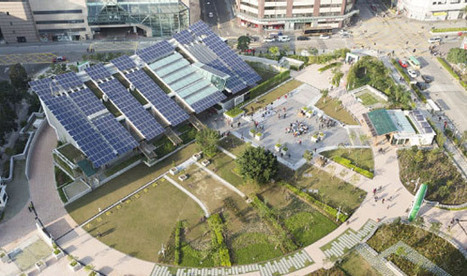
Image Source: Arup Hong Kong’s Zero Carbon Building (ZCB) has won the inaugural “Champion of the Innovation Award for the Engineering Industry” from the Hong Kong Institution of Engineers (HKIE). The ZCB employed a swath of integrated innovatio …

Duane Tilden‘s insight:

The ZCB employed a swath of integrated innovations to best meet the unique conditions of Hong Kong’ sub-tropical location and frenetic urban setting, incorporating a total of over 80 sustainability features to heighten its efficiency and diminish its environmental impact.

The roof of the three-storey building is almost completely covered in photovoltaic panels to take advantage of Hong Kong’s torrid climate for power generation purposes. In addition to solar power, the ZCB is also capable of producing energy using biodiesel derived from waste cooking oil, which is widely used in the city’s thriving culinary culture.

See on designbuildsource.com.au

Intel, Microsoft top clean energy ranking | SmartPlanet

See on Scoop.itGreen & Sustainable News

The EPA has released an updated ranking of the top 50 organizations that use renewable energy to power their U.S. operations.

Duane Tilden‘s insight:

The agency’s Green Power Partnership, which updates the list quarterly, said Intel uses clean energy to cover 100 percent of its electricity load. Microsoft moved into second place by increasing its green power use to more than 1,9 billion kilowatt-hours annually. Kohl’s came in third, followed by Whole Foods and Walmart.

See on www.smartplanet.com

Unleash Active Daylighting Benefits for Your Green Building with Ciralight SunTracker | Eco-Business.com

See on Scoop.itGreen Building Operations – Systems & Controls, Maintenance & Commissioning

Green buildings in tropical regions such as Indonesia will benefit from active daylighting.

Duane Tilden‘s insight:

Now, what is active daylighting?

95% of available systems are passive in nature – meaning they use static, non-moving/tracking systems unable to adjust for the sun’s angle throughout the day; creating uneven lighting, roaming hot spots, and obtrusive glare.

Active Daylighting is a system that mechanically tracks the sun throughout the day and redirects sunlight inside buildings at an intensity that allows artificial lighting to be turned off. Ciralight’s active daylighting system significantly outperforms passive systems when comparing the amount of daylight directed into a building; upwards of 300% more.

See on www.eco-business.com