CEC Delays Energy Benchmarking and Disclosure Requirements 2 Years for Smaller Buildings


>”[…]Compliance with AB 1103 is not suspended, and will continue to be required, for the sale, lease, or financing of buildings over 10,000 square feet that are otherwise subject to the regulations based upon occupancy type.

Significant barriers to compliance with AB 1103

An Emergency Rulemaking Action requires a description of specific facts justifying the immediate action. In justifying the two-year delay, the CEC explained that several stakeholders had expressed concerns about significant barriers to compliance with AB 1103. The CEC noted the following factors in justifying the two-year delay:

  • Some utilities have required tenant consents before releasing utility usage data despite letters sent from the CEC to utilities in July 2013 prohibiting such requirement. This requirement to obtain tenant consents significantly increases compliance costs.
  • Smaller utilities have expressed concerns with their ability to comply given limited staff and resources.
  • The Portfolio Manager platform and software has experienced significant technical problems.
  • The expansion in scope to smaller buildings would increase the number of compliance requests received by utilities, impeding their ability to address barriers to compliance.
  • Smaller building owners may lack the expertise, resources, or capacity necessary to overcome current barriers to compliance without incurring undue expense.
  • Based on initial disclosure data following the January 1, 2014 implementation, it became apparent that “the required disclosures were not being made for the majority of transactions for which they were required.”
  • The development of best practices approaches is lowering compliance costs and paving the way to greater compliance. The additional two years will facilitate lower costs and higher compliance rates before further expanding the program to smaller buildings.”<

See on Scoop.itGreen Building Operations – Systems & Controls, Maintenance & Commissioning

US Company Deploys Aqueous, Lithium-Ion and Flow Batteries for Grid Storage

“Batteries must do more than just work—they have to scale.”

Source: www.greentechmedia.com

>”[…] The startup is a software developer and system integrator that has attracted investment, personnel and a growing roster of turnkey energy storage projects.

[…]

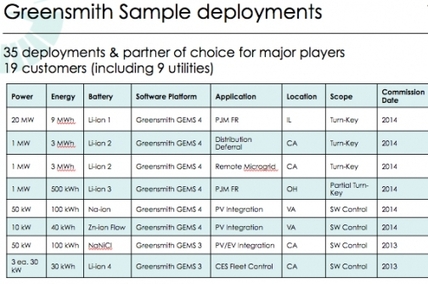
Companies like the 30-employee Greensmith are winning energy storage projects not because they are building better batteries but because they are writing software that integrates batteries with inverters and allows energy storage to work with the grid at scale. Greensmith works with a variety of battery chemistries from different vendors, as well as multiple inverters and power electronics partners.

New battery technologies and projects

Amongst other technologies, Greensmith is using Aquion Energy’s sodium-ion battery. The Pittsburgh, Penn.-based Aquion says its technology can deliver round-trip energy efficiency of 85 percent; a ten-year, 5,000-plus-cycle lifespan; energy storage capacity optimized to charge and discharge for multi-hour applications; and perhaps most notably, a price point of $250 per kilowatt-hour.

In April, Aquion closed a $55 million Series D venture capital investment, bringing total investments and grants to more than $100 million. New investors Bill Gates, Yung’s Enterprise, Nick and Joby Pritzker (through their family’s firm Tao Invest), Bright Capital, and Gentry Venture Partners joined previous investors Kleiner Perkins Caufield & Byers, Foundation Capital, and Advanced Technology Ventures in the round. Aquion is already producing its 1.5-kilowatt-hour S10 Battery Stack units, as well as an 18-kilowatt-hour system that combines twelve of its S10 units.

Greensmith is also using ViZn Energy Systems’ zinc redox flow battery energy storage technology. ViZn aims to produce a 80-kilowatt/160-kilowatt-hour system housed in a 20-foot shipping container, as well as larger systems. Other flow battery firms include American Vanadium, EnerVault, Primus Power, Imergy and ZBB Energy.

The CEO of the firm told GTM that Greensmith is developing a hybrid system using both the Aquion and ViZn storage chemistries.

Since its 2006 founding, Greensmith has deployed 30 battery energy systems for eighteen different customers, nine of them utilities, and is aiming to have 23 megawatts of systems under management by year’s end. […]”<

See on Scoop.itGreen Energy Technologies & Development

5 Steps to Designing a Net Zero Energy Building

traciesimmons's avatardesignrealizedblog

Net zero energy buildings are really just becoming a reality. According to a 2012 Getting to Zero Report by the New Buildings Institute (NBI) and the Zero Energy Commercial Consortium (CBC), 99 commercial buildings have been identified from around the country that are net zero energy performing, zero-energy capable, or are in construction and on their way. And this is just what they know about.

As the industry continues to embark on net zero energy buildings, architecture firms are learning a lot about what it takes to make them reality. San Francisco-based EHDD is one such firm. For nearly a decade they have been designing with net zero in mind.

Sample breakdown of a building&#039;s energy use from EHDD. Sample breakdown of a building’s energy use from EHDD.

According to Brad Jacobson, a Senior Associate at EHDD and recognized leader in sustainable design, “Working on sustainability doesn’t have to be at all about sacrifice. It’s about finding solutions that…

View original post 396 more words

Manufacturer Installs 10 ORC “Machines” to Municipal District Heating System in Europe

RENO, NV–(Marketwired – Aug 7, 2014) – ElectraTherm, a leader in distributed heat to power generation, commissioned 10 Green Machine 4400s in Levice, Slovakia in June 2014.

Source: www.cospp.com

>”[…]The 10-machine installation utilizes the waste heat from two Rolls Royce gas turbines through a combined cycle. Exhaust from the turbines goes through a heat recovery steam generator, and lower temperature exhaust gas that cannot be utilized produces hot water to meet demand for heating on the municipality’s district heating system. The remaining heat runs through ElectraTherm’s Green Machines to generate clean energy and attain attractive feed-in-tariff incentives.

Hot water enters the Green Machine at between 77-116°C (170-240°F), where it heats a working fluid into pressurized vapor, using Organic Rankine Cycle (ORC) and proprietary technologies. As the vapor expands, it drives ElectraTherm’s patented twin screw power block, which spins an electric generator and produces emission free power. Run in parallel, the Green Machines in Levice generate approximately 500 kWe. While combined cycle gas turbines are widely used throughout Europe for power generation and district heating, this is the first application of its kind to utilize ElectraTherm’s ORC technology for the lower temperature waste heat.

The Green Machines help the site reach maximum efficiency levels through heat that would otherwise go to waste. ElectraTherm’s Green Machine generates power from waste heat on applications such as internal combustion engines, biomass, geothermal/co-produced fluids and solar thermal. ElectraTherm’s product line includes units with 35, 65 and 110 kW outputs and offers stand alone or packaged solutions. Read more about Green Machine products at http://electratherm.com/products/.  […]”<

See on Scoop.itGreen Energy Technologies & Development

Sustainability and Development – Defining Relationships between Humanity, Energy and the Natural World

A new ‘Zeitgeist’ is increasingly taking hold in growing pockets of society, politics and the business world. All indications point to one direction – towards the concept of ‘sustainability’ dominating human behavior and thinking in the twenty-first century.

Source: breakingenergy.com

>”As the urbanization wave around the globe rolls on, megacities are increasingly becoming the epicenter of human life and economic activity for billions of people. Inevitably, this trend will bring about new challenges and exacerbate looming, well-known challenges such as climate change. As the World Economic Forum notes in a newly-released report on “The Competitiveness of Cities”: “Cities are especially intensive users of energy, food and water, given their concentrations of people and economic activity, and are responsible for over half of global greenhouse gas emissions. Their challenge, particularly in the developing world, is to fuse technology and markets to become much more efficient in using available resources.” Climate Actions and Economic Significance of Cities Source: Carbon Disclosure Project (CDP); data in overview from various sources Thus, global needs for clean water, sanitation and food as well as demand for energy, mobility (transportation) and for an improved standard of living will increase and put tremendous strain on existing natural resources.

The growing awareness of environmental problems – especially that without a timely, coordinated, and ‘corrective’ intervention by governments the problem of climate change will eventually become irreversible – in addition to the perception of natural resources’ finite supply brings any debate back to the fundamental question of how to sustain life on earth. What is Sustainable Development about?  The first association that comes to mind has to do with energy needs in general – and the finite fossil fuel supply amid projected future demand growth – and carbon-emissions-free energy in particular.

Renewable energy sources (solar, wind, hydro) have the potential to pick up the slack and supply a larger percentage of projected future energy demand globally. In this context, technological innovation represents one suitable solution to problems related to sustainability. However, a different angle to tackle these problems is a change in human behavior based on better information and awareness leading to energy savings by implementing simple energy efficiency measures. This point emphasizes the importance of public awareness and/or education, which can serve as a catalyst for action – i.e. a change of course. Apart from concerns about energy, the concept of sustainability includes all aspects of political, economic, and social life in so far as present actions may constrict future actions.

The so-called UN ‘Brundtland Report’ from 1987 is very instructive on this topic and defines sustainable development as follows: “Humanity has the ability to make development sustainable to ensure that it meets the needs of the present without compromising the ability of future generations to meet their own needs. The concept of sustainable development does imply limits – not absolute limits but limitations imposed by the present state of technology and social organization on environmental resources and by the ability of the biosphere to absorb the effects of human activities. But technology and social organization can be both managed and improved to make way for a new era of economic growth. […]

To date, many companies have realized the merits of modifying their products and processes to become more sustainable. (…) But, these [incremental] innovations will only get us so far. What we need are not just better products and processes, but fundamentally different business models. We need companies and industries whose underlying structures are, at worst, zero negative impact, and at best, contributing to the regeneration and restoration of natural, human and social capital.” The US utility industry will have no other choice than taking steps along the path towards more ‘value creation from sustainability’ in order to remain a viable business model for future generations.”<

See on Scoop.itGreen & Sustainable News

Maintaining High Performance HVAC Control Systems for Cost Savings in Building Operations

The performance level of a building is directly related to the performance level of its control systems. You cannot manage a high performance building without high performing control systems.


Source: www.automatedbuildings.com

>”We rely on control systems to monitor and manage our building systems. For the most part it’s been assumed that once the control system is installed and configured it will work for years with little attention and minimal maintenance. Some systems may be trouble-free, but the majority of them will need regular attention and maintenance. Over time hardware will fail, software parameters and versions change and slowly the control system will “drift” from its original configuration and performance.

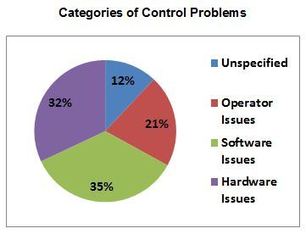
The role of control systems is somewhat undervalued. When you examine the most complex system in most buildings, the HVAC infrastructure, you find that it’s the HVAC control system, not the HVAC equipment, which produces the most operational issues and is the leading cause of inefficient energy use. Lawrence Berkley National Laboratories examined 60 buildings and found the highest frequency of common problems with HVAC was in the control system. Texas A&M research determined that of the operational and maintenance measures that could produce significant energy savings, 77% of the savings were from correcting control problems.

Maintaining a high performing control system involves regular maintenance, software and data management and organizational policies. The issues that can cause problems with a building control system are the same challenges all of us have had at one time or another with our computer or smartphone: problems related to software, hardware, communications networking and “user” mistakes. What follows is an overview of some of the typical control system issues and recommendations as to how to keep it performing at a high level.”<

See on Scoop.itGreen Building Operations – Systems & Controls, Maintenance & Commissioning

Net-Zero Energy for Buildings – ASHRAE Engineering Design and Construction

Integration: Net-zero energy design

ASHRAE has a goal: net-zero energy for all new buildings by 2030. What do engineers need to know to achieve this goal on their projects?

Source: www.csemag.com

>”As net-zero energy and low-energy design projects become more prevalent, engineers must be prepared to collaborate with all members of a project team including architects, energy specialists, lighting designers, builders, and owners in order to accomplish net-zero energy goals with little to no cost premium. Is this possible today or will it take another 10 or more years to get there?

There are many examples of completed projects demonstrating that not only is this possible, but it has been done in all regions of the country using readily available building products and common construction methods. So what’s the secret? It’s all about the design.

Net-zero energy defined

The term “net-zero energy” is abundantly used, but a single universally accepted definition does not exist. In general terms, a net-zero energy building (NZEB) has greatly reduced energy needs achieved through design and energy efficiency, with the balance of energy supplied by renewable energy. In an effort to clarify the issue, the National Renewable Energy Laboratory (NREL) published a paper in June 2006 titled “Zero Energy Buildings: A Critical Look at the Definition,” in which it defined the following four types of NZEBs:

Net Zero Site Energy: A site NZEB produces at least as much renewable energy as it uses in a year, when accounted for at the site.Net Zero Source Energy: A source NZEB produces (or purchases) at least as much renewable energy as it uses in a year, when accounted for at the source. Source energy refers to the primary energy used to extract, process, generate, and deliver the energy to the site. To calculate a building’s total source energy, imported and exported energy is multiplied by the appropriate site-to-source conversion multipliers based on the utility’s source energy type.Net Zero Energy Costs: In a cost NZEB, the amount of money the utility pays the building owner for the renewable energy the building exports to the grid is at least equal to the amount the owner pays the utility for the energy services and energy used over the year.Net Zero Energy Emissions: A net-zero emissions building produces (or purchases) enough emissions-free renewable energy to offset emissions from all energy used in the building annually. Carbon, nitrogen oxides, and sulfur oxides are common emissions that zero-energy buildings offset. To calculate a building’s total emissions, imported and exported energy is multiplied by the appropriate emission multipliers based on the utility’s emissions and on-site generation emissions (if there are any).

A subsequent paper was published by NREL in June 2010 titled “Net-Zero Energy Buildings: A Classification System Based on Renewable Energy Supply Options,” where four classifications of NZEBs were defined:

NZEB:A: Building generates and uses energy through a combination of energy efficiency and renewable energy (RE) collected within the building footprint.NZEB:B: Building generates and uses energy through a combination of energy efficiency, RE generated within the footprint, and RE generated within the site.NZEB:C: Building generates and uses energy through a combination of energy efficiency, RE generated within the footprint, RE generated within the site, and off-site renewable resources that are brought on site to produce energy.NZEB:D: Building uses the energy strategies described for NZEB:A, NZEB:B, and/or NZEB:C buildings, and also purchases certified off-site RE such as Renewable Energy Certificates (RECs) from certified sources. […]

Integrated building design

Integrated building design is a process that promotes holistic collaboration of a project team during all phases of the project delivery and discourages the traditional sequential philosophy. According to ASHRAE, the purpose of the integrated design process is to use a collaborative team effort to prepare design and construction documents that result in an optimized project system solution that is responsive to the objectives defined for the project. […]

Commissioning is an important part of every project, and for NZEB projects the commissioning authority should be a member of the design team and involved throughout the design process. […]”<

See on Scoop.itGreen Building Design – Architecture & Engineering
Liquid Air Processes for Energy Storage and Power – Grid & Transportation

A 19th-century idea might lead to cleaner cars, larger-scale renewable energy.

Source: www.technologyreview.com

>”Highview Power’s process is 50 to 60 percent efficient—the liquid air can yield just over half as much electricity as it takes to make it. Batteries, by contrast, can be more than 90 percent efficient. But the new process can make up for its inefficiency by using waste heat from other processes (see “Audi to Make Fuel Using Solar Power”). Highview has demonstrated that low-temperature waste heat from power plants or even data centers can be used to help warm up the liquefied air. The system can also last for decades, while batteries typically need to be replaced every few years. This longevity could help reduce overall costs.

Several companies are developing ways to improve the efficiency of compressing air, which could also make the liquefaction process more efficient (see “LightSail Energy Snags $37M in Funding” and “Compressed-Air System Could Aid Wind Power”). Liquefied air is about four times more energy-dense than compressed air, and storing it at a large scale takes up less space.

Liquid air might also prove useful in cars and trucks. An inventor named Peter Dearman has made a compact system that, instead of relying on large heat exchangers, uses antifreeze injected into an engine’s combustion chamber to recycle heat that would otherwise be wasted. He built a ramshackle prototype and showed that it could power a car. Ricardo is working on a version that could eventually be commercialized.

Liquid air stores energy at about the density of nickel–metal hydride batteries and some lithium-ion batteries, the kind used in hybrid and electric cars now. But it has a key advantage—it can be poured into a fuel tank far faster than a battery can be recharged, says Andrew Atkins, a senior technologist at Ricardo. The engine would run on liquid nitrogen—basically liquid air with the oxygen removed—and would emit only nitrogen. The carbon emissions associated with the engine would depend on the power source used to liquefy the nitrogen.”<

Canadian green building market shows strong growth into future reported by CaGBC

The Canadian green building market has grown in the last few years and is expected to continue its strong growth in years to come, according to a recent report released by the Canadian Green Building Council (CaGBC).

Source: dcnonl.com

>”The report projects the figure to grow in upcoming years and a shift to happen as firms ramp up their green projects to more than 60 per cent. The main factors triggering the green trend include companies wanting to do ‘the right thing’ when it comes to social and environmental responsibility.

“Doing the right thing was very important to a lot of the respondents, which surprised me…obviously the Canadian industry has a lot social consciousness” added Mueller.

Companies are also experiencing significant cost savings through various efficiencies.

Eighty two per cent of building owners and developers report decreases in energy consumption compared to similar buildings and 68 per cent of owners/developers report decreases in water consumption.

In Canada, businesses reduced their operating costs by 17 per cent through green buildings in 2014, ahead of the global average of 15 per cent in 2012.

[…]


The top sectors currently with green projects expected to be certified LEED (Leadership in Energy and Environmental Design) are, new institutional construction, new commercial construction, new low-rise residential, new mid and high-rise residential, and existing buildings/retrofit.

“In the public sector, the institutional sector, there’s a very strong commitment to build buildings to the LEED standard,” Mueller added. “Our focus is very much on building the LEED standard.”

Green Building is also beginning to build a strong business case for itself, according to the report.

Thirty seven per cent of owners project a spike in occupancy rates, 32 per cent expect improved tenant retention, 26 per cent expect improved lease rates and 13 per cent forecast a higher return on investment.

The median payback period for investment on a new green building is eight years, according to the report.

According to Mueller, owners and developers who are repeat green builders usually maintain a positive experience, but it’s the first timers that need to be shown the right steps in pursuing green building.

“If you’re an owner doing it for the first time, you have to be diligent, you have to be prudent to select the right consultants,” he said. “You have to do your due diligence and we certainly will be at the council to help first-time users to apply the LEED program and to make sure they have a positive experience.”<

Cost Effective ‘net zero’ energy in Jerseyville, Illinois subdivision

Lexington Farms, an affordable housing project of rental homes [built in Illinois].

Source: www.stltoday.com

>”Rooftop solar panels and wind turbines mounted over garages power all 32 homes at Lexington Farms, a new Jerseyville subdivision designed to provide residents no-cost electricity. […]

“Over the course of a year the solar array and wind turbines provide all the energy needed to power heating and air-conditioning systems, along with other household electricity needs,” said Jeff Lewis, president of MidAmerica Solar. “While similar technology has been used in homes, it hasn’t been done on this scale in an entire subdivision.” […]

Each home can produce up to 7.2 kilowatts of energy from roof-mounted solar panels.

Wind turbines mounted on masts over garages provide up to 1 kilowatt of additional energy. Lewis said tests were conducted to make sure the turbines’ vibrations were so slight as to be unnoticed by the homes’ occupants.

Ground-mounted solar panels at the subdivision’s entrance generate power for the community center.

Lexington Farms’ three-bedroom homes rent for $590 per month to families with incomes of $41,000 or less. The houses have central air conditioning, heat, hot water and other appliances that are powered by electricity generated by the solar panels and wind turbines.

The Illinois Housing Development Authority provided more than $2.5 million in assistance for the project, including federal low-income housing tax credits and federal stimulus money. Funding also came from a $260,000 grant from the Illinois Department of Economic Opportunity and financing from Sterling Bank.

Included in the project are 16 streetlights that operate entirely off the electrical grid.

The streetlights, made by MidAmerica Solar, have their own wind turbines and solar panels that provide electricity to energy-efficient LED lights and a backup battery. The lights used to come from China. Now they come from a small factory in Affton.”<