Norway: A recycling-happy nation in dire need of trash

See on Scoop.itGreen & Sustainable News

Sweden isn’t the only nation in the throes of a serious trash deficit. As it turns out, Norway is also desperately seeking rubbish to burn in its cogeneration plants. Perhaps the U.S. could lend a helping hand?

Duane Tilden‘s insight:

Excerpts…

Norway’s garbage woes aren’t an anomaly in Scandinavia and across Northern Europe where the demand for trash to fuel garbage-burning incinerator plants is high but the supply is devastatingly low due in part to residents’ pertinacious recycling habits. In fact, Northern European countries only produce 150 million tons of trash annually, while the overall capacity of incinerating plants is 700 million tons and growing.

[…] While the burning of garbage is not an environmentally flawless method of producing energy, modern day cogeneration plants are relatively high-tech affairs and the pollution generated is far less than coal. This method also renders landfills nearly irrelevant.

See on www.mnn.com

11 Tips to Cultivate a Strong Twitter Following

See on Scoop.itTwitter & Social Media

“Are you new to Twitter or just want to build a substantial following on this popular social network? Here are 11 tips that I’ve found helpful.”

See on oedb.org

#Wind Energy Innovation: GE Tests High #Efficiency Turbine in the #Netherlands | The #Energy Collective

See on Scoop.itGreen Energy Technologies & Development

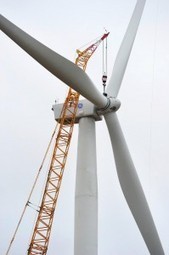
General Electric recently announced it had started testing the prototype of what it calls the world’s most efficient high-output wind turbine. The new 2.5-120 is being tested in Wieringermeer, Netherlands.

Duane Tilden‘s insight:

Combining efficiency and power output at low-wind-speed sites, the 2.5-120 captures a 25 percent increase in efficiency and a 15 percent increase in power output compared to GE’s current model. GE says wind farm operators at low-winds-speed sites can benefit from its efficiency and output, thanks to its advanced controls and 120-meter rotor which enable increased energy capture and greater power output in low-wind areas. The taller tower, which has a maximum hub height of 139 meters, makes it ideal for heavily forested regions in places like Europe and Canada.

See on theenergycollective.com

ComEd’s “Smart Switches” Reducing Service Interruptions; “Self-healing” technology key to improving reliability – Electric Light & Power

See on Scoop.itGreen Energy Technologies & Development

Distribution Automation (Smart Switches) routes power around potential problem areas, often with no noticeable interruption in service.  Installation of these devices resulted in 82,000 fewer customer power interruptions in 2012. During the severe storms that hit the Chicago area in mid-April, DA devices prevented 20,000 service interruptions.

Duane Tilden‘s insight:

By remotely monitoring and controlling grid operations, Distribution Automation (DA) devices, or smart switches, are a central feature of smart grid technology and ComEd’s effort to reduce the frequency and duration of outages.

[…] if a tree were to fall on a utility pole resulting in an interruption, far fewer customers would be impacted because it enables us to better isolate the damaged section,” explained McMahan. “DA introduces a self-healing capability to the electric grid by allowing us to resolve issues before customers might even be aware of them, and that has a profoundly positive impact on people’s daily lives.”

When fully implemented, distribution automation and smart meters will communicate with ComEd’s operations center, alerting the utility of an outage and eliminating the need for customers to call to report they are out of power.  […]  To see how smart meters and DA devices work together, click this link http://youtu.be/L4xp7a1di7Y .

Under the smart grid law, ComEd committed to spend $2.6 billion over 10 years to strengthen and modernize the electric grid in northern Illinois. More than $1.3 billion is earmarked to deploy a Smart Grid system and install smart meters in four million homes and businesses to give customers greater control over their energy consumption and costs.  The current schedule calls for ComEd to begin installing smart meters in 2015. […]

See on www.elp.com

US #SmartGrid #Networks Exploiting Infrastructure to Provide #Wireless Broadband

See on Scoop.itGreen Energy Technologies & Development

The USDA Rural Development’s Rural Utilities Service (RUS) has now spent the $250 million committed for smart grid technologies.

Duane Tilden‘s insight:

This investment is helping smart grids to become the norm across the country. A side benefit is that utilities are also developing their smart grids for telecoms over and above that used by meters to send data to network controllers.

A hindrance to cities aiming to develop comprehensive WiFi networks has come from the powerful telecoms industry, which employs its lobbying clout to push for laws blocking or preventing municipalities from offering WiFi or fixed broadband services.

See on www.circleid.com

How To Triple Your Success Using #SocialMedia #Advertising Platforms | #Forbes

See on Scoop.itTwitter & Social Media

The following guest post is by Neal Rodriguez, an online marketer who has helped iconic brands such as The Nielsen Company, Adweek, AOL, and dozens more meet their business objectives using social media and the search engines.

Duane Tilden‘s insight:

[…]

Last month, I delivered a presentation before some public relations professionals representing some of the biggest universities in the country. And when I suggested that they should consider using social ads to convince people to subscribe to their digital assets by Liking their pages on Facebook, or buying views on YouTube using their ad platform, many rejected the idea like I was passing them a plate of AIDS. Interestingly enough, Mr. Weintraub outlined some ways that public relations specialists or marketers assigned to acquire publicity can use social advertisements to target journalists, writers or reporters based on how they classify themselves and post their professional titles as an interest. He simply instructs his readers to target Facebook ads by listing keywords, such as blogger, editor-n-chief, correspondent, news editor, writer, columnist, and dozens more in the interest field.

On social media or other advertising platforms, I always aim to advertise for life-time value; meaning, I like to advertise to acquire contact information and/or have people subscribe to my digital assets like a Facebook business page, or email list. This way I can keep subscribers abreast of everything I’m communicating or marketing. With an engaged following, you create an endless line of opportunities to recoup your investment in the advertising every time you publish new content. Moreover, now that everybody’s a “journalist,” with the immediate ability to tweet, post on Facebook, or launch an online publication with WordPress or other type of open source content management system, when something is worth citing, you’ll have an active user base of publishers that are likely to link to your content. I have also managed email lists to which writers of mainstream media outlets are subscribed; thus having them on board also increases the chance of securing publicity on iconic publications. Mr. Weintraub’s approach, however, allows you target journalists that are not subscribed to stay abreast of your content. He argues that since social advertisements look like organic posts, media stakeholders are more likely to simply click and cite the piece of content to which they’re exposed.

Mr. Weintraub will delve further into how brands can leverage Facebook and other forms of social advertising during his upcoming talk at Search Exchange, in Charlotte, North Carolina in July.

See on www.forbes.com

Klout and Kred Scores: Critical or Meaningless? – Government Technology – Government Technology

Reference Post to original curator.

manliomannozzi's avatarManlio Mannozzi

See on Scoop.itDISCOVERING SOCIAL MEDIA

Government Technology
Klout and Kred Scores: Critical or Meaningless? – Government Technology
Government Technology
Companies like Klout and Kred score how influential individuals, brands and organizations are within their social media networks.

See on www.govtech.com

View original post

Klout and Kred Scores: Social Media, Politics and Influence – How it Works.

See on Scoop.itTwitter & Social Media

Metrics providers offer social media influence scores; here’s what you need to know about them.

Duane Tilden‘s insight:

Do Social Scores Really Matter?

Unfortunately the answer is much more complicated than a simple yes or no. The majority of experts Government Technology spoke with said that, specifically in the public sector (versus the private sector), the social media influence scores of those who follow you tend to matter much more than your own scores. Why? Because others’ Klout and Kred scores can help you better identify whom in your constituency to respond to, as well as how best and how soon to engage with them. Social media influence scores essentially offer a shortcut to identifying, evaluating and engaging key influencers in your specific sector.

For example, someone with high Klout and Kred scores has a wide scope of influence online. What they say, post, share or tweet about your federal, state or local agency within their own and others’ social media networks has a higher potential to reach and impact others significantly more (and perhaps more meaningfully) than someone with low social media influence scores.

“If you are a government agency and you have someone yelling and screaming at you on Twitter or Facebook, or if someone just created a social media account simply to harass an agency, a social media manager or communications director could pick up on a person like that very quickly if they have both a low Klout score and low Kred scores,” said David Gerzof Richard, a social media and marketing professor at Emerson College in Boston and president of public relations and social media firm BIGfish.

“Conversely if you find people who have high Klout and Kred scores, and they really understand where your agency is going, and your agency’s goals, and they’re sharing your social media content, those people would especially be your super targets,” Richard said. “They’re the people you want to make sure are seeing your agency’s social media messaging and content, because they’re actively sharing it and they have a high rate of influence. What they share gets a lot of exposure and engagement, so it’s important to engage them.”

Examining your followers’ social media influence scores also helps to quickly, easily separate the “wheat from the chaff,” said Richard, enabling you to prioritize positive influencers and advocates over “noisy,” negative trolls and other disruptive followers.   Be Aware, but not too Concerned

“I think it’s a good practice for state and local governments to be aware of their social media metric scores, but I wouldn’t say they should necessarily be concerned about them, particularly on a day-to-day basis,” said Bill Greeves, CIO of Wake County, N.C., and co-author of Social Media in the Public Sector Field Guide.

See on www.govtech.com

How do you compare? New report reveals stats about social media usage in Canada

See on Scoop.itTwitter & Social Media

One in three anglophone Canadians says not a single day goes by without checking into their social media feeds.

Duane Tilden‘s insight:

The report is based on telephone surveys with 4,001 anglophone Canadians in the fall and found almost seven in 10 Internet users declared they were regular social media users, logging on at least once a month. That figure was up by about six per cent compared to 2011.

Aimee Morrison:  “I think social media is hitting a tipping point in a way that cellphones did in the later part of the 1990s, where we’ve moved from the stage where it was something that the early adopters did and then the hipsters did and then the kids did.”

Facebook remains far and away the most popular social network. About 63 per cent of surveyed Internet users and 93 per cent of social media users said they’re on Facebook.  While Twitter gets a lot of media hype and is growing rapidly it’s not all that commonly used in Canada, according to MTM’s numbers.

Less than one in five Internet users surveyed said they were on Twitter in the last month, although those numbers had grown by 80 per cent in a year, up from just 10 per cent in 2011.

Read more: http://bit.ly/188PavD

See on www.ctvnews.ca

Europe’s Most Advanced Paper Recycling Plant Opened in UK – Waste Management World

See on Scoop.itGreen Energy Technologies & Development

A recycled paper mill claimed to be the most advanced in Europe has been officially opened by Michael Fallon, the UK’s minister of state for business & energy, at Partington Wharfside, Trafford.

Duane Tilden‘s insight:

SIACA said that the mill will help to some 450,000 tonnes a year of used paper from export by recycling it within the UK – reducing carbon emissions by 84,011 tonnes per year – equivalent to taking 28,000 cars off the road each.

Economic boost

According to the company PM-11 has led to the creation of 94 direct jobs plus opportunities for contractors and other roles.

“This cutting edge facility shows how state of the art technology and innovation can help drive growth. It’s a real boost for the economy and will create new jobs for Partington and the local area,” commented Fallon.

See on www.waste-management-world.com