Cove Point LNG Project Obtains Federal Approval and Opposition

Initially, Cove Point helped the United States overcome what was then an energy shortage. Now that our nation is developing a burgeoning surplus of natural gas, Cove Point can help send a small portion of that surplus to allied nation’s looking for stable supplies of clean energy, supporting economic development and replacing coal as a fuel.

Source: www.fierceenergy.com

>” […] The project offers significant economic, environmental and geopolitical benefits. The construction of the approximately $3.8 billion export project will create thousands of skilled construction jobs, an additional $40 million in annual tax revenue to Calvert County, and millions of dollars in new revenues for Maryland and the federal government, as well as a reduction in the nation’s trade deficit by billions of dollars annually.

Dominion’s project has faced and will continue to face significant and widespread grassroots opposition. Despite these benefits, environmental and community groups are denouncing FERC’s approval of the controversial project, claiming that the facility will incentivize environmental damage from fracking across the mid-Atlantic region and, according to federal data, would likely contribute more to global warming over the next two decades than if Asian countries burned their own coal.

Environmental groups, including the Chesapeake Climate Action Network, Earthjustice, and the Sierra Club are poised to petition FERC and potentially to sue the agency to challenge on the basis of an inadequate environmental review. These groups are assessing the issue upon which to file a motion for a rehearing, which needs to occur before an appeal can happen.

The groups claim that in its Environmental Assessment, which was limited at best, FERC omitted credible analysis of the project’s lifecycle global warming pollution, including all the pollution associated with driving demand for upstream fracking and fracked gas infrastructure.

The Dominion Cove Point project would be the first LNG export facility to be sited so close to a residential area and in such close proximity to Marcellus Shale fracking operations, and could trigger more global warming pollution than all seven of Maryland’s existing coal-fired power plants combined, the groups contend.

“FERC’s decision to approve Cove Point is the result of a biased review process rigged in favor of approving gas industry projects no matter how great the environmental and safety concerns,” said Mike Tidwell, director of the Chesapeake Climate Action Network, in a statement. “FERC refused to even require an environmental impact statement for this $3.8 billion facility right on the Bay. We intend to challenge this ruling all the way to court if necessary…we will continue to fight this project until it is stopped.”

Dominion must now review and accept the order. Upon completion, Dominion will file an implementation plan describing how it plans to comply with the conditions set forth in the order. Dominion expects to ask the FERC for a “Notice to Proceed” at that time and plans to begin construction when the notice is received. This process – from Dominion review through FERC’s notice – is expected to take several weeks.

Cove Point is the fourth liquefied natural gas export project to receive approval to site, construct and operate and is the first LNG export project on the East Coast. “<

See on Scoop.itGreen & Sustainable News

Net Zero Energy Buildings at Zero Cost

The Netherlands has found a way to refurbish existing buildings to net zero energy, within a week, with a 30-year builders’ guarantee and no subsidies.

Source: www.energypost.eu

>”Inside the house, the pounding rain stills to distant murmur. That’s thanks to the triple glazing, points out Ron van Erck, enthusiastic member of Platform31, an innovation programme funded by the Dutch government that brings together different actors for out-of-the-box thinking to crack intractable problems. One of its big successes to date is Energiesprong, an initiative that turns the building market on its head to deliver social housing with zero net energy consumption, i.e. no energy bill, at zero cost to the tenant and with no subsidies to the builder.

Starting off in 2010 with three staff, a €50 million budget and five years to come up with something to make buildings more sustainable, Energiesprong today boasts 45 staff and a deal with 27 housing associations and four big construction companies to refurbish 111,000 houses in the Netherlands. Total investment? €6 billion. The initial focus is social housing, but it’s already looking at the private market, care centres and commercial office buildings too.

How does the plan work? The basic trick is that tenants instead of paying their energy bills, pay a similar amount to the housing corporations that own the houses. With this money, the corporations pay building companies to retrofit the houses, which after renovation have net zero energy costs. The building companies have for this project developed ‘industrialised’ renovation procedures that are highly cost-effective. One important difference with existing renovation projects is that all elements that are needed for a successful move to zero-energy housing are brought together  in one plan.

Energy Post’s Sonja van Renssen met with manager Jasper van den Munckhof, to understand exactly what Energiesprong does, how it does it and why it will succeed – in the Netherlands and elsewhere.

Q: What was your starting point?

A: We started off with what we spend. The household energy bill in the Netherlands is about €13 billion. This money is available. If you spent it on a mortgage or payback on a loan of about 30 years [instead of energy], you have €225 billion to invest in the Dutch housing stock. This is substantial money: €30-40,000 per house to make it energy neutral.

“Retrofit wasn’t interesting – unless you were rich – but using the energy bill to fund it, no one had thought of that! A building and its energy system were developed as parallel, complementary but not integrated, entities.”

-Jan Kamphuis, BJW Wonen, a one-stop-shop for retrofits inspired by Energiesprong

The trick is, how to get this money flowing. We tried to imagine what owners would need to start investing. They buy kitchens and they don’t see this as an investment but good for their family. You need to get this focus on people and how they buy stuff, how they accept things. If you lose that focus and think it’s about financial arrangements, you won’t find a solution.

Q: So what will make people spend money on retrofits?

A: It needs to be very well done, like if they buy a car, they buy a decent one. It has to be fast – the problem with retrofitting (vs. buying new stuff) is that it’s usually a lot of trouble, dust and hassle. So we said one, the retrofits have to be done within a week. Two, it has to be affordable: ideally the cost to the tenant before and after should be equal. That means the energy bill converted to the mortgage or extra rent has to cover the full cost of the retrofit. Three, it has to be attractive. It needs to be something you see. […]”<

See on Scoop.itGreen & Sustainable News

Efficient HVAC Systems

Gallery

This gallery contains 15 photos.

Originally posted on Energy Systems & Sustainable Living:
Heating, Ventilation and Air Conditioning systems (HVAC) controls the indoor climate by adding or extracting heat and adding or removing mass (e.g. water vapour and dust). To combat summer heat and winter…

Energy Efficiency Gains, Backfire & The Rebound Effect – A Problem?

“Every few years, a new paper comes out about the rebound effect and the issue receives some short-term attention. (When a consumer or business buys an efficient car or air conditioner, they may use their energy-efficient equipment a little more often or may spend some of their energy bill savings on things that use energy—these are examples of rebound effects.)  […]”

Source: aceee.org

>” […] we found that rebound may average about 20%, meaning that 80% of the savings from energy efficiency programs and policies register in terms of reduced energy use, while the 20% rebound contributes to increased consumer amenities (for example, more comfortable homes) as well as to a larger economy.  […]

E2e, a joint initiative of three universities, released a working paper entitled “The Rebound Effect and Energy Efficiency Policy.” In it, they discuss various types of rebound and ways to analyze it. Much of their data relates to gasoline and oil prices and consumer and market responses to changes in those prices. They find that for developed countries, “most… studies fall […] in the range of 5 to 25 percent” direct rebound effect (where direct captures consumer response but not whole-economy effects). In developing countries, where incomes are lower and impose constraints on miles driven and other energy-consuming behavior, the E2e paper finds the “most common range” is 10-40% demand elasticity (related to but not exactly the same as direct rebound). They also discuss macroeconomic effects, emphasizing studies that show rebound of 11 percent and 21 percent due to economic growth. By way of comparison, the ACEEE paper estimates 10 percent direct rebound on average for the United States, noting the first of the two economic growth studies. In addition, in the case of oil prices, the E2e paper discusses how improvements in fuel economy soften oil prices, which can lead to a 20-30% increase in global oil use due to these price effects. Bottom line: The E2e paper sees modestly higher rebound effects than the earlier ACEEE paper.  […]

Regarding electricity use, Breakthrough discusses how electricity use has risen more quickly than generating plant efficiency has increased. The authors call this backfire, even as they acknowledge that these trends are also affected by rising incomes, urbanization, changes in consumer preferences, and other socioeconomic and demographic trends. They provide no evidence on the relative importance of energy efficiency relative to these other factors. Furthermore, they seem to mix up energy efficiency and economic efficiency.[…]

Breakthrough released their new report with an op-ed in the New York Times. The op-ed goes several steps further than the report. First, applying its claims of lighting backfire from the 1800s, it claims that LED lighting, for which the most recent Nobel Prize in physics was awarded, will increase lighting energy use, particularly in developing countries. As I wrote in a letter to the editor of the Times, LEDs are about six times more efficient than incandescent lamps, so in order to reach the backfire point, the average purchaser would need to increase the amount of lighting they use by a factor of six. While such an increase may well happen among the poorest households in developing countries, it is unlikely to be seen in developed countries, or even among the middle class in developing countries.

The Breakthrough op-ed also claims that the International Energy Agency and the Intergovernmental Panel on Climate Change find that “rebound could be over 50 percent globally.” While technically correct, their claim takes the upper end of the ranges found in recent IEA and IPCC studies. For example, IEA states, “Direct rebound can range from 0% to as much as 65%. However, estimates tend to converge between 10% and 30%.” It would be much more accurate if the institute would cite the full range, instead of looking only at the extreme. Applying that logic, I could argue that IEA supports ACEEE’s 10% direct rebound estimate–at least 10% is within IEA’s most likely range of 10-30%. IPCC estimates get similar treatment from Breakthrough.

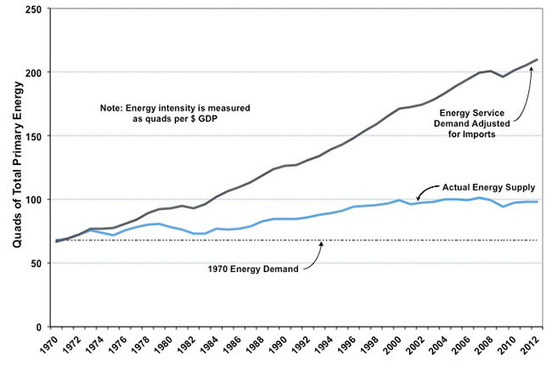
Bottom line: The E2e analysis is very reasonable, but Breakthrough appears to be more interested in exaggerating to make its case, rather than sticking to the facts. The truth is that for 40 years energy efficiency has had a dramatic effect on worldwide energy consumption. In the United States, if we were to use energy today at the rate we were in 1974, we would be consuming more than twice the amount that we are actually using. […]”<


See on Scoop.itGreen & Sustainable News

Multifamily Building Energy Efficiency: SLEEC Financing

This winter, ACEEE, in partnership with Energi Insurance Services, will host a second gathering of select members of the Small Lenders Energy Efficiency Community (SLEEC) in Washington, D.C. The initial SLEEC convening in October 2013 brought together small- to medium-size lenders to discuss strategies for expanding activity in the market for energy efficiency financing. Building off the success of that first meeting, the second SLEEC gathering will focus exclusively on financing in the multifamily sector […]

Source: aceee.org

>” […] The goal of the upcoming SLEEC meeting is to discuss how recent developments inform the lender perspective on the size, attractiveness, and viability of the finance market for multifamily efficiency. We chose to address multifamily this year because potential savings are phenomenal at an estimated $3.4 billion per annum, and multifamily has traditionally been characterized by the label “hard to reach” due to significant barriers to entry. Single-family residential, large commercial, and MUSH (municipal, universities, schools, and hospitals) markets pose fewer barriers and have therefore been easier to approach, while multifamily is a more complex market posing greater obstacles.

The first and most commonly cited obstacle is known as the split-incentive problem: Landlords and building owners don’t always have an incentive to pursue energy efficiency improvements since their tenants would be the ones benefitting from reductions in energy bills. The next most bemoaned roadblocks are a lack of information and lack of available capital. Landlords and owners are experts at running their buildings, but may be in the dark on energy efficiency. Utilities and many loan agencies, while knowledgeable about energy efficiency, lack experience interacting with tenants. The resulting information gap inhibits energy efficiency projects from getting off the ground. This problem is exacerbated by a lack of capital, especially in the affordable housing market, where many buildings owners hold 30-year mortgages on their property with only one refinancing opportunity after 15 years. Unless building owners and potential lenders can capitalize on this small window, many projects would not have another opportunity to finance efficiency improvements for another 15 years.

Despite these barriers, there are a number of successful initiatives that are poised for impact. Perhaps the most successful is Energy Savers, a Chicago-based partnership between Elevate Energy and the Community Investment Corporation (CIC) that has retrofitted 17,500 apartments since 2008.  […] Innovative programs such as these are paving the way for energy efficiency in the multifamily housing market.

A perceived lack of capital may be attributable to issues surrounding the valuation of energy efficiency from a building owner’s perspective that manifests as low demand. […] “<


See on Scoop.itGreen Building Design – Architecture & Engineering

Lighting Controls in Buildings, Demand Management and Microgrid Development

Lighting control systems can help microgrids shed load, improve demand response, use resources efficiently, and offer greater overall reliability.

Source: energyefficiencymarkets.com

>” […] Lighting Control Facilitates Load-shed Strategies

Load shed, or the ability to quickly reduce electricity use during peak periods, is critical to ensuring microgrid reliability. Because lighting uses a considerable proportion of building peak electrical loads (30% of peak electricity),1 and because reduced light levels deliver immediate reductions in electricity, lighting control is one of the simplest and most predictable demand response solutions.

The reduction of lighting load also provides a reduction in HVAC cooling load during the summer, which is the most common peak electrical period.  Furthermore, since dimming is typically unobtrusive when it is executed over a period of time (as little as 10 seconds), lighting control is a viable option for immediate emergency response.

Dimming as a load shed strategy is highly effective because the human visual system has the ability to accommodate a wide variety of light levels with minimal effect on the occupants2,3.  When a demand reduction is required a gradual dimming of electric lighting can reduce light levels by 35 percent before 20 percent of the occupants attempt to intervene.  Response time is essentially instantaneous, typically has little impact on occupant comfort, and demand savings from lighting are more predictable than those from HVAC response.

Light management systems have the capability to automatically trigger a demand response event from a utility signal or from time clock scheduling. Therefore, a predictable and effective demand response strategy can be automatically implemented while going virtually unnoticed to the building occupants.

Energy codes, standards, and green building certifications such as ASHRAE (American Society of Heating, Refrigerating, and Air Conditioning Engineers) 90.1, IECC (International Energy Conservation Code), California Title 24, ASHRAE 189, IgCC (International Green Construction Code), or LEED (Leadership in Energy and Environmental Design) now include lighting controls as a part of a whole-building energy strategy.

There are subtle differences for each code/standard/certification, but some general requirements and/or credits include: required lighting control for most areas (manual or automatic), automatic lighting shut-off, some automatic receptacle shut-off, daylight controls for daylit spaces, automatic shut-off of exterior lighting during daytime hours, and various levels of occupancy/vacancy control. As a result of buildings updating their basic lighting control infrastructure to meet code, they are increasingly becoming capable of connecting to a microgrid, without the need for additional significant investments.

[…]”<

See on Scoop.itGreen Building Operations – Systems & Controls, Maintenance & Commissioning

Could desalination solve California’s water problem?

Desalination would seem to answer every prayer to fix California’s water shortages. But turning the sea into drinking water is not so easy. The state’s first major desalination plant, under construction in Carlsbad, is a major test for the industry and wary environmental groups.

Source: www.sacbee.com

See on Scoop.itsustainability and resilience

BEMS for Smaller Buildings $6 Billion Growth from 2014 to 2022

The market for building energy management systems (BEMS) for small and medium-sized commercial buildings is expanding as building owners and managers demand more energy savings and easier ways to manage energy use in their facilities, notes Navigant Research.

Source: www.achrnews.com

>” […]“Lower expenditures on energy management in the small and medium-sized building market, along with the lower penetration of advanced controls and building management systems, has limited the penetration of BEMS in this sector,” said Noah Goldstein, research director with Navigant Research. “Given the increasing importance of energy savings, however, BEMS are poised to be a tool that enables savings in both cost and carbon emissions in small and medium buildings.”

The most rapid growth in the BEMS market for smaller buildings, according to the report, is expected to occur in Europe and Asia Pacific, where new construction and regulation are promoting the installation of BEMS equipment and in turn creating demand for associated services and software. In the North American market, BEMS sales are expected to be concentrated in software, driven by utility and regulatory initiatives that promote energy efficiency and building energy reporting. […]”<


See on Scoop.itGreen Building Operations – Systems & Controls, Maintenance & Commissioning

Electric Vehicle Market – Nissan Tests “Demand Response” Energy Management System

Nissan is assessing the potential of electric vehicles in energy management systems. […]  is participating in the “demand response” energy supply and demand system testing together with businesses and government authorities in Japan.

Source: green.autoblog.com

>”[…]  Demand response is a strategy to make power grids more efficient by modifying consumers’ power consumption in consideration of available energy supply. Since the Great East Japan Earthquake in March 2011 the supply and demand of electricity during peak use hours in Japan has drawn attention. Under the demand response scheme, power companies request aggregators* to use energy conservation measures, and they are compensated for the electricity that they save.

Usually when energy-saving is requested consumers may respond by moderating their use of air conditioning and lighting. However, by using the storage capacity of electric vehicles and Vehicle to Home (V2H) systems, consumers can reduce their use of power at peak times without turning off lights and appliances. This is particularly useful in commercial establishments where it is difficult to turn power off to save electricity.

The demand response scheme involves assessing the usefulness of energy-saving measures using V2H systems during peak-use periods and analyzing the impact of monetary incentives on business. For example, the testing involves a LEAF and LEAF to Home system which is connected to power a Nissan dealer’s lighting system during regular business hours using stored battery energy. This reduces electricity demand on the power grid. The aggregator is then compensated for the equivalent of the total amount of electricity that is saved. Two or three tests per month will be conducted on designated days for three hours’ each time sometime between 8:00 a.m. to 8:00 p.m. from October 2014 through January 2015.

Effective use of renewable energy and improvements in the efficiency of power generation facilities will enable better energy management in the future and help reduce environmental impact. Field tests using EVs’ high-capacity batteries that are being conducted globally are proving their effectiveness in energy management. Additionally, if similar compensation schemes for energy-saving activities were applied to EV owners it could accelerate the wider adoption of EVs and reduce society’s carbon footprint.

Nissan has sold more than 142,000 LEAFs globally since launch. The Nissan LEAF’s power storage capability in its onboard batteries, coupled with the LEAF to Home power supply system, is proving attractive to many customers. As the leader in Zero Emissions, Nissan is promoting the adoption of EVs to help build a zero-emission society in the future. Along with these energy management field tests, Nissan is actively creating new value through the use of EVs’ battery power storage capability and continuing to promote initiatives that will help realize a sustainable low-carbon society.

* Aggregators refers to businesses that coordinate two or more consumers (e.g. plants and offices) and trade with utility companies the total amount of the electricity they have succeeded in curbing.”<

See on Scoop.itGreen Energy Technologies & Development

US EPA Awards Energy Star to 3 CHP (Cogen) Projects

The US Environmental Protection Agency (EPA) has recognised three combined heat and power projects with ENERGY STAR CHP awards.

Source: www.cospp.com

>”[…] Eastman Chemical Company’s Kingsport, Tennessee, Campus plant (pictured) was recognised for its 200 MW CHP system, which includes 17 GE steam turbine generators. The Kingsport industrial campus, one of the largest chemical manufacturing sites in North America, employs nearly 7000 people […]

Seventeen boilers produce steam to support manufacturing processes, help meet the space heating/cooling needs of 550 buildings, and drive 17 GE and two ABB steam turbine generators with a combined design output of 200 MW. With an operating efficiency of more than 78%, the predominantly coal-fired system requires approximately 14% less fuel than grid-supplied electricity and conventional steam production, saving Eastman Chemical approximately US$45 million per year.

Janssen Research & Development, LLC, one of the Janssen Pharmaceutical Companies of Johnson & Johnson, was granted an award for its 3.8 MW CHP system, powered by a Caterpillar lean-burn low-emissions reciprocating natural gas generator set. The system supplies 60% of the annual power needs for the site and approximately 40% of the thermal energy used to support R&D operations and heat, cool, and dehumidify the facility’s buildings.

With an operating efficiency of more than 62%, the system requires approximately 29% less fuel than grid-supplied electricity and conventional steam production, saving approximately $1.1 million per year.

Merck’s CoGen3 CHP system at its West Point facility was also recognised by the EPA. A pharmaceutical and vaccine manufacturing, R&D and warehouse and distribution centre, the project is powered by a 38 MW GE 6B heavy-duty gas turbine and recovers heat to produce steam to heat, cool and dehumidify approximately 7 million square feet of manufacturing, laboratory and office space.

The system, designed by Burns & Roe, is the third CHP system that Merck has installed at the 400-acre West Point, Pennsylvania campus. With an operating efficiency of more than 75%, the natural gas-fired system requires approximately 30% less fuel than grid-supplied electricity and conventional steam production.”<


See on Scoop.itGreen Energy Technologies & Development