 Smart campus technologies harness the potential to advance everything from productivity to security measures to the operations of the buildings in which students live and study. The United States a…
Source: The Power of the Smart Campus
Smart campus technologies harness the potential to advance everything from productivity to security measures to the operations of the buildings in which students live and study. The United States a…
Source: The Power of the Smart Campus

Figure 1: Projected Job Growth by Sectors – Green Economy Report, 2011 (1)
“WASHINGTON – The U.S. Department of Energy today released the agency’s first annual analysis of how changes in America’s energy profile are affecting national employment in multiple energy sectors. By using a combination of existing energy employment data and a new survey of energy sector employers, the inaugural U.S. Energy and Employment Report (USEER) provides a broad view of the national current energy employment landscape.
USEER examines four sectors of the economy — electric power generation and fuels; transmission, wholesale distribution, and storage; energy efficiency; and motor vehicles — which cumulatively account for almost all of the United States’ energy production and distribution system and roughly 70 percent of U.S. energy consumption. By looking at such a wide portion of the energy economy, USEER can provide the public and policy makers with a clearer picture of how changes in energy technology, systems, and usage are affecting the economy and creating or displacing jobs.
Some key findings of the report include:
3.64 million Americans work in traditional energy industries, including production, transmission, distribution, and storage.
Of these, 600,000 employees contribute to the production of low-carbon electricity, including renewable energy, nuclear energy and low emission natural gas.
An additional 1.9 million Americans are employed, in whole or in part, in energy efficiency.
Roughly 30 percent of the 6.8 million employees in the U.S. construction industry work on energy or building energy efficiency projects.
A copy of the full report is available HERE.
The report also found several energy industries with projected increases in new jobs. Responding to the USEER survey of employers, the energy efficiency sector predicted hiring rates of 14 percent in 2016, or almost 260,000 new hires. Projected hiring rates were at 5 percent within the electric power generation and fuels sector, reflecting overall growth despite a loss of employment in 2015 in the oil and natural gas extraction sectors. Transmission, wholesale distribution, and storage firms anticipate 4 percent employment growth in 2016. Solar energy firms predicted 15 percent job growth over the next year.
Yet even as the report found the opportunity for job growth in many energy sectors, over 70 percent of all employers surveyed found it “difficult or very difficult” to hire new employees with needed skills.
“The transformation of our energy system and the growth of energy efficiency technologies are creating opportunities for thousands of new jobs, especially in energy efficiency and solar,” said David Foster, Senior Advisor on Energy and Industrial Policy at the Department of Energy. “This report gives an important snapshot of energy employment in America, and subsequent reports will provide better information to guide policies and priorities that create new jobs, appropriately train workers, and promote a successful national energy policy.” …” (1)
“…As a rule of thumb, investment in renewable energy and energy efficiency generate about 3 times the amount of jobs that other energy related investments create (gas, oil, coal, nuclear). Average numbers of jobs created per million euro invested (3CSEP):
[…] (2)

Figure 2: Job Generators Comparison Chart (3)
“[…] While much of the debate on climate change and employment has focused on renewables, another and more significant source of jobs from decarbonization has received much less attention. Substantial efficiency gains are technically feasible and economically viable in industry, housing, transportation, and services. Businesses can make a profit and households can enjoy real savings. And spending the surplus on things other than fossil energy will boost an economy’s employment.
For example, the United States is a diversified economy that imports substantial amounts of equipment for renewables. A recent study carefully considered economy-wide effects of reducing emissions by 40 percent by 2030 through a mix of clean energy and energy efficiency (Pollin and others, 2014). It concluded that $200 billion a year in investment would generate a net gain of about 2.7 million jobs: 4.2 million in environmental goods and service sectors and their supply chains but 1.5 million lost in the shrinking fossil- and energy-intensive sectors. The net gain of 2.7 million jobs would reduce the unemployment rate in the 2030 U.S. labor market by about 1.5 percentage points—for example, from 6.5 percent to 5 percent. The authors consider this a conservative estimate; for example, it does not take into account the 1.2 to 1.8 million jobs likely gained from reinvested savings.
Other studies show similar results. A review of 30 studies covering 15 countries and the European Union as a whole found appreciable actual or potential net gains in employment (Poschen, 2015). Most studies considering emission targets in line with the ambitions announced for a Paris agreement in December find net gains on the order of 0.5 to 2.0 percent of total employment, or 15 million to 60 million additional jobs. In emerging market economies such as Brazil, China, Mauritius, and South Africa, green investment was found to accelerate economic growth and employment generation when compared with business as usual. Several studies suggest that more ambitious climate targets would generate greater gains in employment (for a discussion of particular countries, see Poschen, 2015). […]” (3)
(1) http://bit.ly/1RsVAdc
(2) http://1.usa.gov/1Tby7lt
(3) http://bit.ly/1RlUaV8
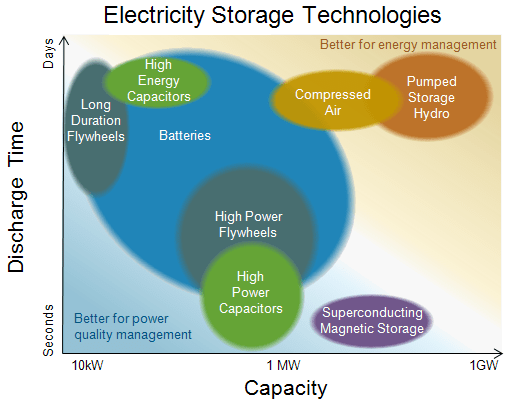
Image Source: U.S. Energy Information Administration (1)
“It doesn’t always rain when you need water, so we have reservoirs – but we don’t have the same system for electricity,” says Jill Cainey, director of the UK’s Electricity Storage Network.
[…] Big batteries, whose costs are plunging, are leading the way. But a host of other technologies, from existing schemes like splitting water to create hydrogen,compressing air in underground caverns, flywheels and heated gravel pits, to longer term bets like supercapacitors and superconducting magnets, are also jostling for position.
In the UK, the first plant to store electricity by squashing air into a liquid is due to open in March, while the first steps have been taken towards a virtual power station comprised of a network of home batteries.
“We think this will be a breakthrough year,” says John Prendergast at RES, a UK company that has 80MW of lithium-ion battery storage operational across the world and six times more in development, including its first UK project at a solar park near Glastonbury. “All this only works if it reduces costs for consumers and we think it does,” he says.
Energy storage is important for renewable energy not because green power is unpredictable – the sun, wind and tides are far more predictable than the surge that follows the end of a Wimbledon tennis final or the emergency shutdown of a gas-fired power plant. Storage is important because renewable energy is intermittent: strong winds in the early hours do not coincide with the peak demand of evenings. Storage allows electricity to be time-shifted to when it is needed, maximising the benefits of windfarms and solar arrays. (2)

Image Credit: GTM Research / SEIA U.S. Solar Market Insight
Source Credit: March 9 (SeeNews) by Plamena Tisheva
“[…] The market will be driven by the utility-scale segment, which will account for 74% of annual installations following a rush to take advantage of the federal Investment Tax Credit (ITC) that was initially set to expire at the end of this year. The residential and commercial markets are also expected to see strong growth in 2016, though.
With the ITC now extended, state-level drivers and risks will move to the forefront in 2016, says the US Solar Market Insight Report 2015, published in conjunction with the Solar Energy Industries Association (SEIA).
In 2017, the US solar market is expected to shrink to 10 GW due to the pull-in of utility demand in 2016. “But between 2018 and 2020, the extension of the ITC will reboot market growth for utility PV and support continued growth in distributed solar as a growing number of states reach grid parity,” said GTM Research senior analyst Cory Honeyman. […]”
Source Link: http://bit.ly/1LdMdRB

With 88 projects from coast to coast, it might be the biggest grid edge R&D effort ever. Here’s how the money is going to be spent.
Sourced through Scoop.it from: www.greentechmedia.com
“[…] The Grid Modernization Multi-Year Program Plan will bring a consortium of 14 national laboratories together with more than 100 companies, utilities, research organizations, state regulators and regional grid operators. The scope of this work includes integrating renewable energy, energy storage and smart building technologies at the edges of the grid network, at a much greater scale than is done today.
That will require a complicated mix of customer-owned and utility-controlled technology, all of which must be secured against cyberattacks and extreme weather events. And at some point, all of this new technology will need to become part of how utilities, grid operators, regulators, ratepayers and new energy services providers manage the economics of the grid.
DOE has already started releasing funds to 10 “pioneer regional partnerships,” or “early-stage, public-private collaborative projects […] The projects range from remote microgrids in Alaska and grid resiliency in New Orleans, to renewable energy integration in Vermont and Hawaii, and scaling up to statewide energy regulatory overhauls in California and New York. Others are providing software simulation capabilities to utilities and grid operators around the country, or looking at ways to tie the country’s massive eastern and western grids into a more secure and efficient whole.
Another six “core” projects are working on more central issues, like creating the “fundamental knowledge, metrics and tools we’re going to need to establish the foundation of this effort,” he said (David Danielson). Those include technology architecture and interoperability, device testing and validation, setting values for different grid services that integrated distributed energy resources (DERs) can provide, and coming up with the right sensor and control strategy to balance costs and complexity.
Finally, the DOE has identified six “cross-cutting” technology areas that it wants to support, Patricia Hoffman, assistant secretary of DOE’s Office of Electricity Delivery and Energy Reliability, noted in last week’s conference call. Those include device and integrated system testing, sensing and measurement, system operations and controls, design and planning tools, security and resilience, and institutional support for the utilities, state regulators and regional grid operators that will be the entities that end up deploying this technology at scale.
Much of the work is being driven by the power grid modernization needs laid out in DOE’s Quadrennial Energy Review, which called for $3.5 billion in new spending to modernize and strengthen the country’s power grid, while the Quadrennial Technology Review brought cybersecurity and interoperability concerns to bear.[…]
DOE will hold six regional workshops over the coming months to provide more details, Danielson said. We’ve already seen one come out this week — the $18 million in SunShot grants for six projects testing out ways to bring storage-backed solar power to the grid at a cost of less than 14 cents per kilowatt-hour.
“We can’t look at one attribute of the grid at a time,” he said. “We’re not just looking for a secure grid — we’re looking for an affordable grid, a sustainable grid, a resilient grid.” And one that can foster renewable energy and greenhouse gas reduction at the state-by-state and national levels. […]
The Nature of Things – Shattered Ground
fracking documentary
Sourced through Scoop.it from: www.youtube.com

image credit: (2)
“[…] “Fracking”, or Hydraulic Fracturing, is a new technology that has opened up immense resources of natural gas buried in deep shale beds. The process involves injection of highly-pressurized water, sand and chemicals to shatter underground layers of shale and extract previously inaccessible natural gas.
But the process and its sudden spread across the North American landscape, has become an incredibly divisive issue, ripping apart communities and even families. The backlash to the gas industry is unprecedented, with some countries, Canadian provinces and American states adopting fracking bans and moratoriums. […] “(1)
(1) http://www.cbc.ca/natureofthings/episodes/shattered-ground
“[…] In Dimock, Pennsylvania, residents found their water contaminated after fracking began nearby. As it turns out, the cement casings that were meant to prevent the water from escaping had failed, and now all of their water was contaminated. One man described his daughter’s experience showering in that water:
“My daughter would get in the shower in the morning, and she would have to get out and lay on the floor because she thought she was going to pass out from the methane. She had eczema on the insides of her arms, hives up and down her body, and she said, ‘I want to have kids some day’. You know, my job is to protect my kids, how do I protect them from this?” […] “(2)

The oil cartel is living in a time-warp, seemingly unaware that global energy politics have changed forever
Sourced through Scoop.it from: www.telegraph.co.uk
“…OPEC says battery costs may fall by 30-50pc over the next quarter century but doubts that this will be enough to make much difference, due to “consumer resistance”.
This is a brave call given that Apple and Google have thrown their vast resources into the race for plug-in vehicles, and Tesla’s Model 3s will be on the market by 2017 for around $35,000.
Ford has just announced that it will invest $4.5bn in electric and hybrid cars, with 13 models for sale by 2020. Volkswagen is to unveil its “completely new concept car” next month, promising a new era of “affordable long-distance electromobility.”
The OPEC report is equally dismissive of Toyota’s decision to bet its future on hydrogen fuel cars, starting with the Mirai as a loss-leader. One should have thought that a decision by the world’s biggest car company to end all production of petrol and diesel cars by 2050 might be a wake-up call.
Goldman Sachs expects ‘grid-connected vehicles’ to capture 22pc of the global market within a decade, with sales of 25m a year, and by then – it says – the auto giants will think twice before investing any more money in the internal combustion engine. Once critical mass is reached, it is not hard to imagine a wholesale shift to electrification in the 2030s. […]
A team of Cambridge chemists says it has cracked the technology of a lithium-air battery with 90pc efficiency, able to power a car from London to Edinburgh on a single charge. It promises to cut costs by four-fifths, and could be on the road within a decade.
There is now a global race to win the battery prize. The US Department of Energy is funding a project by the universities of Michigan, Stanford, and Chicago, in concert with the Argonne and Lawrence Berkeley national laboratories. The Japan Science and Technology Agency has its own project in Osaka. South Korea and China are mobilising their research centres.
A regulatory squeeze is quickly changing the rules of global energy.The Grantham Institute at the London School of Economics counts 800 policies and laws aimed at curbing emissions worldwide.
Goldman Sachs says the model to watch is Norway, where electric vehicles already command 16.3pc of the market. The switch has been driven by tax exemptions, priority use of traffic lanes, and a forest of charging stations.
California is following suit. It has a mandatory 22pc target for ‘grid-connected’ vehicles within ten years. New cars in China will have to meet emission standards of 5 litres per 100km by 2020, even stricter than in Europe. […]
In the meantime, OPEC revenues have crashed from $1.2 trillion in 2012 to nearer $400bn at today’s Brent price of $36.75, with fiscal and regime pain to match.
This policy has eroded global spare capacity to a wafer-thin 1.5m b/d, leaving the world vulnerable to a future shock. It implies a far more volatile market in which prices gyrate wildly, eroding confidence in oil as a reliable source of energy.
The more that this Saudi policy succeeds, the quicker the world will adopt policies to break reliance on its only product. As internal critics in Riyadh keep grumbling, the strategy is suicide.
Saudi Arabia and the Gulf states are lucky. They have been warned in advance that OPEC faces slow-run off. The cartel has 25 years to prepare for a new order that will require far less oil.
If they have any planning sense, they will manage the market to ensure crude prices of $70 to $80. They will eke out their revenues long enough to control spending and train their people for a post-petrol economy, rather than clinging to 20th Century illusions.
Sheikh Ahmed Zaki Yamani, the former Saudi oil minister, warned in aninterview with the Telegraph fifteen years ago that this moment of reckoning was coming and he specifically cited fuel-cell technologies.
“Thirty years from now there will be a huge amount of oil – and no buyers. Oil will be left in the ground. The Stone Age came to an end, not because we had a lack of stones.”
They did not listen to him then, and they are not listening now.”
Its been pretty windy recently, So wind farms are probably doing quite well at the moment. The biggest wind farm in the world, at the moment, is the London array, which can produce 630MW of power.
The future is very encouraging for wind power. The technology is growing exponentially due to the current power crisis and the ongoing discussions about nuclear power plants. Wind turbines are becoming more efficient and are able to produce increased electricity capacity given the same factors.
Facts & figures:
There is over 200 GW (Giga Watts) of installed wind energy capacity in the world.
The Global Wind Energy Council (GWEC) has forecasted a global capacity of 2,300 GW by 2030. This will cover up to 22% of the global power consumption.

A wind turbine converts the kinetic energy of wind into rotational mechanical energy. This energy is directly converted, by a generator, into electrical energy. Large wind turbines typically have a generator installed on top of the tower. Commonly, there…
View original post 489 more words

Speakers at a presentation in West Vancouver on the risks associated with the proposed LNG project in Howe Sound voiced concerns, Wednesday, over everything from environmental contamination to the risk of explosions from transporting natural gas.
Source: www.nsnews.com
>”[…] “Canada doesn’t have a whole pile of rules about LNG because it doesn’t have a whole pile of plants,” said Eoin Finn a seasonal resident of Bowyer Island in Howe Sound, and speaker at the event. Finn holds a PhD in physical chemistry and is a close follower of the LNG project.
He said an LNG plant of this size has never before existed in Canada. He has concerns over the country’s lack of environmental regulations in place against this particular resource.
“There are no plants on the West Coast of Canada nor on the U.S. except a tiny one in Alaska but that’s 100 miles from anywhere and it’s about one-tenth (the size of) Woodfibre.”
When it comes to the risks associated with the proposed development, Finn said there are many, including emissions output, the risk of shipping accidents and the plant’s cooling system, which would use seawater.
“One of the big issues is that the plant will be cooled by seawater from the sound. This is pretty old technology that’s been dismissed and refused and abandoned in California and Europe.”
He said that the current proposed cooling system for the plant would suck in 17,000 tonnes of seawater (3.7 million gallons) per hour, and chlorinate it while it circulates through the system, before releasing it back into Howe Sound.
Finn explained that any such practice would be “extremely damaging” to marine life and that similar systems down the coast in California have been banned.
Although the plant will be powered by electricity, Finn said it will still produce emissions, including 140,000 tons of carbon dioxide a year.
Among Finn’s other concerns was tanker traffic associated with the project, which would see between six and eight tankers navigating through the sound per month.
He cited a risk of explosions associated with the ships, which could have potential negative effects on area property values. Large waves generated from those vessels could also be a problem for the area, something Finn compared to the BC Ferries Fast Cat situation years before. […]
Wade Davis, Bowen Island resident and professor of anthropology, said the issue of whether or not the plant will go in place holds a deeper meaning than simply a local environmental danger.
“This is not simply about a local issue in Howe Sound, this is a metaphor for who we are to be as a people,” he explained to the audience. “If we are actually prepared to invest our lives in this way, the most glorious fjord in the world, what else in our country will be immune to such violations?” he asked. […]”<
See on Scoop.it – Green & Sustainable News

According to a new IDC Energy Insights report, “Business Strategy: Global Smart Building Technology Spending 2015–2019 Forecast,”* smart building technology spending will grow from $6.3 billion in 2014 to $17.4 billion in 2019, registering a compound annual growth rate of 22.6 percent. The most aggressive adoption will be in Asia/Pacific, North America, and Western Europe. …Continue Reading
Source: www.energymanagertoday.com
>”[…]
After several years of slower-than-expected growth, the smart building technology market is expected to grow rapidly as there is increasingly broad market awareness of the business value. Smart buildings enable facility optimization through the convergence of information technology and building automation.
In developing this forecast, several trends were identified. One trend is that vertical industries have a large impact on the rate of adoption of smart building technologies. Buildings managed in the government or healthcare verticals, for example, tend to be more mature in their appreciation of the benefits of smart buildings and more advanced in their deployment. Secondly, investments over the past several years have focused on HVAC systems. Customers are now beginning to expand their evaluation to lighting, plug load, equipment maintenance and other issues.
From a geographic perspective, North America will continue to implement smart building technology driven largely by corporate objectives of controlling and reducing energy costs. Many European nations will continue to expand their investments in smart building technology, driven by continued EU and local governmental regulations. And within Asia/Pacific, China’s rapid building boom continues apace, resulting in new construction with many smart building capabilities designed in from the beginning.”<
See on Scoop.it – Green Building Operations – Systems & Controls, Maintenance & Commissioning

 duanetilden