Green Infrastructure: A Landscape Approach

“There are really two definitions of green infrastructure. One is an inter-connected network of green open spaces that provide a range of ecosystem services — from clean air and water to wildlife habitat and carbon sinks. The other is a more limited one promoted by the E.P.A.: small-scale green systems designed to be urban stormwater management infrastructure. In either definition, green infrastructure is about bringing together “natural and built environments” and using the “landscape as infrastructure,” said Rouse. […]”

Jared Green's avatarTHE DIRT

gibook
Green infrastructure is starting to mean different things to different people, said David Rouse, ASLA, a landscape architect and planner at Wallace, Roberts & Todd (WRT) during a session at the American Planning Association (APA) conference in Chicago. Rouse was there with Theresa Schwarz, Kent State Cleveland Urban Design Collaborative; Karen Walz, Strategic Community Solutions; and Ignacio Bunster-Ossa, FASLA, a landscape architect with WRT, who together co-authored a new book published by APA called Green Infrastructure: A Landscape Approach.

There are really two definitions of green infrastructure. One is an inter-connected network of green open spaces that provide a range of ecosystem services — from clean air and water to wildlife habitat and carbon sinks. The other is a more limited one promoted by the E.P.A.: small-scale green systems designed to be urban stormwater management infrastructure. In either definition, green infrastructure is about bringing together “natural and…

View original post 1,297 more words

The Smart City

“With this unprecedented access to information, Smart Cities will deliver new levels of efficiency, effectiveness, safety, reliability, and higher levels of service. This access enables a city to anticipate and prevent problems in areas like reducing accidents by rerouting traffic, and reducing crime by identifying hot spots. New insight also enables the provision of services like finding a parking spot, monitoring air pollution, intelligent lighting, and others. A sense and respond model (a key future enabler) allows for the delivery of many of these services without human intervention.

A next generation of efficiency is also enabled, as asset tracking will streamline operations and insight will deliver unprecedented levels of efficiency. For example, a recent survey of water utilities found a saving potential between $7.1 and $12.5 billion each year through smart water solutions. The chief globalization officer of Cisco has said that smart cities drive energy consumption savings of 30% and water consumption savings of 50%. These environmental benefits include reducing greenhouse gas emissions and improving waste management. Boston University Installed self-powered trash receptacles which wirelessly alerted collection vehicles when they were full, resulting in on-campus trash collection being reduced from 14 times per week to an average of 1.6 times per week.

The Smart City

The Smart City is Defined as a developed urban area that creates sustainable economic development and a high quality of life by excelling in multiple key areas; economy, mobility, environment, people, living, and government. Excelling in these key areas requires strong human capital, social capital, and information and communications technology. We are in the early days of an evolution towards Smart Cities, and IDC Government Insights finds that most cities are deploying these projects department by department. In a recent IDC White paper, they provide a maturity model to describe this Smart City evolution…”

Frank Diana's avatarReimagining the Future

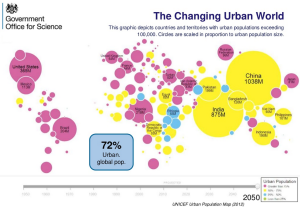
Next up in this ongoing look at disruptive scenarios is the Smart City. For the first time in history, more than 50% of the world’s population lives in cities, and that percentage moves to 70% by 2050. This visual effectively captures the dramatic move towards urbanization:

Urbanization Statistics

View original post 1,802 more words

Bosch Buys Arizona Building Technology Firm

“Climatec is an independent single-source integrator of critical building systems including energy services, building automation and security system integration in the U.S. market. The company provides consulting, planning, implementation and around-the-clock remote management of comprehensive comfort, security, safety and efficiency solutions. Climatec is active in education, healthcare, the public sector, industrial/manufacturing, computing services, office buildings, federal, state and local government, hospitality and energy.”

esdmattroush's avatarTechCentury.com

FARMINGTON HILLS — Farmington Hills-based Robert Bosch North America Corp. has acquired Climatec LLC, a Phoenix, Ariz.-based provider of energy efficiency, building automation, security and safety products and services.

Climatec generated sales of $170 million in 2013, and according to preliminary figures hit $190 million in sales in 2014. The company employs 670 people at 12 offices in Arizona, California, Nevada and Texas.

Climatec has been owned by Pegasus Capital Advisors, L.P. since April 2012. Terms of the transaction were not disclosed.

View original post 501 more words

Facts About Solar Powered LED Lights

Clearworld Solutions's avatarClearworld Solutions

led street lamps

In spite of all the hype about combating global warming and switching to environmentally friendly sources, little attention has been given to the streetlights. Whilst they are crucial to the public, they are very energy consuming, and their servicing is costly. Thus, it is worthy of note when a big city like Los Angeles reports that it will replace 140,000 streetlights with LEDs.

LEDs are attaining traction as a great alternative to conventional lighting because they are relatively environmentally friendly, don’t consume much power and have long life spans. They survive so long, 14 years or more in some instances, that they can be regarded as “semi-permanent”.

Several of the most significant electronic firms see LEDs as the destiny of lighting. The LED market of seasonal lights, lights on the Empire State Building, and so on, is estimated to have a worth of $1 billion by 2013.

In earlier times…

View original post 341 more words

Wind Turbines

rotronicuk's avatarRotronic - BLOG

Its been pretty windy recently, So wind farms are probably doing quite well at the moment. The biggest wind farm in the world, at the moment, is the London array, which can produce 630MW of power.

Wind Energy in General

The future is very encouraging for wind power. The technology is growing exponentially due to the current power crisis and the ongoing discussions about nuclear power plants. Wind turbines are becoming more efficient and are able to produce increased electricity capacity given the same factors.

Facts & figures:

There is over 200 GW (Giga Watts) of installed wind energy capacity in the world.

The Global Wind Energy Council (GWEC) has forecasted a global capacity of 2,300 GW by 2030. This will cover up to 22% of the global power consumption.

WindPower
Converting wind power into electrical power:

A wind turbine converts the kinetic energy of wind into rotational mechanical energy. This energy is directly converted, by a generator, into electrical energy. Large wind turbines typically have a generator installed on top of the tower. Commonly, there…

View original post 489 more words

France now requires all new buildings to have green roofs or solar panels

Susan Davis Cushing's avatarPr0jectClimate

France just passed atrailblazing new lawthat requires that all new buildings constructed in commercial areas to be partially-covered by either solar panels orgreen roofs. Not only will this bring dramatic changes to the nation?s skylines and bolster the efficiency of all new commercial construction, but the law will help France pick up the pace the solar adoption?which has lagged behind other European nations in recent years.

Read more:France requires all new buildings to have green roofs or solar panels | Inhabitat – Sustainable Design Innovation, Eco Architecture, Green Building


Source: inhabitat.com

“Here’s hoping that other nations can soon follow suit.” I had to go back and dig through my sources to make sure I hadn’t dreamed this!

View original post

LED Savings Estimator for Common Commercial Lighting Fixtures

Sarah Moniz's avatarGCE TV

energy savings calculator

With the recent increase in electricity rates, it has never been more important for electrical contractors to show your customers some LED options.  Everyone knows that LED lighting fixtures are more energy efficient, last longer, and require less maintenance and replacement.  However, there will still be commercial customers and business owners who are nervous about the upfront costs associated with a full retrofit or new installation.

While some money will be spent upfront purchasing new LED fixtures, the savings associated with the reduced wattage fixtures can rapidly offset the initial costs.  And with rebates available for commercial customers of NGRID, NSTAR, WMECO, Unitil and Cape Light Compact, your customers will see a return on investment in a short period time with energy savings for years to come.

The Energy group at Granite City Electric is available to work with you on any new construction or retrofit project to ensure all…

View original post 234 more words

Impact of energy efficiency standards in the US

Electricity storage becomes priority as solar and wind energy cost keeps dropping

“And the cost of solar power is declining amazingly. Austin Energy signed a deal recently that a solar farm is selling at 5 cents a kilowatt-hour. A recent study by Lazard gave a cost of 5.6 cents for solar and 1.4 cents for wind power (with current subsidies) or 7.2 cents for solar and 3.7 cents for wind without subsidies. Natural gas came in at 6.1 cents and coal at 6.6 cents. The Solar Energy Industries Association claims that in the Southwest electricity contracts for solar energy have dropped 70 percent since 2008.”

Peter Spitz's avatarchemengineeringposts

imgres The rapid advances in the use of solar and wind energy – more in Europe, but now also gaining momentum in the U.S.- has put electricity “storage” front and center. That is because there is no solar production at night and little on cloudy days, while strong winds are unpredictable in most locations. So, the best “model” for these renewable energy sources is to generate as much as possible at favorable times and to “store” excess production for periods when solar and wind energy supply are low.

And the cost of solar power is declining amazingly. Austin Energy signed a deal recently that a solar farm is selling at 5 cents a kilowatt-hour. A recent study by Lazard gave a cost of 5.6 cents for solar and 1.4 cents for wind power (with current subsidies) or 7.2 cents for solar and 3.7 cents for wind without subsidies. Natural gas came in at…

View original post 303 more words

Snohomish PUD’s Energy Storage Initiative