Liquid Air Processes for Energy Storage and Power – Grid & Transportation

A 19th-century idea might lead to cleaner cars, larger-scale renewable energy.

Source: www.technologyreview.com

>”Highview Power’s process is 50 to 60 percent efficient—the liquid air can yield just over half as much electricity as it takes to make it. Batteries, by contrast, can be more than 90 percent efficient. But the new process can make up for its inefficiency by using waste heat from other processes (see “Audi to Make Fuel Using Solar Power”). Highview has demonstrated that low-temperature waste heat from power plants or even data centers can be used to help warm up the liquefied air. The system can also last for decades, while batteries typically need to be replaced every few years. This longevity could help reduce overall costs.

Several companies are developing ways to improve the efficiency of compressing air, which could also make the liquefaction process more efficient (see “LightSail Energy Snags $37M in Funding” and “Compressed-Air System Could Aid Wind Power”). Liquefied air is about four times more energy-dense than compressed air, and storing it at a large scale takes up less space.

Liquid air might also prove useful in cars and trucks. An inventor named Peter Dearman has made a compact system that, instead of relying on large heat exchangers, uses antifreeze injected into an engine’s combustion chamber to recycle heat that would otherwise be wasted. He built a ramshackle prototype and showed that it could power a car. Ricardo is working on a version that could eventually be commercialized.

Liquid air stores energy at about the density of nickel–metal hydride batteries and some lithium-ion batteries, the kind used in hybrid and electric cars now. But it has a key advantage—it can be poured into a fuel tank far faster than a battery can be recharged, says Andrew Atkins, a senior technologist at Ricardo. The engine would run on liquid nitrogen—basically liquid air with the oxygen removed—and would emit only nitrogen. The carbon emissions associated with the engine would depend on the power source used to liquefy the nitrogen.”<
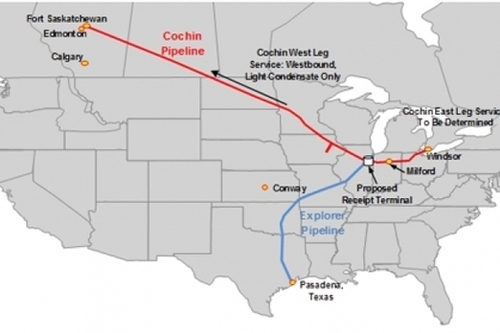

Obama approves border-crossing pipeline carrying corrosive fracked gas diluent to Alberta Tar-Sands

See on Scoop.itGreen Energy Technologies & Development

But the pipeline has problems with stress corrosion cracking. Is it safe to expand?

Duane Tilden‘s insight:

>Kinder Morgan Cochin LLC is now allowed to reverse and expand to build a 1,900-mile proposed pipeline to transport gas produced by hydraulic fracturing of the Eagle Ford Shale basin in Texas north into Alberta. It would carry gas condensate that is used to dilute the bitumen in the tar sands. The extra-thick oil produced in the tar sands needs to be cut with 30 per cent condensate so it can be carried, according to the Financial Post.

The Cochin pipeline has had some safety issues in the past, however. Last year, the National Energy Board sent Kinder Morgan a letter regarding Stress Corrosion Cracking (SCC) failure in the U.S. back in 2003. At the time, the U.S. Pipeline and Hazardous Materials Safety Administration (PHMSA) issued an order imposing a 20 per cent pressure restriction on the pipeline. Kinder Morgan later voluntarily imposed a further restriction on the operating pressure and received approval to increase  the operating pressure of the pipeline in US to 6895 kPa (1000 psi) in March 2012.<

See on www.vancouverobserver.com

Greening Coal Power with CO2-eating Microalgae as a Biofuel Feedstock

See on Scoop.itGreen Energy Technologies & Development

Successful microalgae-to-biodiesel conversion has been the goal of some renewable energy researchers for more than two decades.

Duane Tilden‘s insight:

>To that end, Algae.Tec has signed a deal with Macquarie Generation, Australia’s largest electricity generator, to put an “algae carbon capture and biofuels” production facility next to a coal-fired power station in Australia’s Hunter Valley. Macquarie Generation, which operates the Sydney-area 2640 MW Bayswater Power Station, will feed waste CO2 into an enclosed algae growth system. […]

Projections are for the first year of production to hit 100,000 tons of algae biomass; half of which would be converted to an estimated 60 million liters of biodiesel. One sea-land container would generate 250 tons of biomass per annum, said the company, which would be harvested on a continuous basis. […]

Stroud projects that some 75 percent of his company’s income will come from biodiesel. The remaining 25 percent of Algae.Tec’s income will hinge on the sale of the microalgae’s leftover biomass for animal feed.<

See on www.renewableenergyworld.com

Surplus fossil fuels expected to exceed carbon budget

See on Scoop.itGreen & Sustainable News

It won’t be difficult to blow by the 1-trillion ton threshold based on the amount of fossil fuels still in the ground. As Amy Myers Jaffe remarks, “scarcity will not be the force driving a shift to alternative energy. Climate and energy policy initiatives will have to take into consideration the possibility of oil and gas surpluses and lower fossil fuel prices.”

Duane Tilden‘s insight:

>The lesson here is that the economics are still in favor of producing fossil fuels. The cyclical nature of energy prices suggests that higher prices will spur development of technologies to reach more difficult energy deposits. This doesn’t mean that oil and natural gas prices will be low for the rest of time, but it does reflect how high energy prices in the 2000s led not only to funding and research in alternative fuels (particularly biofuels), but also in oil and gas technologies. This investment coupled with decades of U.S. government and academic research proved fruitful with the combination of horizontal drilling and hydraulic fracturing becoming a deployable technology.

We have now entered a period of energy surplus where we produce energy from “unconventional sources” using technological breakthroughs like horizontal drilling and hydraulic fracturing in places like North Dakota, south Texas, Lousiana, and Pennsylvannia. (and soon to be California?).<

See on blogs.scientificamerican.com

Algae Biofuel Emits at Least 50% Less Carbon than Petroleum Fuels

See on Scoop.itGreen Energy Technologies & Development

Algae-derived biofuel can reduce life cycle CO2 emissions by 50 to 70 percent compared to petroleum fuels, and is approaching a similar Energy Return on Investment (EROI) as conventional petroleum according to a new peer-reviewed paper published in…

Duane Tilden‘s insight:

>The study entitled Pilot-scale data provide enhanced estimates of the life cycle energy and emissions profile of algae biofuels produced via hydrothermal liquefaction (HTL) is the first to analyze data from a commercial-scale algae-to-energy farm. Researchers examined field data from Sapphire Energy facilities in Las Cruces and Columbus, New Mexico.

Researchers at the Pacific Northwest National Laboratory recently concluded that 14 percent of land in the continental United States, or the combined area of Texas and New Mexico, could be used to grow and produce algae for conversion into transportation fuels. In 2008, the U.S. Department of Energy found that for algae fuel to completely replace petroleum in the United States it would need roughly 30,000 square kilometers of land, or half the area of South Carolina, so the potential is certainly there for a massive transition from dirty oil-based transportation fuels to cleaner burning domestic green crude from algae.<


See on inhabitat.com

Clay key to high-temperature supercapacitors

See on Scoop.itGreen Energy Technologies & Development

Clay, an abundant and cheap natural material, is a key ingredient in a supercapacitor that can operate at very high temperatures, according to researchers who have developed such a device.

Duane Tilden‘s insight:

>”Our intention is to completely move away from conventional liquid or gel-type electrolytes, which have been limited to low-temperature operation of electrochemical devices,” said Arava Leela Mohana Reddy, lead author and a former research scientist at Rice.

“We found that a clay-based membrane electrolyte is a game-changing breakthrough that overcomes one of the key limitations of high-temperature operation of electrochemical energy devices,” Reddy said. “By allowing safe operation over a wide range of temperatures without compromising on high energy, power and cycle life, we believe we can dramatically enhance or even eliminate the need for expensive thermal management systems.”

A supercapacitor combines the best qualities of capacitors that charge in seconds and discharge energy in a burst and rechargeable batteries that charge slowly but release energy on demand over time. The ideal supercapacitor would charge quickly, store energy and release it as needed.<

See on www.sciencedaily.com

Regenerative Suspension: How Bumps In The Road Can Generate Electrical Power

See on Scoop.itGreen Energy Technologies & Development

ZF Friedrichshafen AG and Levant Power Corp. have joined together to produce the first fully-active advanced suspension system that recovers energy and directs it to charge the battery while the car is moving.

Duane Tilden‘s insight:

>Gas2 says it’ll be “a while” before the system will go mainstream — likely several years — but it seems a no-brainer for every hybrid and electric vehicle to install this system or one like it to eke out battery charge through energy that is normally wasted. Gas-powered cars also have batteries that get a charge while the engine is running, but they use a belt attached to the engine itself to charge the battery. This causes gas-powered engines to be less efficient, and with most conventional cars using only around 15 percent of the potential energy of gasoline, efficiency comes at a premium.

Most hybrid car drivers will be familiar with the concept of recovering energy from normal car functions because of the increasingly frequent use of brake systems that, when used, transfer heat and friction of normal braking to the battery. As fuel economy standards improve over the next decade, car manufacturers are looking for anything they can do to make cars more efficient.<

See on thinkprogress.org

Waste Heat Energy Recovery – ThermoAcoustic Refrigeration for Transportation Industry

Revisiting the Automotive ThermoAcoustic Refrigerator – ATAR

Diagram of Simplified ThermoAcoustic Engine

I wish to further investigate the idea of thermoacoustics for waste heat recovery processes.  Also, will in future look into latest developments in thermoacoustics, including any applications, studies, reviews or products and manufacturers.

In today’s new economy of energy efficiency, there are technologies available that are worth further investigation that can be utilized for improved performance.  Automotive air conditioning is one industry which could bear further scrutiny, where running compressors consume valuable fuel, decreasing the energy efficiency and increasing operating cost of a vehicle.

For professional drivers where fuel consumption increases will come out of pocket, the utilization of air conditioning is an important consideration.  The idea of using the waste heat in the exhaust system to provide the cooling energy necessary to provide air conditioning is a novel approach to improving vehicle efficiency and comfort.  The concept of thermoacoustic refrigeration is not new, and was previously reviewed by concerns of the ozone layer depletion and refrigerants, which ultimately lead to changes in the refrigeration and HVAC industries.

See original reference paper presented at 2005 Proceedings of Acoustics:  http://bit.ly/17qwTYK

Biofuel Production from Palm oil plantation waste

See on Scoop.itGreen Building Design – Architecture & Engineering

NextFuels to produce biofuels from palm plantation residue – Renewable Energy Magazine, at the heart of clean energy journalism

Duane Tilden‘s insight:

>Edible palm oil has surpassed soybean to become the largest source of cooking oil in the world, accounting for over 50 million tons of oil annually.

While plantation owners have managed to increase the productivity of their land by 15X since the late 80s, the growth of the industry has created a corresponding residue problem. Approximately 4.4 to 6 metric tons of agricultural waste is generated for each metric ton of oil. There are over 1,000 crude palm oil (CPO) mills in Southeast Asia and a single (60 tons per hour) mill can generate 135,000 tons of agricultural residue a year.

NextFuels uses a system called bio-liquefaction that efficiently transforms agricultural biomass to green energy. Biomass is placed into the plant mixed with water. The mixture is then heated to 330-degree Celsius while pressure is increased to 220 bar. Increasing the pressure keeps the water from coming to a boil, which conserves energy.

When cooled, the hydrocarbons form a putty-like substance called GreenCrude. Roughly 25 percent of the GreenCrude can be burned as a solid fuel in industrial boilers. The remaining 75 percent can be converted into a liquid-fuel equivalent to petroleum that is compatible with existing pipelines and vehicles.

The equipment required to convert GreenCrude into liquid fuels, in a process called hydrodeoxygenation, is already installed at most refineries and can… <

See on www.renewableenergymagazine.com

Jobs for the Future: Energy Efficiency creates Employment — ECEEE

See on Scoop.itGreen & Sustainable News

Energy efficiency initiatives create jobs, and normally very good jobs.  Recent analysis shows that between 17 and 19 net jobs can be created for every million euros spent.

Duane Tilden‘s insight:

>Jobs to improve energy efficiency in all end-use sectors are of high value.  Many require technical qualifications, such as engineering or architectural degrees.  Many require re-training from existing jobs. There will be a demand for financial specialists, construction engineers, behaviour specialists, project managers, auditors, data base managers, policy analysts and the like.  And these jobs are available to all, regardless of age or gender.

The hard work of creating these jobs begins once the Directive is finally approved.  The long-term policy framework needs to be in place and the funding and implementation strategy need to be well developed. But in the longer term, opportunity is knocking at the door, and it deserves a welcome mat.<

See on www.eceee.org