Waste Heat Recovery using Supercritical CO2 turbines to create Electrical Power

See on Scoop.itGreen Building Design – Architecture & Engineering
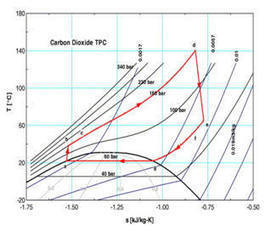
Working fluids with relatively low critical temperature and pressure can be compressed directly to their supercritical pressures and heated to their supercritical state before expansion so as to obtain a better thermal match with the heat source.

Duane Tilden‘s insight:

>Chen et al. [1-3] did a comparative study of the carbon dioxide supercritical power cycle and compared it with an organic Rankine cycle using R123 as the working fluid in a waste heat recovery application. It shows that a CO2 supercritical power cycle has higher system efficiency than an ORC when taking into account the behavior of the heat transfer between the heat source and the working fluid. The CO2 cycle shows no pinch limitation in the heat exchanger. Zhang et al.  [4-11] has also conducted research on the supercritical CO2 power cycle. Experiments revealed that the CO2 can be heated up to 187℃ and the power generation efficiency was 8.78% to 9.45% [7] and the COP for the overall outputs from the cycle was 0.548 and 0.406, respectively, on a typical summer and winter day in Japan [5].

Organic fluids like isobutene, propane, propylene, difluoromethane and R-245fa [12] have also been suggested for supercritical Rankine cycle. It was found that supercritical fluids can maximize the efficiency of the system. However, detailed studies on the use of organic working fluids in supercritical Rankine cycles have not been widely published.

There is no supercritical Rankine cycle in operation up to now. However, it is becoming a new direction due to its advantages in thermal efficiency and simplicity in configuration.<

See on www.eng.usf.edu
Bloomberg predicts: Solar to add more megawatts than wind in 2013

See on Scoop.itGreen Energy Technologies & Development

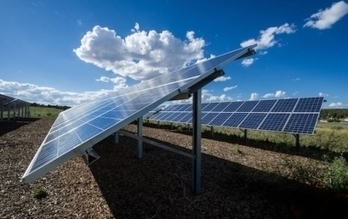
Bloomberg New Energy Finance predicts that for the first time more new solar power capacity — compared to wind — will be added to the world’s global energy infrastructure this year.

Duane Tilden‘s insight:

>In an BNEF’s analysts forecast 36.7GW of new photovoltaic capacity this year, compared to 33.8 GW of new onshore wind farms, and  1.7 GW of offshore wind.

In 2012, wind — onshore and offshore — added 46.6 GW, while PV added 30.5GW, record figures in both cases. But in 2013, a slowdown in the world’s two largest wind markets, China and the US, is opening the way for the rapidly growing PV market to overtake wind.

“The dramatic cost reductions in PV, combined with new incentive regimes in Japan and China, are making possible further, strong growth in volumes,” said Jenny Chase, head of solar analysis at Bloomberg New Energy Finance. “Europe is a declining market, because many countries there are rapidly moving away from incentives, but it will continue to see new PV capacity added.”<

See on www.renewableenergymagazine.com

Robotic Technologies Applied to Solar Energy Market – Installation and Maintenance

See on Scoop.itGreen Building Design – Architecture & Engineering

Mountain View CA (SPX) Sep 20, 2013 – … robotic technologies deliver revolutionary installation and cleaning services at highly competitive prices … for building and maintenance of utility-scale solar plants..

Duane Tilden‘s insight:

>The typical installation process for utility-scale projects is similar to that of a small-scale, 20-panel, residential installation. Despite incremental improvements to the process, a 200,000-panel installation has retained many of the characteristics of a 20-panel installation.

They are both labor-intensive, and require repetitive bolt-tightening and glass-hauling. While these are minor flaws in a 20-panel system, they create significant inefficiencies in 20,000- or 200,000-panel systems.

Alion Energy has plugged the shortcomings of the current installation methods by changing the materials and design used in the mounting structure as well as by automating the installation. By combining robotic installation technology with established construction practices, Alion Energy has built a system twice as fast and 75 percent more labor-efficient that lowers solar electricity’s levelized cost of energy (LCOE) to compete with traditional energy sources.<

See on www.solardaily.com

World Record Solar Cell with 44.7 Percent Efficiency (news)

See on Scoop.itGreen Energy Technologies & Development

Freiburg, Germany – The Fraunhofer Institute for Solar Energy Systems ISE, Soitec, CEA-Leti and the Helmholtz Center Berlin jointly announced on late Monday having achieved a new world record for the conversion of sunlight into electricity using a new solar cell structure with four solar subcells. …

Duane Tilden‘s insight:

>These solar cells are used in concentrator photovoltaics (CPV), a technology which achieves more than twice the efficiency of conventional PV power plants in sun-rich locations. The terrestrial use of so-called III-V multi-junction solar cells, which originally came from space technology, has prevailed to realize highest efficiencies for the conversion of sunlight to electricity. In this multi-junction solar cell, several cells made out of different III-V semiconductor materials are stacked on top of each other. The single subcells absorb different wavelength ranges of the solar spectrum.<

See on renewable-energy-industry.com

India’s First LEED’s Green Building targets “Net Zero” with High Efficiency Solar Power

See on Scoop.itGreen Building Design – Architecture & Engineering

New Delhi, India (SPX) Sep 19, 2013 – SunPower has announced that Swadeshi Civil Infrastructure has completed the installation of a 930-kilowatt (kW) SunPower solar system on the rooftop of the Indira Paryavaran Bhavan building…

Duane Tilden‘s insight:

>The state-of-the art landmark will be India’s first net zero energy building. Its design emphasizes conservation featuring trees to reduce adverse environmental impact, adequate natural light and shaded landscaped areas to reduce ambient temperature.

The building is targeted to achieve Platinum from the Leadership in Energy and Environmental Design green building rating system, known as LEED INDIA. It also is expected to receive a five star Green Rating for Integrated Habitat Assessment from the rating system developed by the Energy and Resource Institute and supported by the Ministry of New and Renewable Energy, the nodal ministry of Indian government.<

See on www.solardaily.com

Stanford Scientists Analyse Life Cycle Costs of Energy Storage vs Curtailment for Renewables

See on Scoop.itGreen Energy Technologies & Development

Stanford CA (SPX) Sep 17, 2013 –
Renewable energy holds the promise of reducing carbon dioxide emissions. But there are times when solar and wind farms generate more electricity than is needed by consumers.

Duane Tilden‘s insight:

>”We calculated how much energy is used over the full lifecycle of the battery – from the mining of raw materials to the installation of the finished device,” Barnhart said. “Batteries with high energetic cost consume more fossil fuels and therefore release more carbon dioxide over their lifetime. If a battery’s energetic cost is too high, its overall contribution to global warming could negate the environmental benefits of the wind or solar farm it was supposed to support.”

For this study, he and his colleagues calculated the energetic cost of grid-scale photovoltaic solar cells and wind turbines.

“Both wind turbines and photovoltaics deliver more energy than it takes to build and maintain them,” said GCEP postdoctoral scholar Michael Dale, a co-author of the study. “However, our calculations showed that the overall energetic cost of wind turbines is much lower than conventional solar panels, which require lots of energy, primarily from fossil fuels, for processing silicon and fabricating other components.” […]

To find out, the researchers compared the energetic cost of curtailing solar and wind power, versus the energetic cost of grid-scale storage. Their calculations were based on a formula known as “energy return on investment” – the amount of energy produced by a technology, divided by the amount of energy it takes to build and maintain it.

Using that formula, the researchers found that the amount of energy required to create a solar farm is comparable to the energy used to build each of the five battery technologies. “Using batteries to store solar power during periods of low demand would, therefore, be energetically favorable,” Dale said.

The results were quite different for wind farms. The scientists found that curtailing wind power reduces the energy return on investment by 10 percent. But storing surplus wind-generated electricity in batteries results in even greater reductions – from about 20 percent for lithium-ion batteries to ?more than 50 percent for lead-acid.<

See on www.solardaily.com

Coal opposes Senate Energy Commission Nomination

See on Scoop.itGreen & Sustainable News

Ronald J. Binz, nominated to lead the Federal Energy Regulatory Commission, is opposed by the coal industry because of his efforts to promote renewable energy.

Duane Tilden‘s insight:

>At the Electricity Consumers Resource Council, which represents large industrial customers, Marc Yacker, a vice president, said that the coal industry had some reason to be worried. The industry believes, he said, that “the whole idea of socializing the cost of new transmission necessary to get wind to population centers is anti-coal.”<

See on www.nytimes.com

Canadian renewable energy output continues to fall

See on Scoop.itGreen & Sustainable News

The contribution from renewable energy sources continues to decline in Canada in comparison to conventional carbon-based fuel according to Federal statistics

Duane Tilden‘s insight:

>“While wind output dropped 14.4% and solar slipped 3.6%, Canada’s total generation of electricity declined 0.8%, which means that renewables continue to lose share” said Bill Eggertson, the Executive Director of the Canadian Association for Renewable Energies. “We’ve been warning for some time that the good news on the growth in renewables, is overshadowed by the even-greater growth in conventional energy output. The recent meeting of energy ministers in Yellowknife noted that green power capacity has grown at a rapid pace over the last decade and the trend is expected to continue, but that is not due to sources which many Canadians regard as truly renewable. Feed-in tariffs and legislated renewable portfolio standards are key, but there must be stronger efforts to curtail the growth of conventional energy sources, or the share from renewables will continue to drop.”<

See on www.renewableenergymagazine.com

Are current batteries cost effective for wind and solar power storage on the grid?

See on Scoop.itGreen Energy Technologies & Development

Renewable energy holds the promise of reducing carbon dioxide emissions. But there are times when solar and wind farms generate more electricity than is needed by consumers.

Duane Tilden‘s insight:

>”We calculated how much energy is used over the full lifecycle of the battery – from the mining of raw materials to the installation of the finished device,” Barnhart said. “Batteries with high energetic cost consume more fossil fuels and therefore release more carbon dioxide over their lifetime. If a battery’s energetic cost is too high, its overall contribution to global warming could negate the environmental benefits of the wind or solar farm it was supposed to support.” […]

In addition to batteries, the researchers considered other technologies for storing renewable energy, such as pumped hydroelectric storage, which uses surplus electricity to pump water to a reservoir behind a dam. Later, when demand for energy is high, the stored water is released through turbines in the dam to generate electricity. […]

Storage is not the only way to improve grid reliability. “Energy that would otherwise be lost during times of excess could be used to pump water for irrigation or to charge a fleet of electric vehicles, for example,” Dale said.

See on phys.org

Net Energy Metering Policies Helping To Spur Solar Growth

See on Scoop.itGreen Building Design – Architecture & Engineering

All across the United States, rooftop solar panels are popping up on homes, businesses and schools like mushrooms in a forest, and utility-scale solar projects are bringing huge amounts of clean energy into our communities.  Why?

Duane Tilden‘s insight:

>Today, smart policies — likeRenewable Portfolio Standards (RPS) and Net Energy Metering (NEM) — are helping to fuel solar’s explosive growth. Our industry now employs 120,000 Americans at 5,600 U.S. companies. What’s more, we’re now generating enough electricity to power more than 1.5 million homes…

Part of this amazing success story can also be attributed to the fact that the average cost of a solar system has dropped by nearly 40 percent over the past two years and by a whopping 50 percent since 2010.  As a result, American consumers, businesses and schools are flocking to rooftop solar.  According to the most recent statistics, the residential market alone grew by 48 percent in the second quarter of 2013 compared to the same time period a year ago. […]

NEM has significantly contributed to this growth.  Simply put, NEM is a credit on your bill that represents the full value of electricity delivered.  Think of it this way: surplus energy generated by a home or business system is exported to the electricity grid, allowing a consumer’s meter to spin backwards.  This allows the homeowner or business owner to have greater control over their energy use and prices.  […]”<

See on www.renewableenergyworld.com