Formal consultation commences on the world’s first purpose built tidal lagoon | Specification Online

See on Scoop.itGreen Building Design – Architecture & Engineering

The formal consultation process has started on the world’s first purpose built tidal lagoon for Swansea Bay, with public exhibitions taking place at 18 locations around the Swansea Bay area until August 5.

Duane Tilden‘s insight:

>The proposed tidal lagoon will have a rated capacity of 240 Megawatts (MW), generating 400GWh net annual output. This is enough electricity for approximately 121,000 homes.

In addition to generating electricity, the £650 million development will also provide visitor facilities and other amenities including art, education, mariculture and sporting/recreational facilities. The seawall is expected to be open to the public during daylight hours for walking, running, cycling etc, though access will be controlled in extreme weather.

LDA Design, the project masterplanners and landscape architects for Swansea Bay Tidal Lagoon, has completed the coordination of exhibition material for the public exhibitions. As part of the formal consultation for the proposed Development Consent Order (DCO) application by Tidal Lagoon (Swansea Bay) plc (TLSB), a new, virtual 3D programme has been prepared, which shows the proposed lagoon in the context of Swansea Bay.  <

See on specificationonline.co.uk

Scottish tidal power potential less than estimated, still Viable – new Study via Reuters

See on Scoop.itGreen Energy Technologies & Development

* Pentland Firth could generate maximum of 1.9 GW of power* 1 GW seen more realistic, vs prior estimates of 10-20 GW

LONDON, July 10 (Reuters) – Proposed tidal turbines in Pentland Firth, which separates…

Duane Tilden‘s insight:

>New research led by the University of Oxford suggests, however, that the maximum that Pentland Firth could produce would be 1.9 gigawatts, with 1 GW a more realistic target.

That is far below previous estimates of 10 GW to as much as 20 GW. […]  The study was less optimistic about the firth’s potential because it took into account factors such as how many turbines it would be feasible to build, how they would interact with each other and variations from tidal cycles.

“Our study provides the first robust data about how much energy it would be feasible to extract,” said Thomas Adcock, lead author of the report and fellow in engineering science at Oxford University.

Pentland Firth could still generate power equivalent to almost half of Scotland’s annual electricity consumption, which amounted to 37 terrawatt hours in 2011, Adcock added. […]<

See on www.reuters.com

Is Scotland’s Pentland Firth the World’s Best Site for Tidal Power

See on Scoop.itGreen Energy Technologies & Development

Tidal streams could bring large amounts of energy within a decade if government support is available, study says

Duane Tilden‘s insight:

>The world’s best site for tidal power, the Pentland firth, could provide half of Scotland’s electricity, according to the first robust estimate of its potential. The tidal streams, which surge through the firth at five metres per second, could bring large amounts of renewable energy in reach within a decade if enough government support is available, said the Oxford University engineer behind the new study.

From Anglesey to the Severn estuary to Portland Bill, the UK has the greatest potential for generating predictable, clean energy from tidal channels. Turbines are already operating at Strangford Loch in Northern Ireland and prototypes are being tested in the Menai Straits off Anglesey.

But the Pentland firth is the greatest resource. “It is almost certainly the best site for tidal stream power in the world,” said Thomas Adcock, at Oxford University, who led the new work published in the journal Proceedings of the Royal Society A. The water flow is rapid there because the tide shifting from the Atlantic into the North Sea is forced through a narrow eight-mile channel.<

See on www.guardian.co.uk

Demand for DC Brushless Motors to increase over 50% in Transportation Sector by 2017

See on Scoop.itGreen & Sustainable News

Automotive systems are becoming increasingly electrically-driven and electric motor manufacturers are benefiting.

Duane Tilden‘s insight:

>“[…] Increasing sales of plug-in electric vehicles, which have powertrain and chassis systems that are electromechanically-driven, are expected to provide greater growth potential for brushless DC motor shipments than for brushed DC motors.

[…]

Although DC brushed motors usage is expanding with the increasing number of electromechanically-driven powertrain and chassis systems, DC brushless motor shipments for powertrain and chassis applications are expected to outpace those of DC brushed motors twofold from 2012 to 2017. The respective average annual growth of DC brushed and DC brushless motor shipments from 2012 to 2017 is expected to be 3.5 percent and 7 percent according to IMS Research. <

See on www.imsresearch.com

World Solar PV Market To Hit 45 GW In 2014, Deutsche Bank Forecasts

See on Scoop.itGreen & Sustainable News

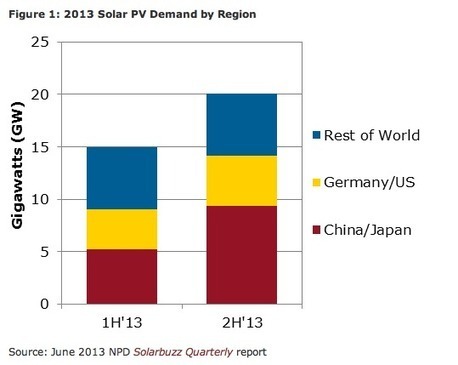
Deutsche Bank is the latest to upgrade its forecasts – for the second time in as many months – predicting that the 2014 global solar market could jump to 45 GW, after rising to 38-40 GW in 2013.

>Deutsche’s analysis is more bullish than an NPD Solarbuzz report last week that forecast solar PV demand for calendar 2013 to reach a record high of 35.1 GW, after a strong second half that would result in 20 GW being installed. In March, the research group predicted full year demand of just 31 GW.

NPD Solarbuzz analyst Michael Barker said the market was still in transition (from older markets such as Europe to newer ones in Asia), and would continue to rely on four key countries for the bulk of demand – Germany, China, Japan, and the US – which accounted for more than 60% of demand in the first half.

It said China and Japan alone would account for 45% of global demand in the second half, up from just 10% three years ago.<


Sustainable Heating and Cooling of Buildings | Leonardo ENERGY

See on Scoop.itGreen Energy Technologies & Development

In many non-residential buildings across Europe, the energy consumed for heating and cooling is more than half the total energy consumption of the building. This is not inevitable. The introduction of simple design concepts and currently available technologies can lead to significant reductions in the energy consumption, operating costs, and carbon emissions of both new and existing buildings.

See on www.leonardo-energy.org

Unclean at Any Speed – IEEE Spectrum

See on Scoop.itGreen Energy Technologies & Development

Electric cars don’t solve the automobile’s environmental problems

Duane Tilden‘s insight:

>Two dozen governments around the world subsidize the purchase of electric vehicles. In Canada, for example, the governments of Ontario and Quebec pay drivers up to C $8500 to drive an electric car. The United Kingdom offers a £5000 Plug-in Car Grant. And the U.S. federal government provides up to $7500 in tax credits for people who buy plug-in electric vehicles, even though many of them are affluent enough not to need such help. (The average Chevy Volt owner, for example, has an income of $170 000 per year.)

Some states offer additional tax incentives. California brings the total credit up to $10 000, and Colorado to $13 500—more than the base price of a brand new Ford Fiesta. […]

There are other perks. Ten U.S. states open the high-occupancy lanes of their highways to electric cars, even if the car carries a lone driver. Numerous stores offer VIP parking for electric vehicles—and sometimes a free fill-up of electrons. Mayor Johnson even moved to relieve electric-car owners of the burden of London’s famed congestion fee.

Alas, these carrots can’t overcome the reality that the prices of electric cars are still very high—a reflection of the substantial material and fossil-fuel costs that accrue to the companies constructing them. And some taxpayers understandably feel cheated that these subsidies tend to go to the very rich. Amid all the hype and hyperbole, it’s time to look behind the curtain. Are electric cars really so green?

It’s worth noting that this investigation was commissioned by the U.S. Congress and therefore funded entirely with public, not corporate, money.  […]

Part of the impact arises from manufacturing. Because battery packs are heavy (the battery accounts for more than a third of the weight of the Tesla Roadster, for example), […] Electric motors and batteries add to the energy of electric-car manufacture.

In addition, the magnets in the motors of some electric vehicles contain rare earth metals. […]

The materials used in batteries are no less burdensome to the environment, the MIT study noted. Compounds such as lithium, copper, and nickel must be coaxed from the earth and processed in ways that demand energy and can release toxic wastes. […]

See on spectrum.ieee.org

Colorado’s oil and gas boom is polluting the state’s air

See on Scoop.itGreen & Sustainable News

Drillers pump 600 tons of air pollution over Colorado every day, and three-quarters of the state’s air pollution enforcement cases are linked to drilling.

Duane Tilden‘s insight:

>The 50,000 oil and gas wells in the state are collectively pumping hundreds of tons of pollution into the air every day, making the drilling industry the state’s largest source of airborne volatile organic compounds and third-largest source of nitrogen oxides. That’s according to a report in The Denver Post: […]<

See on grist.org

Scientists Adding Color to Solar Panels

See on Scoop.itGreen Building Design – Architecture & Engineering

If you have noticed the design and layout of solar panels around, you would have thought a minute or two about its aesthetics. Though not too bad, the dark

Duane Tilden‘s insight:

>The Institute is developing a SIS (semiconductor-insulator-semiconductor) variety solar panel. The package consists of a silicon substrate which absorbs light and converts it into electricity.[…]

The change in color does not make solar cells less efficient. The cell’s working is also not affected by the thickness of the conductive oxide layer. The SIS cell has the same simulated efficiency of around 20%.

The technology might later on use a type of inkjet printing that deposits the oxide layer with more flexibility, which would allow complex designs too. With this, solar cells could turn out to be part of beautiful architectural designs in future.<

See on www.greenpacks.org

The 21st century data center: You’re doing it wrong | ZDNet

See on Scoop.itGreen Building Design – Architecture & Engineering

Outdated designs are keeping data centers from reaching their full potential.

Duane Tilden‘s insight:

>One example of this are data centers that use raised floors for cooling. Many IT pundits have discredited this method of cooling as wasteful, including Schneider Electric’s territory manager for the Federal government and the ACT, Olaf Moon.

[…]

Cappuccio notes that engineering firms that are consulted to build data centers know about the newer and more efficient ways to do things. But rather than try something new, they prefer the stock standard cookie-cutter approach to creating data centers because it’s fast and easy, he said.

[…]

“I’ve seen a lot of data centers being built that are too big,” says Cappuccio. “We’re finding people with data centers that are three to four years old when they realise they have far too much space, and are still providing air conditioning to those areas. So they begin to shrink them, putting up walls, bringing down the ceiling so they don’t air condition the extra space.”

See on www.zdnet.com