Renewables & Energy Efficiency Can Cut Power Plants’ Water Use 97% by 2050

wupt-plantscherer-Coal-Fired-plantSee on Scoop.itGreen & Sustainable News

Investing in renewables and energy efficiency could reduce power plants’ water withdrawals by 97 percent from current levels by 2050 and cut carbon emissions 90 percent from current levels, according to a study by the Union of Concerned Scientists…

Duane Tilden‘s insight:

>The report warns that a “business-as-usual” approach would keep emissions within 5 percent of current levels and water withdrawals would not drop significantly until after 2030. And while utilities’ ongoing shift to natural gas would decrease water use in the coming decades, the study says its ongoing requirements could still harm water-strained areas. This shift to natural gas also would do little to lower the power sector’s carbon emissions.

More than 40 percent of US freshwater withdrawals are used for power plant cooling, the report says. These plants also lose several billion gallons of freshwater every day through evaporation.

Further, increasing demand and drought are putting a greater strain on water resources. Low water levels and high water temperatures can cause power plants to cut their electricity output in order to avoid overheating or harming local water bodies. Such energy and water collisions can leave customers with little or no electricity or with added costs because their electric supplier has to purchase power from elsewhere, as occurred during the past two summers.<

See on www.environmentalleader.com

Innovations in waste water treatment processes to provide clean energy

See on Scoop.itGreen Energy Technologies & Development

The race is on to develop innovative, cost-effective ways to extract value from waste water instead of just dumping it, writes Sadhbh Walshe

Duane Tilden‘s insight:

>In a conventional treatment process, ammonia is converted back into nitrogen gas, a non-harmful gas which can be safely released into the atmosphere. The conversion process is expensive, however, and energy prohibitive.

What the Stanford team do, instead, is to use a less energy-intensive process to convert the ammonia into nitrous oxide (N2O), a powerful substance that is typically used to turbo-boost cars or fire rockets.

Normally, N2O is discouraged from forming because it is a harmful greenhouse gas, but when it is burned along with methane it becomes an energy source that can be used to power the treatment facility. According to Scherson, there is a double energy-saving benefit.

“Our process reduces energy input in nitrogen treatment and then the energy from nitrous oxide can potentially be used to power the plant making it energy neutral or even energy positive.”<

See on www.guardian.co.uk

China shortfall in processed Uranium puts pressure on Global Nuclear Fuel supplies

See on Scoop.itGreen & Sustainable News

BEIJING (Reuters) – The abrupt cancellation of a $6.5 billion uranium processing project in southern China has left Beijing with a headache as it tries to secure the fuel required to sustain an ambitious…

Duane Tilden‘s insight:

>China currently has 15 reactors with an aggregate installed capacity of 12.57 gigawatts (GW), but another 30 plants are under construction and due to go into operation between now and 2016, adding another 29 GW to the total.

Gaining more control over the global fuel supply chain is crucial to China’s plans to increase total nuclear capacity to 58 GW by 2020, and will require not only overseas acquisitions but also more enrichment capacity.

[…]

PROCESSING IMPORTS

While Beijing’s 2020 target for the amount of power to be generated from nuclear sources was scaled back after the Fukushima disaster in Japan, its 2030 target of around 200 GW remained intact. Analysts expect annual primary uranium demand to rise tenfold over the period to around 40,000 tonnes.

To meet that demand, CNNC and CGNPC have been exploring domestic uranium deposits, but a surge in imports is inevitable, and is expected to put pressure on global supplies.<

See on www.reuters.com

Climate Change Will Cause More Energy Breakdowns, U.S. Warns

See on Scoop.itGreen & Sustainable News

The national power supply is increasingly vulnerable to severe weather, according to a new Department of Energy study.

Duane Tilden‘s insight:

>The effects are already being felt, the report says. Power plants are shutting down or reducing output because of a shortage of cooling water. Barges carrying coal and oil are being delayed by low water levels in major waterways. Floods and storm surges are inundating ports, refineries, pipelines and rail yards. Powerful windstorms and raging wildfires are felling transformers and transmission lines.

“We don’t have a robust energy system, and the costs are significant,” said Jonathan Pershing, the deputy assistant secretary of energy for climate change policy and technology, who oversaw production of the report. “The cost today is measured in the billions. Over the coming decades, it will be in the trillions. You can’t just put your head in the sand anymore.”<

See on www.nytimes.com

Swansea Bay hydrokinetic project continues moving forward

See on Scoop.itGreen Building Design – Architecture & Engineering

Energy development group Tidal Lagoon Power Limited has reached a significant milestone in the development of a massive hydroelectric power project with the announcement of three design, build and deliver agreements.


Duane Tilden‘s insight:

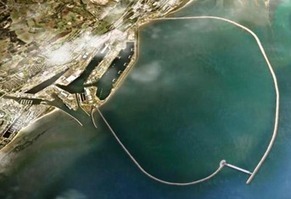
>[…]According to TLP, the US$966.5 million project will consist of a 6-mile-long, 35-foot-high semi-circular sea wall that will enclose an area west of Swansea Marina.  The wall would be dotted along its length with a number of hydro turbines, giving the project a cumulative capacity of around 250 MW.

Each of TLP’s three partners adds a unique quality to the project’s development, the company said.  Costain will work in developing and managing the schedule for pre-construction and construction phases, developing construction methodology for civil engineering works including turbine and sluice structures, access routes and complex temporary works, including temporary bund for construction turbine housing.

Meanwhile, Atkins will provide engineering design and geotechnical expertise. TLP said this includes “designing both the turbine house and the innovate breakwater bund wall, which uses a combination of giant tubular sand bags protected by armor made up of different sized rocks.”

Last, Van Oord is developing construction methodology suitable for the harsh off-shore conditions in Swansea Bay.  The Swansea is the first tidal lagoon power project envisioned by TLP, which said in May that it is considering a similar project off Wales’ north coast. As much as 10,000 MW of tidal lagoon power potential in the United Kingdom, the group said. […]<

See on www.hydroworld.com

Formal consultation commences on the world’s first purpose built tidal lagoon | Specification Online

See on Scoop.itGreen Building Design – Architecture & Engineering

The formal consultation process has started on the world’s first purpose built tidal lagoon for Swansea Bay, with public exhibitions taking place at 18 locations around the Swansea Bay area until August 5.

Duane Tilden‘s insight:

>The proposed tidal lagoon will have a rated capacity of 240 Megawatts (MW), generating 400GWh net annual output. This is enough electricity for approximately 121,000 homes.

In addition to generating electricity, the £650 million development will also provide visitor facilities and other amenities including art, education, mariculture and sporting/recreational facilities. The seawall is expected to be open to the public during daylight hours for walking, running, cycling etc, though access will be controlled in extreme weather.

LDA Design, the project masterplanners and landscape architects for Swansea Bay Tidal Lagoon, has completed the coordination of exhibition material for the public exhibitions. As part of the formal consultation for the proposed Development Consent Order (DCO) application by Tidal Lagoon (Swansea Bay) plc (TLSB), a new, virtual 3D programme has been prepared, which shows the proposed lagoon in the context of Swansea Bay.  <

See on specificationonline.co.uk

Scottish tidal power potential less than estimated, still Viable – new Study via Reuters

See on Scoop.itGreen Energy Technologies & Development

* Pentland Firth could generate maximum of 1.9 GW of power* 1 GW seen more realistic, vs prior estimates of 10-20 GW

LONDON, July 10 (Reuters) – Proposed tidal turbines in Pentland Firth, which separates…

Duane Tilden‘s insight:

>New research led by the University of Oxford suggests, however, that the maximum that Pentland Firth could produce would be 1.9 gigawatts, with 1 GW a more realistic target.

That is far below previous estimates of 10 GW to as much as 20 GW. […]  The study was less optimistic about the firth’s potential because it took into account factors such as how many turbines it would be feasible to build, how they would interact with each other and variations from tidal cycles.

“Our study provides the first robust data about how much energy it would be feasible to extract,” said Thomas Adcock, lead author of the report and fellow in engineering science at Oxford University.

Pentland Firth could still generate power equivalent to almost half of Scotland’s annual electricity consumption, which amounted to 37 terrawatt hours in 2011, Adcock added. […]<

See on www.reuters.com

Is Scotland’s Pentland Firth the World’s Best Site for Tidal Power

See on Scoop.itGreen Energy Technologies & Development

Tidal streams could bring large amounts of energy within a decade if government support is available, study says

Duane Tilden‘s insight:

>The world’s best site for tidal power, the Pentland firth, could provide half of Scotland’s electricity, according to the first robust estimate of its potential. The tidal streams, which surge through the firth at five metres per second, could bring large amounts of renewable energy in reach within a decade if enough government support is available, said the Oxford University engineer behind the new study.

From Anglesey to the Severn estuary to Portland Bill, the UK has the greatest potential for generating predictable, clean energy from tidal channels. Turbines are already operating at Strangford Loch in Northern Ireland and prototypes are being tested in the Menai Straits off Anglesey.

But the Pentland firth is the greatest resource. “It is almost certainly the best site for tidal stream power in the world,” said Thomas Adcock, at Oxford University, who led the new work published in the journal Proceedings of the Royal Society A. The water flow is rapid there because the tide shifting from the Atlantic into the North Sea is forced through a narrow eight-mile channel.<

See on www.guardian.co.uk

World Solar PV Market To Hit 45 GW In 2014, Deutsche Bank Forecasts

See on Scoop.itGreen & Sustainable News

Deutsche Bank is the latest to upgrade its forecasts – for the second time in as many months – predicting that the 2014 global solar market could jump to 45 GW, after rising to 38-40 GW in 2013.

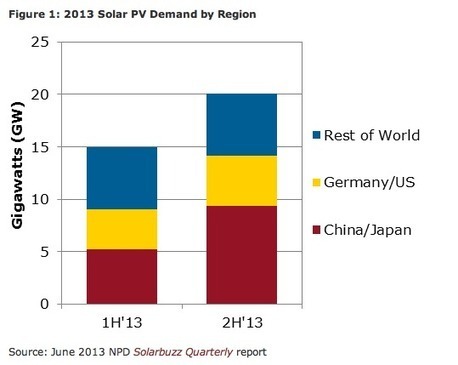
>Deutsche’s analysis is more bullish than an NPD Solarbuzz report last week that forecast solar PV demand for calendar 2013 to reach a record high of 35.1 GW, after a strong second half that would result in 20 GW being installed. In March, the research group predicted full year demand of just 31 GW.

NPD Solarbuzz analyst Michael Barker said the market was still in transition (from older markets such as Europe to newer ones in Asia), and would continue to rely on four key countries for the bulk of demand – Germany, China, Japan, and the US – which accounted for more than 60% of demand in the first half.

It said China and Japan alone would account for 45% of global demand in the second half, up from just 10% three years ago.<


Plan B Updates – 115: Peak Water: What Happens When the Wells Go Dry? | EPI

See on Scoop.itGreen Energy Technologies & Development

Peak oil has generated headlines in recent years, but the real threat to our future is peak water. There are substitutes for oil, but not for water. We can produce food without oil, but not without water.

See on www.earth-policy.org