The petrodollar effect: Just how much is the loonie tied to oil prices?

Leaked Documents Reveal Industry PR Push For “Energy East” a Larger Canadian Pipeline after Keystone XL

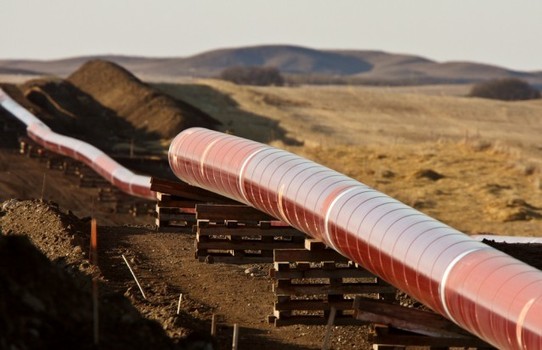
With the debate still raging over Keystone XL, the company behind the pipeline is already hard at work promoting a PR strategy for its larger and entirely Canadian pipeline, Energy East.

Source: thinkprogress.org

See on Scoop.itGreen & Sustainable News

Keystone XL Pipeline Climate Backgrounder

Pembina Institute Backgrounder, January 2013

Source: www.documentcloud.org

>”The climate implications of the proposed Keystone XL oilsands pipeline

by Nathan Lemphers

At a Glance Canada’s oilsands industry is growing quickly, with plans to nearly triple production from 1.8 to 5.2 million barrels a day by 2030.

To realize this substantial growth, pipelines to export markets are essential. TransCanada’s Keystone XL pipeline from the oilsands to a new market on the U.S. Gulf Coast is the most significant proposal awaiting approval. If built, Keystone XL will be a key driver for oilsands growth.

Other alternatives to ship oilsands to the west or east coast of Canada will, for the short to medium term, play a less dominant role in accelerating oilsands development.  These other proposals are smaller in pipeline capacity than Keystone XL, are in the very early stages of development, or face major public opposition. Regardless of whether other oilsands transport options move ahead, approval of Keystone XL will lead to substantial expansion of oilsands production and therefore an increase in global greenhouse gas emissions.

Filling Keystone XL with oilsands will cause a 36 per cent increase from current oilsands production, for which the higher upstream emissions alone will be equivalent to the annual emissions from 6.3 coal-fired power plants or over 4.6 million cars. This value will be higher when the additional emissions from upgrading and refining in the U.S. are considered.

In the absence of a credible plan for responsible development of the oilsands, including mitigating GHG emissions growth to a level that would allow Canada to meet its international climate commitments, the United States should not go ahead with the proposed Keystone XL pipeline.

[…]”<

See on Scoop.itGreen & Sustainable News

Commodity Copper Price Forecast Drops on Rising Dollar, Falling Oil

Copper prices will fall next year as a strengthening U.S. dollar and weaker oil prices push down marginal production costs, according to Goldman Sachs Group

Source: www.hellenicshippingnews.com

>” […]

Copper for delivery in three months on the London Metal Exchange fell 0.3 percent to $6,682 a ton at 12:44 p.m. in Shanghai. Prices are down 9.2 percent this year and headed for a second annual decline.

The bank said prices could fall below its estimates to average $5,600 a ton if China’s state stockpiling agency stops buying copper. The State Reserve Bureau will buy 500,000 tons of refined copper this year and 200,000 tons in 2015, supporting prices at around $6,200 to $6,300 a ton, according to the bank

The U.S. dollar’s rise will reduce marginal costs of copper mine production as 83 percent of operating costs are in local producing-country currencies, the bank said in the report. The Bloomberg Dollar Spot Index, which measures the greenback against a basket of 10 peers, is up 7.5 percent this year.

Lower energy and labor expenses, as well as the cost of equipment such as steel needed to grind copper ore and mining explosives, point to declining production costs over the next six to 12 months, the bank said. Brent crude, the global oil benchmark, has fallen 29 percent this year.

The bank lowered its six-month price forecast to $6,200 a ton from $6,600 and its 12-month outlook to $6,000 a ton from $6,200.”<

See on Scoop.itGreen & Sustainable News

Will Falling oil prices cause oil sands shut-downs in Alberta?

Alberta Premier Jim Prentice says his province’s oil companies are not facing closures, even as prices approach $70 a barrel.

Source: www.ctvnews.ca

>””We don’t see oilsands operations shutting down,” Prentice told CTV’s Question Period in an interview that aired Sunday. “These are massive capital investments that have been built on a 50-year time horizon.”

Crude oil prices have dramatically fallen since June, when prices reached this year’s high of $107.54 USD per barrel of West Texas Intermediate crude oil. On Friday, WTI oil was about $75.70 per barrel.

[…]

The report said falling oil prices have been caused by large supply, low demand, and strong U.S. dollar. In order for the price to stabilize, “further oil price drops would likely be needed for supply to take a hit — or for demand growth to get a lift,” it said.

Analysts suggest that once prices fall below $72 a barrel, companies will begin to face serious financial consequences, and that some may be forced to close. But Prentice said Albertan oilsands companies are expected to survive the continuing drop in prices, even if they reach that $72 threshold.

Conservative Alberta MP Kevin Sorenson, the minister of state for finance, disagrees, saying falling oil prices could hurt employment numbers.

“We know that if oil prices continue to fall … in the long term that’s going to be very difficult,” Sorenson told Question Period. “It’s not so much that $70 is the plateau, but if it continued to fall, we could expect that there would be job losses.”

Though Prentice was more optimistic about the “resilience” of Albertan companies, he also said falling prices are cause for concern.

“I don’t want to underestimate the importance of this. The low-price environment has a significant implication for all of us,” Prentice said.

The premier said new projects may need to be postponed, and that the Albertan government must be prepared to control spending and budgeting.

According to the Alberta government’s budget website, if oil prices drop even $1 per barrel over 12 months, it can result in more than $200 million less in revenue for the province.

[…]

But Alberta’s provincial government factors all these variables into their economic forecasts.

“People need to be aware it’s a time for fiscal prudence. It’s a time for caution,” Prentice said Sunday. “And it’s a time to control what we can control, which is our public expenditures.” “<

Read more: http://www.ctvnews.ca/politics/falling-oil-prices-won-t-cause-shut-downs-in-alberta-prentice-1.2104374#ixzz3JXBPxTA3

See on Scoop.itGreen & Sustainable News

Fossil Fuel Development in the Arctic is a Bad Investment

Source: www.earth-policy.org

>”Currently, about 10 percent of the world’s oil and one-quarter of its natural gas production come from the Arctic region, which has warmed by more than 2 degrees Celsius since the mid-1960s. Countries that border the Arctic Ocean are staking claims to expand their rights beyond the traditional 200-mile exclusive economic zone in anticipation of future oil and gas prospects. According to current estimates, the United States has the largest Arctic oil resources, both on and offshore. Russia comes in second for oil, but it has the most natural gas. Norway and Greenland are virtually tied for third largest combined oil and gas resources. Canada comes in fifth, with almost equal parts oil and natural gas.

In developing these resources, Russia is leading the pack. Production has started at almost all of the 43 large oil and natural gas fields that have been discovered in the Russian Arctic, both on land and offshore. Russia drew its first oil from an offshore rig in Arctic waters in December 2013. […]

[…] operating in the Arctic brings great risks. The shrinking Arctic sea iceallows waves to become more powerful. The remaining ice can be more easily broken up into ice floes that can collide with vessels or drilling platforms. Large icebergs can scour the ocean floor, bursting pipes or other buried infrastructure. Much of the onshore infrastructure is built on permafrost—frozen ground—that can shift as the ground thaws from regional warming, threatening pipe ruptures. Already, official Russian sources estimate that there have been more than 20,000 oil spills annually from pipelines across Russia in recent years.  Arctic operations are far away from major emergency response support. The freezing conditions make it unsafe for crews to be outside for extended periods of time. Even communication systems are less reliable at the far end of the Earth. Why take such risks to pursue these dirty fuels when alternatives to oil and gas are there for the taking?

Rather than searching for new ways to get oil, we can look for better ways to move people and goods. Bus rapid transit, light rail and high-speed rail can move more people for less energy than a car can. And for the cars that remain on the road, electric and plug-in hybrid electric vehicles—powered by a clean energy grid—are much more efficient than those with a traditional internal combustion engine. Encouraging bicycle use through bike lanes andbike-sharing programs gets people active and out of cars.

Natural gas, which is mainly used to produce electricity, can be replaced with power generated by wind, solar, and geothermal projects. Many countries are demonstrating what is possible with renewables. Denmark already gets one-third of its electricity from wind. Australia is now dotted with 1 million rooftop solar systems. Iceland generates enough geothermal power to meet close to 30 percent of its electricity needs. These are just a few examples of looking past the old familiar solution to a better cleaner one. The risky search under every rock and iceberg for oil and gas deposits is a costly distraction from investing in a clean energy future.”<

See on Scoop.itGreen & Sustainable News

GE seeks to Clean up Fracking’s Dirty Water Problem

See on Scoop.itGreen & Sustainable News

GE has demonstrated technology aimed at addressing one of the biggest challenges with fracking: water pollution.

Duane Tilden‘s insight:

>Concerns about water pollution and other environmental issues related to fracking have led some places, including France and New York State, to block the process. As fracking increases in dry areas and places that lack adequate treatment and disposal options, pressure to block it could grow.

“Water-treatment technology is going to become more and more critical as the industry moves forward,” says Amy Myers Jaffe, executive director of energy and sustainability at the University of California at Davis, and a new member of a GE environmental advisory board. She says the continued use of fracking depends on the “industry getting its act together to do it in an environmentally sustainable way.”

Better water-treatment options could change the way oil and gas producers operate by making it economical to treat water at fracking sites instead of trucking it long distances to large water-treatment facilities or disposal wells. The technology is specifically targeted to places such as the Marcellus shale, one of the largest sources of shale gas in the U.S., where wastewater is far too salty for existing on-site treatment options (see “Can Fracking Be Cleaned Up?” and “Using Ozone to Clean Up Fracking”).

Each fracking well can require two to five million gallons of fresh water, which is pumped underground at high pressure to fracture rock and release trapped oil and gas. Much of that water flows back out, carrying with it the toxic chemicals used to aid the fracking process, as well as toxic materials flushed from the fractured rock.

Producers currently reuse much of that water, but that involves first storing it in artificial ponds, which can leak, and then diluting it, a step that consumes millions of gallons of fresh water. Eventually they can’t reuse the water any more so they need to ship it, often over long distances, to specialized treatment and disposal locations. Transporting the wastewater is expensive, and it comes with a risk of spills. At disposal sites, the wastewater is injected deep underground in a process that can cause earthquakes.

The new technology would make it unnecessary to dilute the wastewater, or transport it for treatment or disposal. […]<

See on www.technologyreview.com

COGA brings state into lawsuit against Longmont ‘fracking’ ban

See on Scoop.itGreen & Sustainable News

The lawsuit against Longmont&#27;s ban on fracking has now roped in the Colorado Oil and Gas Conservation Commission, the state&#27;s regulatory agency.

Duane Tilden‘s insight:

>Boulder County District Court Judge D.D. Mallard said she would allow the Colorado Oil and Gas Association to bring in the COGCC as an additional plaintiff, a move called “joinder.” In her ruling, Mallard said that while both parties had an interest in seeing the ban overturned, the state agency had aims that would not be adequately represented by COGA, the state’s largest oil and gas industry group.

“COGA’s interest in this case is to overturn the charter amendment so that its members can proceed with oil and gas production using fracking […]

Longmont voters passed the ban on hydraulic fracturing, or “fracking,” last November with about 60 percent in favor. Supporters of the ban say the practice can lead to environmental damage; opponents say the practice is so well-established that a ban on fracking is practically a ban on drilling, and that only the state has the authority to regulate the methods used.<

See on www.timescall.com

Duke U Study Links Hydraulic Fracturing to Ground Water Contamination

See on Scoop.itGreen & Sustainable News

The debate about whether or not fracking can contaminate ground water supplies has been raging for a while now, and a new study by Duke University has found proof

Duane Tilden‘s insight:

>But let us allow Jacksona et. al. to speak for themselves, from the report: “We analyzed 141 drinking waterwells across the Appalachian Plateaus physiographic province of northeastern Pennsylvania, examining natural gas concentrations and isotopic signatures with proximity to shale gas wells. Methane was detected in 82% of drinking water samples, with average concentrations six times higher for homes” less than one kilometer from the fracked natural gas wells. […]

“They found that, on average, methane concentrations were six times higher and ethane concentrations were 23 times higher at homes within a kilometer of a shale gas well.  Propane was detected in 10 samples, all of them from homes within a kilometer of drilling. […]

The ethane and propane data are “particularly interesting,” he noted, “since there is no biological source of ethane and propane in the region […]<

See on oilprice.com

Fracking ban halts first shale gas project in Spain

See on Scoop.itGreen & Sustainable News

A ban on fracking in a northern region of Spain has crimped Repsol SA’s plans to begin drilling for shale gas in the north of Spain.

Duane Tilden‘s insight:

>Spain’s richest shale gas reserves have been determined to exist in the northern region of Cantabria, but back in April the local Cantabrian government  implemented the country’s first fracking ban, worried that such activities may pollute the local sources of drinking water. (Related article: Duke University Study Links Fracking to Ground Water Contamination) […]

Repsol had planned to begin seismic studies, with a view to drilling, in July, but the Cantabrian fracking ban, which prevents all hydraulic fracturing activities within the region’s borders, has put a hold on plans. In truth, it is not fully understood how the ban will affect Repsol, whose Luena project covers 290 square miles, and stretches from Cantabria down to Castille & Leon. Normally when a project extends across two regions or more it is regulated by the national Industry Ministry, not local governments. <

See on www.csmonitor.com