#Wind Energy Innovation: GE Tests High #Efficiency Turbine in the #Netherlands | The #Energy Collective

See on Scoop.itGreen Energy Technologies & Development
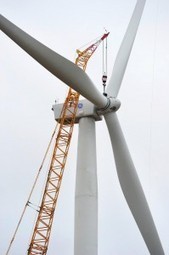
General Electric recently announced it had started testing the prototype of what it calls the world’s most efficient high-output wind turbine. The new 2.5-120 is being tested in Wieringermeer, Netherlands.

Duane Tilden‘s insight:

Combining efficiency and power output at low-wind-speed sites, the 2.5-120 captures a 25 percent increase in efficiency and a 15 percent increase in power output compared to GE’s current model. GE says wind farm operators at low-winds-speed sites can benefit from its efficiency and output, thanks to its advanced controls and 120-meter rotor which enable increased energy capture and greater power output in low-wind areas. The taller tower, which has a maximum hub height of 139 meters, makes it ideal for heavily forested regions in places like Europe and Canada.

See on theenergycollective.com

Vestas Receives Its Largest Order Ever in Chile

See on Scoop.itGreen & Sustainable News

Project consists of 22 V100-1.8 MW and 35 V100-2.0 MW wind turbines, which will be installed in Coquimbo region.

Duane Tilden‘s insight:

The order has been placed by Empresas Públicas de Medellín (EPM), a Colombian multi-utility focusing on power generation, transmission and distribution, natural gas distribution, wastewater treatment and telecommunications. The company’s power segment has an installed base of 3,250MW, equal to 23.5% of the national installed capacity.

The Los Cururos wind power plant will have an estimated annual production of more than 290,000MWh, […] it will provide enough electricity to cover the residential electricity consumption of more than 550,500 people in Chile.

See on www.onlinetes.com

Wind energy is clearly B.C.’s clean choice

See on Scoop.itGreen & Sustainable News

British Columbians have consistently called for an energy system that is independent, low-impact and as affordable as possible.

Duane Tilden‘s insight:

For many decades, the province has benefited significantly from the abundant and affordable supply of hydroelectricity provided through dams built by BC Hydro between the 1920s and the 1980s. Demand now significantly exceeds these aging sources of supply. […]

Wind energy is the ideal complement to B.C.’s existing hydro-dependent electricity system. B.C.’s wind energy resources produce more electricity in winter, when demand for power is at its highest and there is less water available to generate hydroelectricity. Better yet, we have the potential to integrate 6,000 MW of wind-generated electricity at minimal cost within BC Hydro’s existing and planned hydroelectric facilities, so wind-generated power is available when it’s needed. In fact, combining new wind energy resources with B.C.’s heritage hydroelectric resources will create a stronger hybrid electricity system better suited to the needs of the province than the system in place today.

Read more: http://www.vancouversun.com/business/Wind+energy+clearly+clean+choice/8308417/story.html#ixzz2RsG9qP16

See on www.vancouversun.com

Sierra Club, utilities spar over Nebraska wind power

See on Scoop.itGreen & Sustainable News

The Sierra Club in Nebraska criticized the state’s public power utilities for failing to get more wind power online to compete with Iowa, which landed a planned data center for Facebook Inc. in Altoona and increased incentives for Google Inc. that allow it to expand in Council Bluffs.

Duane Tilden‘s insight:

A Facebook spokesman confirmed in email to Midwest Energy News that access to wind power was a factor in its decision to locate in Iowa.

But John Boyd Jr., a New Jersey consultant who helps companies site data centers, told Midwest Energy News the demand for wind power was driven by marketing. “There’s public relations value above and beyond the economic value of wind energy,” Boyd said.

He acknowledged he doesn’t think wind power is the leading criteria for siting decisions. More important factors, he said, are tax incentives, real estate costs and the price of the electricity.  Altoona will provide a 20-year property tax exemption to Facebook, but the jobs must pay at least $23.12 per hour.

Data centers typically are extremely large buildings that house computer servers designed to store massive amounts of data. They typically create few jobs.

See on siouxcityjournal.com

Solar Wind Energy Tower, Inc. Partners with Commonwealth Dynamics, Inc.

See on Scoop.itGreen Energy Technologies & Development

Solar Wind Energy Tower, Inc. Partners with Commonwealth Dynamics, Inc.

Duane Tilden‘s insight:

Over the last six months, Solar Wind Energy’s design and construction management  teaming partners have been diligently working on value engineering the core of our Tower structure in order to reduce cost, time of construction and utilize readily available construction materials, some of which that are indigenous to our region of construction.

Read more: http://www.digitaljournal.com/pr/1207274#ixzz2RVmrH89d

See on www.digitaljournal.com

Why Canada needs more community power | rabble.ca

See on Scoop.itGreen & Sustainable News

By Brian Iler Kirsten Iler Pro Bono

| April 25, 2013

Community power means locally owned renewable energy projects that are developed and controlled (entirely or in part) by people living in the community.

Duane Tilden‘s insight:

Under the second round of Ontario’s Feed‑in Tariff program or FIT 2.0, established under the Green Energy Act, 2009, community power advocates succeeded in getting a 10 per cent set aside of the available power grid capacity, being 25 megawatts, for community‑controlled groups. A hard-won victory, and, again, a small step in the right policy direction.

With the close of the FIT application window in January 2013, the Ontario Power Authority has reportedly received about 80-megawatts worth of community‑based applications, or nearly four times the space on the grid that was set aside for communities under the program.

Current Canadian renewable energy policies fail to capitalize on the massive social potential of community power. Policies must be redesigned in order to give ordinary citizens more access to control and experience the benefits of the growth of the renewable energy sector. This should involve setting larger capacity set-asides for community groups, and offering incentives for community participation, such as tax deductible investments (e.g. RRSPs), which proved effective in Denmark. It could also require multinationals to invest part of their profits into community-owned wind power, as has been proposed in the United Kingdom.

See on rabble.ca

NEMA Praises Introduction of Bill to Promote Energy Storage Technologies, National

See on Scoop.itGreen Energy Technologies & Development

April 25, 2013 – NEMA endorsed HR 1465, STORAGE 2013, which promotes adoption of state-of-the-art energy storage technologies, calling this legislation “carefully crafted” in its regard for entire range of energy storage technologies. …

Duane Tilden‘s insight:

“Energy storage is a key enabler of the Smart Grid and is transforming the way we think about electricity,” said NEMA President and CEO Evan R. Gaddis. “By getting us beyond the need to generate electricity at the same moment as it is used, energy storage delivers greater system efficiency, enhances reliability and resiliency, and fosters integration of renewable energy.”

STORAGE 2013 would offer a 30 percent investment tax credit for energy storage used in connection with the power grid, with no project eligible to receive more than $40 million, and the total program capped at $1.5 billion. For municipal utilities and electric cooperatives, the legislation would make energy storage eligible for new clean renewable energy bonds. To promote efficiency and distributed generation in the commercial and residential markets, the bill offers a 30 percent credit (up to $1 million) for onsite application of energy storage.

See on news.thomasnet.com

International Battery and Energy Storage Alliance Founded – Solar Novus Today

See on Scoop.itGreen Energy Technologies & Development

IPVEA and EuPD Research form International Battery and Energy Storage Alliance

Duane Tilden‘s insight:

The newly founded alliance plans to support and enable cooperation between companies from the fields of solar energy production, electrical energy storage and smart grid technologies. Together, the members of the International Battery and Energy Storage Alliance (IBESA) will create access to professional resources, market intelligence, new networks, and emerging markets. Over 70 members of the International PV Equipment Association (IPVEA) will immediately benefit from this strong partnership.

Alongside companies in the photovoltaic, battery and solar storage sectors, IBESA is also a valuable partner for energy providers, municipal utilities, installers, consulting firms and banks. …

Interested companies can contact the International Battery and Energy Storage Alliance directly in order to become members.

See on www.solarnovus.com

Lawmakers float renewable energy finance bill – The Hill’s E2-Wire

See on Scoop.itGreen Energy Technologies & Development

A bipartisan, bicameral group of lawmakers revived legislation Wednesday that aims to spur renewable energy investment through federal tax code tweak. Lawmakers unveiled the Master Limited Partnerships Parity Act — spearheaded in the Senate by Sens.

Duane Tilden‘s insight:

The bill would extend master limited partnerships to renewable energy projects ranging from wind power to energy efficiency. Currently, only oil-and-gas projects can use the financing mechanism.

“This market-driven solution supports the all-of-the-above energy strategy we need to power our country for generations to come. Our legislation will unleash private capital, create jobs and modernize our tax code,” Coons said in a statement.

See on thehill.com

Biofuel Used to Make Stronger Building Materials

See on Scoop.itGreen Building Design – Architecture & Engineering

Biodiesel Fuel. Image Source: Tomorrow Is Greener Civil engineers have developed a tougher and more resilient form of concrete by using waste material created during the manufacture of biofuel as a proxy for cement.

Duane Tilden‘s insight:

Biofuel manufactured from cellulose materials such as wood and straw creates a residue called lignin, which is generally deemed a waste product and disposed of via burning or burial.

Engineers at the University of Kansas have found that the lignin has immense potential as a green building ingredient. When 20 per cent lignin waste was added to a concrete mix as a replacement for cement, the ensuing chemical reaction created a building material endowed with 30 per cent more strength.

The findings could have tremendous implications for both the biofuel and concrete industries, as well as the carbon footprint of the construction sector, which generates immense CO2 emissions due to cement production.

See on designbuildsource.com.au