Lightweight ‘solar cloth’ photovoltaics for Integration with Building Structures

A Cambridge start-up believes its flexible solar panelling solution could fundamentally change the landscape of solar installation in the commercial sector.

The Solar Cloth Company’s award winning flexible thin film photovoltaics (FTFP) are a few micrometres thick and can be integrated into flexible and lightweight tensile structures called building integrated photovoltaics (BIPV). In doing so, they provide an alternative to traditional photovoltaic panels that are heavy and cumbersome.

Source: www.theengineer.co.uk

See on Scoop.itGreen Building Design – Architecture & Engineering

Ice Energy Storage Solution Awarded 16 Contracts by SCE

Santa Barbara – Ice Energy today (Nov 5, 2014) announced it has been awarded sixteen contracts from Southern California Edison (SCE) to provide 25.6 megawatts of behind-the-meter thermal energy storage using Ice Energy’s proprietary Ice Bear system.

Source: www.ice-energy.com

>” […] Ice Energy was one of 3 providers selected in the behind-the-meter energy storage category, which was part of an energy storage procurement by SCE that was significantly larger than the minimum mandated by the California Public Utility Commission (CPUC). SCE is one of the nation’s leaders in renewable energy and the primary electricity supply company for much of Southern California.

The contract resulted from an open and competitive process under SCE’s Local Capacity Requirements (LCR) RFO. The goals of the LCR RFO and California’s Storage Act Mandates are to optimize grid reliability, support renewables integration to meet the 2020 portfolio standards, and support the goal of reducing greenhouse gas emissions to 20% of 1990 levels by 2050.

“SCE’s focus on renewable energy is critical to helping meet California’s long-term goals, and Ice Energy is proud to be part of the solution with these contracts,” said Mike Hopkins, CEO of Ice Energy, the leading provider of distributed thermal energy storage technology. “Using ice for energy storage is not new, we’ve just made it distributed, efficient, and cost-effective. The direct-expansion AC technology is robust and proven, which is important because SCE and other utilities require zero risk for their customers.”

In 2013, 22 percent of the power SCE delivered came from renewable sources, compared to 15 percent for other power companies in the state. The utility is on track to meet the state’s goal of 33 percent, and procuring energy storage helps them meet those targets while maintaining a robust and reliable grid.

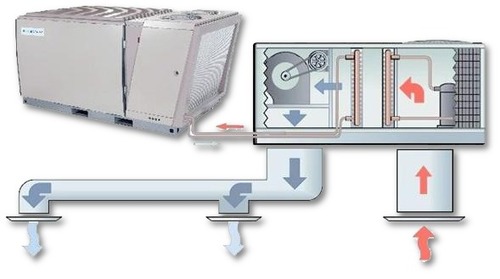
Ice Energy’s product, the Ice Bear, attaches to one or more standard 5-20 ton commercial AC units. The Ice Bear freezes ice at night when demand for power is low, capacity is abundant and increasingly sourced from renewables such as wind power. Then during the day, stored ice is used to provide cooling, instead of the power-intensive AC compressor. Ice Bears are deployed in smart-grid enabled, megawatt-scale fleets, and each Ice Bear can reduce harmful CO2 emissions by up to 10 tons per year. Installation is as quick as deploying a standard AC system.

“Ice Bears add peak capacity to the grid, reduce and often eliminate the need for feeder and other distribution system upgrades, improve grid reliability and reduce electricity costs,” Hopkins said. “What’s special about our patented design and engineering is the efficiency and cost. It’s energy storage at the lowest cost possible with extraordinary reliability.”

See on Scoop.itGreen Energy Technologies & Development

Thermal Energy Storage uses Ice for Cooling of Buildings – Smart Grid Technologies

Ice Energy’s proven Ice Bear system is the most cost effective and reliable distributed energy storage solution for the grid. The Ice Bear delivers up to six hours of clean, firm, non-fatiguing stored energy daily and is fully dispatchable by the utility. Ice Bear projects are job engines, creating long-term green jobs in the hosting communities.

Source: www.ice-energy.com

>” […] The Ice Bear system is an intelligent distributed energy storage solution that works in conjunction with commercial direct-expansion (DX) air-conditioning systems, specifically the refrigerant-based, 4-20 ton package rooftop systems common to most small to mid-sized commercial buildings.

The system stores energy at night, when electricity generation is cleaner, more efficient and less expensive, and delivers that energy during the peak of the day to provide cooling to the building.

Daytime energy demand from air conditioning – typically 40-50% of a building’s electricity use during peak daytime hours – can be reduced significantly by the Ice Bear. Each Ice Bear delivers an average reduction of 12 kilowatts of source equivalent peak demand for a minimum of 6 hours daily, shifting 72 kilowatt-hours of on-peak energy to off-peak hours. In addition, the Ice Bear can be configured to provide utilities with demand response on other nearby electrical loads – effectively doubling or even tripling the peak-demand reduction capacity of the Ice Bear.

When aggregated and deployed at scale, a typical utility deployment will shift the operation of thousands of commercial AC condensing units from on-peak periods to off-peak periods, reducing electric system demand, improving electric system load factor, reducing electric system costs, and improving overall electric system efficiency and power quality.

The Ice Bear is installed behind the utility-customer meter, but the Ice Bear system was designed for the utility as a grid asset, with most of the benefits flowing to the utility and grid as a whole. Therefore Ice Bear projects are typically funded either directly or indirectly by the utility.[…]

At its most basic, the Ice Bear consists of a large thermal storage tank that attaches directly to a building’s existing roof top air-conditioning system.

The unit makes ice at night, and uses that ice during the day to efficiently deliver cooling directly to the building’s existing air conditioning system.

The Ice Bear energy storage unit operates in two basic modes, Ice Cooling and Ice Charging, to store cooling energy at night, and to deliver that energy the following day.

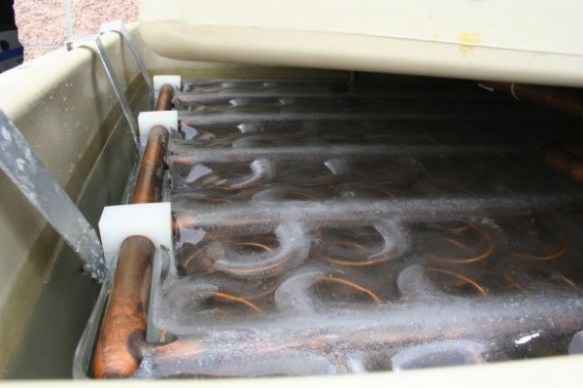
During Ice Charge mode, a self-contained charging system freezes 450 gallons of water in the Ice Bear’s insulated tank by pumping refrigerant through a configuration of copper coils within it. The water that surrounds these coils freezes and turns to ice. The condensing unit then turns off, and the ice is stored until its cooling energy is needed.

As daytime temperatures rise, the power consumption of air conditioning rises along with it, pushing the grid to peak demand levels. During this peak window, typically from noon to 6 pm, the Ice Bear unit replaces the energy intensive compressor of the building’s air conditioning unit.

[…]

The Ice Cooling cycle lasts for at least 6 hours.

Once the ice has fully melted, the Ice Bear transfers the job of cooling back to the building’s AC unit, to provide cooling, as needed, until the next day. During the cool of the night, the Ice Charge mode is activated and the entire cycle begins again. […]”<

See on Scoop.itGreen Energy Technologies & Development
The financial case for energy efficiency

“The report, Building the Future, has piled pressure on Ministers to act to fix Britain’s badly insulated homes. The report shows that a much more ambitious energy efficiency investment programme would pay for itself and significantly boost the UK economy.

The programme would add £13.9 billion annually to the UK economy by 2030, with GDP boosted by £3.20 for every £1 invested by the Government. A national scheme to make homes super-energy efficient would result in £8.6 billion in energy savings per year by 2030, an average energy saving of £372 per household. After taking into account loan repayments this would result in £4.95 billion in financial savings per year for Britain’s households.”

Grid Parity Is Accelerating the US Solar Revolution

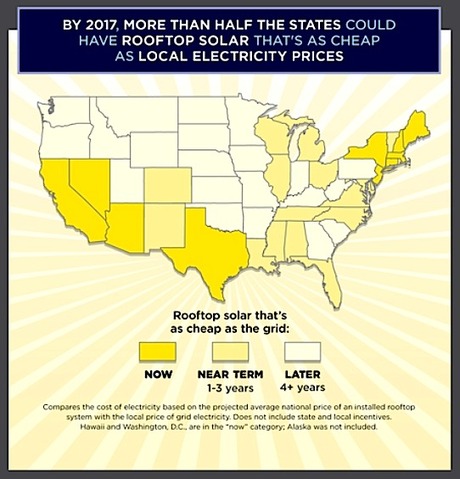
“Solar PV installations in the U.S. increased an impressive 485% from 2010 to 2013, and by early 2014, there were more than 480,000 systems in the country. That’s 13,400 MW, enough to power about 2.4 million typical American homes.”


Source: www.pvsolarreport.com

>” […] You can definitely see a correlation between electricity price and amount of solar installed, though there are exceptions. Kansas, for example, has fairly high grid prices but little solar — a testament to the fact that good policy is also a key ingredient in promoting solar. And Alaska is not exactly highly populated. For the most part, though, solar is flourishing in states with high electricity rates.

In some states like California, already one of the most expensive places for electricity in the country, residential rates will soon be going up further. Customers in the PG&E service area are looking at a 3.8% increase in electricity bills. Overall, electricity prices in the U.S. have been rising rapidly. According to the Energy Information Administration, in the first half of 2014, U.S. retail residential electricity prices went up 3.2% from the same period last year — the highest year-over-year growth since 2009. […]

The fact is, solar and other renewables just keep getting cheaper. We’ve noticed a number of stories debating this recently, many in reaction to an Economist article on how expensive wind and solar really are. But as Amory Lovins points out, the reality is that renewables are getting cheaper all the time, regardless of anyone’s arguments.

What does this mean? It means that grid parity is coming sooner than you might think […]”<

See on Scoop.itGreen Energy Technologies & Development
Solar Energy Storage Added to Eight California Schools

Burton School District, in the heart of California’s sun-drenched San Joaquin Valley, will also house combined solar and energy storage systems[…]

Source: www.pvsolarreport.com

>”In the commercial sector, the cost of energy storage is now low enough that businesses are finding it a useful addition to solar. Generally, businesses’ peak energy consumption is when electricity is most expensive, which makes energy storage especially useful.

As the cost of energy storage continues to decline, large solar companies have been integrating it into their product offerings to complement a solar system. […]

The district will install solar and DemandLogic to generate and store its own clean, renewable electricity at eight schools. This will be the largest combined solar and energy storage installation SolarCity has undertaken to date. It will allow the district schools to reduce energy costs by using stored electricity to lower peak demand.

SolarCity will install the district’s solar systems and battery storage at eight elementary and middle schools, as well as additional solar generation at a district office. The solar installations will total more than 1.4 MW of capacity, with storage providing an additional 360 kW (720 kWh) of power to reduce peak demand. The new solar systems are expected to save the district more than $1 million over the life of the contracts, and the DemandLogic battery storage systems could save thousands more on demand charges each year.

[…]

The new SolarCity systems are expected to generate 2,300 MWh of solar energy annually, and enough over the life of the contract to power more than 4,000 homes for a year. The solar systems will also offset over 43 million pounds of carbon dioxide and save more than 203 million gallons of water, an especially important environmental benefit in the drought-stricken valley. The entire storage project is expected to be completed by May 2015.”<

See on Scoop.itGreen Energy Technologies & Development

Net Zero Energy Buildings at Zero Cost

The Netherlands has found a way to refurbish existing buildings to net zero energy, within a week, with a 30-year builders’ guarantee and no subsidies.

Source: www.energypost.eu

>”Inside the house, the pounding rain stills to distant murmur. That’s thanks to the triple glazing, points out Ron van Erck, enthusiastic member of Platform31, an innovation programme funded by the Dutch government that brings together different actors for out-of-the-box thinking to crack intractable problems. One of its big successes to date is Energiesprong, an initiative that turns the building market on its head to deliver social housing with zero net energy consumption, i.e. no energy bill, at zero cost to the tenant and with no subsidies to the builder.

Starting off in 2010 with three staff, a €50 million budget and five years to come up with something to make buildings more sustainable, Energiesprong today boasts 45 staff and a deal with 27 housing associations and four big construction companies to refurbish 111,000 houses in the Netherlands. Total investment? €6 billion. The initial focus is social housing, but it’s already looking at the private market, care centres and commercial office buildings too.

How does the plan work? The basic trick is that tenants instead of paying their energy bills, pay a similar amount to the housing corporations that own the houses. With this money, the corporations pay building companies to retrofit the houses, which after renovation have net zero energy costs. The building companies have for this project developed ‘industrialised’ renovation procedures that are highly cost-effective. One important difference with existing renovation projects is that all elements that are needed for a successful move to zero-energy housing are brought together  in one plan.

Energy Post’s Sonja van Renssen met with manager Jasper van den Munckhof, to understand exactly what Energiesprong does, how it does it and why it will succeed – in the Netherlands and elsewhere.

Q: What was your starting point?

A: We started off with what we spend. The household energy bill in the Netherlands is about €13 billion. This money is available. If you spent it on a mortgage or payback on a loan of about 30 years [instead of energy], you have €225 billion to invest in the Dutch housing stock. This is substantial money: €30-40,000 per house to make it energy neutral.

“Retrofit wasn’t interesting – unless you were rich – but using the energy bill to fund it, no one had thought of that! A building and its energy system were developed as parallel, complementary but not integrated, entities.”

-Jan Kamphuis, BJW Wonen, a one-stop-shop for retrofits inspired by Energiesprong

The trick is, how to get this money flowing. We tried to imagine what owners would need to start investing. They buy kitchens and they don’t see this as an investment but good for their family. You need to get this focus on people and how they buy stuff, how they accept things. If you lose that focus and think it’s about financial arrangements, you won’t find a solution.

Q: So what will make people spend money on retrofits?

A: It needs to be very well done, like if they buy a car, they buy a decent one. It has to be fast – the problem with retrofitting (vs. buying new stuff) is that it’s usually a lot of trouble, dust and hassle. So we said one, the retrofits have to be done within a week. Two, it has to be affordable: ideally the cost to the tenant before and after should be equal. That means the energy bill converted to the mortgage or extra rent has to cover the full cost of the retrofit. Three, it has to be attractive. It needs to be something you see. […]”<

See on Scoop.itGreen & Sustainable News

Efficient HVAC Systems

Gallery

This gallery contains 15 photos.

Originally posted on Energy Systems & Sustainable Living:
Heating, Ventilation and Air Conditioning systems (HVAC) controls the indoor climate by adding or extracting heat and adding or removing mass (e.g. water vapour and dust). To combat summer heat and winter…

Multifamily Building Energy Efficiency: SLEEC Financing

This winter, ACEEE, in partnership with Energi Insurance Services, will host a second gathering of select members of the Small Lenders Energy Efficiency Community (SLEEC) in Washington, D.C. The initial SLEEC convening in October 2013 brought together small- to medium-size lenders to discuss strategies for expanding activity in the market for energy efficiency financing. Building off the success of that first meeting, the second SLEEC gathering will focus exclusively on financing in the multifamily sector […]

Source: aceee.org

>” […] The goal of the upcoming SLEEC meeting is to discuss how recent developments inform the lender perspective on the size, attractiveness, and viability of the finance market for multifamily efficiency. We chose to address multifamily this year because potential savings are phenomenal at an estimated $3.4 billion per annum, and multifamily has traditionally been characterized by the label “hard to reach” due to significant barriers to entry. Single-family residential, large commercial, and MUSH (municipal, universities, schools, and hospitals) markets pose fewer barriers and have therefore been easier to approach, while multifamily is a more complex market posing greater obstacles.

The first and most commonly cited obstacle is known as the split-incentive problem: Landlords and building owners don’t always have an incentive to pursue energy efficiency improvements since their tenants would be the ones benefitting from reductions in energy bills. The next most bemoaned roadblocks are a lack of information and lack of available capital. Landlords and owners are experts at running their buildings, but may be in the dark on energy efficiency. Utilities and many loan agencies, while knowledgeable about energy efficiency, lack experience interacting with tenants. The resulting information gap inhibits energy efficiency projects from getting off the ground. This problem is exacerbated by a lack of capital, especially in the affordable housing market, where many buildings owners hold 30-year mortgages on their property with only one refinancing opportunity after 15 years. Unless building owners and potential lenders can capitalize on this small window, many projects would not have another opportunity to finance efficiency improvements for another 15 years.

Despite these barriers, there are a number of successful initiatives that are poised for impact. Perhaps the most successful is Energy Savers, a Chicago-based partnership between Elevate Energy and the Community Investment Corporation (CIC) that has retrofitted 17,500 apartments since 2008.  […] Innovative programs such as these are paving the way for energy efficiency in the multifamily housing market.

A perceived lack of capital may be attributable to issues surrounding the valuation of energy efficiency from a building owner’s perspective that manifests as low demand. […] “<


See on Scoop.itGreen Building Design – Architecture & Engineering

Lighting Controls in Buildings, Demand Management and Microgrid Development

Lighting control systems can help microgrids shed load, improve demand response, use resources efficiently, and offer greater overall reliability.

Source: energyefficiencymarkets.com

>” […] Lighting Control Facilitates Load-shed Strategies

Load shed, or the ability to quickly reduce electricity use during peak periods, is critical to ensuring microgrid reliability. Because lighting uses a considerable proportion of building peak electrical loads (30% of peak electricity),1 and because reduced light levels deliver immediate reductions in electricity, lighting control is one of the simplest and most predictable demand response solutions.

The reduction of lighting load also provides a reduction in HVAC cooling load during the summer, which is the most common peak electrical period.  Furthermore, since dimming is typically unobtrusive when it is executed over a period of time (as little as 10 seconds), lighting control is a viable option for immediate emergency response.

Dimming as a load shed strategy is highly effective because the human visual system has the ability to accommodate a wide variety of light levels with minimal effect on the occupants2,3.  When a demand reduction is required a gradual dimming of electric lighting can reduce light levels by 35 percent before 20 percent of the occupants attempt to intervene.  Response time is essentially instantaneous, typically has little impact on occupant comfort, and demand savings from lighting are more predictable than those from HVAC response.

Light management systems have the capability to automatically trigger a demand response event from a utility signal or from time clock scheduling. Therefore, a predictable and effective demand response strategy can be automatically implemented while going virtually unnoticed to the building occupants.

Energy codes, standards, and green building certifications such as ASHRAE (American Society of Heating, Refrigerating, and Air Conditioning Engineers) 90.1, IECC (International Energy Conservation Code), California Title 24, ASHRAE 189, IgCC (International Green Construction Code), or LEED (Leadership in Energy and Environmental Design) now include lighting controls as a part of a whole-building energy strategy.

There are subtle differences for each code/standard/certification, but some general requirements and/or credits include: required lighting control for most areas (manual or automatic), automatic lighting shut-off, some automatic receptacle shut-off, daylight controls for daylit spaces, automatic shut-off of exterior lighting during daytime hours, and various levels of occupancy/vacancy control. As a result of buildings updating their basic lighting control infrastructure to meet code, they are increasingly becoming capable of connecting to a microgrid, without the need for additional significant investments.

[…]”<

See on Scoop.itGreen Building Operations – Systems & Controls, Maintenance & Commissioning