Is Scotland’s Pentland Firth the World’s Best Site for Tidal Power

See on Scoop.itGreen Energy Technologies & Development

Tidal streams could bring large amounts of energy within a decade if government support is available, study says

Duane Tilden‘s insight:

>The world’s best site for tidal power, the Pentland firth, could provide half of Scotland’s electricity, according to the first robust estimate of its potential. The tidal streams, which surge through the firth at five metres per second, could bring large amounts of renewable energy in reach within a decade if enough government support is available, said the Oxford University engineer behind the new study.

From Anglesey to the Severn estuary to Portland Bill, the UK has the greatest potential for generating predictable, clean energy from tidal channels. Turbines are already operating at Strangford Loch in Northern Ireland and prototypes are being tested in the Menai Straits off Anglesey.

But the Pentland firth is the greatest resource. “It is almost certainly the best site for tidal stream power in the world,” said Thomas Adcock, at Oxford University, who led the new work published in the journal Proceedings of the Royal Society A. The water flow is rapid there because the tide shifting from the Atlantic into the North Sea is forced through a narrow eight-mile channel.<

See on www.guardian.co.uk
World Solar PV Market To Hit 45 GW In 2014, Deutsche Bank Forecasts

See on Scoop.itGreen & Sustainable News

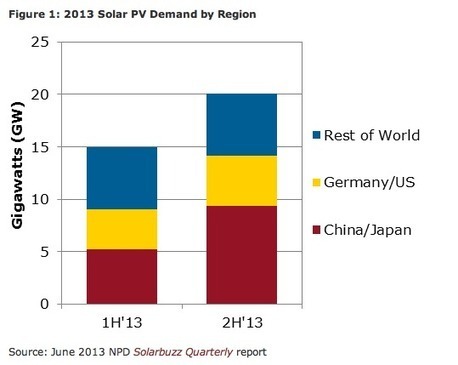
Deutsche Bank is the latest to upgrade its forecasts – for the second time in as many months – predicting that the 2014 global solar market could jump to 45 GW, after rising to 38-40 GW in 2013.

>Deutsche’s analysis is more bullish than an NPD Solarbuzz report last week that forecast solar PV demand for calendar 2013 to reach a record high of 35.1 GW, after a strong second half that would result in 20 GW being installed. In March, the research group predicted full year demand of just 31 GW.

NPD Solarbuzz analyst Michael Barker said the market was still in transition (from older markets such as Europe to newer ones in Asia), and would continue to rely on four key countries for the bulk of demand – Germany, China, Japan, and the US – which accounted for more than 60% of demand in the first half.

It said China and Japan alone would account for 45% of global demand in the second half, up from just 10% three years ago.<


Solar Energy and Community Projects

See on Scoop.itGreen & Sustainable News

What does it take to cook up a community solar project? A dash of crowdfunding, a pinch of grassroots outreach, and a generous helping of persistence. That’s the word from San Francisco nonprofits RE-volv and Everybody Solar.

See on theenergycollective.com

Concern about emissions trading scheme affecting the impact of renewables

See on Scoop.itGreen & Sustainable News

Deep problems in Europe’s carbon trading scheme – its flagship climate change policy – are set to cancel out over 700m tonnes of emissions saved through renewable energy and energy efficiency efforts, according to a new report.

The study, by carbon trading thinktank Sandbag, found that a huge oversupply of carbon pollution permits means many are being banked to enable emissions after 2020, when efforts to tackle global warming should be intensifying. These emissions, nearly equivalent to Germany’s annual carbon pollution, will cancel out efforts made in other areas to cut carbon.

The report also warns that Europe’s emissions trading scheme (ETS) is a “global dumping ground” for “dubious” carbon permits created by projects around the world.

See on energyindemand.com

Expect more turbulence in world markets

See on Scoop.itGreen & Sustainable News

The US Federal Reserve’s hint that it is likely to wind up its quantitative easing programme next year has caused jitters in world markets.

Duane Tilden‘s insight:

>[…] QE {quantitative easing} was in response to lessons learnt from the Great Depression of the 1930s.  That downturn, which lasted a decade, was triggered by liquidity drying up quickly and countries then putting up barriers in a failed attempt to protect their economies.

It’s the kind of collapse that Bernanke, the 14th chairman of the Fed and a scholar of the Depression, was trying to avoid when he chose a course of stimulus. Many doubt QE will be repeated.

The volatility in markets is quite possibly the final stage of Bernanke’s risky experiment to rescue the global economy from the financial crisis, which was sparked by a crisis in US subprime mortgages and the collapse of US investment bank Lehman Bros in September 2008. […]<

See on www.fm.co.za

Research and Energy Efficiency | The Energy Collective

See on Scoop.itGreen Energy Technologies & Development

Every time energy policy is being discussed, you’ll usually find a call for more R&D spending at the top of the list of ways to solve problems. While I agree that research is great, it’s obviously not enough and, if anything, only the first step.

Duane Tilden‘s insight:

>The result of this comparison doesn’t come as a surprise to anyone who is remotely interested in energy issues. There is a massive energy efficiency gap between the US and other world economies. While this is no surprise to many, it should be a lesson for all those who tell the public that meaningful action requires yet more R&D spending. The 200 million citizens of Japan and Germany are proof that even the technology and the concepts of the past can make a huge difference.<

See on theenergycollective.com

Innovative Empire State Building Program Saves Millions, Establishes New Energy Efficiency Model Nationwide

See on Scoop.itGreen Building Operations – Systems & Controls, Maintenance & Commissioning

/PRNewswire/ — The innovative energy efficiency program at the Empire State Building has exceeded guaranteed energy savings for the second year in a row, saving $2.3 million and providing a new model for building retrofits that is now being rolled…

Duane Tilden‘s insight:

>”The success from the Empire State Building retrofit project further demonstrates that thoughtfully applied energy-efficiency investments can deliver unparalleled returns through a combination of lower energy, lower operating costs, and increased building valuation,” said Iain Campbell, vice president, Global Energy and WorkPlace Solutions, Johnson Controls Building Efficiency.  “When implemented under a performance contract, the energy savings are guaranteed, ensuring a no-risk investment and a smart business decision.”

The retrofit has attracted new Empire State Building tenants over the past two years, including LinkedIn, Skanska, LF USA, Coty Inc., the Federal Deposit Insurance Corp., and Shutterstock.  These tenants sought space that reflected their sustainability values, provided more comfort for employees, and allowed them to monitor and control their energy use.

“The Empire State Building project has conclusively proven the business case for deep energy retrofits of any building,” said Raymond Quartararo, international director at Jones Lang LaSalle.  “We have consistently surpassed annual projected energy savings through a process that is very transparent, quantitatively intense and internationally approved.  The overwhelming majority of people want to do their part to reduce energy usage while delivering economic returns and occupying an environmentally responsible building.”<

See on www.sacbee.com

Better Buildings Act Brings Energy Efficiency Opportunities to Tenants

See on Scoop.itGreen & Sustainable News

Bipartisan Bennet-Ayotte Legislation Aimed at Boosting Energy Efficiency in Commercial Buildings

Duane Tilden‘s insight:

>To date, the focus has been on how real estate owners and developers may lower energy consumption at the “whole-building” level. However, office tenants like data centers, law firms, banks, trading floors, restaurants, and retail stores use a lot of energy – especially in areas experiencing large growth and development. The Better Buildings Act takes a holistic approach by considering office tenants’ impact on energy consumption and behaviors.

In addition to the “Tenant Star” designation, the bill asks the Department of Energy to study and learn from private sector “best practices” of how commercially-leased spaces are designed to achieve high performance and help reduce utility costs for businesses.

“Senators Bennet and Ayotte have championed innovative, transformative energy policy through their Better Buildings Act and its ‘Tenant Star’ provisions,” said Jeffrey D. DeBoer, President and CEO of The Real Estate Roundtable. “Tenants consume 50% or more of the energy used by commercial buildings, so they should be recognized for making smart choices in high-performance design and operations within leased spaces they control.  This bill is a major step forward to better align commercial landlords and tenants toward a common goal of lowering energy use in built environments across our nation.”<

See on www.bennet.senate.gov

China Invests Billions in International Renewable Energy Projects

See on Scoop.itGreen & Sustainable News

See on insights.wri.org

A Significant Win for Clean Energy in Colorado

See on Scoop.itGreen & Sustainable News

Today Colorado Governor John Hickenlooper signed a measure to expand and improve the state’s Renewable Energy Standard that will drive clean energy investment, increase jobs and renewable project development in rural Colorado.

Duane Tilden‘s insight:

>As a result of the move by Xcel and the Governor’s signature on SB 252, Colorado will have an additional 1,000 MW of renewable energy or a 40 percent increase from the current amount of installed renewable energy in the state.

The announcement pulled the rug from under fossil fuel funded opponents of SB 252 who had argued renewable energy is too expensive.

The bill, co-sponsored by Senate President John Morse and House Speaker Mark Ferrandino, will also expand opportunities for distributed generation and eliminates unnecessary preferences for in-state generation.<

See on switchboard.nrdc.org