Net Energy Metering Policies Helping To Spur Solar Growth

See on Scoop.itGreen Building Design – Architecture & Engineering

All across the United States, rooftop solar panels are popping up on homes, businesses and schools like mushrooms in a forest, and utility-scale solar projects are bringing huge amounts of clean energy into our communities.  Why?

Duane Tilden‘s insight:

>Today, smart policies — likeRenewable Portfolio Standards (RPS) and Net Energy Metering (NEM) — are helping to fuel solar’s explosive growth. Our industry now employs 120,000 Americans at 5,600 U.S. companies. What’s more, we’re now generating enough electricity to power more than 1.5 million homes…

Part of this amazing success story can also be attributed to the fact that the average cost of a solar system has dropped by nearly 40 percent over the past two years and by a whopping 50 percent since 2010.  As a result, American consumers, businesses and schools are flocking to rooftop solar.  According to the most recent statistics, the residential market alone grew by 48 percent in the second quarter of 2013 compared to the same time period a year ago. […]

NEM has significantly contributed to this growth.  Simply put, NEM is a credit on your bill that represents the full value of electricity delivered.  Think of it this way: surplus energy generated by a home or business system is exported to the electricity grid, allowing a consumer’s meter to spin backwards.  This allows the homeowner or business owner to have greater control over their energy use and prices.  […]”<

See on www.renewableenergyworld.com

Supply of Renewable Wind Power Surges in Texas with some Plant Closures

See on Scoop.itGreen & Sustainable News

Market Upheaval In the U.S., hydraulic fracturing techniques used to drill shale have produced a flood of cheap natural gas. That, combined with the growth in wind and tepid customer demand, is upending power markets, leading to plant closures and bankruptcy for some generator owners.

Duane Tilden‘s insight:

>Traditional power companies across the U.S. and Europe are struggling to compete in wholesale markets with newer generators supplying subsidized wind and solar energy. In Texas, wind has more than doubled in the past six years and now makes up 13 percent of the state’s generation capacity.[…]

Falling Prices – Electricity prices for 2014 also have fallen. The on-peak North Texas power price for next year has dropped 19 percent since reaching a peak on May 23, according to data compiled by Bloomberg.

During a heat wave in the first week of August, ample wind supplies served to keep a lid on prices that would’ve normally spiked from the higher demand, NRG Chief Executive Officer David Crane said during a call with investors on Aug. 9. “Wind energy reduces electricity prices and that is good for consumers,” said Michael Goggin, an analyst for the American Wind Energy Association, an industry trade group. “Wind energy has no fuel costs, allowing it to replace more expensive and polluting sources of energy.”

Once complete, Oncor’s power lines will be part of a system that can eventually deliver about 18,500 megawatts of wind power, nearly double the amount now available in Texas and 25 percent of the state’s current generation capacity.<

See on www.renewableenergyworld.com

Are developing Microgrids the Answer to supply next generation Electricity Markets?

See on Scoop.itGreen & Sustainable News

Managing the effect of intermittent renewables on the grid is one of the critical challenges we address in making the transition to renewables. One of the primary goals of grid modernization (aka “Smart Grid”) is to adapt grid management to account for the effects of intermittency in real time.

Duane Tilden‘s insight:

>Microgrids are one possible solution to these challenges. Microgrids, part of the Smart Grid toolbox, are autonomously managed and powered sections of the distribution grid that can be as small as a single building, or as large as a downtown area or neighborhood. Automation and digital communications are used to manage rooftop solar, small scale combined heat and power systems and storage systems, along with matching supply to demand.  Heating or cooling may also be a part of a microgrid. Microgrids can efficiently manage smaller sections of the grid, according to the local demand patterns and availability of renewable resources. They can also disconnect, or “island” from the larger grid to provide higher reliability.

Can microgrids reduce complexity and increase options for electricity market participants? What are the major barriers to microgrid implementation, and how might they be overcome? Are there other approaches, besides the microgrid, that might be employed as well?<

See on www.ourenergypolicy.org

Waste Heat Energy Recovery – ThermoAcoustic Refrigeration for Transportation Industry

Revisiting the Automotive ThermoAcoustic Refrigerator – ATAR

Diagram of Simplified ThermoAcoustic Engine

I wish to further investigate the idea of thermoacoustics for waste heat recovery processes.  Also, will in future look into latest developments in thermoacoustics, including any applications, studies, reviews or products and manufacturers.

In today’s new economy of energy efficiency, there are technologies available that are worth further investigation that can be utilized for improved performance.  Automotive air conditioning is one industry which could bear further scrutiny, where running compressors consume valuable fuel, decreasing the energy efficiency and increasing operating cost of a vehicle.

For professional drivers where fuel consumption increases will come out of pocket, the utilization of air conditioning is an important consideration.  The idea of using the waste heat in the exhaust system to provide the cooling energy necessary to provide air conditioning is a novel approach to improving vehicle efficiency and comfort.  The concept of thermoacoustic refrigeration is not new, and was previously reviewed by concerns of the ozone layer depletion and refrigerants, which ultimately lead to changes in the refrigeration and HVAC industries.

See original reference paper presented at 2005 Proceedings of Acoustics:  http://bit.ly/17qwTYK

Energy Management – Determining Load Factor to Maximize Control

See on Scoop.itGreen Building Operations – Systems & Controls, Maintenance & Commissioning

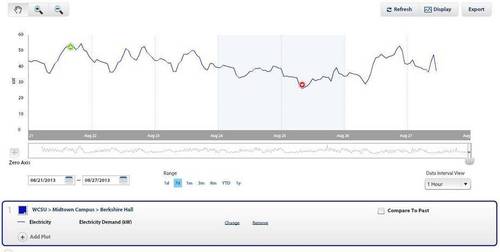
Understanding load factor is an important component to energy management and learning how to take control of your electricity use.

Duane Tilden‘s insight:

>Load factor is a ratio or percentage of the consistency of your electricity consumption – in other words, load factor is a way to answer the “how ‘spikey’ is your load?” question. The easiest way to understand your own load factor is by looking at your real-time energy data. Not only will your energy data indicate your load factor, but it will also highlight other important aspects of your electricity use over time that will enable you to make smarter energy management decisions.

While looking at your real-time energy data is the best way to accurately get your load factor, you can approximate it from your utility bill information. To manually find out your load factor, divide your total consumption (in kWh) by the number of hours in your billing period. Then, divide the result by your peak demand during the billing period, and the number you compute is your load factor. A load factor closer to 1, or 100%, indicates that you are using energy more evenly or consistently over time. It might also mean you are reducing your peak demand or otherwise avoiding spikes.<

See on energysmart.enernoc.com

Quantitative Analysis of Factors Contributing to Urban Heat Island Intensity

See on Scoop.itGreen Building Design – Architecture & Engineering

Ryu, Young-Hee, Jong-Jin Baik, 2012: Quantitative Analysis of Factors Contributing to Urban Heat Island Intensity. J. Appl. Meteor. Climatol., 51, 842–854.

Duane Tilden‘s insight:

>This study identifies causative factors of the urban heat island (UHI) and quantifies their relative contributions to the daytime and nighttime UHI intensities using a mesoscale atmospheric model that includes a single-layer urban canopy model. A midlatitude city and summertime conditions are considered. Three main causative factors are identified: anthropogenic heat, impervious surfaces, and three-dimensional (3D) urban geometry. Furthermore, the 3D urban geometry factor is subdivided into three subfactors: additional heat stored in vertical walls, radiation trapping, and wind speed reduction. To separate the contributions of the factors and interactions between the factors, a factor separation analysis is performed. In the daytime, the impervious surfaces contribute most to the UHI intensity. The anthropogenic heat contributes positively to the UHI intensity, whereas the 3D urban geometry contributes negatively. In the nighttime, the anthropogenic heat itself contributes most to the UHI intensity, although it interacts strongly with other factors. The factor that contributes the second most is the impervious-surfaces factor. The 3D urban geometry contributes positively to the nighttime UHI intensity. Among the 3D urban geometry subfactors, the additional heat stored in vertical walls contributes most to both the daytime and nighttime UHI intensities. Extensive sensitivity experiments to anthropogenic heat intensity and urban surface parameters show that the relative importance and ranking order of the contributions are similar to those in the control experiment.

Keywords: Urban meteorology

Received: May 7, 2011;<

See on journals.ametsoc.org

NASA – Ecosystem, Vegetation Affect Intensity of Urban Heat Island Effect

See on Scoop.itGreen Building Design – Architecture & Engineering

NASA researchers studying have found that the intensity of the “heat island” created by a city depends on the ecosystem it replaced and on the regional climate.

Duane Tilden‘s insight:

I have measured the heat island effect in the Greater Vancouver area, specifically Metrotown, Burnaby to be in the order of 6 deg C, during a late summer evening.

>”The placement and structure of cities — and what was there before — really does matter,” said Marc Imhoff, biologist and remote sensing specialist at NASA’s Goddard Space Flight Center in Greenbelt, Md. “The amount of the heat differential between the city and the surrounding environment depends on how much of the ground is covered by trees and vegetation. Understanding urban heating will be important for building new cities and retrofitting existing ones.”

Goddard researchers including Imhoff, Lahouari Bounoua, Ping Zhang, and Robert Wolfe presented their findings on Dec. 16 in San Francisco at the Fall Meeting of the American Geophysical Union.

Scientists first discovered the heat island effect in the 1800s when they observed cities growing warmer than surrounding rural areas, particularly in summer. Urban surfaces of asphalt, concrete, and other materials — also referred to as “impervious surfaces” — absorb more solar radiation by day. At night, much of that heat is given up to the urban air, creating a warm bubble over a city that can be as much as 1 to 3°C (2 to 5°F) higher than temperatures in surrounding rural areas.

The impervious surfaces of cities also lead to faster runoff from land, reducing the natural cooling effects of water on the landscape. More importantly, the lack of trees and other vegetation means less evapotranspiration — the process by which trees “exhale” water. Trees also provide shade, a secondary cooling effect in urban landscapes.

Using instruments from NASA’s Terra and Aqua satellites, as well as the joint U.S. Geological Survey-NASA satellite Landsat, researchers created land-use maps distinguishing urban surfaces from vegetation. The team then used computer models to assess the impact of urbanized land on energy, water, and carbon balances at Earth’s surface. <

See on www.nasa.gov

MHI Completes Acquisition of Pratt & Whitney Power Systems

See on Scoop.itGreen Energy Technologies & Development

Tokyo, May 20, 2013 – Mitsubishi Heavy Industries, Ltd. (MHI) has completed its acquisition of Pratt & Whitney Power Systems, the small and medium-size gas turbine business unit of Pratt & Whitney (P&W), an aeroengine manufacturer.

Duane Tilden‘s insight:

>MHI has traditionally focused its gas turbine business on large-capacity, high-efficiency systems. With the addition of PWPS’s small and medium-size aero-derivative engines, MHI has expanded its power generation product portfolio and is able to offer customers a full product lineup.

PWPS’s aero-derivative gas turbines are highly acclaimed, especially for their emergency power generation applications, compact design, and rapid start-up time. More than 1,700 aero-derivative turbines have been delivered worldwide. Significant growth is anticipated in applications that require a flexible power source complementary to a renewable-energy power source. Robust market demand is also expected as small power sources for applications in emerging markets. PWPS’s main product has been the 30MW (megawatt) class machine. The company is developing an innovative 60MW class model, which is expected to significantly boost PWPS’s market share.

Turboden’s ORC turbines have the capability to generate power or supply hot water using a relatively low-temperature heat source such as biomass, factory waste heat or geothermal energy. The company has sold more than 300 units in 20 countries, primarily in Europe. In Japan, increasing opportunities are emerging to use ORC technology in biomass and geothermal applications, and MHI plans to significantly increase sales in those expanding markets.

MHI and P&W have been in a collaborative relationship in aeroengine production for many years. After the acquisition of PWPS, MHI will continue to collaborate with P&W in the supply of engine parts for gas turbines and development of new machines.<

See on www.mhi.co.jp

Applied Thermodynamics: Organic Rankine cycle – Wikipedia

See on Scoop.itGreen Energy Technologies & Development

Duane Tilden‘s insight:

We have all seen the Rankine Cycle engine, most typically as the inefficient steam locomotive.  The modern efficient designs use turbines to convert heat energy from two reservoirs of different temperatures to mechanical energy.

The Organic Rankine Cycle engine uses a fluid – vapor phase change other than water/steam and a wide range of compounds are available including proprietory mixtures.  These mixtures allow for the conversion to mechanical energy in a wide range of applications and temperatures.  Two such applications would be waste heat to energy and geothermal energy systems.

See on en.wikipedia.org

Creating Value: Energy Retrofits for Buildings

See on Scoop.itGreen & Sustainable News

Buildings in the U.S. consume[…] 42 percent of the nation’s primary energy and 72 percent of its electricity. Much of that energy is needlessly wasted through inefficient design and operation.

Duane Tilden‘s insight:

>Rather than examine energy costs in isolation, our approach assesses how energy and sustainability improvements add value to all parts of a property or company. This approach is not revolutionary, but rather more comprehensive, applying industry-accepted valuation methods to the full set of retrofit value contributions, including saved energy costs, health and productivity benefits, reputation and leadership, and risk reduction.

Energy investment (and resultant property outcomes) should be treated as one of many factors that influence value, including location, tenant mix, quality of design, and more. Evaluating retrofits within the broader context of property/company value enables a logical, defensible calculation and assessment of a deep retrofit’s relative contribution to value. Previous attempts to value energy retrofits have ignored retrofits’ value contributions and overlooked standard approaches to valuing properties and companies.<

See on www.rmi.org