GE links up with Coca Cola in Brazil – Cogeneration & On-Site Power Production (Combined Heat & Power)

See on Scoop.itGreen Energy Technologies & Development

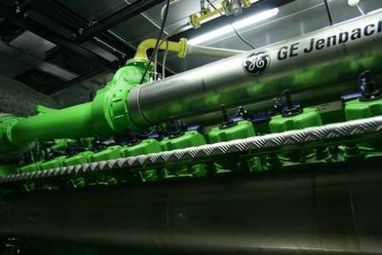
The 12 MW facility will provide all of the plant’s on-site heat and power needs. Brazilian energy company Light Esco will install three ecomagination-qualified Jenbacher J624 engines at the Andina Brasil-Coca-Cola bottling facility.

Duane Tilden‘s insight:

The power plant is expected to begin operating in November 2013 and will also produce cold water, carbon dioxide (CO2) and nitrogen to support the bottling operations.

By installing quadgeneration technology to recover food-grade CO₂, factories can reduce emissions by up to an additional 40 percent when compared to using separate power and heat generating equipment.

See on www.cospp.com

#Landfill methane-to-energy project gets national award – #Renewable #Energy

See on Scoop.itGreen Energy Technologies & Development

Lycoming County was one of seven places in the country to receive the U.S. Environmental Protection Agency’s award for excellence in landfill gas energy projects for 2012.

Duane Tilden‘s insight:

Yaw, who was present at Thursday’s presentation at the commissioners’ meeting, said he frequently became frustrated when driving by the landfill and seeing excess methane being flared off.

“We’re utilizing all of the landfill methane (now). We’re not flaring anything,” said Tucker.

The county’s waste gas-to-energy project produces enough electricity to power 4,000 homes a year and has the equivalent reduction of 80,000 barrels of oil a year, according to PPL Renewable Energy.

Donna Zickefoose, Allenwood Federal Correctional Complex warden, said the local institution is the first federal prison to be involved in such a project. She said it will save the prison $5 million during the next decade.

See on www.sungazette.com

US president aims to add 40GW to 82GW of installed CHP capacity by 2020

See on Scoop.itGreen Energy Technologies & Development

Low gas prices, state incentives, environmental regulations and the retirement of old power plants helps fuel rising investment in combined heat and power (CHP) installations in the US, according to a Department of Energy (DOE) and Environmental Protection Agency (EPA) report.


Duane Tilden‘s insight:

Obama’s CHP initiative

The 40GW CHP expansion goal is based on a 2012 Executive Order from Obama which encourages the Departments of Energy, Commerce, and Agriculture, and the EPA […] to coordinate policies in order to encourage investment in industrial efficiency measures such as CHP.

The installation of a further 40MW of capacity would save about 1 quadrillion Btu of energy annually, eliminate over 150 million metric tons of CO2 emissions and save energy users some $10 billion a year.

Shale gas revolution helps spur CHP growth

Currently about 8 percent of US power generation capacity and 12 percent of MWh generated annually comes from CHP, according to the DOE report, while 87 percent of CHP installations support manufacturing plants.

The recent US shale gas revolution has helped spur renewed interest in the sector, after investment in new CHPs slowed down between 2004 and 2005, mainly due to volatile gas prices and an uncertain economic outlook.

See on gastopowerjournal.com

Waste fat will power UK’s biggest sewage works | Energy Live News

See on Scoop.itGreen & Sustainable News

Waste fat and oil from restaurants and clogged up drains underground (pictured) will soon power the UK’s largest sewage works. A new power station at Beckton in East London opening …

Duane Tilden‘s insight:

Thames Water says it has agreed to buy 75 GWh of this output to run its Beckton sewage works, which serves roughly 3.5 million people, as well as a nearby desalination plant […]

The water firm has committed to provide the power station with 30 tonnes a day of fat, oil and grease (FOG) enough to fill a six metre-long shipping container. That’s at least half of the fuel the generator needs to run.

Developed and run by ‘green’ utility 2OC, it’s set to produce 130 Gigawatt hours (GWh) a year of renewable electricity – enough to run 39,000 average-sized homes.

See on www.energylivenews.com

Energy Storage Series: Why We Need It, And Why We Don’t

See on Scoop.itGreen Energy Technologies & Development

It’s almost a cliché that there’s a “friendly debate” pitting utilities against renewable energy. But concerns on the utility side of the table are real: intermittency, potential destabilization at the feeder level, non-baseload, and peaks in generation that don’t necessarily match demand peaks. Today’s power infrastructure involves unpredictability in both supply and demand that is extremely difficult to manage.

Duane Tilden‘s insight:

The big question in energy storage, Wheaton says, boils down simply: what does it cost to build more generation (to oversupply), vs. how to store and manage energy? Today it’s more “economically rational” to build more generation, whether it’s solar or wind or even coal, he noted. As energy storage technology costs come down — and as there is better understanding and calculation of externalized costs, such as societal impacts — “we will see those lines cross, and more utilities will go to energy storage as a more economical means to serve the grid.”

Fundamentally, economics determines the decision of over-generation vs. energy storage; right now “either energy storage is not cheaper, or the payback is not enough to shift over,” noted Luebbe. As the cost (dollars per kilowatt-hour) come down and energy storage costs intersect with those in over-generation, “then everyone will do it because it’s economically the logical thing to do.”

See on www.renewableenergyworld.com
ComEd Created 2400 Jobs through Grid Modernization Programs in 2012

See on Scoop.itGreen Energy Technologies & Development

ComEd submitted this week to the Illinois Commerce Commission data showing that the 2011 Smart Grid law created more than 2400 full-time equivalent jobs in Illinois in 2012.

Duane Tilden‘s insight:

“The grid modernization programs are putting many linemen, electricians and specialists who work on our electric grid back to work in well-paying, skilled jobs. This helps the Illinois economy and boosts other local industries, too,” said Michael Carrigan, president, Illinois AFL-CIO. “Getting the programs back on track will protect and increase jobs for Illinois workers.”

ComEd’s grid modernization investments have provided an important boost to Illinois manufacturers, suppliers and service providers with the expertise necessary to support the electrical system upgrade. Last year, ComEd awarded grid modernization contracts worth a total of $118 million, including 71 percent to Illinois companies providing services and products from engineering to cable to smart switches. Of the total, $54 million, or 46 percent, was spent with diverse suppliers.

See on tdworld.com

International Hydropower Association announces IHA World Congress – HydroWorld

See on Scoop.itGreen & Sustainable News

Members of the hydroelectric power community will convene in May for the International Hydropower Association’s World Congress for discussions concerning hydropower development around the world.

Duane Tilden‘s insight:

This Congress — titled “Advancing Sustainable Hydropower” — runs May 21-24, 2013, in Sarawak, Malaysia, and includes four days of interactive sessions and discussions designed not only to be informative, IHA said, but to test current strategies and stimulate future thinking.

See on www.hydroworld.com

Small Hydro Power for micro hydro power generation in streams & rivers. HydroWorld

See on Scoop.itGreen & Sustainable News

Read the hot small hydro power project news & technology.

Duane Tilden‘s insight:

Hydroelectric plants with a capacity of 20 MW or less are a valuable niche of the hydro industry, providing local power in underdeveloped countries and sources of new capacity in established markets.

See on www.hydroworld.com

SolarReserve Completes Molten Salt Receiver Panel Assembly on Crescent Dunes Solar Energy Plant Tower

See on Scoop.itGreen Energy Technologies & Development

SolarReserve, a U.S. developer of large-scale solar power projects, today announced completion of the assembly of the molten salt receiver panels that sits on top of the 540 foot solar power tower for its 110 megawatt (MW) Crescent Dunes Solar…

Duane Tilden‘s insight:

The project will utilize technology […] to capture and store the sun’s energy in order to deliver a firm electricity supply to Nevada, day or night, without the need to burn fossil fuels. The molten salt “receiver” is actually comprised of panels formed by hundreds of special alloy tubes which will be flowing with molten salt for energy absorption and storage. Once complete, the project will be capable of storing 10 hours of full load electricity production, enough to power 75,000 homes at peak electric demand periods, even after dark.

The project closed financing and initiated construction in September of 2011 and is scheduled to complete construction and start plant commissioning at the end of 2013, including first electricity production by the end of the year. The Crescent Dunes project has secured a 25-year power purchase agreement with NV Energy to sell 100 percent of the electricity output of the facility to serve homes across Nevada.  […]

“The energy storage capability of this technology solves the problem of intermittency typical of other renewable energy sources. Additionally, because of it high efficiency, this technology can generate almost twice as much energy as a comparably sized solar facility, including facilities powered by photovoltaic panels or by a direct steam tower.” said Kevin Smith, CEO of SolarReserve.

See on www.azocleantech.com

What Will Be the Next Technological Breakthrough in Energy?

See on Scoop.itGreen Energy Technologies & Development

What technological breakthrough is most likely in the next 10 years that could completely change the energy equation as we now see it?

Duane Tilden‘s insight:

Jeffrey Ball: Information Technologies to Increase Efficiency, and Solar Power Seem Promising

Predicting new-energy technological breakthroughs tends to be a fool’s errand. A decade ago, few envisioned the breakthrough that has most rocked the U.S. energy world: the one-two punch of fracking and horizontal drilling that has unlocked huge stores of shale gas from California to New York.

Right now, two broad areas of new energy technology seem particularly promising: information technologies that could spur major energy-efficiency improvements; and cheaper and more-reliable solar power. […]

Study after study has pegged energy efficiency as the lowest-cost way to curb fossil-fuel consumption and the resulting greenhouse-gas emissions. The problem has been figuring out how to unlock those efficiency improvements in the real world. Today, creative minds are at work developing electronic systems to track and display the energy use of institutional and individual consumers in ways that could make those users much more conscious both about how much energy they consume and about precisely what they could do to cost-effectively consume less. More information, in short, could equal less power.

See on online.wsj.com