Climate Change Will Cause More Energy Breakdowns, U.S. Warns

See on Scoop.itGreen & Sustainable News

The national power supply is increasingly vulnerable to severe weather, according to a new Department of Energy study.

Duane Tilden‘s insight:

>The effects are already being felt, the report says. Power plants are shutting down or reducing output because of a shortage of cooling water. Barges carrying coal and oil are being delayed by low water levels in major waterways. Floods and storm surges are inundating ports, refineries, pipelines and rail yards. Powerful windstorms and raging wildfires are felling transformers and transmission lines.

“We don’t have a robust energy system, and the costs are significant,” said Jonathan Pershing, the deputy assistant secretary of energy for climate change policy and technology, who oversaw production of the report. “The cost today is measured in the billions. Over the coming decades, it will be in the trillions. You can’t just put your head in the sand anymore.”<

See on www.nytimes.com

UK Energy Efficiency Requirements and Business

See on Scoop.itGreen & Sustainable News

Proposals for an Energy Savings Opportunity Schemes have been published by the UK Government that will make it compulsory for large companies to undertake energy audits.

Duane Tilden‘s insight:

>An ESOS assessment would undertake a review of the total energy use and energy efficiency of the organisation, including the measurement of an energy intensity ratio (e.g. energy use per employee or per unit of output) and, as appropriate, considering the variation in energy use over time within key buildings, key industrial operations, and key transport activities (exempting de minimis energy use).

The review would need to be proportionate and sufficiently representative “to permit the drawing of a reliable picture of overall energy performance” of the organisation and present clear information on potential savings, which identify and quantify cost-effective energy savings opportunities.

These should be, wherever practical, based on life cycle assessments (LCA) instead of simple payback periods (SPP), as the former are more realistic.

All procedures for doing this are outlined under the international standard for energy management, ISO 50001, with which all energy and facility managers are encouraged to become competent.

The Government has come under sustained criticism recently for failing to do enough to promote energy efficiency.<

See on theenergycollective.com

COGA brings state into lawsuit against Longmont ‘fracking’ ban

See on Scoop.itGreen & Sustainable News

The lawsuit against Longmont&#27;s ban on fracking has now roped in the Colorado Oil and Gas Conservation Commission, the state&#27;s regulatory agency.

Duane Tilden‘s insight:

>Boulder County District Court Judge D.D. Mallard said she would allow the Colorado Oil and Gas Association to bring in the COGCC as an additional plaintiff, a move called “joinder.” In her ruling, Mallard said that while both parties had an interest in seeing the ban overturned, the state agency had aims that would not be adequately represented by COGA, the state’s largest oil and gas industry group.

“COGA’s interest in this case is to overturn the charter amendment so that its members can proceed with oil and gas production using fracking […]

Longmont voters passed the ban on hydraulic fracturing, or “fracking,” last November with about 60 percent in favor. Supporters of the ban say the practice can lead to environmental damage; opponents say the practice is so well-established that a ban on fracking is practically a ban on drilling, and that only the state has the authority to regulate the methods used.<

See on www.timescall.com

Duke U Study Links Hydraulic Fracturing to Ground Water Contamination

See on Scoop.itGreen & Sustainable News

The debate about whether or not fracking can contaminate ground water supplies has been raging for a while now, and a new study by Duke University has found proof

Duane Tilden‘s insight:

>But let us allow Jacksona et. al. to speak for themselves, from the report: “We analyzed 141 drinking waterwells across the Appalachian Plateaus physiographic province of northeastern Pennsylvania, examining natural gas concentrations and isotopic signatures with proximity to shale gas wells. Methane was detected in 82% of drinking water samples, with average concentrations six times higher for homes” less than one kilometer from the fracked natural gas wells. […]

“They found that, on average, methane concentrations were six times higher and ethane concentrations were 23 times higher at homes within a kilometer of a shale gas well.  Propane was detected in 10 samples, all of them from homes within a kilometer of drilling. […]

The ethane and propane data are “particularly interesting,” he noted, “since there is no biological source of ethane and propane in the region […]<

See on oilprice.com

Fracking ban halts first shale gas project in Spain

See on Scoop.itGreen & Sustainable News

A ban on fracking in a northern region of Spain has crimped Repsol SA’s plans to begin drilling for shale gas in the north of Spain.

Duane Tilden‘s insight:

>Spain’s richest shale gas reserves have been determined to exist in the northern region of Cantabria, but back in April the local Cantabrian government  implemented the country’s first fracking ban, worried that such activities may pollute the local sources of drinking water. (Related article: Duke University Study Links Fracking to Ground Water Contamination) […]

Repsol had planned to begin seismic studies, with a view to drilling, in July, but the Cantabrian fracking ban, which prevents all hydraulic fracturing activities within the region’s borders, has put a hold on plans. In truth, it is not fully understood how the ban will affect Repsol, whose Luena project covers 290 square miles, and stretches from Cantabria down to Castille & Leon. Normally when a project extends across two regions or more it is regulated by the national Industry Ministry, not local governments. <

See on www.csmonitor.com

Swansea Bay hydrokinetic project continues moving forward

See on Scoop.itGreen Building Design – Architecture & Engineering

Energy development group Tidal Lagoon Power Limited has reached a significant milestone in the development of a massive hydroelectric power project with the announcement of three design, build and deliver agreements.


Duane Tilden‘s insight:

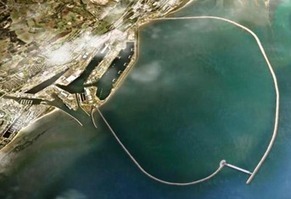
>[…]According to TLP, the US$966.5 million project will consist of a 6-mile-long, 35-foot-high semi-circular sea wall that will enclose an area west of Swansea Marina.  The wall would be dotted along its length with a number of hydro turbines, giving the project a cumulative capacity of around 250 MW.

Each of TLP’s three partners adds a unique quality to the project’s development, the company said.  Costain will work in developing and managing the schedule for pre-construction and construction phases, developing construction methodology for civil engineering works including turbine and sluice structures, access routes and complex temporary works, including temporary bund for construction turbine housing.

Meanwhile, Atkins will provide engineering design and geotechnical expertise. TLP said this includes “designing both the turbine house and the innovate breakwater bund wall, which uses a combination of giant tubular sand bags protected by armor made up of different sized rocks.”

Last, Van Oord is developing construction methodology suitable for the harsh off-shore conditions in Swansea Bay.  The Swansea is the first tidal lagoon power project envisioned by TLP, which said in May that it is considering a similar project off Wales’ north coast. As much as 10,000 MW of tidal lagoon power potential in the United Kingdom, the group said. […]<

See on www.hydroworld.com

Formal consultation commences on the world’s first purpose built tidal lagoon | Specification Online

See on Scoop.itGreen Building Design – Architecture & Engineering

The formal consultation process has started on the world’s first purpose built tidal lagoon for Swansea Bay, with public exhibitions taking place at 18 locations around the Swansea Bay area until August 5.

Duane Tilden‘s insight:

>The proposed tidal lagoon will have a rated capacity of 240 Megawatts (MW), generating 400GWh net annual output. This is enough electricity for approximately 121,000 homes.

In addition to generating electricity, the £650 million development will also provide visitor facilities and other amenities including art, education, mariculture and sporting/recreational facilities. The seawall is expected to be open to the public during daylight hours for walking, running, cycling etc, though access will be controlled in extreme weather.

LDA Design, the project masterplanners and landscape architects for Swansea Bay Tidal Lagoon, has completed the coordination of exhibition material for the public exhibitions. As part of the formal consultation for the proposed Development Consent Order (DCO) application by Tidal Lagoon (Swansea Bay) plc (TLSB), a new, virtual 3D programme has been prepared, which shows the proposed lagoon in the context of Swansea Bay.  <

See on specificationonline.co.uk

Scottish tidal power potential less than estimated, still Viable – new Study via Reuters

See on Scoop.itGreen Energy Technologies & Development

* Pentland Firth could generate maximum of 1.9 GW of power* 1 GW seen more realistic, vs prior estimates of 10-20 GW

LONDON, July 10 (Reuters) – Proposed tidal turbines in Pentland Firth, which separates…

Duane Tilden‘s insight:

>New research led by the University of Oxford suggests, however, that the maximum that Pentland Firth could produce would be 1.9 gigawatts, with 1 GW a more realistic target.

That is far below previous estimates of 10 GW to as much as 20 GW. […]  The study was less optimistic about the firth’s potential because it took into account factors such as how many turbines it would be feasible to build, how they would interact with each other and variations from tidal cycles.

“Our study provides the first robust data about how much energy it would be feasible to extract,” said Thomas Adcock, lead author of the report and fellow in engineering science at Oxford University.

Pentland Firth could still generate power equivalent to almost half of Scotland’s annual electricity consumption, which amounted to 37 terrawatt hours in 2011, Adcock added. […]<

See on www.reuters.com

Is Scotland’s Pentland Firth the World’s Best Site for Tidal Power

See on Scoop.itGreen Energy Technologies & Development

Tidal streams could bring large amounts of energy within a decade if government support is available, study says

Duane Tilden‘s insight:

>The world’s best site for tidal power, the Pentland firth, could provide half of Scotland’s electricity, according to the first robust estimate of its potential. The tidal streams, which surge through the firth at five metres per second, could bring large amounts of renewable energy in reach within a decade if enough government support is available, said the Oxford University engineer behind the new study.

From Anglesey to the Severn estuary to Portland Bill, the UK has the greatest potential for generating predictable, clean energy from tidal channels. Turbines are already operating at Strangford Loch in Northern Ireland and prototypes are being tested in the Menai Straits off Anglesey.

But the Pentland firth is the greatest resource. “It is almost certainly the best site for tidal stream power in the world,” said Thomas Adcock, at Oxford University, who led the new work published in the journal Proceedings of the Royal Society A. The water flow is rapid there because the tide shifting from the Atlantic into the North Sea is forced through a narrow eight-mile channel.<

See on www.guardian.co.uk

Synthesis of Butanol: Towards a Better Biofuel

See on Scoop.itGreen Energy Technologies & Development

Researchers have developed a catalyst to convert ethanol into butanol with high selectivity, potentially allowing butanol to replace ethanol as a biofuel.

Duane Tilden‘s insight:

>[…] Because manufacturers can prepare ethanol from renewable sources, researchers consider the biofuel a good alternative to standard fossil fuels such as gasoline. Indeed, its production and use have increased remarkably in the last ten years; manufacturers now commonly add ethanol to gasoline fuels.

Despite this increased use, however, ethanol has several disadvantages. It has a lower calorific value than standard gasoline (19.6 vs. 32 MJ/liter); moreover, it is corrosive. For this reason, the maximum amount which can be added to standard gasoline is about 10 %; cars cannot use fuels with higher ethanol amounts without engine modifications.

Butanol: a Better Option

1-Butanol (CH3-CH2-CH2-CH2-OH), an alcohol with a longer chain, could be a better alternative to ethanol. Indeed, it has a higher calorific value (29.2 MJ/liter) and it is much less corrosive; because of this, manufacturers can add it to gasoline in higher proportions without engine modifications, and theoretically it could completely replace the gasoline. Moreover, its octane number is very similar to that of gasoline – 96 vs 91-99.

Despite these characteristics, however, we’re not yet using butanol in cars due to the difficulties in producing the alternative biofuel. […]<

See on www.decodedscience.com