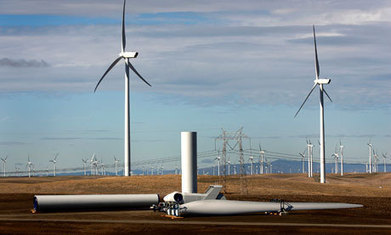
Small Hydro Power for micro hydro power generation in streams & rivers. HydroWorld

See on Scoop.itGreen & Sustainable News

Read the hot small hydro power project news & technology.

Duane Tilden‘s insight:

Hydroelectric plants with a capacity of 20 MW or less are a valuable niche of the hydro industry, providing local power in underdeveloped countries and sources of new capacity in established markets.

See on www.hydroworld.com

Law Firms Plays Key Role In Green Deal

See on Scoop.itGreen & Sustainable News

The UK Top 100 firm [Ward Hadaway] has advised renewable energy company JFS & Associates on the latest in its series of joint ventures with farmers to install and build anaerobic digestion (AD) plants to generate green energy.

Duane Tilden‘s insight:

The plant being built at Howla Hay Farm will be capable of generating 250kWh of electricity enough to power 250 homes.

Matthew Flint, director at JFS & Associates, which is based in Stokesley, North Yorkshire, said: “It is great news to be able to announce the second in what we aim to be a whole series of these developments which provide a win-win for both parties in the joint venture.

“The farmer gets to share in the proceeds of the electricity generated opening up a new revenue stream as well as getting the benefit of the by-products of the process, such as heat and bio-fertiliser to further improve the profitability of their existing business.

“We get a readily available source of feedstock for the AD plants and, by using our expertise and experience in the renewable energy sector, we can generate and sell electricity to feed back into the National Grid.”

See on www.power-eng.com

Neodymium and Thorium

See on Scoop.itGreen Energy Technologies & Development

Thorium is cheaper than uranium and would allow the USA to manufacture neodymium magnets within the US and brake [sic] China’s grip on the neodymium magnet and ele…

Duane Tilden‘s insight:

Wind and Neodymium

Jack Lifton’s research on mineral resources make him an important figure in projecting the future of energy. Lifton spotted the Lemhi Pass thorium reserve discoveries early on, Lifton has recently focused on world rare earth production, and as Lifton has pointed out, rare earths will play important roles in the future of energy. Lifton pointed out the importance of the rare earth element neodymium for the wind generation industry.

There’s another rare earth metal that’s critically important to our society—neodymium. In 1984, General Motors and Sumitomo developed the neodymium iron boron alloy for permanent magnets, which is the basis of all modern electric motors because it allows you to make a very small electric motor with the highest possible power density. Neodymium total world production is less than 20,000 tons. That may sound like a lot to you, but it’s tiny. And the fact is it’s recently been projected that a single wind turbine electric generator producing 1 megawatt of electricity requires one ton of neodymium.

http://bit.ly/10w37hB

++++++++++++++++++++++++++++++++++++++++++++++++++++++++

The liquid fluoride thorium reactor (acronym LFTR; spoken as lifter) is a thermal breeder reactor that uses the thorium fuel cycle in a fluoride-based molten (liquid) salt fuel to achieve high operating temperatures at atmospheric pressure.

The LFTR is a type of thorium molten salt reactor (TMSR). […]

In a LFTR, thorium and uranium-233 are dissolved in carrier salts, forming a liquid fuel. Typical operation sees the liquid fuel salt being pumped between a critical core and an external heat exchanger, where the heat is transferred to a nonradioactive secondary salt, that then transfers its heat again to a steam turbine or closed-cycle gas turbine.[2]

This technology was first investigated at the Oak Ridge National Laboratory Molten-Salt Reactor Experiment in the 1960s. It has recently been the subject of a renewed interest worldwide.[3] Japan, China, the UK, as well as private US, Czech and Australian companies have expressed intent to develop and commercialize the technology.

http://bit.ly/XoTEMt
See on www.youtube.com

Wind power capacity grew 20% globally in 2012, figures show

See on Scoop.itGreen Energy Technologies & Development

A relative slowdown in new wind turbine construction in China was offset by increases in the US, Germany, India and the UK

Duane Tilden‘s insight:

“While China paused for breath, both the US and European markets had exceptionally strong years,” said Steve Sawyer, secretary general of the Global Wind Energy Council (GWEC), which produced the statistics. “Asia still led global markets, but with North America a close second, and Europe not far behind.”

The UK now ranks sixth in the world for installed wind power, with 8.5GW. In Europe, only Germany (31GW) and Spain (23GW) have more. China leads the world with 77GW installed and the US is second with 60GW. […]

The record year for installation in the US was driven by a rush to beat an anticipated end to tax credits: 8GW of the total 13GW were installed in the last quarter of 2012. However, the tax credit has since been extended, meaning a dramatic slowdown in the US in 2013 is less likely. […]

See on www.guardian.co.uk

Emissions: First-time reports from industry reveal massive methane emissions — 02/06/2013 — www.eenews.net

See on Scoop.itGreen Energy Technologies & Development

U.S. EPA’s addition of oil, gas and coal methane emissions to its online greenhouse gas tracking tool revealed an 82.6-million-metric-ton increase in carbon dioxide equivalents over numbers from the previous year, when those figures were not…

Duane Tilden‘s insight:

Coal power still dominates emissions

Last year, EPA completed standards requiring hydraulically fractured gas wells to use technology that will cut toxic emissions and smog-forming pollution by 2015.

As a co-benefit, the upgrades will also reduce methane by up to 1.7 million tons, said EPA. However, environmental groups have said that the methane issue must be addressed separately from other pollutants (ClimateWire, April 19, 2012).

Coal-fired power plants are the largest source of carbon emissions, outpacing the second-largest source — petroleum and natural gas systems — by a factor of almost 10-to-1. Power plants accounted for two-thirds of total greenhouse gas emissions.

See on www.eenews.net

China’s Energy Market Forecast: “Contrary to observations of recent coal-electricity negotiations, views expressed on the China Coal Market Summit, held on Dec. 21, 2012, generally predicted 2013 a better year for coal-fired power generation.”

Gas Drilling, North Dakota : Image of the Day

See on Scoop.itGreen & Sustainable News

Cities and people are scarce in northwestern North Dakota, but nighttime satellite imagery shows the Bakken Formation aglow with brightly-lit drilling equipment.

Duane Tilden‘s insight:

Northwestern North Dakota is one of the least-densely populated parts of the United States. Cities and people are scarce, but satellite imagery shows the area has been aglow at night in recent years. The reason: the area is home to the Bakken shale formation, a site where gas and oil production are booming.

On November 12, 2012, the Visible Infrared Imaging Radiometer Suite (VIIRS) on the Suomi NPP satellite captured this nighttime view of widespread drilling throughout the area. Most of the bright specks are lights associated with drilling equipment and temporary housing near drilling sites, though a few are evidence of gas flaring. Some of the brighter areas correspond to towns and cities including Williston, Minot, and Dickinson. …

See on earthobservatory.nasa.gov

Taking energy efficiency seriously

See on Scoop.itGreen Building Operations – Systems & Controls, Maintenance & Commissioning

Despite the lack of attention paid to the issue during this year’s presidential campaign (at least, before Sandy came along), Barack Obama’s first term was a bit of a quiet revolution for climate change policy in America…

“More than 13 percent of the $700 billion American Recovery Act went to energy spending, most of it green. … the largest portion – $32 billion –went to energy efficiency and retrofitting projects. This was the biggest such investment in the history of history. It may even have finally heralded the arrival of a “Negawatt Revolution”….”

“Still, the right incentive structures to encourage the necessary investments in energy efficiency are not yet in place. Energy bills are still viewed by customers in terms of monthly costs that would go up because of short-term investments rather than yearly ones that will ultimately go down because of long-term savings….. The Negawatt Revolution may have begun in earnest during these past four years, but we can’t afford to wait until 2037 for it to finally reach its full potential. The possible benefits to the environment – and the economy – are too great for us to continue to forego.”

See on www.startribune.com