Data Centers and Energy Efficiency

New analysis suggests there’s still an opportunity to cut power consumption and save billions in 2014.

Source: www.greenbiz.com

>”A new tally by the Natural Resources Defense Council (NRDC) suggests there’s still a big opportunity to cut energy usage by 40 percent, saving more than $3.8 billion in 2014 alone.  Put another way, that’s like switching off 39 billion kilowatt-hours of electricity, the equivalent of 14 large, coal-fired power plants.

“Most of the attention is focused on the highly visible hyperscale ‘cloud’ data centers like Google’s and Facebook’s, but they are already very efficient and represent less than 5 percent of U.S. data center electricity consumption,” said Pierre Delforge, NRDC’s director of high-tech energy efficiency. “Our small, medium, corporate and multi-tenant data centers are still squandering huge amounts of energy.”

Here’s the likely outcome: By 2020, U.S. data centers will probably require about 140 kilowatt-hours of electricity to keep online.

The biggest culprits in wasteful IT power consumption are underutilized servers using significant amounts of electricity without performing any useful purpose, according to NRDC.  […]

Figures suggest the average server operates at just 12 percent to 18 percent of its capacity, which means businesses could stand to be far more aggressive about consolidating or virtualizing them. That’s particularly true of the smallest server rooms, ones that crop up with little advance planning.

“The more work a server performs, the more energy-efficient it is—just as a bus uses much less gasoline per passenger when ferrying 50 people than when carrying just a handful,” the analysis notes.

Among the recommended fixes for this persistent problem are the adoption of metrics that provide deeper insight into average server utilization, more public disclosure of data center energy performance information, and “green” data center leases that provide incentives for energy savings.

The reason why these green data center service contracts work, according to the report, is because they create financial incentives for companies to consider their energy use. […]”<


See on Scoop.itGreen Energy Technologies & Development

California Building Code Title 24 Will Revolutionize Efficiency Financing for Buildings

See on Scoop.itGreen Building Design – Architecture & Engineering

If successful, Title 24 will open the door to increased amounts of energy efficiency financing, expanded sources of capital and lower financing costs.

Duane Tilden‘s insight:

>California’s Title 24

Title 24 is California’s body of state building codes. These codes have been revised to move the building industry toward comprehensive building solutions with a goal of achieving Zero Net Energy (ZNE) residential and commercial buildings. In a ZNE building, the annual building’s energy consumption is equal to the building’s onsite renewable energy generation. California has set a goal for all new residential construction to be ZNE by 2020 and for all new commercial construction to be ZNE by 2030. Additionally, the repurposing and remodeling of existing buildings that are of a size-threshold defined by Title 24 will also have to comply with Title 24 revised codes.

Financing a “smart” Zero Net Energy building

The challenge of financing any energy efficiency or renewable energy project is in providing assurances to the source of capital that the project will actually generate sufficient cost savings to cover financing costs plus repayment of invested capital. The number one challenge for winning energy efficiency investments is the uncertainty in documenting bill savings results. Too often, the cost savings generated by an investment in energy efficiency is lost in higher electric bills as new loads are added and utilities raise rates.

Information technologies that monitor, control and financially operate a building through links to real time prices of grid-supplied electricity are the foundation for enabling Title 24 project financing. Smart ZNE buildings will operate to optimize the economics between reducing building demand, reducing energy consumption, on-site generation, use of on-site energy storage and purchases of grid electricity.

What will further enable the financing of ZNE buildings is the ability of enabling information technologies to “look forward” in time to proactively shape a building’s operation and grid purchases to financially support the building’s project financing. The technologies that can achieve these results have already been invented. What California is pursuing through its Title 24 code revisions is a massive economies of scale push for these technologies to drive their costs down and increase their ability to be financed.

The sales pie just got bigger…a lot bigger

Beginning in 2014, Title 24 will blow the sales doors open for smart building technologies, energy efficiency technologies, onsite energy storage and renewable energy technologies. Title 24 will create a new competitive landscape for architects, general contractors, sub-contractors and vendors based upon their ability to offer price competitive services and products that comply with Title 24 codes. The construction industry’s sales path for energy efficiency projects will no longer be anchored by utility incentives that support targeted energy efficiency upgrades like re-lamping a building with more efficient lights. The new sales path will be based upon cost-effectively delivering code compliance to achieve financeable building performance. New competitive advantages will be won by contractors and architects that offer building performance assurances to building owners and financing sources.<

See on www.triplepundit.com

How Real Estate Energy Managers Can Use Big Data to Schedule Building Energy Retrofits

See on Scoop.itGreen Building Operations – Systems & Controls, Maintenance & Commissioning

Big Data remains a fairly nebulous concept for many real estate professionals, including those who stand to gain tremendously from it right now: real estate energy managers.

Duane Tilden‘s insight:

>To effectively time energy retrofit measures, energy managers can first develop those measures. New energy analytical tools such as FirstFuel identify and develop measures, and even estimate a range for capital cost. It does this analysis remotely over the course of a day just by analyzing hourly electricity data (which is sometimes also stored by the utility); no time-intensive on-site energy audit is required. Another new tool is Retroficiency, which provides a high-level look at energy performance improvement potential using the same interval data and, with minimal additional data from the IWMS, can further develop retrofit measures to investment-grade level.

After identifying energy-retrofit measures for the portfolio using remote energy analysis tools or more standard on-site energy analysis, energy managers can create a new retrofit measures database in the IWMS. Having this new database on hand enables managers to integrate energy retrofit opportunities with space management, maintenance and capital upgrade needs, and potentially other real estate issues. Such integration drives down the incremental cost of an energy retrofit, which is the gross cost minus the avoided cost of otherwise required capital or space upgrades.<

See on blog.rmi.org

US GSA Recognizes two 3rd-party Green Building Certification Systems

See on Scoop.itGreen Building Design – Architecture & Engineering
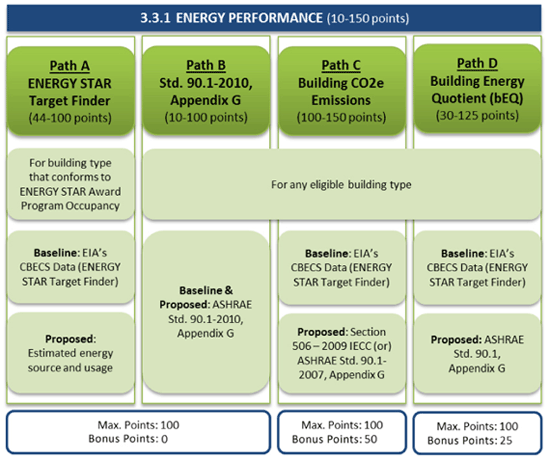
Green-Globes-NC-Building-Energy-Performance-Paths-chart

LEED and Green Globes approved as third party certification programs for federal facilities.

Duane Tilden‘s insight:

>In its recommendation to DOE, GSA recommended the Green Building Initiative’s Green Globes 2010 and the U.S. Green Building Council’s Leadership in Energy and Environmental Design (LEED) 2009 as the third party certification systems that the federal government can use to gauge performance in its construction and renovation projects. Other certification systems were not selected because they did not align with the government’s requirements. Additionally, under this recommendation, GSA will conduct more regular reviews in order to keep up with the latest green building tools that the market has to offer.

Third party certification systems like LEED and Green Globes help in measuring reduction targets for water, energy, and greenhouse gas emissions against industry standards. Agencies can use one of the two certification systems that best meet their building portfolios, which range from office buildings, to laboratories, to hospitals, to airplane hangars.

Federal construction and modernization projects must adhere to the government’s own green building requirements by law and executive orders. No one certification system meets all of the federal government’s green building requirements. Green building certification systems are just one tool that GSA uses to cut costs and meet sustainability and economic performance goals.<

See on www.todaysfacilitymanager.com

GBI’s Green Globes Recognized by Portland’s GSA as Equivalent to LEED for Green Building

See on Scoop.itGreen Building Design – Architecture & Engineering

PORTLAND, OR–(Marketwired – Oct 29, 2013) – The Green Building Initiative (GBI) applauds the General Services Administration on its recognition of Green Globes® alongside the U.S.

Duane Tilden‘s insight:

>GBI’s growth in the market is due to its commitment to the practicality of its tools for use by building owners, designers, and facility managers as well as its commitment to open, consensus-based review of its technical criteria. In 2010, GBI was recognized for developing Green Globes for New Construction as the first ever American National Standard for a commercial building rating system. As it continues to improve its rating systems based on changes in the market, GBI remains committed to using the American National Standards Institute (ANSI) approved consensus procedures.

“GBI is the only commercial building rating system developer to vet its technical criteria through the ANSI process,” stated GBI Chairman Tonjes. “This helps to ensure that GBI’s rating systems provide the opportunity to evaluate the widest range of buildings using an open, science-based approach to building performance.”

ANSI/GBI 01-2010, also known as Green Globes for New Construction, is due for revision before the end of 2015 based on ANSI periodic maintenance requirements. According to Tonjes, GBI’s ANSI-based rating system review process will begin before the end of this year with the filing of required documents followed by reformation of the technical review committee.

GBI’s tools have a significant focus on both the reduction and efficient use of energy and water in buildings. These, along with other criteria, help reduce building operating costs and their overall impact on the environment.

“Since 2005, the Green Globes product line has evolved to include several updated and expanded tools,” stated Erin Shaffer, vice president of federal outreach at GBI.<

See on www.marketwired.com

2015 IECC energy code raises requirements for efficiency, lighting controls, advanced HVAC in existing buildings

See on Scoop.itGreen Building Design – Architecture & Engineering

By Brianna Crandall, October 23, 2013—Hearings to finalize the 2015 International Energy Conservation Code (IECC) wrapped up in Atlantic City recently with big wins for higher efficiency requirements in existing buildings, controls for lighting and daylighting hardware and HVAC equipment specifications, according to a news release from the New Buildings Institute (NBI),

Duane Tilden‘s insight:

>The IECC is reviewed and updated every three years and serves as the model energy code for states and local jurisdictions across the country. The last version is the 2012 IECC.

In the United States, buildings account for about 40% of the energy consumed and 38% of all CO2 emissions, according to the U.S. Green Building Council. Cost-effective measures that cut the energy used by buildings represent a critical strategy to help building owners save money and curb the impacts of climate change, notes NBI.

“The updates related to existing and historic buildings clarify and further extend the code’s impact on the current building stock and will mean large energy savings growing over time,” said Jim Edelson, NBI senior manager of codes and policy. “Taken together, the approved code changes represent the most significant code revisions for energy consumption of existing buildings since the 1970s.”<

See on www.fmlink.com

Boston Leads Ranking of Energy-Efficient U.S. Cities by ACEEE

See on Scoop.itGreen & Sustainable News

A new ranking highlights Boston’s achievements in conserving energy as the Senate debates a bipartisan energy efficiency bill.

Duane Tilden‘s insight:

>ACEEE graded 34 cities for their efforts in five areas: buildings, transportation, energy and water utility programs, local government operations, and community-wide initiatives.  […]

The cities’ leap forward in energy-efficiency efforts has been a stark contrast to the slow movement on Capitol Hill, where the Energy Savings and Industrial Competitiveness Act of 2013, authored by Sen. Jeanne Shaheen (D-New Hampshire) and Sen. Rob Portman (R-Ohio) has been struggling to move forward.

The bill, […] would require the federal government—the nation’s single largest energy consumer—to update government buildings to improve energy efficiency, institute electricity-saving measures for government computers, and make it easier for agencies to switch to electric and natural-gas-powered vehicles. It also would provide training for workers in how to build more energy-efficient buildings for the private sector, and help finance private-sector renovations for energy efficiency. […]<

See on news.nationalgeographic.com

Virtual Energy Audits: The Next Big Thing in Buildings?

See on Scoop.itGreen Building Operations – Systems & Controls, Maintenance & Commissioning

Virtual energy audits use software to collect meter data, weather information, etc. and algorithms to develop energy efficiency recommendations.

Duane Tilden‘s insight:

>The goal of any energy audit is to identify savings by analyzing data, determining how and where a building is using energy, and then providing operational and capital energy efficiency measures that improve overall performance.

A traditional ASHRAE Level II Audit includes a manual inspection of data related to a facility’s Building Envelope, Lighting, Heating, Ventilation, and Air Conditioning (HVAC), Domestic Hot Water (DHW), Plug Loads, and Compressed Air and Process Uses (for manufacturing, service, or processing facilities). Analysis is conducted to quantify baseloads and account for seasonal variation. A Level II Audit will also include an evaluation of lighting, air quality, temperature, ventilation, humidity, and other conditions that may affect energy performance and occupant comfort. The process also includes detailed discussions with the building owners, managers, and tenants – there is a lot you can learn just by talking to people about what they think is working and not, what the financial objectives of the organization are, and how that should feed into the recommendations.  […]

Ok, I get it: So what’s a virtual energy audit?

Essentially a virtual energy audit is much like a traditional audit: the goal is to synthesize a whole bunch of data and come up with a list of recommendations that are going to deliver you the biggest bang for your buck. Unlike a detailed ASHRAE Level II audit, it’s better to think of virtual audits as delivering against the 80/20 rule. For a lot less physical effort, it’s going to get you about 80% of the detailed insights that a traditional ASHRAE Level II energy audit would deliver. And for many organizations, that’s OK – because their biggest, most obvious energy hogs are the ones driving the biggest bills at the end of the month.<

See on energysmart.enernoc.com

Monitoring Motivates Less Electricity Use

See on Scoop.itGreen & Sustainable News

Researchers found that families that were simply told they were in a study to track electricity use reduced electricity use more than 2.5 percent.

Duane Tilden‘s insight:

>The general phenomenon is called the Hawthorne effect: study subjects change their behavior because they’re being observed. So researchers collaborated with a utility to test for the Hawthorne effect in electricity use.

They monitored almost 5,600 randomly selected households. Half received a postcard saying that their energy use would be monitored for a month for research purposes. They also got four follow-up reminder postcards over the month. They received no other information, instructions or incentives.

The control group monitored for the study got no notifications. That group continued using the same amount of electricity. But the families being tracked reduced energy use 2.7 percent. And when the study period ended, their energy use shot back up. The report is in the Proceedings of the National Academy of Sciences. [Daniel Schwartz et al., The Hawthorne effect and energy awareness]<

See on www.scientificamerican.com

Quantitative Analysis of Factors Contributing to Urban Heat Island Intensity

See on Scoop.itGreen Building Design – Architecture & Engineering

Ryu, Young-Hee, Jong-Jin Baik, 2012: Quantitative Analysis of Factors Contributing to Urban Heat Island Intensity. J. Appl. Meteor. Climatol., 51, 842–854.

Duane Tilden‘s insight:

>This study identifies causative factors of the urban heat island (UHI) and quantifies their relative contributions to the daytime and nighttime UHI intensities using a mesoscale atmospheric model that includes a single-layer urban canopy model. A midlatitude city and summertime conditions are considered. Three main causative factors are identified: anthropogenic heat, impervious surfaces, and three-dimensional (3D) urban geometry. Furthermore, the 3D urban geometry factor is subdivided into three subfactors: additional heat stored in vertical walls, radiation trapping, and wind speed reduction. To separate the contributions of the factors and interactions between the factors, a factor separation analysis is performed. In the daytime, the impervious surfaces contribute most to the UHI intensity. The anthropogenic heat contributes positively to the UHI intensity, whereas the 3D urban geometry contributes negatively. In the nighttime, the anthropogenic heat itself contributes most to the UHI intensity, although it interacts strongly with other factors. The factor that contributes the second most is the impervious-surfaces factor. The 3D urban geometry contributes positively to the nighttime UHI intensity. Among the 3D urban geometry subfactors, the additional heat stored in vertical walls contributes most to both the daytime and nighttime UHI intensities. Extensive sensitivity experiments to anthropogenic heat intensity and urban surface parameters show that the relative importance and ranking order of the contributions are similar to those in the control experiment.

Keywords: Urban meteorology

Received: May 7, 2011;<

See on journals.ametsoc.org