Biofuel Production from Palm oil plantation waste

See on Scoop.itGreen Building Design – Architecture & Engineering

NextFuels to produce biofuels from palm plantation residue – Renewable Energy Magazine, at the heart of clean energy journalism

Duane Tilden‘s insight:

>Edible palm oil has surpassed soybean to become the largest source of cooking oil in the world, accounting for over 50 million tons of oil annually.

While plantation owners have managed to increase the productivity of their land by 15X since the late 80s, the growth of the industry has created a corresponding residue problem. Approximately 4.4 to 6 metric tons of agricultural waste is generated for each metric ton of oil. There are over 1,000 crude palm oil (CPO) mills in Southeast Asia and a single (60 tons per hour) mill can generate 135,000 tons of agricultural residue a year.

NextFuels uses a system called bio-liquefaction that efficiently transforms agricultural biomass to green energy. Biomass is placed into the plant mixed with water. The mixture is then heated to 330-degree Celsius while pressure is increased to 220 bar. Increasing the pressure keeps the water from coming to a boil, which conserves energy.

When cooled, the hydrocarbons form a putty-like substance called GreenCrude. Roughly 25 percent of the GreenCrude can be burned as a solid fuel in industrial boilers. The remaining 75 percent can be converted into a liquid-fuel equivalent to petroleum that is compatible with existing pipelines and vehicles.

The equipment required to convert GreenCrude into liquid fuels, in a process called hydrodeoxygenation, is already installed at most refineries and can… <


See on www.renewableenergymagazine.com

Quantitative Analysis of Factors Contributing to Urban Heat Island Intensity

See on Scoop.itGreen Building Design – Architecture & Engineering

Ryu, Young-Hee, Jong-Jin Baik, 2012: Quantitative Analysis of Factors Contributing to Urban Heat Island Intensity. J. Appl. Meteor. Climatol., 51, 842–854.

Duane Tilden‘s insight:

>This study identifies causative factors of the urban heat island (UHI) and quantifies their relative contributions to the daytime and nighttime UHI intensities using a mesoscale atmospheric model that includes a single-layer urban canopy model. A midlatitude city and summertime conditions are considered. Three main causative factors are identified: anthropogenic heat, impervious surfaces, and three-dimensional (3D) urban geometry. Furthermore, the 3D urban geometry factor is subdivided into three subfactors: additional heat stored in vertical walls, radiation trapping, and wind speed reduction. To separate the contributions of the factors and interactions between the factors, a factor separation analysis is performed. In the daytime, the impervious surfaces contribute most to the UHI intensity. The anthropogenic heat contributes positively to the UHI intensity, whereas the 3D urban geometry contributes negatively. In the nighttime, the anthropogenic heat itself contributes most to the UHI intensity, although it interacts strongly with other factors. The factor that contributes the second most is the impervious-surfaces factor. The 3D urban geometry contributes positively to the nighttime UHI intensity. Among the 3D urban geometry subfactors, the additional heat stored in vertical walls contributes most to both the daytime and nighttime UHI intensities. Extensive sensitivity experiments to anthropogenic heat intensity and urban surface parameters show that the relative importance and ranking order of the contributions are similar to those in the control experiment.

Keywords: Urban meteorology

Received: May 7, 2011;<

See on journals.ametsoc.org

NASA – Ecosystem, Vegetation Affect Intensity of Urban Heat Island Effect

See on Scoop.itGreen Building Design – Architecture & Engineering

NASA researchers studying have found that the intensity of the “heat island” created by a city depends on the ecosystem it replaced and on the regional climate.

Duane Tilden‘s insight:

I have measured the heat island effect in the Greater Vancouver area, specifically Metrotown, Burnaby to be in the order of 6 deg C, during a late summer evening.

>”The placement and structure of cities — and what was there before — really does matter,” said Marc Imhoff, biologist and remote sensing specialist at NASA’s Goddard Space Flight Center in Greenbelt, Md. “The amount of the heat differential between the city and the surrounding environment depends on how much of the ground is covered by trees and vegetation. Understanding urban heating will be important for building new cities and retrofitting existing ones.”

Goddard researchers including Imhoff, Lahouari Bounoua, Ping Zhang, and Robert Wolfe presented their findings on Dec. 16 in San Francisco at the Fall Meeting of the American Geophysical Union.

Scientists first discovered the heat island effect in the 1800s when they observed cities growing warmer than surrounding rural areas, particularly in summer. Urban surfaces of asphalt, concrete, and other materials — also referred to as “impervious surfaces” — absorb more solar radiation by day. At night, much of that heat is given up to the urban air, creating a warm bubble over a city that can be as much as 1 to 3°C (2 to 5°F) higher than temperatures in surrounding rural areas.

The impervious surfaces of cities also lead to faster runoff from land, reducing the natural cooling effects of water on the landscape. More importantly, the lack of trees and other vegetation means less evapotranspiration — the process by which trees “exhale” water. Trees also provide shade, a secondary cooling effect in urban landscapes.

Using instruments from NASA’s Terra and Aqua satellites, as well as the joint U.S. Geological Survey-NASA satellite Landsat, researchers created land-use maps distinguishing urban surfaces from vegetation. The team then used computer models to assess the impact of urbanized land on energy, water, and carbon balances at Earth’s surface. <

See on www.nasa.gov

Waste to Energy – Incinerator Operations threaten Community recycling programs

See on Scoop.itGreen Building Design – Architecture & Engineering

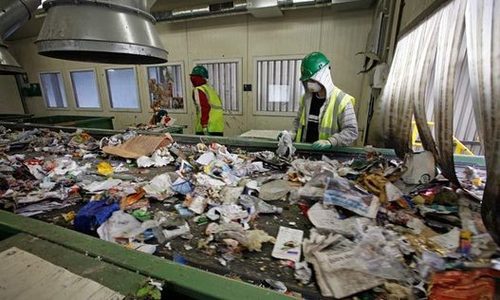
Rise in number of plants burning waste may be disincentive to greener methods of disposal

Duane Tilden‘s insight:

>Experts said the use of incinerators had consequences for recycling as local authorities were forced to divert waste to feed the plants. “The choice to invest in thermal treatment can hold back recycling efforts,” Adam Baddeley, principal consultant at Eunomia, said. “At one level, the money invested in such plant simply isn’t available to put into building recycling plants or collection infrastructure. And once you’ve built an incinerator or gasifier, there’s a strong incentive to keep it fed with waste, even if that means keeping on collecting as ‘black bag’ rubbish, material that would be economically practicable to collect separately for recycling.”

Charmian Larke, technical adviser for Cornwall Waste Forum, which unsuccessfully opposed a large incinerator in the south-west, questioned the planning process that resulted in incinerators being approved. “Some of them [planning officers] have spent their entire careers trying to get this incinerator so they are wedded to the idea,” Larke said. “But if the council members understood how bad these contracts were, the officers would lose their jobs.”

Larke claimed that many of the incinerators were built in poorer areas. “There’s a feeling that people who are downtrodden have a harder time getting their act together to object, and hence it’s easier to place nasty things next to them.”<

See on www.theguardian.com

A Republican Case for Climate Action

See on Scoop.itGreen & Sustainable News

By WILLIAM D. RUCKELSHAUS, LEE M. THOMAS, WILLIAM K. REILLY and CHRISTINE TODD WHITMAN Published: August 1, 2013The United States must move now on substantive steps to curb climate change, at home and internationally.

Duane Tilden‘s insight:

>Mr. Obama’s plan is just a start. More will be required. But we must continue efforts to reduce the climate-altering pollutants that threaten our planet. The only uncertainty about our warming world is how bad the changes will get, and how soon. What is most clear is that there is no time to waste.<

See on www.nytimes.com

Water-Smart Power: Strengthening the U.S. Electricity System in a Warming World (2013) | UCSUSA

See on Scoop.itGreen & Sustainable News

This report shows how the U.S. can build an electricity system that protects our water resources and dramatically reduces global warming emissions.

Duane Tilden‘s insight:

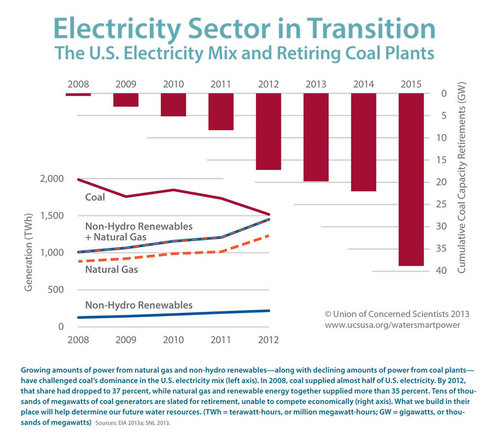
>The country stands at a critical crossroads. Many aging, water-intensive power plants are nearing the end of their lives. The choices we make to replace them will determine the water and climate implications of our electricity system for decades to come.

Today’s electricity system cannot meet our needs in a future of growing demand for power, worsening strains on water resources, and an urgent need to mitigate climate change.

[…]

Energy-water collisions are happening now, and are poised to worsen in a warming world

  • The heat waves and drought that hit the U.S. in 2011 and 2012 shined a harsh light on the vulnerability of the U.S. power sector to extreme weather, and revealed water-related electricity risks across the country.
  • When plants cannot get enough cooling water, they must cut back or completely shut down their generators, as happened in 2011 and 2012 at plants around the country.
  • Nationally, the 2012 drought was the worst in half a century. Amid soaring temperatures in the Midwest, several power plant operators got permission to discharge exceptionally hot water rather than reduce power output.
  • Electricity-water collisions are poised to worsen in a warming world as the power sector helps drive climate change. Extreme weather conditions that have historically been outliers are expected to become standard fare.<

See on www.ucsusa.org

Glut of Natural gas squeezes biofuel market

See on Scoop.itGreen Energy Technologies & Development

Farm Power Northwest has built five anaerobic digesters in Oregon and Washington in recent years, but the brothers who founded the company say the outlook for new projects has lost its luster.

Duane Tilden‘s insight:

>The Mount Vernon, Wash.-based company, founded by brothers Daryl and Kevin Maas, uses manure from dairy farms to create methane gas, then burns it in generators and sells the resulting electricity to power utilities.

[…]

While power utilities paid up to 9 cents per kilowatt-hour several years ago for digester-produced electricity, the rate has now fallen to 5 cents per kilowatt-hour, said Kevin Maas.

The reason is the price of natural gas — a common fuel for electrical generation — has plummeted as domestic production has skyrocketed. Natural gas is now trading at below $4 per thousand cubic feet, compared with nearly $13 per thousand cubic feet in 2008.

That’s because new technology known as hydraulic fracturing, or fracking, has greatly increased the amount of natural gas that can be economically extracted from the ground.

With the cost of natural gas so much lower, other energy feedstocks like biogas from digesters become less competitive, experts say.<

See on www.capitalpress.com

Water in Crisis: A New Paradigm in Power Generation

See on Scoop.itGreen & Sustainable News

The US can affordably and sustainably meet its energy and water needs by pursuing a “renewables-and-efficiency” path, according to a new EW3 report.

Duane Tilden‘s insight:

>The current system of power generation in the U.S., according to EW3, “clearly cannot meet our needs in a future of growing demand for electricity, worsening strains on water resources, and an urgent need to mitigate climate change.”

What’s urgently needed, they assert, is a system of power generation that is much more resilient – one that is not only much less dependent on water, but one that can operate sustainably in a warming climate and, at the same time, help mitigate climate change. With the release of its second report, EW3 advocates making decisions today that puts U.S. society firmly on such a path. […]

EW3′s research team constructed two long-term scenarios in order to better understand and analyze the implications of decisions made today regarding electricity production in the U.S. in terms of water usage and greenhouse gas emissions.

Pursuing a business-as-usual path that would see natural gas combustion growing to account for 60 percent of U.S. power generation in coming decades “would fail to reduce carbon emissions, and would not tap opportunities to safeguard water,” EW3′s research team found. In sharp contrast, both water usage and carbon emissions in the power sector would drop much further, and faster, under a “renewables-and-efficiency” scenario.

Under the renewables-and-efficiency scenario, both water withdrawals and consumption by the power sector would be less than half of today’s levels by 2030. By 2050, water withdrawals would be 97 percent below today’s levels while water consumption would drop 85 percent – nearly 80 percent below the business-as-usual scenario.<

See on www.triplepundit.com

China’s Coal-Fired Economy Dying of Thirst as Mines Lack Water

See on Scoop.itGreen & Sustainable News

Coal industries and power stations use as much as 17 percent of China’s water, and almost all of the collieries are in the vast energy basin in the north that is also one of the country’s driest regions.

Duane Tilden‘s insight:

>About half of China’s rivers have dried up since 1990 and those that remain are mostly contaminated. Without enough water, coal can’t be mined, new power stations can’t run and the economy can’t grow. At least 80 percent of the nation’s coal comes from regions where the United Nations says water supplies are either “stressed” or in “absolute scarcity.” […]

Geneva-based Pictet Asset Management’s $3.17 billion global water fund doubled its exposure to stocks offering water services in China to 10 percent since 2007.  […]

Beijing Enterprises has risen 55 percent this year to HK$3.10 and Deutsche Bank sees it reaching HK$3.20 within a year. China Everbright is up 81 percent to HK$7.10 and JPMorgan Chase & Co. estimates it will reach HK$7.60 by mid-October.

Severe Pollution  “The best opportunity is in industrial water re-use, and for the mining industry, it is of the utmost urgency,” said Junwei Hafner-Cai, a manager of RobecoSAM’s Sustainable Water fund. “Water that has been released from the coal mines and from petrochemical plants has resulted in severe pollution on top of the water scarcity.”

A shortage of coal because of the lack of water to mine and process the fuel may force China to increase imports, pushing up world prices, according to Debra Tan, director at research firm China Water Risk in Hong Kong. China, which mines 45 percent of the world’s coal, may adopt an aggressive “coal-mine grab” to secure supplies, said Tan.<

See on www.moneynews.com

Water Stress Threatens Future Energy Production

See on Scoop.itGreen Building Design – Architecture & Engineering

When we flip on a light, we rarely think about water.  But electricity generation is the biggest user of water in the United States.  Thermoelectric power plants alone use more than 200 billion gallons of water a day – about 49 percent of the…

Duane Tilden‘s insight:

>Large quantities of water are needed as well for the production, refining and transport of the fuels that light and heat our homes and buildings, and run our buses and cars.  Every gallon of gasoline at the pump takes about 13 gallons of water to make.

And of course hydroelectric energy requires water to drive the turbines that generate the power.  For every one-foot drop in the level of Lake Mead on the Colorado River, Hoover Dam loses 5-6 megawatts of generating capacity – enough to supply electricity to about 5,000 homes.

In short, energy production is deeply dependent on the availability of water.  And, as a report released last week by the U.S. Department of Energy (DOE) makes clear, as climate change brings hotter temperatures, more widespread and severe droughts, and lower river and lake levels, the nation’s energy supply is becoming more vulnerable. […]

One particularly interesting figure in the report compares the water requirements of seven different types of electric power facilities – nuclear, coal, biopower, natural gas combined-cycle, concentrated solar, photovoltaic solar and wind.  The last two come out as by far the most water-conserving electricity sources.  In contrast to the 20,000-60,000 gallons per megawatt-hour needed for nuclear and coal plants with “once-through” cooling systems, PV solar and wind require only negligible quantities.<

See on newswatch.nationalgeographic.com