California based Pattern Energy files for IPO to $345 million – Wind Power

See on Scoop.itGreen & Sustainable News

(Reuters) – Renewable power producer Pattern Energy Group Inc filed with U.S. regulators on Friday to raise up to $345 million in an initial public offering of common shares.


Duane Tilden‘s insight:

>The California-based company owns and operates wind power projects and has an interest in eight wind power projects located in the United States, Canada and Chile, representing a combined capacity of 1,041 megawatts.

[…]


Pattern Energy said it expects to benefit from growing demand for renewable sources of energy, amid increasing concerns related to greenhouse gas emissions and increasing prices of fossil fuels.

[…]


Pattern Energy reported net income of $44.3 million and revenue of $58.7 million in the quarter ended June 30.  The filing did not reveal how many Class A shares the company planned to sell or their expected price.  The company listed BMO Capital Markets, RBC Capital Markets, Morgan Stanley as underwriters to its offering. <


See on www.reuters.com

Dong Energy Working to Cut Offshore Wind Cost by 40% This Decade

See on Scoop.itGreen Energy Technologies & Development

Dong Energy A/S, Denmark’s state- controlled utility, is leading a drive to cut offshore wind- power costs by as much as 40 percent by the end of the decade.

Duane Tilden‘s insight:

>“The cost of energy from offshore wind turbines must be reduced,” Bent Christensen, a vice president at Dong’s wind division, said in the statement. “We expect to find significant savings” by cutting the size of foundations and changing the way turbines are installed, he said. Offshore wind power costs about 2.7 times more than onshore turbines, according to Bloomberg New Energy Finance, which puts the cost at about $221 a megawatt-hour over the life of a project. Governments are seeking to reduce the expense of wind farms at sea to expand power supplies without adding to carbon emissions or building on land.<

See on www.renewableenergyworld.com

Debunking the Renewables “Disinformation Campaign”

See on Scoop.itGreen & Sustainable News

Misleading coverage fuels policy uncertainty and doubt, reducing investment security and industry development. Disinformation hurts the industry and retards its—and our nation’s—progress

Duane Tilden‘s insight:

The Fox Business example is not a singular incident. Some mainstream media around the world have a tendency to publish misinformed or, worse, systematically and falsely negative stories about renewable energy. Some of those stories’ misinformation looks innocent, due to careless reporting, sloppy fact checking, and perpetuation of old myths. But other coverage walks, or crosses, the dangerous line of a disinformation campaign—a persistent pattern of coverage meant to undermine renewables’ strong market reality. This has become common enough in mainstream media that some researchers have focused their attention on this balance of accurate and positive coverage vs. inaccurate and negative coverage.

Tim Holmes, researcher for the U.K.’s Public Interest Research Centre (PIRC), points out press coverage is important because it can influence not only “what people perceive and believe” but also “what politicians think they believe.” […]

The disinformation campaign about job creation is not limited to Europe. A Cato Institute article claimed that if people believe a commitment to renewables will fuel job growth “we’re in a lot of trouble.” Yet in 2012 alone, more than 110,000 new U.S. clean-energy direct jobs were created, and in 2010, the U.S. had more jobs in the “clean economy” than in the fossil-fuel industries. The Bureau of Labor Statistics reportsthat direct employment in May 2012 totaled 181,580 for oil and gas extraction, 87,520 for coal mining, and 93,200 for iron and steel production. BLS doesn’t similarly classify solar or wind jobs, but reputable analysts have determined from bottom-up industry surveys that in September 2012, for example, the U.S. had 119,016 direct solar jobs (89 percent full-time, the rest at least half-time), up 27 percent in two years—more than in steel-making or coal-mining. Had you heard that before? Why not?

THE COST OF DISINFORMATION

The sad truth is that the debate on clean and renewable energy is unbalanced, and seldom by accident. The CCGroup’s study showed that only 10 percent of articles focusing on renewables even contained comment from a spokesperson from the renewable energy industry. This violates basic journalistic standards. Renewables must be a part of their own conversation. Much of the conversation on renewables is misinformed and misrepresented. And when bad news does happen, says ACORE president and retired U.S. Navy Vice Admiral Dennis McGinn, opponents of renewables are pushing it “as if it’s the only news. They are dominating the conversation through misrepresentation, exaggeration, distraction, and millions of dollars in lobbying and advertising.”<

See on blog.rmi.org

Creating Value: Energy Retrofits for Buildings

See on Scoop.itGreen & Sustainable News

Buildings in the U.S. consume[…] 42 percent of the nation’s primary energy and 72 percent of its electricity. Much of that energy is needlessly wasted through inefficient design and operation.

Duane Tilden‘s insight:

>Rather than examine energy costs in isolation, our approach assesses how energy and sustainability improvements add value to all parts of a property or company. This approach is not revolutionary, but rather more comprehensive, applying industry-accepted valuation methods to the full set of retrofit value contributions, including saved energy costs, health and productivity benefits, reputation and leadership, and risk reduction.

Energy investment (and resultant property outcomes) should be treated as one of many factors that influence value, including location, tenant mix, quality of design, and more. Evaluating retrofits within the broader context of property/company value enables a logical, defensible calculation and assessment of a deep retrofit’s relative contribution to value. Previous attempts to value energy retrofits have ignored retrofits’ value contributions and overlooked standard approaches to valuing properties and companies.<

See on www.rmi.org

Jobs for the Future: Energy Efficiency creates Employment — ECEEE

See on Scoop.itGreen & Sustainable News

Energy efficiency initiatives create jobs, and normally very good jobs.  Recent analysis shows that between 17 and 19 net jobs can be created for every million euros spent.

Duane Tilden‘s insight:

>Jobs to improve energy efficiency in all end-use sectors are of high value.  Many require technical qualifications, such as engineering or architectural degrees.  Many require re-training from existing jobs. There will be a demand for financial specialists, construction engineers, behaviour specialists, project managers, auditors, data base managers, policy analysts and the like.  And these jobs are available to all, regardless of age or gender.

The hard work of creating these jobs begins once the Directive is finally approved.  The long-term policy framework needs to be in place and the funding and implementation strategy need to be well developed. But in the longer term, opportunity is knocking at the door, and it deserves a welcome mat.<

See on www.eceee.org

London Sewers Fatberg’s used for Clean Energy

See on Scoop.itGreen & Sustainable News

Giant Fatberg Found Under London Has Surprising Use

Duane Tilden‘s insight:

>”Clean” Energy?

Despite the disgust, as well as the inconvenience, there’s actually some good news about fatbergs. Made of dense fats and oils, the structures are highly caloric, which makes them helpful for producing energy.

Rob Smith, a man with the enviable title of London’s “chief flusher,” told us that simply removing the fat and burning it in a turbine can produce more than 130 gigawatts of power each year, or about enough to power 40,000 London homes. The city plans to put the 15-ton berg to the same use, creating some very real cracks in the term clean energy.<

See on news.nationalgeographic.com

1973-74 Oil Crisis – Timeline – Slaying the Dragon of Debt – UC Berkeley

See on Scoop.itGreen & Sustainable News

Between October 1973 and January 1974 world oil prices quadrupled. By putting an end to decades of cheap energy, the 1973-74 oil crisis, which was led by Arab members of the Organization of Petroleum Exporting Countries (OPEC), exacerbated the economic difficulties facing many industrialized nations, forced developing countries to finance their energy imports through foreign borrowing, and generated large surpluses for oil-exporters.

Duane Tilden‘s insight:

>The 1973-74 oil crisis followed years of often acrimonious negotiations between members of the Organization of Petroleum Exporting Countries (OPEC) and Western oil companies over petroleum production and pricing levels. Richard Nixon’s decision to take the U.S. off the gold standard in 1971 was of particular importance in contributing to the oil crisis.

Because oil prices were denominated in dollars, the devaluation that accompanied the end of the Bretton Woods monetary regime negatively impacted oil exporting countries and led OPEC officials to consider remedial steps, such as pricing oil in gold instead of dollars. Little came of these efforts until October 1973, when Arab members of OPEC, in response to the outbreak of the Yom Kippur War, raised the posted price of crude by 70% and placed an embargo on exports to the U.S. and other nations allied with Israel.

Although the fighting ended in late October, OPEC continued to use the “oil weapon” over the coming months. In November oil exporters cut production 25% below September levels, and the following month they doubled the price of crude. By January 1974 world oil prices were four times higher than they had been at the start of the crisis.<

See on bancroft.berkeley.edu

Fukushima leaks will keep fisheries closed indefinately

See on Scoop.itGreen & Sustainable News

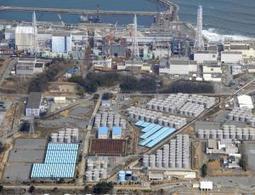
Some Japanese fisheries face a long-term threat from the steady trickle of radioactive water from the stricken Fukushima Daiichi nuclear plant

Duane Tilden‘s insight:

>Last month the plant’s owner, Tepco, finally admitted what many had suspected – that the plant was leaking. Now Japan’s Nuclear Regulatory Authority is calling the situation an emergency, and says Tepco’s plans to stop the leak are unlikely to work.

The problem is that groundwater is entering the damaged reactor buildings, picking up radioactive elements like caesium and seeping out to sea. Tepco has spent months pumping the water to the surface and storing it in tanks, and sinking wells to lower the water table.

[…] Given that Tepco is unlikely to stem the leaks from Fukushima any time soon, the fishing ban could continue for a long time. “People ask when will it be safe, and we can’t answer that,” says Buesseler. “The only thing you can do is stop the source, and that’s a huge engineering challenge.”<

See on www.newscientist.com

UK offers Big Tax Breaks for Shale Gas Fracking

See on Scoop.itGreen & Sustainable News

Chancellor George Osborne has said that the Treasury will go ahead with the most generous tax regime for shale gas in the world.

Duane Tilden‘s insight:

>In the North Sea oil and gas exploration has received tax breaks along the same lines. This has brought about a renewed interest in this field, which is both technically very difficult and rather expensive. The tax allowance will see a huge relief for fracking, with a portion of each production sites income taxation going to a level of 30% in place of the 62% currently levied.

The British Geological Society has said that shale gas in northern England alone could be as high as 1,300 trillion cubic feet and just 10% of that would meet Britain’s needs for more than 40 years.

Water UK, a representative of Britain’s biggest water suppliers has voiced fears that large quantities of water needed for fracking would stretch water supplies very thinly in the areas earmarked for fracking sites, and there is a concern of contamination of water supplies with chemical waste and methane gas. Water UK said that damage could be done to the existing water pipe infrastructure with resultant shortages for home and business use.

Fracking companies say that lengthy waiting periods for environmental permission to begin fracking are a major concern, and Ministers have said they will endeavour to minimise the waiting period from over three months to under two weeks. Public support for shale gas exploration is low.<

See on www.pcmswitch.co.uk

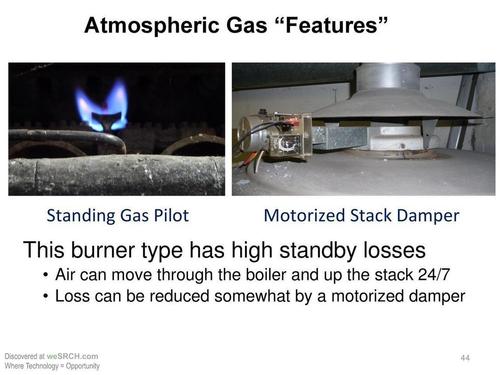
Atmospheric Gas Features – free slide submission, upload slide – weSRCH

See on Scoop.itGreen Building Design – Architecture & Engineering

The features are satnding gas pilot and motorized stack damper. This burner type has high standby losses. Air can move through the boiler and up the stack 24/7…. , Atmospheric Gas Features – free slide submission, upload slide – weSRCH.

Duane Tilden‘s insight:

Educational slideshow.

See on www.wesrch.com