Scottish Power should not sponsor fuel poverty conference, say campaigners

See on Scoop.itGreen & Sustainable News

Fuel Poverty Action says energy company with £712m profits ‘whilst people froze in their homes’ is not appropriate sponsor

Duane Tilden‘s insight:

>Scottish Power came under particular fire this summer when its annual report revealed a doubling of annual pre-tax profits to £712m barely months after it had hiked its gas and electricity prices by 7%. The same report also showed that Scottish Power had paid a dividend of £890m to its parent company, Iberdrola, and given a £129,000 bonus to chief corporate officer Keith Anderson, taking his total pay for 2012 to over half a million pounds.

Fuel Poverty Action accused Scottish Power at the time of “making a killing” while Citizens Advice also expressed concern that there were “too many families forced to choose between heating or eating” and urged companies to put customers before shareholders.<

See on www.theguardian.com

Inside look at General Motors’ new hyper-green data center

See on Scoop.itGreen Building Design – Architecture & Engineering

WARREN, Michigan—General Motors has gone through a major transformation … a three-year effort to reclaims its own IT after 20 years of outsourcing.

Duane Tilden‘s insight:

>The first physical manifestation of that transformation is here at Warren, where GM has built the first of two enterprise data centers. The $150 million Warren Enterprise Data Center will cut the company’s energy consumption for its enterprise IT infrastructure by 70 percent, according to GM’s CIO Randy Mott. If those numbers hold up, the center will pay for itself with that and other savings from construction within three years. […]

The data center is part of a much larger “digital transformation” at the company, Mott said. GM is consolidating its IT operations from 23 data centers scattered around the globe (most of them leased) and hiring its own system engineers and developers for the first time since 1996. Within the next three to five years, GM expects to hire 8,500 new IT employees with 1,600 of them in Warren. “We’re already at about the 7,000 mark for internal IT from our start point of about 1,700,” Mott said. […]

So far, three of the company’s 23 legacy data centers have been rolled into the new Warren data center. That’s eliminated a significant chunk of the company’s wide-area network costs. “We have 8,000 engineers at (Vehicle Engineering Center) here,” Liedel said. And those engineers are pushing around big chunks of data—the “math” for computer-aided design, computer aided manufacturing, and a wide range of high-performance computing simulations.

“Now with the data center on the same campus, we’re not paying for the WAN bandwidth we had before,” Liedel explained. “We’ve got dark fiber here on the campus, and the other major concentration of engineers is at Milford at the Proving Ground.” Milford and Warren are connected over fiber via dens wave division multiplexing, providing 10 channels of 10-gigabit-per-second bandwidth.<

See on arstechnica.com

Remote Wireless Power Systems for Buildings

See on Scoop.itGreen Building Operations – Systems & Controls, Maintenance & Commissioning

Mobile Technology News and Information

Duane Tilden‘s insight:

>Ossia’s patented smart antenna technology uses phased arrays to transfer power without the use of inductive coils, ultrasonic waves, magnetic resonance, charging pads or mats. The Cota technology consists of two parts: a charger and a receiver. The Cota-powered charger automatically locates Cota receivers built into devices or batteries, and delivers signals that are sent omnidirectionally. Once they hit the charger, these signals follow the same path back to the receiver, focusing energy at the exact location of the device. Cota continuously streams power to multiple devices, even as they move around a room. The laws of physics make the Cota technology inherently safe, naturally avoiding anything that absorbs energy, such as people, pets and even plants.<

See on www.mobiletechnews.com

Canadian renewable energy output continues to fall

See on Scoop.itGreen & Sustainable News

The contribution from renewable energy sources continues to decline in Canada in comparison to conventional carbon-based fuel according to Federal statistics

Duane Tilden‘s insight:

>“While wind output dropped 14.4% and solar slipped 3.6%, Canada’s total generation of electricity declined 0.8%, which means that renewables continue to lose share” said Bill Eggertson, the Executive Director of the Canadian Association for Renewable Energies. “We’ve been warning for some time that the good news on the growth in renewables, is overshadowed by the even-greater growth in conventional energy output. The recent meeting of energy ministers in Yellowknife noted that green power capacity has grown at a rapid pace over the last decade and the trend is expected to continue, but that is not due to sources which many Canadians regard as truly renewable. Feed-in tariffs and legislated renewable portfolio standards are key, but there must be stronger efforts to curtail the growth of conventional energy sources, or the share from renewables will continue to drop.”<

See on www.renewableenergymagazine.com

U.S. Nuclear Power waning: A history of Failures

See on Scoop.itGreen & Sustainable News

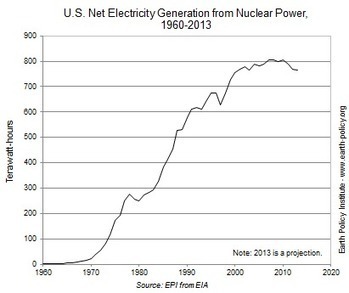
By J. Matthew RoneyNuclear power generation in the United States is falling. After increasing rapidly since the 1970s, electricity generation at U.S. nuclear plants began to grow more slowly in the…

Duane Tilden‘s insight:

>Of the 253 reactors that were ordered by 1978, 121 were canceled either before or during construction, according to the Union of Concerned Scientists’ David Lochbaum. Nearly half of these were dropped by 1978. The reactors that were completed—the last of which came online in 1996—were over budget three-fold on average.

By the late 1990s, 28 reactors had permanently closed before their 40-year operating licenses expired. […]

In 2012, the U.S. Nuclear Regulatory Commission (NRC) approved four new reactors for construction, two each at the Vogtle plant in Georgia and the Summer plant in South Carolina. These reactors are all of the same commercially untested design, purportedly quicker to build than previous plants. Both projects benefit from fairly new state laws that shift the economic risk to ratepayers. These “advanced cost recovery” laws, also passed in Florida and North Carolina, allow utilities to raise their customers’ rates to pay for new nuclear plants during and even before construction—regardless of whether the reactors are ever finished.

Construction at both sites began in March 2013. Even as the first concrete was poured at the $14-billion Vogtle project, it was reportedly 19 months behind schedule and more than $1 billion over budget. The Summer project, a $10 billion endeavor, also quickly ran into problems. […] With these delays, the earliest projected completion date for any of these reactors is some time in late 2017. […]

This year has also already witnessed the permanent shutdown of four reactors totaling 3.6 gigawatts of capacity. The first to fall was Duke’s Crystal River reactor in Florida. Although the plant was licensed to run until 2016, Duke decided to close it rather than pay for needed repairs. Then Dominion Energy’s 39-year-old Kewaunee reactor in Wisconsin closed, citing competition from low gas prices. It had recently been approved to operate through 2033. And in June, Southern California Edison shuttered its two San Onofre reactors after 18 months of being offline due to a leak in a brand new steam generator. These retirements leave the United States with 100 reactors, averaging 32 years in operation. (France is second, with 58 reactors.)

More closures will soon follow, particularly among the roughly half of U.S. reactors in so-called merchant areas […]

Dealing with nuclear waste is another expensive proposition. Over the past 30 years, the U.S. government has spent some $15 billion trying to approve a central repository for nuclear waste, and for most of that time the only site under consideration has been Nevada’s Yucca Mountain. Amid concerns about the site’s safety and its extreme unpopularity in Nevada, the Obama administration has moved to abandon the project entirely and explore other options.

A federal appeals court ruled in August 2013 that the NRC must resume reviewing the site’s suitability. In the meantime, the waste keeps accumulating. The 75,000 tons of waste now stored at 80 temporary sites in 35 states is projected to double by 2055. […]


See on grist.org

Virtual Energy Audits: The Next Big Thing in Buildings?

See on Scoop.itGreen Building Operations – Systems & Controls, Maintenance & Commissioning

Virtual energy audits use software to collect meter data, weather information, etc. and algorithms to develop energy efficiency recommendations.

Duane Tilden‘s insight:

>The goal of any energy audit is to identify savings by analyzing data, determining how and where a building is using energy, and then providing operational and capital energy efficiency measures that improve overall performance.

A traditional ASHRAE Level II Audit includes a manual inspection of data related to a facility’s Building Envelope, Lighting, Heating, Ventilation, and Air Conditioning (HVAC), Domestic Hot Water (DHW), Plug Loads, and Compressed Air and Process Uses (for manufacturing, service, or processing facilities). Analysis is conducted to quantify baseloads and account for seasonal variation. A Level II Audit will also include an evaluation of lighting, air quality, temperature, ventilation, humidity, and other conditions that may affect energy performance and occupant comfort. The process also includes detailed discussions with the building owners, managers, and tenants – there is a lot you can learn just by talking to people about what they think is working and not, what the financial objectives of the organization are, and how that should feed into the recommendations.  […]

Ok, I get it: So what’s a virtual energy audit?

Essentially a virtual energy audit is much like a traditional audit: the goal is to synthesize a whole bunch of data and come up with a list of recommendations that are going to deliver you the biggest bang for your buck. Unlike a detailed ASHRAE Level II audit, it’s better to think of virtual audits as delivering against the 80/20 rule. For a lot less physical effort, it’s going to get you about 80% of the detailed insights that a traditional ASHRAE Level II energy audit would deliver. And for many organizations, that’s OK – because their biggest, most obvious energy hogs are the ones driving the biggest bills at the end of the month.<

See on energysmart.enernoc.com

Are current batteries cost effective for wind and solar power storage on the grid?

See on Scoop.itGreen Energy Technologies & Development

Renewable energy holds the promise of reducing carbon dioxide emissions. But there are times when solar and wind farms generate more electricity than is needed by consumers.

Duane Tilden‘s insight:

>”We calculated how much energy is used over the full lifecycle of the battery – from the mining of raw materials to the installation of the finished device,” Barnhart said. “Batteries with high energetic cost consume more fossil fuels and therefore release more carbon dioxide over their lifetime. If a battery’s energetic cost is too high, its overall contribution to global warming could negate the environmental benefits of the wind or solar farm it was supposed to support.” […]

In addition to batteries, the researchers considered other technologies for storing renewable energy, such as pumped hydroelectric storage, which uses surplus electricity to pump water to a reservoir behind a dam. Later, when demand for energy is high, the stored water is released through turbines in the dam to generate electricity. […]

Storage is not the only way to improve grid reliability. “Energy that would otherwise be lost during times of excess could be used to pump water for irrigation or to charge a fleet of electric vehicles, for example,” Dale said.

See on phys.org

Industrial networking expands PLC functionality – Energy Efficiency

See on Scoop.itGreen Building Operations – Systems & Controls, Maintenance & Commissioning

Combining real-time Ethernet with visualization, control, and communication capabilities allows PLCs to open the door to a new level of visibility and control for manufacturers.

Duane Tilden‘s insight:

>The days when workers served as the brain and brawn in manufacturing are long gone, while human-machine interaction has become commonplace on the factory floor. A prime example of this is the PLC, which has been the workhorse in automation and manufacturing industries across the board for many years. By interfacing with everything from sensors and machine guards to motion control and advanced identification devices, PLCs ensure operations run smoothly (see Figure 1). Through the flexibility offered with PLCs, manufacturers can manage multiple machines at once—achieving a higher level of integration and process automation machines and improving production quality and cost of operation.

The benefits of the PLC are well known. Their contributions toward efficiency enhancement and the behind-the-scenes support of industrial Ethernet make this heightened control possible. Together, these technologies make communication between humans and machine a seamless, profitable combination. Consisting of various protocols, industrial Ethernet was developed with deterministic capabilities to provide a cost-effective alternative to legacy automation systems.

With advanced capabilities, sophisticated functionality, and simplified installation, the PLC is a cornerstone of modern manufacturing. However, to effectively use these devices, users must understand the crucial role networking plays and the individual requirements that must be considered for an effective solution.  […]<

See on www.plantengineering.com

Clay key to high-temperature supercapacitors

See on Scoop.itGreen Energy Technologies & Development

Clay, an abundant and cheap natural material, is a key ingredient in a supercapacitor that can operate at very high temperatures, according to researchers who have developed such a device.

Duane Tilden‘s insight:

>”Our intention is to completely move away from conventional liquid or gel-type electrolytes, which have been limited to low-temperature operation of electrochemical devices,” said Arava Leela Mohana Reddy, lead author and a former research scientist at Rice.

“We found that a clay-based membrane electrolyte is a game-changing breakthrough that overcomes one of the key limitations of high-temperature operation of electrochemical energy devices,” Reddy said. “By allowing safe operation over a wide range of temperatures without compromising on high energy, power and cycle life, we believe we can dramatically enhance or even eliminate the need for expensive thermal management systems.”

A supercapacitor combines the best qualities of capacitors that charge in seconds and discharge energy in a burst and rechargeable batteries that charge slowly but release energy on demand over time. The ideal supercapacitor would charge quickly, store energy and release it as needed.<

See on www.sciencedaily.com

Geothermal Energy: Iceland could provide renewable energy to the UK

See on Scoop.itGreen & Sustainable News

Under plans currently being discussed by both the UK and Icelandic governments, renewable electricity could be provided by Iceland to the UK at a cheaper cost than offshore wind.

Duane Tilden‘s insight:

>The plans being discussed by the two governments concern a 1,000km undersea cable with a capacity of 1GW. The package is worth an estimated £4 billion with the inclusion of related generation and onshore transmission investments and could be operational by 2022.  […]


At present, Iceland benefits from some of the lowest electricity prices in Europe given that much of their renewable energy comes from hydroelectricity and geothermal. […] the interconnector could provide power to the UK at around 60 to 70 percent of the price of offshore wind and that whichever way you look at it there are big potential benefits. However, in order to be successful, the Icelandic government must also convince their own citizens that there are also benefits for Iceland and there are concerns that exposure to a larger market could increase domestic energy prices.<

See on www.renewableenergymagazine.com