Renewable Energy Provides Half of New US Generating Capacity in 2014

According to the latest “Energy Infrastructure Update” report from the Federal Energy Regulatory Commission’s (FERC) Office of Energy Projects, renewable energy sources (i.e., biomass, geothermal, hydroelectric, solar, wind) provided nearly half (49.81 percent – 7,663 MW) of new electrical generation brought into service during 2014 while natural gas accounted for 48.65 percent (7,485 MW).


Image source:  http://usncre.org/

Source: www.renewableenergyworld.com

>” […] By comparison, in 2013, natural gas accounted for 46.44 percent (7,378 MW) of new electrical generating capacity while renewables accounted for 43.03 percent (6,837 MW). New renewable energy capacity in 2014 is 12.08 percent more than that added in 2013.

New wind energy facilities accounted for over a quarter (26.52 percent) of added capacity (4,080 MW) in 2014 while solar power provided 20.40% (3,139 MW). Other renewables — biomass (254 MW), hydropower (158 MW), and geothermal (32 MW) — accounted for an additional 2.89 percent.

For the year, just a single coal facility (106 MW) came on-line; nuclear power expanded by a mere 71MW due to a plant upgrade; and only 15 small “units” of oil, totaling 47 MW, were added.

Thus, new capacity from renewable energy sources in 2014 is 34 times that from coal, nuclear and oil combined — or 72 times that from coal, 108 times that from nuclear, and 163 times that from oil.

Renewable energy sources now account for 16.63 percent of total installed operating generating capacity in the U.S.: water – 8.42 percent, wind – 5.54 percent, biomass – 1.38 percent, solar – 0.96 percent, and geothermal steam – 0.33 percent.  Renewable energy capacity is now greater than that of nuclear (9.14 percent) and oil (3.94 percent) combined.

Note that generating capacity is not the same as actual generation. Generation per MW of capacity (i.e., capacity factor) for renewables is often lower than that for fossil fuels and nuclear power. According to the most recent data (i.e., as of November 2014) provided by the U.S. Energy Information Administration, actual net electrical generation from renewable energy sources now totals a bit more than 13.1 percent of total U.S. electrical production; however, this figure almost certainly understates renewables’ actual contribution significantly because EIA does not fully account for all electricity generated by distributed renewable energy sources (e.g., rooftop solar).

Can there any longer be doubt about the emerging trends in new U.S. electrical capacity? Coal, oil, and nuclear have become historical relics and it is now a race between renewable sources and natural gas with renewables taking the lead.”<

See on Scoop.itGreen & Sustainable News

Impact of energy efficiency standards in the US

Minimum Efficiency Standards for Electric Motors to Increase – DOE

DOE’s analyses estimate lifetime savings for electric motors purchased over the 30-year period that begins in the year of compliance with new and amended standards (2016-45) to be 7.0 quadrillion British thermal units (Btu). The annualized energy savings—0.23 quadrillion Btu—is equivalent to 1% of total U.S. industrial primary electricity consumption in 2013.

Source: www.eia.gov

>” Nearly half of the electricity consumed in the manufacturing sector is used for powering motors, such as for fans, pumps, conveyors, and compressors. About two thirds of this machine-drive consumption occurs in the bulk chemicals, food, petroleum and coal products, primary metals, and paper industries. For more than three decades the efficiency of new motors has been regulated by federal law. Beginning in mid-2016, an updated standard established this year by the U.S. Department of Energy (DOE) for electric motors will once again increase the minimum efficiency of new motors.

The updated electric motor standards apply the standards currently in place to a wider scope of electric motors, generating significant estimated energy savings. […]

Legislation has increased the federal minimum motor efficiencies requirements over the past two decades, covering motors both manufactured and imported for sale in the United States. The Energy Policy Act of 1992 (EPAct) set minimum efficiency levels for all motors up to 200 horsepower (hp) purchased after October 1997. The U.S. Energy Independence and Security Act (EISA) of 2007 updated the EPAct standards starting December 2010, including 201-500 hp motors. EISA assigns minimum, nominal, full-load efficiency ratings according to motor subtype and size. The Energy Policy and Conservation Act of 1975 also requires DOE to establish the most stringent standards that are both technologically feasible and economically justifiable, and to periodically update these standards as technology and economics evolve.

Motors typically fail every 5 to 15 years, depending on the size of the motor. When they fail they can either be replaced or repaired (rewound). When motors are rewound, their efficiencies typically diminish by a small amount. Large motors tend to be more efficient than small motors, and they tend to be used for more hours during the year. MotorMaster+ and MotorMaster+ International, distributed by the U.S. Department of Energy and developed by the Washington State University Cooperative Extension Energy Program in conjunction with the Bonneville Power Administration, are sources for cost and performance data on replacing and rewinding motors.

Improving the efficiency of motor systems, rather than just improving the efficiency of individual motors, may hold greater potential for savings in machine-drive electricity consumption. Analysis from the U.S. Department of Energy shows that more than 70% of the total potential motor system energy savings is estimated to be available through system improvements by reducing system load requirements, reducing or controlling motor speed, matching component sizes to the load, upgrading component efficiency, implementing better maintenance practices, and downsizing the motor when possible.”<


See on Scoop.itGreen Energy Technologies & Development

Energy Efficiency in Buildings – How VFD’s Save Energy

Have you wondered why Pumps and Fans are such a great opportunity to save energy using variable speed drives? ABB can help you estimate your energy savings a…

Source: www.youtube.com

>”  Efficiencies of Motors and Drives

The full load efficiency of AC electric motors range from around 80% for the smallest motors to over 95% for motors over 100 HP. The efficiency of an electric motor drops significantly as the load is reduced below 40%. Good practice dictates that motors should be sized so that full load operation corresponds to 75% of the rated power of the motor. […]

The efficiency of an electric motor and drive system is the ratio of mechanical output power to electrical input power and is most often expressed as a percentage.

Motor System Efficiency =Output MechanicalInput Electrical x 100%

A VFD is very efficient. Typical efficiencies of 97% or more are available at full load. At reduced loads the efficiency drops. Typically, VFDs over 10 HP have over 90% efficiency for loads greater than 25% of full load. This is the operating range of interest for practical applications. […]

The system efficiency is lower than the product of motor efficiency and VFD efficiency because the motor efficiency varies with load and because of the effects of harmonics on the motor.

Unfortunately, it is nearly impossible to know what the motor/ drive system efficiency will be, but because the power input to a variable torque system drops so remarkably with speed, an estimate of the system efficiencies is really all that is needed.

When calculating the energy consumption of a motor drive system, estimated system efficiency in the range of 80-90 % can be used with motors ranging from 10 HP and larger and loads of 25% and greater.

In general, lower efficiency ranges correspond to small motor sizes and loads and higher efficiency ranges corresponds to larger motors and loads.

b. Comparison with Conventional Control Methods

Estimating Energy Savings

Fans and pumps are designed to be capable of meeting the maximum demand of the system in which they are installed.

However, quite often the actual demand could vary and be much less than the designed capacity. These conditions are accommodated by adding outlet dampers to fans or throttling valves to pumps.

These are effective and simple controls, but severely affect the efficiency of the system.

Using a VFD to control the fan or pump is a more efficient means of flow control than simple valves or inlet or outlet dampers. The power input to fans and pumps varies with the cube of the speed, so even seemingly small changes in speed can greatly impact the power required by the load. […]

In addition to major energy savings potential, a drive also offers built-in power factor correction, better process control and motor protection. […]”<*

* Extracted from:  http://www.nrcan.gc.ca/energy/products/reference/15385

See on Scoop.itGreen Building Design – Architecture & Engineering

Why Demand Response will shape the future of Energy

Matching supply to demand is crucial when it comes to energy — and this concept can help us do it.

Source: www.mnn.com

>” […] Our energy grid is not designed to put out a steady amount of energy throughout the day. Rather, it is designed to crank up or wind down depending on the amount of energy that’s being demanded by the markets.

That means there’s a baseload of generation that’s always on — churning out steady amounts of relatively cheap, dependable power night and day. This has typically been made up of coal and nuclear plants, which can produce large amounts of power but can’t be made to cycle up and down efficiently in the face of fluctuating demand. On top of the baseload, you have an increasing amount of intermittent sources as the world transitions to renewable energy technologies like wind and solar. And then, on top of these intermittent sources are so-called “peaking” plants, often running on natural gas and sometimes diesel or even jet fuel. These can be deployed at very short notice, when there’s either unusually high demand or when another source isn’t available (e.g. the sun isn’t shining enough for solar), but are expensive, inefficient and disproportionately polluting.  One of the most effective ways to meet this challenge also happens to be the simplest — reward people for not using energy when it’s in highest demand.

An old idea whose time has come
Demand response, as it is known by those in the industry, is really not all that new. Many utilities have offered cheaper electricity rates for off-peak hours, encouraging consumers to shift their habits and reduce the pressure on the peak. Similarly, energy producers around the world have partnered with energy-hungry industries to ask them to power down at times of high demand. What’s new, however, is an ever more sophisticated array of technologies, meaning more people can participate in demand response schemes with less disruption to their daily lives. […]

A more sophisticated approach
On the commercial side, demand response has been a strategy for some time because it took very little infrastructure to implement — just an energy-hungry business ready and willing to cut its consumption in times of need, and able to educate its workforce about how and why to do so. Here too, however, the concept is becoming a lot more sophisticated and scalable as technology allows us to better communicate between producers and consumers, and to coordinate the specific needs of the grid. And as distributed energy storage becomes more commonplace, consumers may not even have to modulate their overall use — but rather allow the utility to switch them to battery power when grid supply is constrained. […]

A huge potential to cut peak demand
A report from federal regulators suggests that U.S. demand response capacity had the potential to shave 29GW off of peak demand in 2013, representing a 9.9 percent increase over 2012. When the U.K.’s National Grid, which manages the nation’s transmission infrastructure, put out a call for companies willing to cut consumption at key times, over 500 different sites came forward. The combined result was the equivalent of 300MW of power that can be removed from the grid at times of need. And constrained by its rapid growth of renewables following the Fukushima disaster, Japan is now looking at shoring up its grid by starting a national demand response program in 2016. […]”<

See on Scoop.itGreen Energy Technologies & Development

Reduce Costs and Energy Use Through Elevator Efficiency Upgrades

Buying or installing elevator equipment that promotes low-energy consumption can help save money and reduce a building’s environmental footprint.

Source: highrisefacilities.com

>”As part of a building’s overall energy usage, elevators consume up to 10 percent of the total energy in a building. From an environmental standpoint, the most significant impact elevators have is the electricity use while the elevator is in service. Therefore, buying or installing elevator equipment that promotes low-energy consumption can help save money and reduce a building’s environmental footprint.

Buildings and Energy

One way to measure overall energy usage is by calculating the power factor (PF) of the building and/or its energy-consuming devices. These are generally motors, transformers, high intensity discharge (HID) lighting, fluorescent devices or other pieces of equipment that require magnetism to operate. […]

Power factor is a measurement of electrical system efficiency in the distribution and consumption of electrical energy. It is the percentage of the amount of electric power being provided that is converted into real work and expressed as a number between zero and one. For example, if a device had a .70 PF, then 70 percent of the power that the utilities generate to run the device is actually being converted into real work. The lower the PF number, the poorer the PF efficiency. The higher the PF number, the greater the PF efficiency.

In some areas, utilities use PF in the computation of the demand charge. A low PF for a customer’s facility could result in a demand charge penalty that increases the monthly demand cost. This is where newer, more innovative elevator control systems can contribute to lower energy consumption and improve a buildings’ overall PF.

Because of electrical losses caused during generation, distribution and consumption of electricity, the amount of power needed to be provided by a utility company will be greater than the amount for which they get paid by consumers.

Comparative Analysis

During a recent modernization of two identical traction elevators, before and after energy data was collected. The original, first generation silicon controlled rectifier (SCR), direct current (DC) motor control was measured using a series of fixed run patterns and known loads. After modernization, the new insulated-gate bipolar transistor (IGBT)-based alternating current (AC) motor control for a permanent magnet synchronous motor system was measured using the same run patterns and known loads.

The SCR-DC system used far more energy (watts/hour) to move the exact same load through the exact same distance compared to the IGBT-based permanent magnet AC control (Chart 1). In fact, in these six load tests, the IGBT-based system used less than half the energy. An incredible 383 percent increase in power factor of the IGBT-based system compared to the SCR-DC system (Chart 2). That means more of the energy consumed was being converted into real work with less waste in terms of heat and magnetism.

These kinds of energy usage reductions and PF increases are becoming even greater as newer elevator technology gets incorporated into buildings (Chart 3).

It’s easy to see how reducing energy consumption and increasing power rating can benefit the building’s owners and operators. However, these same improvements benefit the community as well. The electricity not being used in one building can be used by other customers — allowing utilities to meet the community’s electricity demand without increasing electricity generation. That translates into no rolling blackouts or brownouts, no new power plants being built and an overall smaller environmental footprint.

Hydraulic Elevators

Up to this point, traction elevator technology was discussed where wire ropes pull the elevator from above the car. In contrast, the hydraulic elevator pushes the elevator cab through the hoistway. The way a hydraulic system works is a piston and cylinder are sunk in the ground below the elevator. To go up, a pump forces oil from an oil tank reservoir into the cylinder — causing the piston to rise, making the elevator cab go up. To go down, gravity and the weight of the cab pushes the piston down into the cylinder and forces the hydraulic oil back into the tank reservoir. Historically, hydraulic elevators (or hydros) have been installed where either the building had fewer floors (typically six to eight) or lower material and installation costs were a consideration (when compared to a traction elevator). […]

Considerations Beyond the Hoistway

Energy reduction of a building’s elevators can also impact heating, ventilation and air conditioning (HVAC) systems. Quite often, elevator machine rooms are air conditioned to support removal of the heat generated by elevator control systems. Motor-generator-based elevator controls create a tremendous amount of heat; the effect is multiplied when several systems are contained in the same machine room.

Additionally, a check should be made of the shut-down timer typically employed with motor-generators (M-G) sets. Is it working? Does the M-G set turn off after a set period of time? Or has the timer failed and no longer shuts down the motor-generator, wasting energy as the M-G set turns but no work is being done by the elevator?

The elevator cab’s lighting can impact both the energy consumption and HVAC systems. A recent survey conducted of a 34-story high rise office building with 18 elevators showed the cab lights were on 24-hours a day. There are 28 incandescent light bulbs per elevator. That worked out to 100-amps of power being consumed continuously. By replacing the incandescent bulbs with compact fluorescents, energy consumption could be cut to 30 percent. And if a 24-hour clock timer is added to shut the lights off at midnight, even more energy could be saved.

Reducing Energy Consumption

Finally, if you’re considering an elevator modernization, call your electric provider or visit their Website to explore the possibility of energy rebates from the local utility provider. It is quite common for utilities to offer dollar incentives for specific building improvements that reduce energy consumption and improve PF.

There are various benefits to building owners and facility managers who lower their power consumption and understand how power factor helps reduce the overall cost of energy, particularly the energy used to run the elevators in their buildings. These benefits go beyond the elevators themselves to include benefits derived from HVAC systems, cab lighting and energy consumed when the elevators are not moving that affect the monthly utility bill.”


See on Scoop.itGreen Energy Technologies & Development

Study Finds Global Opportunities for Improvements in Elevator Efficiency

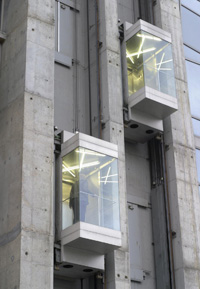
1259707a-d405-4e90-9e4b-4b7660c1a1d0.jpgElevators and escalators make up 2 to 5 percent of the energy used in most buildings, but can reach as high as 50 percent during peak operational times. At 5 percent, that means the yearly energy consumption of U.S. elevators is approximately five times of that used in all of Washington D.C.


image source: http://www.thyssenkrupp.com/en/produkte/energieeffiziente-aufzugssysteme.html

Source: aceee.org

>”Chicago—More energy-efficient elevators can significantly reduce the costs of operating a building, but the information needed to help building owners identify the appropriate elevator system—and the savings associated with it—aren’t readily available, according to a new study published by a leading policy group. The study, by the American Council for an Energy-Efficient Economy, was published with the support of UTC Building & Industrial Systems, the parent organization of Otis, the world’s largest manufacturer and maintainer of people-moving products.

[…] The technology exists today to reduce that consumption by 40 percent or more, especially by cutting energy use between trips, when an elevator is idle, according to the study. Some technologies have been found to reduce consumption by as much as 75 percent, but without a standard way to measure energy savings and a rating system to distinguish more efficient elevators, building owners may be unaware of the benefits of upgrading to a more efficient system or choosing a more efficient system for new construction.

“Enhanced visibility when it comes to elevator efficiency can help customers grasp the full value package of better controls, improved performance, reduced sound, and increased comfort,” said Harvey Sachs, ACEEE senior fellow, and the study’s lead author. Sameer Kwatra of ACEEE presented the study on Tuesday, January 27 at the 2015 American Society of Heating, Refrigerating and Air-Conditioning Engineers (ASHRAE) Winter Conference in Chicago.

The study lays out a framework for industry leaders to set common standards for measuring elevator efficiency. Those standards could lead to a rating system, such as the U.S. Environmental Protection Agency’s ENERGY STAR® ratings already in place for heating, ventilating and air-conditioning systems, and many home appliances. Clear standards also could lead energy utilities and government agencies to offer incentives, such as rebates, for very efficient models. And building label programs, such as the U.S. Green Building Council’s LEED® program, could include elevator efficiency as a factor in certifying buildings. Right now, the LEED program considers elevators a part of unregulated “process loads,” and there are no direct credits for installing more efficient systems.

“Owners see elevators as an extension of the building lobby — a way to include their personality and values in the building,” said John Mandyck, chief sustainability officer, UTC Building & Industrial Systems. “As consumers and tenants better understand and value the effects green buildings have on the health and productivity of inhabitants, clear standards for measuring elevator efficiency can provide a great opportunity to reduce operating costs and showcase the environmental attributes of a building.”

The report identified energy-efficient elevator technologies that can be included in building codes and factored in elevator rating and labeling systems. […]”<

See on Scoop.itGreen Building Design – Architecture & Engineering

Determining the True Cost (LCOE) of Battery Energy Storage

The true cost of energy storage depends on the so-called LCOE = Round-trip efficiency + maintenance costs + useful life of the energy system

Source: www.triplepundit.com

By Anna W. Aamone

“With regard to [battery] energy storage systems, many people erroneously think that the only cost they should consider is the initial – that is, the cost of generating electricity per kilowatt-hour. However, they are not aware of another very important factor.

This is the so-called LCOE, levelized cost of energy(also known as cost of electricity by source), which helps calculate the price of the electricity generated by a specific source. The LCOE also includes other costs associated with producing or storing that energy, such as maintenance and operating costs, residual value, the useful life of the system and the round-trip efficiency. […]

Batteries and round-trip efficiency

[…] due to poor maintenance, inefficiencies or heat, part of the energy captured in the battery is released … or rather, lost. The idea of round-trip efficiency is to determine the overall efficiency of a system (in that case, batteries) from the moment it is charged to the moment the energy is discharged. In other words, it helps to calculate the amount of energy that gets lost between charging and discharging (a “round trip”).

[…] So, as it turns out, using batteries is not free either. And it has to be added to the final cost of the energy storage system.

Maintenance costs

[…] An energy storage system requires regular check-ups so that it operates properly in the years to come. Note that keeping such a system running smoothly can be quite pricey. Some batteries need to be maintained more often than others. Therefore when considering buying an energy storage system, you need to take into account this factor. […]

Useful life of the energy system

Another important factor in determining the true cost of energy storage is a system’s useful life. Most of the time, this is characterized by the number of years a system is likely to be running. However, when it comes to batteries, there is another factor to take into account: use. […]

More often than not, the life of a battery depends on the number of charge and discharge cycles it goes through. Imagine a battery has about 10,000 charge-discharge cycles. When they are complete, the battery will wear out, no matter if it has been used for two or for five years.

[…] [However] flow batteries can be charged and discharged a million times without wearing out. Hence, cycling is not an issue with this type of battery, and you should keep this in mind before selecting an energy storage system. Think twice about whether you want to use batteries that wear out too quickly because their useful life depends on the number of times they are charged and discharged. Or would you rather use flow batteries, the LCOE of which is much lower than that of standard batteries?

So, what do we have so far?

LCOE = Round-trip efficiency + maintenance costs + useful life of the energy system.

These are three of the most important factors that determine the LCOE. Make sure you consider all the factors that determine the true cost of energy storage systems before you buy one.

Image credit: Flickr/INL”

See on Scoop.itGreen Energy Technologies & Development
What is “Levelized Cost of Energy” or LCOE?

As a financial tool, LCOE is very valuable for the comparison of various generation options. A relatively low LCOE means that electricity is being produced at a low cost, with higher likely returns for the investor. If the cost for a renewable technology is as low as current traditional costs, it is said to have reached “Grid Parity“.

Source: www.renewable-energy-advisors.com

>”LCOE (levelized cost of energy) is one of the utility industry’s primary metrics for the cost of electricity produced by a generator. It is calculated by accounting for all of a system’s expected lifetime costs (including construction, financing, fuel, maintenance, taxes, insurance and incentives), which are then divided by the system’s lifetime expected power output (kWh). All cost and benefit estimates are adjusted for inflation and discounted to account for the time-value of money. […]

LCOE Estimates for Renewable Energy

When an electric utility plans for a conventional plant, it must consider the effects of inflation on future plant maintenance, and it must estimate the price of fuel for the plant decades into the future. As those costs rise, they are passed on to the ratepayer. A renewable energy plant is initially more expensive to build, but has very low maintenance costs, and no fuel cost, over its 20-30 year life. As the following 2012 U.S. Govt. forecast illustrates, LCOE estimates for conventional sources of power depend on very uncertain fuel cost estimates. These uncertainties must be factored into LCOE comparisons between different technologies.

LCOE estimates may or may not include the environmental costs associated with energy production. Governments around the world have begun to quantify these costs by developing various financial instruments that are granted to those who generate or purchase renewable energy. In the United States, these instruments are called Renewable Energy Certificates (RECs). To learn more about environmental costs, visit our Greenhouse Gas page.

LCOE estimates do not normally include less tangible risks that may have very large effects on a power plant’s actual cost to ratepayers. Imagine, for example, the LCOE estimates used for nuclear power plants in Japan before the Fukushima incident, compared to the eventual costs for those plants.

Location

An important determination of photovoltaic LCOE is the system’s location. The LCOE of a system built in Southern Utah, for example, is likely to be lower than that of an identical system built in Northern Utah. Although the cost of building the two systems may be similar, the system with the most access to the sun will perform better, and deliver the most value to its owner. […]”<


See on Scoop.itGreen Energy Technologies & Development

CanGEA Report Claims Geothermal Creates more Jobs than Site C Dam

a recent report by a canadian industry group that is promoting geothermal energy, thermal energy generated and stored in the earth, says geothermal operations can create more permanent jobs than the site c dam in northeastern b.c.

Source: www.journalofcommerce.com

>”According to Geothermal Energy: The Renewable and Cost Effective Alternative to Site C, 1,100 megawatts – the same amount as Site C – of geothermal power projects would create more sustainable employment for surrounding communities.

“While Site C promises only 160 permanent jobs, U.S. Department of Energy statistics indicate that the equivalent amount of geothermal energy would produce 1,870 permanent jobs. This does not include jobs that result from the direct use of geothermal heat, which are also significant.”

However, said Alison Thompson, managing director of Canadian Geothermal Energy Association  (CanGEA), which published the report, geothermal projects would result in fewer construction jobs than the Site C dam.

“Geothermal projects would be spread around the province, not all on one site,” she said. “And, unlike Site C, they would not be built all at once. They would be staggered, with construction beginning in the highest-priority regions first.”

According to Dave Conway, a Site C spokesman, the $7.9 billion project will create about 10,000 person-years of direct construction employment, and 33,000 person-years of total employment during development and construction.

Construction will take about eight years.  This includes seven years for  the construction itself and one year for commissioning, site reclamation and demobilization.

Thompson said geothermal energy has other advantages over hydro.  “For example, geothermal power has a lower unit energy cost and capital cost,” she said.  “And, the physical and environmental footprint of geothermal is small.”

The CanGEA report says the “strategic dispersion” of geothermal projects will have lower transmission costs than Site C.

“There is every reason to believe that, given the thoughtful and (methodical) development of B.C.’s geothermal potential, geothermal power could provide all of B.C.’s future power requirements at a lower cost to ratepayers than the proposed Site C project.” […]

“For the most part, Canada’s geothermal power sector lay dormant for the following two decades while interest in the industry continued to grow outside of Canada’s borders.” […]”<

See on Scoop.itGreen & Sustainable News