Bio-Gas Waste Treatment System Installs Remote Fuel Station for Fleet

MADISON, WI–(Marketwired – Mar 3, 2015) – BioCNG, LLC announced that the St. Landry Parish Solid Waste Disposal District’s BioCNG Vehicle Fuel Project, which was fully commissioned in 2012, will be expanded to include an additional BioCNG system and a remote CNG fueling station. BioCNG, which partnered with the District…

Source: www.marketwired.com

>”[…]

The expansion is part of a contract between St. Landry Solid Waste and Progressive Waste Systems. In exchange for continuation of its existing waste hauling contract with the District, Progressive Waste has agreed to purchase new CNG-powered trucks, and will have access to the increased BioCNG generated from the expanded system. The expanded project will also provide BioCNG fuel to additional St. Landry Parish clients.

St. Landry Parish Solid Waste Disposal District executive director Katry Martin, said, “The fact that the hauler that delivers waste to the Parish landfill will fuel its trucks with the biogas generated from the landfill is a true example of the power of renewable energy sources and a preview of the future of biogas.”

The St. Landry Parish BioCNG Vehicle Fuel Project received the U.S. Environmental Protection Agency’s Landfill Methane Outreach Program (LMOP) 2012 Project of the Year award. The system was originally designed to serve public works trucks and the sheriffs’ vehicle fleet. Now, with a new fuel purchaser, the District will increase on-site BioCNG production and provide an off-site CNG fueling station. The District can transport the BioCNG to the off-site location in a compressed gas tube trailer. […]”<


See on Scoop.itGreen Energy Technologies & Development

Brewery’s Waste Treatment Bio-Gas Fuel Micro-Turbines for Grid Power

Sierra Nevada taps waste-to-energy technologies as a way to close operational loops and demonstrate responsible brewing practices.

Source: www.rewmag.com

>”[…]

Biogas benefits

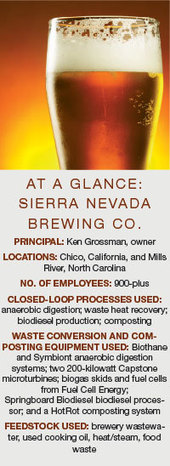
Sierra Nevada operates breweries in Chico, California, and in Mills River, North Carolina. While the Chico facility has been in operation since 1980, the Mills River brewery didn’t break ground until 2012. Both facilities operate anaerobic digesters for treating brewery effluent water. Each facility uses the biogas produced from the digesters a little bit differently. In Chico, the biogas is used to offset natural gas production for use in its boilers. The Mills River digester is also used in the boilers but is also being fed into two 200-kilowatt microturbines from Capstone of Chatsworth, California, which will generate electricity to power the operation.

McKay says the first anaerobic digester was installed in Chico in 2002, well before the technology had gained traction in the United States. The digester, manufactured by Veolia Water Technologies subsidiary Biothane, Pennsauken, New Jersey, is an upflow anaerobic sludge bed. The biogas produced from the digestion process is cleaned and treated by a biogas skid designed by Fuel Cell Energy, Danbury, Connecticut, before it is used in the boilers. When the digester was initially installed, Sierra Nevada had planned on using the biogas in its fuel cells, but the inconsistent flow of biogas from the digester was problematic for the fuel cells without a buffer zone.

“We just decided we would send the biogas all to the boilers because the boilers could definitely use it,” says McKay.

The fuel cells were installed in Chico in 2005 and are considered “old technology” by today’s standards, according to McKay. The company is currently deciding on a replacement for the fuel cells which is planned to be completed by the end of the year. Fuel cells, microturbines and other engine technologies have all been considered as potential replacements.

“Ideally we would like to produce electricity from any biogas we are producing at the wastewater treatment plant,” McKay says, adding, “It is fine to use in the boiler, but we would prefer to make electricity because it would be closing the loop a little bit better.” […]”<

See on Scoop.itGreen Energy Technologies & Development
Geothermal Energy Could Cleanly Power the Planet

The Earth’s heat offers a clean and steady source of electricity, though it doesn’t come cheap.

Source: news.nationalgeographic.com

>” […]

An alternative to fossil fuels, geothermal has potential far beyond Indonesia. It could help tame global warming by producing copious amounts of renewable energy. The United Nations estimates global reserves at about 200 gigawatts—double the total capacity of all U.S. nuclear power plants. Yet despite decades of effort, only 6.5 percent of that potential has been tapped.

Indonesia’s story explains why.

Volcanoes Offer Peril and Promise

A chain of more than 17,000 islands, Indonesia has dozens of active volcanoes—more than any other country. Those volcanoes offer the nation a potent energy source via deep underground reservoirs of hot water that seeps out of molten rock. Power plants can extract steam from those reservoirs and use it to turn turbines that generate electricity. […]

Indonesia currently produces the third largest amount of geothermal power, after the U.S. and the Philippines. Still, it’s tapping less than 5 percent of its potential 29-gigawatt capacity. It has 62 projects under way, and if all get built, Indonesia could overtake the Philippines by the end of this year and the U.S. in another decade or two, according to a 2015 industry analysis by the Washington-based Geothermal Energy Association. (See related blog post: “Nicaragua Looks to Geothermal for Energy Independence.”)

“Its resources are so startlingly good,” says Paul Brophy, president of EGS Inc., a California-based firm that recently did consulting work for Indonesia’s government on the geothermal industry.

The country, aiming to triple geothermal output from 1.4 to 4.9 gigawatts by 2019and to hit 10 gigawatts by 2025, is trying to fast-track projects.

Last year it amended a law to stop defining geothermal development as “mining” and thus allow work in protected forests, where many resources are located. The revision also shifts project approval from local to federal officials.

“That’s critical,” Brophy says, noting that the central government has more geothermal expertise.

Implementing the new provisions will take time, says Josh Nordquist of U.S.-based Ormat Technologies, which has invested in geothermal projects in Indonesia. Doing so could be a “real burden” for the government, he says, but adds, “I believe in the end it will work.” […]”<

See on Scoop.itGreen & Sustainable News

Net Zero Building Nears Completion in Edmonton

the mosaic centre for conscious community and commerce is nearly ready for occupancy, which could make it the most northerly net-zero structure on the planet.

Source: www.journalofcommerce.com

>” […] The Edmonton centre’s designers and builders are hoping that others can learn from the project that sustainable design doesn’t have to be costly or time consuming – so much so that they have made the contract, calculations and drawings available to anyone.

The City of Edmonton said the Mosaic Centre will be the world’s most northerly commercial building to achieve net zero status, the city’s first designated LEED platinum building, the first in Alberta to be petal certified by the Living Building Challenge and Canada’s first triple bottom line commercial building.

Once completed, the new 30,000 square foot building will include  photovoltaic panels that will cover much of the roof.

It will also have LED lighting designed with a time-clock/daylight controller to meet minimum light levels and a geo-exchange system which will draw heat in winter and coolant in summer.

The 32 bore hole geothermal system reduced the size of the system by 40 kW, saving about $150,000.

It was built 25 per cent ahead of schedule and five per cent under budget.

HKA architect Vedran Skopac, who worked on the project, said it was done to prove to the industry that complex, sustainable buildings can be delivered on time, on budget and without animosity between the parties.

He said the key to this all started with using Integrated Project Delivery (IPD).

The model emphasizes collaboration at an early stage and encourages all the participants to use their talents and insights throughout the different stages for best results.

“It goes all the way down to the end of the line of the tradesmen,” Skopac said.

“We invested so much in designing the process, and training and making everyone a leader.”

Skopac said a major influence on designing the actual structure was creating collision spaces, or places where building residents would be forced to meet and interact.

Skopac also wanted to influence sustainable behavior, like making windows easy to operate and open rather than using air conditioning, and making natural light penetrate deep into the building rather than encourage residents to turn on lights. […]”<

See on Scoop.itGreen Building Design – Architecture & Engineering

Vanadium Flow Battery Competes With Lithium and Lead-Acid at Grid Scale

The company claims LCOE [Levelized Cost of Energy] is less than half the cost of any other battery technology available.

Source: www.greentechmedia.com

>”[…]

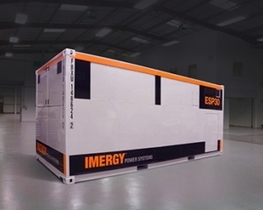
Imergy Power Systems just introduced its third-generation vanadium flow battery, claiming it offers a low-cost, high-performance energy storage solution for large-scale applications, including peak demand management, frequency regulation and the integration of intermittent renewable energy sources.

The ESP250 has an output power capability of 250 kilowatts and 1 megawatt of energy storage capacity. It’s suited for both short- and long-duration storage, with available energy ranging from two to 12 hours of output duration. The 40-foot batteries (each about the size of two shipping containers) are designed to be deployed individually or linked together for larger-scale projects. […]

Where Imergy has been able to edge out its competitors is on material cost. Vanadium is abundant but expensive to extract from the ground. Imergy has developed a unique chemistry that allows it to use cheaper, recycled resources of vanadium from mining slag, fly ash and other environmental waste.

With this chemistry, the levelized cost of energy for Imergy’s batteries is less than half of any other battery on the market right now, according to Hennessy. Vanadium flow batteries are orders of magnitude cheaper than lithium-ion batteries on a lifetime basis because they can be 100 percent cycled an unlimited number of times, whereas lithium-ion batteries wear down with use, according to the firm. Despite the compelling cost claims from Imergy, lithium-ion has been the predominant energy storage technology being deployed at this early point of the market. And very few flow batteries are currently providing grid services.

Imergy’s capital costs are lower than every other battery technology except lead-acid, Hennessy added. But he believes the company can hit that mark (roughly $200 per kilowatt-hour) by the end of the year by outsourcing contracts to manufacturing powerhouse Foxconn Technology Group in China. Delivery of the ESP250 is targeted for summer of 2015.

At this price, Imergy says the ESP250 offers an affordable alternative to peaker plants and can help utilities avoid investing more capital in the grid. Some might disagree with the claim that grid-scale storage can compete with fast-start turbines and natural gas prices below $3 per million Btu. But according to Hennessy, it all comes down to the application. Batteries can’t compete with gas at the 50-megawatt scale, but they can compete with gas at the distribution level.

“Batteries that are distributed have a huge advantage over gas, because when you buy gas down at the low end, you’re paying a lot more than $3 to $4 per MMBtu, because you’ve got to pay for all the transmission down to the small end,” he said.

Demand for cost-effective energy storage is growing as intermittent renewables become cheaper and come on-line in higher volumes. GTM Research anticipates the solar-plus-storage market to grow from $42 million in 2014 to more than $1 billion by 2018.

Imergy sees a ripe market in the Caribbean, parts of Africa and India, Hawaii and other places where the LCOE for solar-plus-storage is already competitive. As costs continue to fall, New York, California and Texas will also become attractive markets.”<


See on Scoop.itGreen Energy Technologies & Development

Comments on Improving EPA’s Proposed Clean Power Plan

The summer deadline is approaching for finalizing the Environmental Protection Agency’s first-ever limits on dangerous carbon pollution from the nation’s power plants, and opponents are ratcheting up their complaints….

Source: www.huffingtonpost.com

“> […] Some 1500 mostly coal- and gas-fired power plants spew out more than two billion tons of heat-trapping carbon dioxide each year — 40 percent of the nation’s total. The vast majority of the millions of public comments submitted last fall express strong support for the Clean Power Plan, which as proposed last June starts in 2020 and ramps emissions down gradually over the next decade.

But big coal polluters and their political allies have big megaphones.

Many hope to kill the proposal outright. But for others the back-up agenda is to get the standards weakened and delayed past 2020. Their comments and speeches read like Armageddon is coming if power plants have to start limiting their carbon pollution in 2020 — five years from now. Republican members of the Senate environment committee banged that drum over and over at a hearing last week. As on so many issues, they hope endless repetition will make their story seem true.

The truth is that the standards and timeline EPA proposed last June are quite modest and readily achievable. They can be met without any threat to the reliability of electric power. A new report from the highly respected Brattle Group shows that states can meet the EPA’s proposal “while maintaining the high level of electric reliability enjoyed by U.S. electricity customers.” […]

The plan as proposed in June sets state-by-state targets that, on an overall national basis, would cut power plants’ carbon pollution by 26 percent by 2020 and 30 percent by 2030, when compared to 2005 levels.

We found that with three specific improvements – I’ll describe them below – the plan could achieve 50 percent more carbon pollution reductions (36 percent by 2020 and 44 percent by 2030).

Here are the three factors:

First, the costs of clean energy are falling dramatically, and EPA’s June proposal was based on out of date cost and performance data for renewable electricity and efficiency energy. An NRDC issue brief published last fall details how sharply the cost and performance of energy efficiency and renewable energy have improved. When we factored in up-to-date data, our analysis shows that the Clean Power Plan’s state-by-state targets as proposed in June 2014 can be met at a net savings to Americans of $1.8-4.3 billion in 2020 and $6.4-9.4 billion in 2030. More reliance on energy efficiency and renewables will also create hundreds of thousands of good-paying jobsthat can’t be shipped overseas.

The lower cost of clean energy technologies opens the door to getting substantially more carbon pollution reductions from the nation’s largest emitters.

We also took two other specific improvements into account:

In an October 2014 notice seeking further public comment, EPA explained that the formula it had used to calculate state targets in the June 2014 proposal did not correctly account for the emission reductions made by renewables and energy efficiency. The formula did not fully account for the reduction in generation at coal and gas power plants that occurs when additional renewables are added to the grid and when businesses and homeowners reduce how much electricity they need by improving the efficiency of our buildings, appliances, and other electricity-using equipment. NRDC corrected the formula in our updated analysis to capture the full emission reduction associated with ramping up renewables and efficiency.EPA also asked for comment on an approach to better balancing state targets by adopting a minimum rate of transition from older high-emitting generation to lower-emitting sources. NRDC analyzed state targets that include conversion of 20 percent of coal generation in 2012 to natural gas generation over the period between 2020 and 2029.

These three factors — updating the cost and performance data for renewables and efficiency, correcting the target-setting formula, and including a minimum rate of transition from higher- to lower-emitting plants — produce the substantial additional carbon pollution reductions in our analysis, all at very reasonable costs. […]”<


See EPA’s Clean Power Plan:  http://www2.epa.gov/carbon-pollution-standards/clean-power-plan-proposed-rule


See on Scoop.itGreen & Sustainable News

Clean Power Plan Seen as Historic Opportunity to Modernize the Electrical Grid

Following the launch of the Clean Power Plan, concerns were raised about how adding renewable energy to the grid would affect reliability. According to a new report […] compliance is unlikely to materially affect reliability.


image source:  http://phys.org/news/2010-10-electric-grid.html

Source: domesticfuel.com

>”[…] Report lead author Jurgen Weiss PhD, senior researcher and lead author said that while the North American Electric Reliability Corporation (NERC) focused on concerns about the feasibility of achieving emissions standards with the technologies used to set the standards, they did not address several mitigating factors. These include:

The impact of retiring older, inefficient coal plants, due to current environmental regulations and market trends, on emissions rates of the remaining fleet;Various ways to address natural gas pipeline constraints; andEvidence that that higher levels of variable renewable energy sources can be effectively managed.

“With the tools currently available for managing an electric power system that is already in flux, we think it unlikely that compliance with EPA carbon rules will have a significant impact on reliability,” reported Weiss.

In November 2014, NERC issued an Initial Reliability Review in which it identified elements of the Clean Power Plan that could lead to reliability concerns. Echoed by some grid operators and cited in comments to EPA submitted by states, utilities, and industry groups, the NERC study has made reliability a critical issue in finalizing, and then implementing, the Clean Power Plan. These concerns compelled AEE to respond to the concerns by commissioning the Brattle study.

“We see EPA’s Clean Power Plan as an historic opportunity to modernize the U.S. electric power system,” said Malcolm Woolf, Senior Vice President for Policy and Government Affairs for Advanced Energy Economy, a business association. “We believe that advanced energy technologies, put to work by policies and market rules that we see in action today, will increase the reliability and resiliency of the electric power system, not reduce it.  […]”<

See on Scoop.itGreen Energy Technologies & Development

Apple to Invest $2 Billion in Solar Farm Powered Data Center Renovation in Arizona

Apple plans to invest $2 billion to build a data center in Arizona in the location where its failed sapphire manufacturing facility exists, the state announced Monday.

Source: blogs.wsj.com

“> […] The company plans to employ 150 full-time Apple staff at the Mesa, Arizona, facility, which will serve as a command center for its global network of data centers. In addition to the investment for the data center, Apple plans to build a solar farm capable of producing 70-megawatts of energy to power the facility.

Apple’s investment is expected to create up to 500 construction jobs as well, the state said.

Apple said it expects to start construction in 2016 after GT Advanced Technologies Inc., the company’s sapphire manufacturing partner, clears out of the 1.3 million square foot site. The $2 billion investment is in addition to the $1 billion that Apple had earmarked to build scratch-resistant sapphire screens at the same location.

The investment comes a few months after GTAT filed for bankruptcy protection in October, citing problems with the Arizona facility. Shortly after its bankruptcy filing, GTAT said it planned to lay off more than 700 employees in Arizona.

In October 2013, Apple had agreed to build a sapphire factory in Mesa that GTAT was going to operate. At the time, Apple had said the new factory was going to create 2,000 jobs and move an important part of its supply chain to the U.S.

However, the project struggled to produce a consistent level of sapphire at the quality demanded by Apple. In the end, Apple did not use sapphire from the facility for its latest iPhones. After GTAT’s bankruptcy, Apple has said it was seeking ways to preserve the jobs lost at the Mesa facility.

Arizona’s governor said the state did not provide additional financial incentives to keep Apple in the state. For the original investment in 2013, Arizona provided $10 million to Apple to sweeten the deal for the company.”<

See on Scoop.itGreen & Sustainable News

Renewable Energy Provides Half of New US Generating Capacity in 2014

According to the latest “Energy Infrastructure Update” report from the Federal Energy Regulatory Commission’s (FERC) Office of Energy Projects, renewable energy sources (i.e., biomass, geothermal, hydroelectric, solar, wind) provided nearly half (49.81 percent – 7,663 MW) of new electrical generation brought into service during 2014 while natural gas accounted for 48.65 percent (7,485 MW).


Image source:  http://usncre.org/

Source: www.renewableenergyworld.com

>” […] By comparison, in 2013, natural gas accounted for 46.44 percent (7,378 MW) of new electrical generating capacity while renewables accounted for 43.03 percent (6,837 MW). New renewable energy capacity in 2014 is 12.08 percent more than that added in 2013.

New wind energy facilities accounted for over a quarter (26.52 percent) of added capacity (4,080 MW) in 2014 while solar power provided 20.40% (3,139 MW). Other renewables — biomass (254 MW), hydropower (158 MW), and geothermal (32 MW) — accounted for an additional 2.89 percent.

For the year, just a single coal facility (106 MW) came on-line; nuclear power expanded by a mere 71MW due to a plant upgrade; and only 15 small “units” of oil, totaling 47 MW, were added.

Thus, new capacity from renewable energy sources in 2014 is 34 times that from coal, nuclear and oil combined — or 72 times that from coal, 108 times that from nuclear, and 163 times that from oil.

Renewable energy sources now account for 16.63 percent of total installed operating generating capacity in the U.S.: water – 8.42 percent, wind – 5.54 percent, biomass – 1.38 percent, solar – 0.96 percent, and geothermal steam – 0.33 percent.  Renewable energy capacity is now greater than that of nuclear (9.14 percent) and oil (3.94 percent) combined.

Note that generating capacity is not the same as actual generation. Generation per MW of capacity (i.e., capacity factor) for renewables is often lower than that for fossil fuels and nuclear power. According to the most recent data (i.e., as of November 2014) provided by the U.S. Energy Information Administration, actual net electrical generation from renewable energy sources now totals a bit more than 13.1 percent of total U.S. electrical production; however, this figure almost certainly understates renewables’ actual contribution significantly because EIA does not fully account for all electricity generated by distributed renewable energy sources (e.g., rooftop solar).

Can there any longer be doubt about the emerging trends in new U.S. electrical capacity? Coal, oil, and nuclear have become historical relics and it is now a race between renewable sources and natural gas with renewables taking the lead.”<

See on Scoop.itGreen & Sustainable News

Determining the True Cost (LCOE) of Battery Energy Storage

The true cost of energy storage depends on the so-called LCOE = Round-trip efficiency + maintenance costs + useful life of the energy system

Source: www.triplepundit.com

By Anna W. Aamone

“With regard to [battery] energy storage systems, many people erroneously think that the only cost they should consider is the initial – that is, the cost of generating electricity per kilowatt-hour. However, they are not aware of another very important factor.

This is the so-called LCOE, levelized cost of energy(also known as cost of electricity by source), which helps calculate the price of the electricity generated by a specific source. The LCOE also includes other costs associated with producing or storing that energy, such as maintenance and operating costs, residual value, the useful life of the system and the round-trip efficiency. […]

Batteries and round-trip efficiency

[…] due to poor maintenance, inefficiencies or heat, part of the energy captured in the battery is released … or rather, lost. The idea of round-trip efficiency is to determine the overall efficiency of a system (in that case, batteries) from the moment it is charged to the moment the energy is discharged. In other words, it helps to calculate the amount of energy that gets lost between charging and discharging (a “round trip”).

[…] So, as it turns out, using batteries is not free either. And it has to be added to the final cost of the energy storage system.

Maintenance costs

[…] An energy storage system requires regular check-ups so that it operates properly in the years to come. Note that keeping such a system running smoothly can be quite pricey. Some batteries need to be maintained more often than others. Therefore when considering buying an energy storage system, you need to take into account this factor. […]

Useful life of the energy system

Another important factor in determining the true cost of energy storage is a system’s useful life. Most of the time, this is characterized by the number of years a system is likely to be running. However, when it comes to batteries, there is another factor to take into account: use. […]

More often than not, the life of a battery depends on the number of charge and discharge cycles it goes through. Imagine a battery has about 10,000 charge-discharge cycles. When they are complete, the battery will wear out, no matter if it has been used for two or for five years.

[…] [However] flow batteries can be charged and discharged a million times without wearing out. Hence, cycling is not an issue with this type of battery, and you should keep this in mind before selecting an energy storage system. Think twice about whether you want to use batteries that wear out too quickly because their useful life depends on the number of times they are charged and discharged. Or would you rather use flow batteries, the LCOE of which is much lower than that of standard batteries?

So, what do we have so far?

LCOE = Round-trip efficiency + maintenance costs + useful life of the energy system.

These are three of the most important factors that determine the LCOE. Make sure you consider all the factors that determine the true cost of energy storage systems before you buy one.

Image credit: Flickr/INL”

See on Scoop.itGreen Energy Technologies & Development