U.S. Nuclear Power waning: A history of Failures

See on Scoop.itGreen & Sustainable News

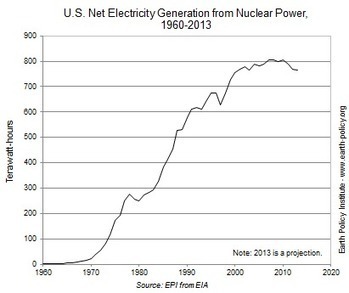
By J. Matthew RoneyNuclear power generation in the United States is falling. After increasing rapidly since the 1970s, electricity generation at U.S. nuclear plants began to grow more slowly in the…

Duane Tilden‘s insight:

>Of the 253 reactors that were ordered by 1978, 121 were canceled either before or during construction, according to the Union of Concerned Scientists’ David Lochbaum. Nearly half of these were dropped by 1978. The reactors that were completed—the last of which came online in 1996—were over budget three-fold on average.

By the late 1990s, 28 reactors had permanently closed before their 40-year operating licenses expired. […]

In 2012, the U.S. Nuclear Regulatory Commission (NRC) approved four new reactors for construction, two each at the Vogtle plant in Georgia and the Summer plant in South Carolina. These reactors are all of the same commercially untested design, purportedly quicker to build than previous plants. Both projects benefit from fairly new state laws that shift the economic risk to ratepayers. These “advanced cost recovery” laws, also passed in Florida and North Carolina, allow utilities to raise their customers’ rates to pay for new nuclear plants during and even before construction—regardless of whether the reactors are ever finished.

Construction at both sites began in March 2013. Even as the first concrete was poured at the $14-billion Vogtle project, it was reportedly 19 months behind schedule and more than $1 billion over budget. The Summer project, a $10 billion endeavor, also quickly ran into problems. […] With these delays, the earliest projected completion date for any of these reactors is some time in late 2017. […]

This year has also already witnessed the permanent shutdown of four reactors totaling 3.6 gigawatts of capacity. The first to fall was Duke’s Crystal River reactor in Florida. Although the plant was licensed to run until 2016, Duke decided to close it rather than pay for needed repairs. Then Dominion Energy’s 39-year-old Kewaunee reactor in Wisconsin closed, citing competition from low gas prices. It had recently been approved to operate through 2033. And in June, Southern California Edison shuttered its two San Onofre reactors after 18 months of being offline due to a leak in a brand new steam generator. These retirements leave the United States with 100 reactors, averaging 32 years in operation. (France is second, with 58 reactors.)

More closures will soon follow, particularly among the roughly half of U.S. reactors in so-called merchant areas […]

Dealing with nuclear waste is another expensive proposition. Over the past 30 years, the U.S. government has spent some $15 billion trying to approve a central repository for nuclear waste, and for most of that time the only site under consideration has been Nevada’s Yucca Mountain. Amid concerns about the site’s safety and its extreme unpopularity in Nevada, the Obama administration has moved to abandon the project entirely and explore other options.

A federal appeals court ruled in August 2013 that the NRC must resume reviewing the site’s suitability. In the meantime, the waste keeps accumulating. The 75,000 tons of waste now stored at 80 temporary sites in 35 states is projected to double by 2055. […]

See on grist.org

Virtual Energy Audits: The Next Big Thing in Buildings?

See on Scoop.itGreen Building Operations – Systems & Controls, Maintenance & Commissioning

Virtual energy audits use software to collect meter data, weather information, etc. and algorithms to develop energy efficiency recommendations.

Duane Tilden‘s insight:

>The goal of any energy audit is to identify savings by analyzing data, determining how and where a building is using energy, and then providing operational and capital energy efficiency measures that improve overall performance.

A traditional ASHRAE Level II Audit includes a manual inspection of data related to a facility’s Building Envelope, Lighting, Heating, Ventilation, and Air Conditioning (HVAC), Domestic Hot Water (DHW), Plug Loads, and Compressed Air and Process Uses (for manufacturing, service, or processing facilities). Analysis is conducted to quantify baseloads and account for seasonal variation. A Level II Audit will also include an evaluation of lighting, air quality, temperature, ventilation, humidity, and other conditions that may affect energy performance and occupant comfort. The process also includes detailed discussions with the building owners, managers, and tenants – there is a lot you can learn just by talking to people about what they think is working and not, what the financial objectives of the organization are, and how that should feed into the recommendations.  […]

Ok, I get it: So what’s a virtual energy audit?

Essentially a virtual energy audit is much like a traditional audit: the goal is to synthesize a whole bunch of data and come up with a list of recommendations that are going to deliver you the biggest bang for your buck. Unlike a detailed ASHRAE Level II audit, it’s better to think of virtual audits as delivering against the 80/20 rule. For a lot less physical effort, it’s going to get you about 80% of the detailed insights that a traditional ASHRAE Level II energy audit would deliver. And for many organizations, that’s OK – because their biggest, most obvious energy hogs are the ones driving the biggest bills at the end of the month.<

See on energysmart.enernoc.com

Are current batteries cost effective for wind and solar power storage on the grid?

See on Scoop.itGreen Energy Technologies & Development

Renewable energy holds the promise of reducing carbon dioxide emissions. But there are times when solar and wind farms generate more electricity than is needed by consumers.

Duane Tilden‘s insight:

>”We calculated how much energy is used over the full lifecycle of the battery – from the mining of raw materials to the installation of the finished device,” Barnhart said. “Batteries with high energetic cost consume more fossil fuels and therefore release more carbon dioxide over their lifetime. If a battery’s energetic cost is too high, its overall contribution to global warming could negate the environmental benefits of the wind or solar farm it was supposed to support.” […]

In addition to batteries, the researchers considered other technologies for storing renewable energy, such as pumped hydroelectric storage, which uses surplus electricity to pump water to a reservoir behind a dam. Later, when demand for energy is high, the stored water is released through turbines in the dam to generate electricity. […]

Storage is not the only way to improve grid reliability. “Energy that would otherwise be lost during times of excess could be used to pump water for irrigation or to charge a fleet of electric vehicles, for example,” Dale said.

See on phys.org

Geothermal Energy: Iceland could provide renewable energy to the UK

See on Scoop.itGreen & Sustainable News

Under plans currently being discussed by both the UK and Icelandic governments, renewable electricity could be provided by Iceland to the UK at a cheaper cost than offshore wind.

Duane Tilden‘s insight:

>The plans being discussed by the two governments concern a 1,000km undersea cable with a capacity of 1GW. The package is worth an estimated £4 billion with the inclusion of related generation and onshore transmission investments and could be operational by 2022.  […]


At present, Iceland benefits from some of the lowest electricity prices in Europe given that much of their renewable energy comes from hydroelectricity and geothermal. […] the interconnector could provide power to the UK at around 60 to 70 percent of the price of offshore wind and that whichever way you look at it there are big potential benefits. However, in order to be successful, the Icelandic government must also convince their own citizens that there are also benefits for Iceland and there are concerns that exposure to a larger market could increase domestic energy prices.<

See on www.renewableenergymagazine.com

Net Energy Metering Policies Helping To Spur Solar Growth

See on Scoop.itGreen Building Design – Architecture & Engineering

All across the United States, rooftop solar panels are popping up on homes, businesses and schools like mushrooms in a forest, and utility-scale solar projects are bringing huge amounts of clean energy into our communities.  Why?

Duane Tilden‘s insight:

>Today, smart policies — likeRenewable Portfolio Standards (RPS) and Net Energy Metering (NEM) — are helping to fuel solar’s explosive growth. Our industry now employs 120,000 Americans at 5,600 U.S. companies. What’s more, we’re now generating enough electricity to power more than 1.5 million homes…

Part of this amazing success story can also be attributed to the fact that the average cost of a solar system has dropped by nearly 40 percent over the past two years and by a whopping 50 percent since 2010.  As a result, American consumers, businesses and schools are flocking to rooftop solar.  According to the most recent statistics, the residential market alone grew by 48 percent in the second quarter of 2013 compared to the same time period a year ago. […]

NEM has significantly contributed to this growth.  Simply put, NEM is a credit on your bill that represents the full value of electricity delivered.  Think of it this way: surplus energy generated by a home or business system is exported to the electricity grid, allowing a consumer’s meter to spin backwards.  This allows the homeowner or business owner to have greater control over their energy use and prices.  […]”<

See on www.renewableenergyworld.com

Monitoring Motivates Less Electricity Use

See on Scoop.itGreen & Sustainable News

Researchers found that families that were simply told they were in a study to track electricity use reduced electricity use more than 2.5 percent.

Duane Tilden‘s insight:

>The general phenomenon is called the Hawthorne effect: study subjects change their behavior because they’re being observed. So researchers collaborated with a utility to test for the Hawthorne effect in electricity use.

They monitored almost 5,600 randomly selected households. Half received a postcard saying that their energy use would be monitored for a month for research purposes. They also got four follow-up reminder postcards over the month. They received no other information, instructions or incentives.

The control group monitored for the study got no notifications. That group continued using the same amount of electricity. But the families being tracked reduced energy use 2.7 percent. And when the study period ended, their energy use shot back up. The report is in the Proceedings of the National Academy of Sciences. [Daniel Schwartz et al., The Hawthorne effect and energy awareness]<

See on www.scientificamerican.com

Supply of Renewable Wind Power Surges in Texas with some Plant Closures

See on Scoop.itGreen & Sustainable News

Market Upheaval In the U.S., hydraulic fracturing techniques used to drill shale have produced a flood of cheap natural gas. That, combined with the growth in wind and tepid customer demand, is upending power markets, leading to plant closures and bankruptcy for some generator owners.

Duane Tilden‘s insight:

>Traditional power companies across the U.S. and Europe are struggling to compete in wholesale markets with newer generators supplying subsidized wind and solar energy. In Texas, wind has more than doubled in the past six years and now makes up 13 percent of the state’s generation capacity.[…]

Falling Prices – Electricity prices for 2014 also have fallen. The on-peak North Texas power price for next year has dropped 19 percent since reaching a peak on May 23, according to data compiled by Bloomberg.

During a heat wave in the first week of August, ample wind supplies served to keep a lid on prices that would’ve normally spiked from the higher demand, NRG Chief Executive Officer David Crane said during a call with investors on Aug. 9. “Wind energy reduces electricity prices and that is good for consumers,” said Michael Goggin, an analyst for the American Wind Energy Association, an industry trade group. “Wind energy has no fuel costs, allowing it to replace more expensive and polluting sources of energy.”

Once complete, Oncor’s power lines will be part of a system that can eventually deliver about 18,500 megawatts of wind power, nearly double the amount now available in Texas and 25 percent of the state’s current generation capacity.<

See on www.renewableenergyworld.com

Coal Power Plants to be retired – Duke Energy Settles Edwardsport air permit Dispute

See on Scoop.itGreen & Sustainable News

Duke Energy Corp. said it reached a settlement with the a handful of environmental and activist organizations over outstanding issues with the.

Duane Tilden‘s insight:

>The Indiana Department of Environmental Management issued the new Knox County, Ind., plant’s air permits in 2008, and- -under the settlement with the Sierra Club, Citizens Action Coalition, Save the Valley and Valley Watch–they remain approved with no changes. The dispute centered on technical issues surrounding the permits that enabled the company to build and operate the plant, the company said.

The settlement also addresses deadlines for retiring units at Duke’s Wabash River Station in Vigo County, Ind. Prior to the settlement, the company had said it planned to retire four, 1950s-vintage units totaling 350 megawatts at the station by the 2015 federal mercury rule deadline. In the agreement, the company agreed to finish the retirements by the compliance deadline or, if the mercury rule is vacated or delayed, by June 1, 2018, whichever comes first.

Duke also had been exploring converting another unit at the Wabash station to natural gas, and, under the settlement, the company agreed to cease burning coal at that 318-megawatt unit by June 1, 2018. The deadline won’t prevent Duke Energy from converting the unit to natural gas earlier.

The settlement also includes a commitment to pursue additional green energy sources.<

See on www.nasdaq.com

Are developing Microgrids the Answer to supply next generation Electricity Markets?

See on Scoop.itGreen & Sustainable News

Managing the effect of intermittent renewables on the grid is one of the critical challenges we address in making the transition to renewables. One of the primary goals of grid modernization (aka “Smart Grid”) is to adapt grid management to account for the effects of intermittency in real time.

Duane Tilden‘s insight:

>Microgrids are one possible solution to these challenges. Microgrids, part of the Smart Grid toolbox, are autonomously managed and powered sections of the distribution grid that can be as small as a single building, or as large as a downtown area or neighborhood. Automation and digital communications are used to manage rooftop solar, small scale combined heat and power systems and storage systems, along with matching supply to demand.  Heating or cooling may also be a part of a microgrid. Microgrids can efficiently manage smaller sections of the grid, according to the local demand patterns and availability of renewable resources. They can also disconnect, or “island” from the larger grid to provide higher reliability.

Can microgrids reduce complexity and increase options for electricity market participants? What are the major barriers to microgrid implementation, and how might they be overcome? Are there other approaches, besides the microgrid, that might be employed as well?<

See on www.ourenergypolicy.org

Proliferation of wireless devices and networks detrimental to environment

See on Scoop.itGreen & Sustainable News

Cloud computing should be driving sustainable development, but its turning us into energy consuming monsters, write Stuart Newstead and Howard Williams

Duane Tilden‘s insight:

>There is a familiarity and comfort in our almost-everywhere connection to always-on communications networks and to the ever-increasing array of services they deliver us. We don’t just consume these network services directly, they give us what economists call “options” – options to connect, options to seek out new services, options to find new information. Clearly we don’t use this network services 24/7, but we value highly the options for instantaneous and simultaneous access at any time.

Cloud-based applications – those stored and managed by massive data centres run by the likes of Amazon, Google, Facebook or Apple – are providing step changes in the financial and environmental efficiency of delivering these services. But the centralising power of the cloud has its corollary in the dispersing effect of wireless networks and devices.

In wireless networks and devices we see fragmentation, duplication and a fundamental shift from mains power and green sources of energy to battery powered always-on devices. In environmental terms here lies the rub. Rather than the “aggregation of marginal gains” (the Sir Dave Brailsford strategy that has propelled success in British cycling), in which lots of tiny improvements add up to a large visible improvement, we are witnessing the aggregation of environmental disadvantages from billions of low-powered but fundamentally energy-inefficient antennas and devices providing the ‘last metre’ connectivity to global networks.

Wireless networks and devices, technologies that should drive sustainable development, are turning into energy-consuming monsters.<

See on www.theguardian.com