Built in 1928 Chicago Apartment Building Energy Retrofit Achieves EPA Energy Star Certification

To say the 55-unit building in Chicago’s South Shore neighborhood was in disarray when it was changing hands in 2009 would be an understatement.

Source: www.chicagotribune.com

>” […] the building is among the first in the Midwest — and only three in Chicago — to achieve the Environmental Protection Agency’s new Energy Star certification for multifamily buildings. Also receiving the designation were two condominium buildings in Chicago, 680 N. Lake Shore Drive and River City, at 800 S. Wells.

[…] Jeffery Parkway also stands as an example of how an older, smaller, affordable apartment building can be made more comfortable for its tenants while saving its owner cash in the long run.

Seeking a neutral third party to help them figure out the entire scope of a rehab project, the Soods obtained a free energy audit of the building and its systems from Elevate Energy, a Chicago-based nonprofit that works with consumers and businesses to improve energy efficiency.

Elevate looks at historical analyses of a building’s energy use and compares it with similar buildings in terms of age and size. Then it performs an on-site performance assessment of the existing heating, cooling and lighting systems and makes recommendations for potential improvements. […]

“The average cost of a retrofit is about $2,500 to $3,000 a unit,” Ludwig said. “We’re not talking about huge-ticket items. A lot of times we are trying to identify the most cost-effective retrofit measures, how can we tighten the building envelope. It doesn’t have to mean a new boiler is going in the basement.”

However, in the case of Jeffery Parkway, it did mean a new steam boiler and new water heaters, among other upgrades.

The project was financially feasible because of a loan from nonprofit Community Investment Corp.’s Energy Savers loan program, which offers a seven-year loan with a 3 percent fixed interest rate for qualified upgrades made to buildings in the seven-county Chicago area and Rockford. […]

“We will cover any of the recommendations that show up in the energy assessment, and we’ll also do other energy-related improvements,” said Jim Wheaton, manager of the Energy Savers program. “This is not a program designed for the North Lake Shore Drive high-rise. It’s designed for buildings affordable for working folks.”

Multifamily buildings receive an Energy Star score of 1 to 100, and those that score above 75 can apply for the certification. Nautilus’ building received a score of 99.

“The savings are tremendous,” Sandeep Sood said. “We were facing, just on the gas bill, a $60,000 bill a year. As of last year, our bill was $18,000. It was an unbelievable savings.” […]”<

See on Scoop.itGreen Building Operations – Systems & Controls, Maintenance & Commissioning

ACEEE Recommends Demand Response as a Strategy to Conquer Peak Demand for Utilities

By Steven Nadel

” … a potential emerging trend that could have a large impact on many utilities: the reduction of the traditional mid-afternoon peak, and the growth of an evening peak. (Peak is the time when demand for power is highest.)”

Source: aceee.org

>” […] In many regions, evening peaks have been growing, as more consumers install air conditioners and operate them when they get home from work. But two other factors are augmenting this trend. First and foremost is the growth in consumer-owned photovoltaic systems. These systems generate the most power on sunny afternoons, which is about when the traditional early afternoon peak occurs. But when the sun goes down, extra power is quickly needed to replace this solar power.  […]

There are many ways to address the growing evening peak, including the following:

  1. Energy efficiency, particularly measures that reduce the evening peak such as efficient lamps, water heaters, stoves and ovens.
  2. Smart controllers that minimize energy use during the evening peak. To provide just one example, a smart refrigerator would not turn on the defrost cycle during this period and might even turn off the main compressor for a few minutes.
  3. Likewise, smart charging systems for electric vehicles could be used, such as a new system recently demonstrated by the Electric Power Research Institute (EPRI), working with a consortium of utilities and auto manufacturers.
  4. Expanded use of demand-response programs to lower the new peak (and coordination of these efforts with energy efficiency programs).
  5. Time-of-use rates and/or demand charges that raise the price of power use during peak times and a lower them at off-peak times.
  6. Use of energy storage at a system, community, or end-user level. Storage able to provide power for several hours could be very useful.Fast ramp-up generation to serve the evening peak and other times when renewable energy production plummets, for example when the wind dies down. Hydro is ideal, but fast ramp-up gas units are now entering the market.

In my opinion, the time of the peak will change in many regions. The shift will be gradual in most areas, so we have time to address it. Rather than trying to stop this change by restricting photovoltaic systems, we’ll be better off figuring out how to manage it, […]”<

See on Scoop.itGreen Energy Technologies & Development

‘Demand Response’ is ‘Disruptive Technology’ Shutting Down Power Plants

FirstEnergy Corp. has a traditional view of wholesale electricity markets: They’re a competition between iron-in-the-ground facilities that can put megawatts on the grid when those megawatts are needed. Think coal plants, nuclear reactors and hydroelectric dams. Missing from the definition is a consumer’s promise to turn off the lights when the grid is stressed — so-called demand response. Instead of creating energy during peak times, demand response resources conserve it, freeing up megawatts […]

Source: powersource.post-gazette.com

>” […]The idea is not new and has been expanding in the territory of PJM Interconnection, a Valley Forge-based grid operator that manages the flow of electricity to 13 states, including Pennsylvania.

FirstEnergy, which owns power plants and utility companies across several states, wants PJM to abandon the demand response concept.

The Ohio-based energy company says demand response, which doesn’t require any kind of capital commitment, is “starving” traditional generation out of its rightful revenue in wholesale markets.

“We feel that it’s going to lead to even more premature closures of power plants,” said Doug Colafella, a spokesman for the firm.

Specifically, FirstEnergy is fighting to get demand response kicked out of PJM’s annual capacity auction, which ensures there’s enough electricity resources to meet projected power demand three years in advance. The auction establishes a single clearing price that will be paid to all successful bidders, like a retainer fee, in exchange for their promise to be available to be called upon three years from now.

During the May auction, which set capacity prices for the 2017-2018 year, the clearing price was $120 a day for each megawatt of electricity bidders committed. About 6 percent, or about 11,000 megawatts, of the capacity secured came from demand response.

FirstEnergy’s Bruce Mansfield coal-fired power plant in Beaver County failed to clear the auction. The company has since postponed upgrades to the facility, which could jeopardize its functioning beyond 2016.

Capacity payments are a stable source of revenue for baseload generation plants, Mr. Colafella said, and a price signal to the market about which way demand is headed, giving generators some indication about whether new facilities will be necessary and profitable.

Demand response distorts that dynamic, he said.

Since May, FirstEnergy has intensified its efforts to drive demand response out of PJM’s markets, having seized on a related court case involving the Federal Energy Regulatory Commission.

“FirstEnergy’s business model is that electricity consumption has been flattening, so they want to take a larger share of the market and how do you take a larger share? You bulldoze everybody out,” said Mei Shibata, CEO of The Energy Agency, a marketing and communications firm and co-author of a recent report on the market for demand response in the U.S. for GreenTech Media Research.

In May, the D.C. Circuit Court vacated a rule created by the Federal Energy Regulatory Commission in 2011 that said demand response should be treated the same way as power plants in wholesale energy markets. That meant demand response providers could offer to shut down a day in advance, when grid operators book electricity for the following day, and get the same price as megawatts from generation.

An electric power industry group sued the FERC claiming that the call to shut off electricity in exchange for payment is a retail choice and retail falls exclusively within state jurisdiction, not federal. The court agreed, setting in motion FirstEnergy’s challenge to demand response in capacity markets, which were not addressed by the court decision. If demand response is a retail product in one context, then it’s a retail product in all, the logic goes.

The same day the court issued its decision, FirstEnergy filed a lawsuit asking a judge to order PJM to recalculate the results of its May capacity auction stripping out demand response.

PJM objected. The Pennsylvania Public Utility Commission, which intervened in that case, charged FirstEnergy with “jumping the gun” on its logic and called its proposal an “unprecedented and wholly unnecessary disruption of the capacity market auction process.”

Even if demand response is excluded from the daily wholesale market as the court decision wills, the market for this resource will continue to expand, said Ms. Shibata.

If, however, FirstEnergy succeeds in kicking demand response out of the capacity market, “that would be a much bigger deal,” she said.

PJM leads the nation in demand response resources, according to Ms. Shibata’s research, and anything that happens to demand response at PJM would likely trickle down to the other grid operators around the country. […]”<

See on Scoop.itGreen Energy Technologies & Development

Why Electric Vehicles are not 100% Green

In 2013 Tesla’s [time-stock symbol=TSLA] Model S won the prestigious Motor Trend Car of the Year award. Motor Trend called it “one of the quickest American four-doors ever built.” It went on to say that the electric vehicle “drives like a sports car, eager and agile and instantly responsive.”

Source: time.com

>” […]

The secret behind Tesla’s success

While the power driving Tesla’s success might be its battery, that’s not the real secret to its success. Instead, Tesla has aluminum to thank for its superior outperformance, as the metal is up to 40% lighter than steel, according to a report from the University of Aachen, Germany. That lighter weight enables Tesla to fit enough battery power into the car to extend the range of the Model S without hurting its performance. Vehicles made with aluminum accelerate faster, brake in shorter distances, and simply handle better than cars loaded down with heavier steel.

Even better, pound-for-pound aluminum can absorb twice as much crash energy as steel. This strength is one of the reasons Tesla’s Model S also achieved the highest safety rating of any car ever tested by the National Highway Traffic Safety Administration.

But it’s not all good news when it comes to aluminum and cars.

Aluminum’s dirty side

[…]  Before alumina can be converted into aluminum its source needs to be mined. That source is an ore called bauxite, which is typically extracted in open-pit mines that aren’t exactly environmentally friendly. Bauxite is then processed into the fine white powder known as alumina, and from there alumina is exposed to intense heat and electricity through a process known as smelting, which transforms the material into aluminum.

Aluminum smelting is extremely energy-intense. It takes 211 gigajoules of energy to make one tonne of aluminum, while just 22.7 gigajoules of energy is required to produce one tonne of steel. In an oversimplification of the process, aluminum smelting requires temperatures above 1,000 degrees Celsius to melt alumina, while an electric current must also pass through the molten material so that electrolysis can reduce the aluminum ions to aluminum metals. This process requires so much energy that aluminum production is responsible for about 1% of global greenhouse gas emissions, according to the Carbon Trust.

There is, however, some good news: Aluminum is 100% recyclable. Moreover, recycled aluminum, or secondary production, requires far less energy to produce than primary production, as the […] chart shows. […]”<


See on Scoop.itGreen Energy Technologies & Development

CAN NYC REDUCE ITS CARBON FOOTPRINT 90% BY 2050?

“The building sector is the source of 75 percent of New York City’s greenhouse gas emissions. 90 by 50’s modeling of eight typical building types shows that heating and cooling loads can be reduced through retrofit measures to a point where all thermal loads can be met by heat pumps, eliminating building fuel use. The resulting electric energy used in 2050, supplied by carbon-free sources, will be slightly more than today’s, while peak demand will increase significantly. “

RO Engineers & Architects's avatarRO Engineers & Architects

In an article by urban green council,

“The building sector is the source of 75 percent of New York City’s greenhouse gas emissions. 90 by 50’s modeling of eight typical building types shows that heating and cooling loads can be reduced through retrofit measures to a point where all thermal loads can be met by heat pumps, eliminating building fuel use. The resulting electric energy used in 2050, supplied by carbon-free sources, will be slightly more than today’s, while peak demand will increase significantly. “

How will we meet this goal when there are a number of behavioral, institutional and infrustructural issues?

Let’s name a few…..

  1. The NYC subway still has outdated lighting with T12 with magnetic ballasts
  2. A large # of residential buildings the tenants leave their window a/c units installed year round which results in heat loss
  3. Alternate side parking- numerous places throughout the city people sit and idle their…

View original post 174 more words

The financial case for energy efficiency

“The report, Building the Future, has piled pressure on Ministers to act to fix Britain’s badly insulated homes. The report shows that a much more ambitious energy efficiency investment programme would pay for itself and significantly boost the UK economy.

The programme would add £13.9 billion annually to the UK economy by 2030, with GDP boosted by £3.20 for every £1 invested by the Government. A national scheme to make homes super-energy efficient would result in £8.6 billion in energy savings per year by 2030, an average energy saving of £372 per household. After taking into account loan repayments this would result in £4.95 billion in financial savings per year for Britain’s households.”

Net Zero Energy Buildings at Zero Cost

The Netherlands has found a way to refurbish existing buildings to net zero energy, within a week, with a 30-year builders’ guarantee and no subsidies.

Source: www.energypost.eu

>”Inside the house, the pounding rain stills to distant murmur. That’s thanks to the triple glazing, points out Ron van Erck, enthusiastic member of Platform31, an innovation programme funded by the Dutch government that brings together different actors for out-of-the-box thinking to crack intractable problems. One of its big successes to date is Energiesprong, an initiative that turns the building market on its head to deliver social housing with zero net energy consumption, i.e. no energy bill, at zero cost to the tenant and with no subsidies to the builder.

Starting off in 2010 with three staff, a €50 million budget and five years to come up with something to make buildings more sustainable, Energiesprong today boasts 45 staff and a deal with 27 housing associations and four big construction companies to refurbish 111,000 houses in the Netherlands. Total investment? €6 billion. The initial focus is social housing, but it’s already looking at the private market, care centres and commercial office buildings too.

How does the plan work? The basic trick is that tenants instead of paying their energy bills, pay a similar amount to the housing corporations that own the houses. With this money, the corporations pay building companies to retrofit the houses, which after renovation have net zero energy costs. The building companies have for this project developed ‘industrialised’ renovation procedures that are highly cost-effective. One important difference with existing renovation projects is that all elements that are needed for a successful move to zero-energy housing are brought together  in one plan.

Energy Post’s Sonja van Renssen met with manager Jasper van den Munckhof, to understand exactly what Energiesprong does, how it does it and why it will succeed – in the Netherlands and elsewhere.

Q: What was your starting point?

A: We started off with what we spend. The household energy bill in the Netherlands is about €13 billion. This money is available. If you spent it on a mortgage or payback on a loan of about 30 years [instead of energy], you have €225 billion to invest in the Dutch housing stock. This is substantial money: €30-40,000 per house to make it energy neutral.

“Retrofit wasn’t interesting – unless you were rich – but using the energy bill to fund it, no one had thought of that! A building and its energy system were developed as parallel, complementary but not integrated, entities.”

-Jan Kamphuis, BJW Wonen, a one-stop-shop for retrofits inspired by Energiesprong

The trick is, how to get this money flowing. We tried to imagine what owners would need to start investing. They buy kitchens and they don’t see this as an investment but good for their family. You need to get this focus on people and how they buy stuff, how they accept things. If you lose that focus and think it’s about financial arrangements, you won’t find a solution.

Q: So what will make people spend money on retrofits?

A: It needs to be very well done, like if they buy a car, they buy a decent one. It has to be fast – the problem with retrofitting (vs. buying new stuff) is that it’s usually a lot of trouble, dust and hassle. So we said one, the retrofits have to be done within a week. Two, it has to be affordable: ideally the cost to the tenant before and after should be equal. That means the energy bill converted to the mortgage or extra rent has to cover the full cost of the retrofit. Three, it has to be attractive. It needs to be something you see. […]”<

See on Scoop.itGreen & Sustainable News

Efficient HVAC Systems

Gallery

This gallery contains 15 photos.

Originally posted on Energy Systems & Sustainable Living:
Heating, Ventilation and Air Conditioning systems (HVAC) controls the indoor climate by adding or extracting heat and adding or removing mass (e.g. water vapour and dust). To combat summer heat and winter…

Energy Efficiency Gains, Backfire & The Rebound Effect – A Problem?

“Every few years, a new paper comes out about the rebound effect and the issue receives some short-term attention. (When a consumer or business buys an efficient car or air conditioner, they may use their energy-efficient equipment a little more often or may spend some of their energy bill savings on things that use energy—these are examples of rebound effects.)  […]”

Source: aceee.org

>” […] we found that rebound may average about 20%, meaning that 80% of the savings from energy efficiency programs and policies register in terms of reduced energy use, while the 20% rebound contributes to increased consumer amenities (for example, more comfortable homes) as well as to a larger economy.  […]

E2e, a joint initiative of three universities, released a working paper entitled “The Rebound Effect and Energy Efficiency Policy.” In it, they discuss various types of rebound and ways to analyze it. Much of their data relates to gasoline and oil prices and consumer and market responses to changes in those prices. They find that for developed countries, “most… studies fall […] in the range of 5 to 25 percent” direct rebound effect (where direct captures consumer response but not whole-economy effects). In developing countries, where incomes are lower and impose constraints on miles driven and other energy-consuming behavior, the E2e paper finds the “most common range” is 10-40% demand elasticity (related to but not exactly the same as direct rebound). They also discuss macroeconomic effects, emphasizing studies that show rebound of 11 percent and 21 percent due to economic growth. By way of comparison, the ACEEE paper estimates 10 percent direct rebound on average for the United States, noting the first of the two economic growth studies. In addition, in the case of oil prices, the E2e paper discusses how improvements in fuel economy soften oil prices, which can lead to a 20-30% increase in global oil use due to these price effects. Bottom line: The E2e paper sees modestly higher rebound effects than the earlier ACEEE paper.  […]

Regarding electricity use, Breakthrough discusses how electricity use has risen more quickly than generating plant efficiency has increased. The authors call this backfire, even as they acknowledge that these trends are also affected by rising incomes, urbanization, changes in consumer preferences, and other socioeconomic and demographic trends. They provide no evidence on the relative importance of energy efficiency relative to these other factors. Furthermore, they seem to mix up energy efficiency and economic efficiency.[…]

Breakthrough released their new report with an op-ed in the New York Times. The op-ed goes several steps further than the report. First, applying its claims of lighting backfire from the 1800s, it claims that LED lighting, for which the most recent Nobel Prize in physics was awarded, will increase lighting energy use, particularly in developing countries. As I wrote in a letter to the editor of the Times, LEDs are about six times more efficient than incandescent lamps, so in order to reach the backfire point, the average purchaser would need to increase the amount of lighting they use by a factor of six. While such an increase may well happen among the poorest households in developing countries, it is unlikely to be seen in developed countries, or even among the middle class in developing countries.

The Breakthrough op-ed also claims that the International Energy Agency and the Intergovernmental Panel on Climate Change find that “rebound could be over 50 percent globally.” While technically correct, their claim takes the upper end of the ranges found in recent IEA and IPCC studies. For example, IEA states, “Direct rebound can range from 0% to as much as 65%. However, estimates tend to converge between 10% and 30%.” It would be much more accurate if the institute would cite the full range, instead of looking only at the extreme. Applying that logic, I could argue that IEA supports ACEEE’s 10% direct rebound estimate–at least 10% is within IEA’s most likely range of 10-30%. IPCC estimates get similar treatment from Breakthrough.

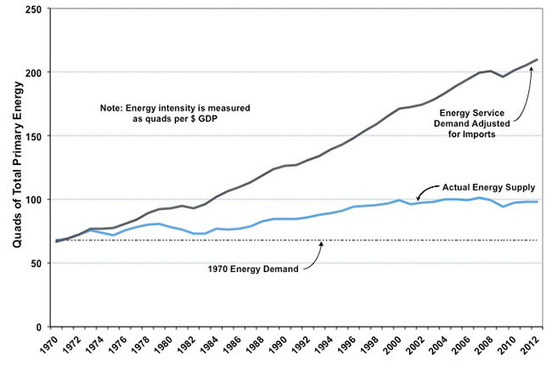
Bottom line: The E2e analysis is very reasonable, but Breakthrough appears to be more interested in exaggerating to make its case, rather than sticking to the facts. The truth is that for 40 years energy efficiency has had a dramatic effect on worldwide energy consumption. In the United States, if we were to use energy today at the rate we were in 1974, we would be consuming more than twice the amount that we are actually using. […]”<


See on Scoop.itGreen & Sustainable News

Multifamily Building Energy Efficiency: SLEEC Financing

This winter, ACEEE, in partnership with Energi Insurance Services, will host a second gathering of select members of the Small Lenders Energy Efficiency Community (SLEEC) in Washington, D.C. The initial SLEEC convening in October 2013 brought together small- to medium-size lenders to discuss strategies for expanding activity in the market for energy efficiency financing. Building off the success of that first meeting, the second SLEEC gathering will focus exclusively on financing in the multifamily sector […]

Source: aceee.org

>” […] The goal of the upcoming SLEEC meeting is to discuss how recent developments inform the lender perspective on the size, attractiveness, and viability of the finance market for multifamily efficiency. We chose to address multifamily this year because potential savings are phenomenal at an estimated $3.4 billion per annum, and multifamily has traditionally been characterized by the label “hard to reach” due to significant barriers to entry. Single-family residential, large commercial, and MUSH (municipal, universities, schools, and hospitals) markets pose fewer barriers and have therefore been easier to approach, while multifamily is a more complex market posing greater obstacles.

The first and most commonly cited obstacle is known as the split-incentive problem: Landlords and building owners don’t always have an incentive to pursue energy efficiency improvements since their tenants would be the ones benefitting from reductions in energy bills. The next most bemoaned roadblocks are a lack of information and lack of available capital. Landlords and owners are experts at running their buildings, but may be in the dark on energy efficiency. Utilities and many loan agencies, while knowledgeable about energy efficiency, lack experience interacting with tenants. The resulting information gap inhibits energy efficiency projects from getting off the ground. This problem is exacerbated by a lack of capital, especially in the affordable housing market, where many buildings owners hold 30-year mortgages on their property with only one refinancing opportunity after 15 years. Unless building owners and potential lenders can capitalize on this small window, many projects would not have another opportunity to finance efficiency improvements for another 15 years.

Despite these barriers, there are a number of successful initiatives that are poised for impact. Perhaps the most successful is Energy Savers, a Chicago-based partnership between Elevate Energy and the Community Investment Corporation (CIC) that has retrofitted 17,500 apartments since 2008.  […] Innovative programs such as these are paving the way for energy efficiency in the multifamily housing market.

A perceived lack of capital may be attributable to issues surrounding the valuation of energy efficiency from a building owner’s perspective that manifests as low demand. […] “<


See on Scoop.itGreen Building Design – Architecture & Engineering