Thermoelectric Solid-State Cooling Technology Wins $44.5M Funding

The near-term applications for Phononic’s science are high-end refrigeration for labs and medical facilities, as well as cooling for fiber optics and data servers that are “necessary to continue Moore’s law,” according to the company.

Source: www.greentechmedia.com

>” […] The 75-employee Phononic develops thermoelectrics — materials that can convert a temperature gradient to a voltage or vice versa. The technology is a brilliant pursuit, but no one has brought it to mass markets economically or at scale just yet. Traditional thermoelectrics use materials such as bismuth telluride or silicon germanium, and more recently, silicon nanowires.

[…] Phononic is looking to develop thermal management technology for consumer devices, and, more strikingly, to replace cheap, ubiquitous and century-old incumbent compressor technology.

CEO Anthony Atti told us this morning that the investment thesis around Phononic is that “semiconductors have revolutionized IT and LEDs, but have not had that same impact on cooling and heating.” He notes that Phononic’s thermoelectric technology is in the realm of Peltier cooling technology, but addresses three major shortcomings of that technology: efficiency, ability to scale, and ease of integration. […]

Atti claims that the compound semiconductor material used in his firm’s thermoelectrics can be manufactured using high-volume, standard semiconductor tools and equipment.

Bruce Sohn, the former president of First Solar, is on the board at Phononic. When we spoke with him this morning, he told us that he had been working with the firm for four years and believes the startup is doing something “revolutionary that can do to compressors what the [integrated circuit] did to the vacuum tube.”

Other companies developing thermoelectric technologies for cooling or capturing waste heat include the following:

  • Alphabet Energy is commercializing thermoelectric waste-heat harvesting technology developed at Lawrence Berkeley National Laboratory and has raised more than $30 million from Encana, a developer of natural gas and other energy sources,
  • TPG Biotech, Claremont Creek Ventures, and the CalCEF Clean Energy Angel Fund.GMZ Energy, spun out of MIT with funding from KPCB, BP Alternative Energy, and Mitsui Ventures, is working on a bismuth-telluride thermovoltaic device that converts solar heat directly into power via the Seebeck effect. In the Seebeck effect, a sharp temperature gradient can result in an electric charge.
  • MTPV describes its product as a thermophotovoltaic. MTPV uses a silicon-based MEMS emitter which takes heat and transfers radiation to a germanium-based photovoltaic device, according to an article inSemiconductor Manufacturing and Design. The company just raised $11.2 million led by Northwater Capital Management’s Intellectual Property Fund, along with Total Energy Ventures, SABIC, the Saudi Basic Industries Corporation, and follow-on investments from Spinnaker Capital, Ensys Capital, the Clean Energy Venture Group and other existing shareholders.
  • Silicium, funded by Khosla Ventures, is investigating high ZT thermoelectrics. The firm’s website claims, “Silicium is developing silicon thermoelectrics that enable substantially increased battery longevity for wearable electronics. By using body heat, Silicium technology can help power an entire spectrum of wearable devices…using off-the-shelf silicon wafers.
  • “Recycled Energy Development (RED) and Ormat have retrofitted factories to capture waste heat, not using thermoelectrics, but by adding CHP or cogeneration. […]”<

See on Scoop.itGreen Energy Technologies & Development

$200m Demand Management Program Approved in NYC to Defer $1 billion SubStation to 2026

The NYPSC approved Con Ed of New York’s proposed $200 million Brooklyn/Queens Demand Management Program that would relieve overloads in the city.

Source: www.rtoinsider.com

>” […] Con Ed’s proposed Brooklyn/Queens Demand Management Program is consistent with the state’s “Reforming the Energy Vision” program to restructure the electricity market with greater reliance on technology and distributed resources, the commission said. “The commission is making a significant step forward toward a regulatory paradigm where utilities incorporate alternatives to traditional infrastructure investment when considering how to meet their planning and reliability needs,” the order states.

Commission Chair Audrey Zibelman added that because of the recent D.C. Circuit Court of Appeals decision striking down federal jurisdiction over demand response in wholesale markets, it’s important for state regulators to set market rules for that resource.

Con Ed said the feeders serving the Brownsville No. 1 and 2 substations began to experience overloads in 2013 and would be overloaded by 69 MW for 40 to 48 hours during the summer by 2018. A new substation, transmission subfeeders and a switching station would cost $1 billion, according to the company. The PSC accepted the company’s estimate of the DM Program’s costs and ordered a cap of $200 million.

The program would include 52 MW of non-traditional utility-side and customer-side relief, including about 41 MW of energy efficiency, demand management and distributed generation, and 11 MW of utility-side battery energy storage. This will include incentives to upgrade building “envelopes,” improve air conditioning efficiency of equipment, encourage greater use of energy controls, and establish energy storage, distributed generation or microgrids.

This will be supplemented by approximately 17 MW of traditional utility infrastructure investment, consisting of 6 MW of capacitors and 11 MW of load transfers from the affected area to other networks.  […]”<


See on Scoop.itGreen Energy Technologies & Development

Applying Intelligent Efficiency to the Transportation Sector

A new report from ACEEE, Energy Savings from Information and Communications Technologies in Personal Travel,estimates that aggressively incorporating a handful of ICT strategies could reduce energy consumption in transportation by almost 13% by 2030.

Source: aceee.org

>” […] Intelligent efficiency is the use of information and communications technologies (ICT) to improve the overall productivity and efficiency of a given sector.

In transportation, intelligent efficiency can affect the way we travel by providing us with real-time feedback and information on fuel economy, making it easier for us to use alternatives to driving such as public transit and bicycles, and by moving traffic away from peak travel times and consolidating travelers into fewer vehicles.

[…] The strategies discussed in the report include:

  • Car and bike sharing
  • Real-time transit information
  • In-vehicle feedback
  • Vehicle-to-vehicle communications and driver assist applications
  • ICT-based transportation demand management programs (TDM)

The report aims to provide readers with a sense of the relative magnitude of energy savings possible from these strategies, and is by no means a definitive overall estimate. ICT could be incorporated in many additional ways in the transportation sector. The strategies described here are simply the tip of the iceberg when it comes to implementation. Studies from Europe have shown that reductions could be as high as 26% if we consider the whole universe of strategies and options. […]”<

See on Scoop.itGreen Energy Technologies & Development

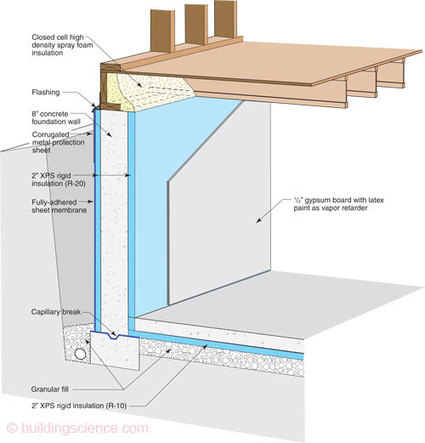
High-R20 Concrete Foundation Construction Diagram – Building Science

This construction strategy has an installed insulation R-value of R-20.

Source: www.buildingscience.com        >” […]


  • Dampproofing
  • 2″ XPS rigid insulation
  • Concrete foundation wall
  • 2″ XPS rigid insulation
  • 2″ XPS rigid sub-slab insulation
  • Gypsum board with vapor retarder paint
  • 2″ XPS rigid insulation under slab

Thermal Control:  This construction strategy has an installed insulation R-value of R-20 and has a predicted annual heating energy loss of 16.7 MBtus.

Moisture Control:  Two inches of XPS on the interior, connected to the thermal break at the slab edge, controls the interior vapor drive and capillary wicking to the interior so there are no moisture related issues from inward vapor diffusion or capillary wicking.

Constructability and Cost:  The interior of the insulated concrete form will require drywall or other thermal barrier to achieve the fire rating required by code. The gypsum board is very easy to attach to the plastic clips designed into the ICF. The drywall should not be painted, if it is not necessary, to allow maximum drying of the concrete. It may be easier and more practical to install a thin framed wall (e.g. 2×3 wood or steel framing) on the interior of the ICF to allow any necessary services to be run in the wall, and potentially more insulation.

Other Considerations:  Because the concrete is installed between two vapor retarding layers, it will take several years for the concrete to dry to equilibrium. Since additional interior vapor control should be avoided, no more than latex paint should be used on the interior surface of the drywall. […]”<


See on Scoop.itGreen Building Design – Architecture & Engineering

Berkeley City Property Owners to Pay For Energy Audits

Later this month, the Berkeley City Council is slated to approve a new law — designed to increase building sustainability and reduce greenhouse gas emissions — that will mandate new fees and recurring energy assessments for local property owners.

Source: www.berkeleyside.com

>” […] The law would require payment of a $79-$240 filing fee, depending on building size, by property owners every 5-10 years. On top of that, property owners will be required to undergo building energy assessments on the same cycle, conducted by registered contractors, to the tune of an estimated $200 for a single-family home and up to $10,000 for large commercial buildings.

The goal of the new law, according to the city, is to make “building energy use information more transparent to owners and prospective renters or buyers,” and ultimately inspire more investment in energy upgrades. The law would replace existing minimum energy and water efficiency measures in Berkeley. The proposed ordinance would not require that upgrades are actually done, but will compile energy scores and summaries for city properties, and make them readily available online.

Explained city sustainability coordinator Billi Romain, “Rather than require a list of specific measures, it requires an evaluation of a building’s efficiency opportunities and identifies all available incentives and financing programs.”

Romain said the hope is that, by giving people a “road map” for potential improvements, they will be more likely to schedule them to fit in with other home projects, such as seismic work. In addition to cutting down on local greenhouse gas emissions, the new ordinance has several other goals, from reducing utility costs that cause local dollars to “leak out” of Berkeley, to creating a more comfortable, durable building stock, as well as fortifying the local “green” workforce. […]

According to a city Energy Commission report on the ordinance, the assessments would take place on a five-year cycle for large buildings and every 8-10 years, or upon sale, for medium-sized and small buildings. Some of the costs may be offset by rebates and other incentives, and the program is set to include temporary “hardship deferrals” for those with financial constraints, and exemptions for high-efficiency buildings (see page 14). […]”<


See on Scoop.itGreen Building Operations – Systems & Controls, Maintenance & Commissioning

Energy Efficiency Key to Reducing Energy Waste and Consumption

Advocates say doing more with less power may be an even more critical weapon in the fight against climate change than renewable technologies.

Source: www.nytimes.com

>” […]

“Some people call energy efficiency low-hanging fruit. I would even say energy efficiency is fruit lying on the ground. We only need to bend over and pick it up.”

Realizing those energy savings would be a huge boon to the climate, ease illness-causing air pollution, reduce many nations’ reliance on fuel imports and increase competitiveness by lowering costs, the advocates say. It creates jobs in fields like upgrading buildings, and is generally cheaper than the alternative of constructing new power plants and buying more energy, they argue. […]”<

See on Scoop.itGreen & Sustainable News

Commercial ORC Used for Waste Heat Recovery on Industrial Electric Arc Furnace

Turboden, a group company of Mitsubishi Heavy Industries, has implemented the first ORC-based heat recovery plant on an Electric Arc Furnace (EAF) in the world

Source: www.pennenergy.com

>” […] The heat recovery system was started up on December 2013. It is connected to the off-gas treatment system of the melting electric furnace. The recovered energy reduces net power consumption, allowing significant CO2 reduction.

In addition to electricity production, the remaining portion of the steam is fed into the Riesa Municipal steam supply system and used in a nearby tire factory production process.

Turboden designs, develops and implements generation plants, allowing reduction of industrial energy consumption and emissions containment through heat recovery from unexploited residual heat streams and exhaust gases in production processes and power plants.

This technology is best applied in energy-intensive industries such as glass, cement, aluminum, iron & steel, where production processes typically generate exhaust gases above 250°C.

These new plants not only provide advantages in terms of environmental sustainability, emissions reduction, increased industrial process efficiency and improved business performance, but they also represent opportunities for increased competitiveness.”<

See on Scoop.itGreen Energy Technologies & Development

Organic Rankine Cycle (ORC) Heat Recovery Technology For Ships

The company has developed a marine Organic Rankine Cycle (ORC) system for waste heat recovery and power generation that could reduce fuel consumption by up to 10%.

Source: www.motorship.com

“> […] Enertime’s ORC system produces between 500kW and 1MW of electrical power depending on the available amount of heat. The unit is based on a tailor-made axial turbine and is specifically designed to work in the marine environment. The development work has involved shipyards, shipowners and a classification society, says Mr David.

“Compared to a steam power cycle, ORC systems need very low maintenance, display good part-load efficiency, high availability and can be operated without permanent monitoring,” he said. “Daily operation and maintenance can be carried out without specific qualification.”

The ORC system can work with any kind of heat source. The unit can recover heat from a number of different sources singly or in combination including low-temperature jacket cooling from engines, steam or thermal oil systems and pressurised hot water. Exhaust gas from engines or auxiliaries is the main available heat on board ships, and it can be collected through an exhaust gas heat exchanger and brought to the ORC unit using steam, pressurised water or thermal oil. […]

The ORC layout is flexible and the unit can also be installed as a retrofit where it is possible to adapt the layout of the machinery to specific constraints by splitting it on different levels, for example.

“This kind of system would be very interesting for bulk carriers, small to medium size oil tankers, ferry boats, small container ships… with payback time between two to five years,” […]”<


See on Scoop.itGreen Energy Technologies & Development

Retro-fit NYC Office Building Achieve’s LEED-EB Gold Rating

A $9 million retrofit that included $1.5 million in improvements that can be directly or indirectly linked to energy and water savings has elevated the building to a select group that includes 1440 Broadway, 498 Seventh Avenue and 345 Hudson Street.

Source: www.rew-online.com

>” […] Built in 1919, the 22-story tower with a block-through arcade of service shops for tenants, has undergone a plethora of changes to improve sustainability to achieve Gold Certification that include reducing water use by over 25 percent annually, saving over 536,800 gallons a year; recycling over 79 percent of ongoing consumable waste; recycling 100 percent of electronics waste; achieving Energy Star Label and Energy Star Scores of 86 and 83 in 2013 and 2014, respectively; and purchasing green power and carbon offsets from US-generated wind energy and landfill gas capture projects representing over 50% of the property’s two-year energy use

“The LEED-EB Gold Certification at 28 West 44th Street demonstrates APF Properties’ ongoing commitment to providing its tenants with a sustainable, modern and healthy environment in which to work,” said John Fitzsimmons, vice president/director of Real Estate Operations at APF Properties.

“Our overall goal is to achieve Energy Star and LEED Certification throughout our commercial office building portfolio in New York, Philadelphia and Houston.

[…]

LEED was developed to define and clarify the term “green building” by establishing a common standard of measurement — a benchmark for the design, construction, and operation of high-performance buildings.

To earn LEED certification, a building must meet certain prerequisites and performance criteria within five key areas of environmental health: 1) sustainable site development, 2) water savings, 3) energy efficiency, 4) materials selection, and 5) indoor environmental quality. Projects are awarded Certified, Silver, Gold, or Platinum certification, depending on the number of credits achieved.”<

See on Scoop.itGreen & Sustainable News

Energy Efficiency, Smart Buildings & Wireless Control Systems

Energy efficient technology and services for the building sector will double by 2022, according to a new report …

Source: www.climatecontrolnews.com.au

>”[…] Since buildings account for a large portion of national energy consumption, most of the governments in the Asia Pacific region have taken steps to promote energy management and energy efficiency in both new construction and existing buildings. […]

“With about 40 per cent of the world’s building stock, Asia Pacific represents a major portion of global real estate,” he said.

“Growing concerns about air pollution in Chinese cities, in particular, is expected to further drive investment in energy efficiency technologies to reduce China’s demand for coal-based electricity.

“The market for energy efficient buildings is expected to double in the next eight years, reaching nearly $92 billion in annual revenue by 2022.”

The largest segment of the energy efficient buildings market in Asia Pacific today is advanced lighting […]

“The commercial buildings sector in the region will experience a significant increase in the adoption of these products in the coming years,” Bloom said. Entitled“Energy Efficient Buildings: Asia Pacific”, the report examines the trends for energy efficient building technology and services in the Asia Pacific region.

It covers three main areas of technology – HVAC, energy efficient lighting, and commercial building automation – as well as the energy service company (ESCO) sector.

The convergence of building automation, information technology, and wireless communications is another area of growth identified by Navigant Research.

A separate report examines the state of the global wireless building controls industry, including global market forecasts for wireless node unit shipments and revenue through 2023.

Wireless controls can be used to link devices found in a variety of building systems, including heating, ventilating, and air conditioning (HVAC), lighting, fire and life safety, and security and access.

In addition, they often provide networked control in buildings or areas where wired controls are simply too challenging or expensive to install.

Worldwide revenue from wireless control systems for smart buildings is expected to grow from $97 million annually in 2014 to $434 million in 2023.  […]

While the adoption and deployment of wireless systems based on standard technologies and protocols, such as Wi-Fi, Zigbee, and EnOcean, are increasing, most wireless devices and control networks used today utilize proprietary, vendor-specific wireless communications technology.

That is likely to change as the demand for interoperability grows, according to the “Wireless Control Systems for Smart Buildings” report. “<

See on Scoop.itGreen Building Operations – Systems & Controls, Maintenance & Commissioning