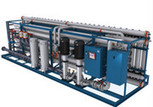
Vanadium Flow Battery Competes With Lithium and Lead-Acid at Grid Scale

The company claims LCOE [Levelized Cost of Energy] is less than half the cost of any other battery technology available.

Source: www.greentechmedia.com

>”[…]

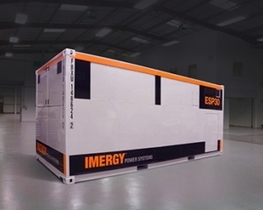
Imergy Power Systems just introduced its third-generation vanadium flow battery, claiming it offers a low-cost, high-performance energy storage solution for large-scale applications, including peak demand management, frequency regulation and the integration of intermittent renewable energy sources.

The ESP250 has an output power capability of 250 kilowatts and 1 megawatt of energy storage capacity. It’s suited for both short- and long-duration storage, with available energy ranging from two to 12 hours of output duration. The 40-foot batteries (each about the size of two shipping containers) are designed to be deployed individually or linked together for larger-scale projects. […]

Where Imergy has been able to edge out its competitors is on material cost. Vanadium is abundant but expensive to extract from the ground. Imergy has developed a unique chemistry that allows it to use cheaper, recycled resources of vanadium from mining slag, fly ash and other environmental waste.

With this chemistry, the levelized cost of energy for Imergy’s batteries is less than half of any other battery on the market right now, according to Hennessy. Vanadium flow batteries are orders of magnitude cheaper than lithium-ion batteries on a lifetime basis because they can be 100 percent cycled an unlimited number of times, whereas lithium-ion batteries wear down with use, according to the firm. Despite the compelling cost claims from Imergy, lithium-ion has been the predominant energy storage technology being deployed at this early point of the market. And very few flow batteries are currently providing grid services.

Imergy’s capital costs are lower than every other battery technology except lead-acid, Hennessy added. But he believes the company can hit that mark (roughly $200 per kilowatt-hour) by the end of the year by outsourcing contracts to manufacturing powerhouse Foxconn Technology Group in China. Delivery of the ESP250 is targeted for summer of 2015.

At this price, Imergy says the ESP250 offers an affordable alternative to peaker plants and can help utilities avoid investing more capital in the grid. Some might disagree with the claim that grid-scale storage can compete with fast-start turbines and natural gas prices below $3 per million Btu. But according to Hennessy, it all comes down to the application. Batteries can’t compete with gas at the 50-megawatt scale, but they can compete with gas at the distribution level.

“Batteries that are distributed have a huge advantage over gas, because when you buy gas down at the low end, you’re paying a lot more than $3 to $4 per MMBtu, because you’ve got to pay for all the transmission down to the small end,” he said.

Demand for cost-effective energy storage is growing as intermittent renewables become cheaper and come on-line in higher volumes. GTM Research anticipates the solar-plus-storage market to grow from $42 million in 2014 to more than $1 billion by 2018.

Imergy sees a ripe market in the Caribbean, parts of Africa and India, Hawaii and other places where the LCOE for solar-plus-storage is already competitive. As costs continue to fall, New York, California and Texas will also become attractive markets.”<

 

See on Scoop.itGreen Energy Technologies & Development

Plastic Packaging Waste in Food Industry

Food packaging today is as wasteful as it was 30 years ago and in some cases, it’s worse, a new report by a non-profit group indicates.

Source: www.cbc.ca

>” Many people take time to separate recyclables and compostables from the garbage. But according to a new report, the food industry isn’t doing enough to help.

The food we eat is often packaged in unrecyclable or difficult-to-recycle materials, says the report from a non-profit group called As You Sow. The group, which promotes environmental and social corporate responsibility, said only about half of consumer packaging in the U.S. ends up being recycled, and the rest ends up as litter or in a landfill. […]

As You Sow surveyed 47 fast-food chains, beverage companies, and consumer goods and grocery companies in the U.S. — most of which sell their products in Canada — including McDonald’s, Coca-Cola, Domino’s pizza and Heineken. It found food packaging today isn’t much better than it was 30 years ago. In some cases, it’s worse.

Shift from glass to plastic

Report author Conrad MacKerron said there has been a shift away from polystyrene since the ’80s, but there has also been a move away from glass, and towards plastic.

“We think it’s of particular concern because of the contribution to plastic pollution in the oceans,” he said. “Plastic litter from takeout orders … plastic cups, straws, plates and so forth contribute to plastic litter, but it is all swept off into waterways and oceans, where they degrade and harm marine life.”

Plastic is the fastest-growing form of packaging, but only 14 per cent is recycled, the report indicates.

MacKerron said a lot of plastics are recyclable. But some, like black Category 7 plastics, require specialized equipment. And even some of the stuff that should be easily recycled just never is.

“So our major finding is that leading beverage, fast-food and packaged good companies are coming significantly short of where they should be when it comes to addressing the environmental aspects of packaging,” MacKerron said.  […]

The biggest offender might just be your morning cup of coffee. It used to produce zero waste, apart from some ground beans and maybe a compostable paper filter.

These days, millions of households are equipped with single-cup brewing machines. The largest company behind those machines, Keurig, produced 9.8 billion little plastic single-serve coffee pods last year, known as K-Cups.

Mike Hachey, the CEO of Egg Studios, is running a campaign that he’s dubbed ‘kill the K-Cup’, in an effort to curb the rise of the single-serve coffee machine.

“We started out with Keurig machines in our offices… and very quickly realized that this packaging is a problem,” he explained.

So while we may be free of the once ubiquitous Styrofoam container, we’ve grown accustomed to a lot of food packaging that isn’t a whole lot better.”<


See on Scoop.itGreen & Sustainable News

US Utilities #1 Priority is to Replace and Modernize Old Grid Infrastructure

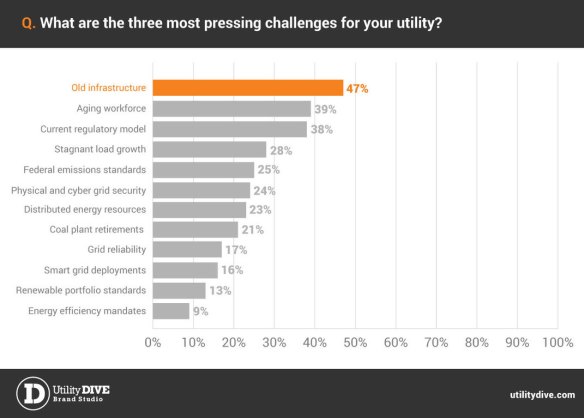
The State of the Electric Utility 2015 survey revealed that aging infrastructure is what troubles industry players most.

Source: www.utilitydive.com

>” Utility executives identified aging infrastructure as the number one challenge facing the electric industry, […] easily topping an aging workforce, regulatory models and stagnant load growth. In response, the industry is spending hundreds of billions to replace and upgrade infrastructure, rushing to meet consumer demand for higher quality power enabled by construction of a more modern grid.

“The last few years there’s been more of an emphasis on transmission and distribution, and the driver there has been the advent of all these new technologies that are trying to connect with the grid,” said Richard McMahon, Jr., vice president of energy supply and finance for the Edison Electric Institute, the electric utility trade organization. “There are also a lot of customer-driven desires utilities are trying to facilitate. There’s a lot of spending on metering automation, as well as at the distribution level, distribution transformers to accommodate distributed generation.”

Today’s grid may not be up to the task of reliably integrating high levels of renewables, distributed energy resources, and smart grid technologies, Utility Dive found. The American Society of Civil Engineers (ASCE) gave U.S. energy infrastructure a barely passing grade of D+ in 2013, at stark odds with the sophisticated grid management required by the rapid acceleration of utility-scale renewables, distributed resources and two-way devices.

“Distributed energy cannot be a profit center without the modernized grid infrastructure that’s needed for grid integration,” Utility Dive concluded in the report. […]

Outages on the rise

The American Society of Civil Engineers report that gave U.S. infrastructure a barely-passing grade pointed out that aging equipment “has resulted in an increasing number of intermittent power disruptions, as well as vulnerability to cyber attacks.”

Significant power outages rose to more than 300 in 2011, up from about 75 in 2007, and the report found many transmission and distribution outages have been attributed to system operations failures, though from 2007 to 2012 water was the primary cause of major outages.

“While 2011 had more weather-related events that disrupted power, overall there was a slightly improved performance from the previous years,” the report said. “Reliability issues are also emerging due to the complex process of rotating in new energy sources and ‘retiring’ older infrastructure.

ASCE said that for now, the United States has sufficient capacity to meet demands, but from 2011 through 2020 demand for electricity in all regions is expected to increase 8% or 9%. The report forecasts that the U.S. will add 108 GW of generation by 2016.

“After 2020, capacity expansion is forecast to be a greater problem, particularly with regard to generation, regardless of the energy resource mix,” the report said. “Excess capacity, known as planning reserve margin, is expected to decline in a majority of regions, and generation supply could dip below resource requirements by 2040 in every area except the Southwest without prudent investments.” […]”<

See on Scoop.itGreen & Sustainable News

Power plant closures quench demand for Pennsylvania’s coal

More than 100 coal-fired power plants nationwide either plan to shut down or already closed their doors in 2014, as the market responds to stricter environmental regulations, cheap natural gas and lackluster electricity demand growth, according to a survey done by the Energy Information Administration. Behind all those closures sit coal mines — many of them in Appalachia — coping with the loss of customers for the fuel that reigned supreme for many decades. Click the image above for a more detai

Source: powersource.post-gazette.com

>” […] More than 17 million tons of coal from Appalachia went to plants slated to shut down in 2013 alone, the latest full year for which such data are available. And the impact is likely to be even bigger, since the EIA’s list of recent or coming closures doesn’t include generators planning a transition from burning coal to burning natural gas.

Companies have been bracing for this change for years, but many have indicated that it’s coming faster and blunter than expected, driven in part by a slew of environmental regulations.

“That’s an unprecedented change to America’s power system in what constitutes the blink of an eye in energy markets — creating enormous potential for market disruptions, supply shortages and rate spikes,” Deck Slone, senior vice president of strategy and public policy at St. Louis-based Arch Coal, wrote in December.

Like its peers, Arch’s stock price reflects the gloom. At $1.30 per share, Tuesday’s closing price represented a one-year low. Virginia-based coal producer Alpha Natural Resources’ also saw its 52-week bottom at $1.13.  […]

Central Appalachian coal mines stand to be big losers in the transition away from coal, Mr. Cosgrove wrote in November. That includes the historically prolific supplies in Virginia, southern West Virginia and eastern Kentucky.

“Falling demand may hasten mine closings in the region, where coal production has dropped 32 percent since 2009,” he wrote.

Some companies have been bracing for the fall for years.  […]

Between 2012 and 2014, Alpha idled 64 mines, reduced its shipments in the eastern part of the country by 28 percent and got rid of more than 4,000 employees.  […]

The situation looks worse for suppliers such as Virginia-based James River Coal Co., which is in the middle of a restructuring, and Virginia-based James C. Justice Co., which has shed a significant portion of its mine portfolio in recent years. The producers stand to lose 28 percent and 48 percent of shipments, respectively, from mines serving affected plants.

For decades, contracts between coal companies and utilities have included force majeure clauses, according to Mr. Cardwell, who has reviewed hundreds of contracts and negotiated dozens during his 18-year tenure as a coal buyer for a Kentucky utility.

Such clauses typically protect power plants from having to take delivery of coal they no longer need if the power plant is prevented from running by some new environmental regulation or another unforeseen circumstance.

Yet lawsuits seem inevitable following current and projected mine closures. “I have a feeling that there’s going to be pretty significant litigation in the future,” Mr. Cardwell said.

One issue that may arise as power plants claim that environmental regulations pushed them out of business is how much of a role competition from cheap natural gas played in their decision either to shut down or use a different fuel.

Gas is all the rage at the moment. The commodity is trading at around $3 per million British thermal units, or Btus, down from more than $13 in the summer of 2008, towards the beginning of the shale revolution in Appalachia.

That’s why some operators, like Consol Energy, now boast flexibility in their contracts with utilities. Consol has refocused its company on a growing shale gas business, retaining only a handful of coal mines.

According to James McCaffrey, senior vice president of marketing at Consol, who spoke at Platts’ Coal Marketing Days in Downtown in September, “Customers want to flip between coal and gas.”

He said the company was actively negotiating a deal where a utility could choose its fuel depending on its preference.

“That’s a good marketing approach: ‘I’ll give you Btus, you tell me how you want them,’ ” Mr. Cardwell said. […]”<

See on Scoop.itGreen & Sustainable News

Renewable Energy Provides Half of New US Generating Capacity in 2014

According to the latest “Energy Infrastructure Update” report from the Federal Energy Regulatory Commission’s (FERC) Office of Energy Projects, renewable energy sources (i.e., biomass, geothermal, hydroelectric, solar, wind) provided nearly half (49.81 percent – 7,663 MW) of new electrical generation brought into service during 2014 while natural gas accounted for 48.65 percent (7,485 MW).


Image source:  http://usncre.org/

Source: www.renewableenergyworld.com

>” […] By comparison, in 2013, natural gas accounted for 46.44 percent (7,378 MW) of new electrical generating capacity while renewables accounted for 43.03 percent (6,837 MW). New renewable energy capacity in 2014 is 12.08 percent more than that added in 2013.

New wind energy facilities accounted for over a quarter (26.52 percent) of added capacity (4,080 MW) in 2014 while solar power provided 20.40% (3,139 MW). Other renewables — biomass (254 MW), hydropower (158 MW), and geothermal (32 MW) — accounted for an additional 2.89 percent.

For the year, just a single coal facility (106 MW) came on-line; nuclear power expanded by a mere 71MW due to a plant upgrade; and only 15 small “units” of oil, totaling 47 MW, were added.

Thus, new capacity from renewable energy sources in 2014 is 34 times that from coal, nuclear and oil combined — or 72 times that from coal, 108 times that from nuclear, and 163 times that from oil.

Renewable energy sources now account for 16.63 percent of total installed operating generating capacity in the U.S.: water – 8.42 percent, wind – 5.54 percent, biomass – 1.38 percent, solar – 0.96 percent, and geothermal steam – 0.33 percent.  Renewable energy capacity is now greater than that of nuclear (9.14 percent) and oil (3.94 percent) combined.

Note that generating capacity is not the same as actual generation. Generation per MW of capacity (i.e., capacity factor) for renewables is often lower than that for fossil fuels and nuclear power. According to the most recent data (i.e., as of November 2014) provided by the U.S. Energy Information Administration, actual net electrical generation from renewable energy sources now totals a bit more than 13.1 percent of total U.S. electrical production; however, this figure almost certainly understates renewables’ actual contribution significantly because EIA does not fully account for all electricity generated by distributed renewable energy sources (e.g., rooftop solar).

Can there any longer be doubt about the emerging trends in new U.S. electrical capacity? Coal, oil, and nuclear have become historical relics and it is now a race between renewable sources and natural gas with renewables taking the lead.”<

See on Scoop.itGreen & Sustainable News

Why Demand Response will shape the future of Energy

Matching supply to demand is crucial when it comes to energy — and this concept can help us do it.

Source: www.mnn.com

>” […] Our energy grid is not designed to put out a steady amount of energy throughout the day. Rather, it is designed to crank up or wind down depending on the amount of energy that’s being demanded by the markets.

That means there’s a baseload of generation that’s always on — churning out steady amounts of relatively cheap, dependable power night and day. This has typically been made up of coal and nuclear plants, which can produce large amounts of power but can’t be made to cycle up and down efficiently in the face of fluctuating demand. On top of the baseload, you have an increasing amount of intermittent sources as the world transitions to renewable energy technologies like wind and solar. And then, on top of these intermittent sources are so-called “peaking” plants, often running on natural gas and sometimes diesel or even jet fuel. These can be deployed at very short notice, when there’s either unusually high demand or when another source isn’t available (e.g. the sun isn’t shining enough for solar), but are expensive, inefficient and disproportionately polluting.  One of the most effective ways to meet this challenge also happens to be the simplest — reward people for not using energy when it’s in highest demand.

An old idea whose time has come
Demand response, as it is known by those in the industry, is really not all that new. Many utilities have offered cheaper electricity rates for off-peak hours, encouraging consumers to shift their habits and reduce the pressure on the peak. Similarly, energy producers around the world have partnered with energy-hungry industries to ask them to power down at times of high demand. What’s new, however, is an ever more sophisticated array of technologies, meaning more people can participate in demand response schemes with less disruption to their daily lives. […]

A more sophisticated approach
On the commercial side, demand response has been a strategy for some time because it took very little infrastructure to implement — just an energy-hungry business ready and willing to cut its consumption in times of need, and able to educate its workforce about how and why to do so. Here too, however, the concept is becoming a lot more sophisticated and scalable as technology allows us to better communicate between producers and consumers, and to coordinate the specific needs of the grid. And as distributed energy storage becomes more commonplace, consumers may not even have to modulate their overall use — but rather allow the utility to switch them to battery power when grid supply is constrained. […]

A huge potential to cut peak demand
A report from federal regulators suggests that U.S. demand response capacity had the potential to shave 29GW off of peak demand in 2013, representing a 9.9 percent increase over 2012. When the U.K.’s National Grid, which manages the nation’s transmission infrastructure, put out a call for companies willing to cut consumption at key times, over 500 different sites came forward. The combined result was the equivalent of 300MW of power that can be removed from the grid at times of need. And constrained by its rapid growth of renewables following the Fukushima disaster, Japan is now looking at shoring up its grid by starting a national demand response program in 2016. […]”<

See on Scoop.itGreen Energy Technologies & Development

Energy Efficiency, the Invisible fuel

THE CHEAPEST AND cleanest energy choice of all is not to waste it. Progress on this has been striking yet the potential is still vast. Improvements in energy…

Source: www.economist.com

>”[…] The “fifth fuel”, as energy efficiency is sometimes called, is the cheapest of all. A report by ACEEE, an American energy-efficiency group, reckons that the average cost of saving a kilowatt hour is 2.8 cents; the typical retail cost of one in America is 10 cents. In the electricity-using sector, saving a kilowatt hour can cost as little as one-sixth of a cent, says Mr Lovins of Rocky Mountain Institute, so payback can be measured in months, not years.

The largest single chunk of final energy consumption, 31%, is in buildings, chiefly heating and cooling. Much of that is wasted, not least because in the past architects have paid little attention to details such as the design of pipework (long, narrow pipes with lots of right angles are far more wasteful than short, fat and straight ones). Energy efficiency has been nobody’s priority: it takes time and money that architects, builders, landlords and tenants would rather spend on other things.

In countries with no tradition of thrifty energy use, the skills needed are in short supply, too. Even the wealthy, knowledgeable and determined Mr Liebreich had trouble getting the builders who worked on his energy-saving house to take his instructions seriously. Painstakingly taping the joins in insulating boards, and the gaps around them, seems unnecessary unless you understand the physics behind it: it is plugging the last few leaks that brings the biggest benefits. Builders are trained to worry about adequate ventilation, but not many know about the marvels of heat exchangers set in chimney stacks. […]

One answer to this market failure is to bring in mandatory standards for landlords and those selling properties. Another involves energy-service companies, known as ESCOs, which guarantee lower bills in exchange for modernisation. The company can develop economies of scale and tap financial markets for the upfront costs. The savings are shared with owners and occupiers. ESCOs are already a $6.5 billion-a-year industry in America and a $12 billion one in China. Both are dwarfed by Europe, with €41 billion ($56 billion) last year. Navigant Research, the consultancy, expects this to double by 2023.

That highlights one of the biggest reasons for optimism about the future of energy. Capital markets, frozen into caution after the financial crash of 2008, are now doing again what they are supposed to do: financing investments on the basis of future revenues. The growth of a bond market to pay for energy-efficiency projects was an encouraging sign in 2014, when $30 billion-40 billion were issued; this year’s total is likely to be $100 billion.

“The price of fossil fuels will always fluctuate. Solar is bound to get cheaper”

Solar energy is now a predictable income stream drawing in serious money. A rooftop lease can finance an investment of $15,000-20,000 with monthly payments that are lower than the customer’s current utility bill. SolarCity, an American company, has financed $5 billion in new solar capacity, raising money initially from institutional investors, including Goldman Sachs and Google, but now from individual private investors—who also become what the company calls “brand ambassadors”, encouraging friends and colleagues to install solar panels too.

The model is simple: SolarCity pays for the installation, then bundles the revenues and sells a bond based on the expected future income stream. Maturities range from one to seven years. The upshot is that the cost of capital for the solar industry is 200-300 basis points lower than that for utilities. […]”<

See on Scoop.itGreen & Sustainable News

WTE Power Plant Saves 1.3 Million GPD of Water Daily with Tertiary Water Treatment & Recycling

Covanta’s Delaware Valley energy-from-waste facility in Chester, Pennsylvania, has saved 1.3 million gallons a day from local water supplies by installing Ge…

Source: www.environmentalleader.com

>” […] The Chester facility generates up to 90 megawatts of clean energy from 3,510 tons per day of municipal solid waste. Previously, the plant used 1.3 MGD — or nearly 5 million liters a day — of municipal drinking water in its waste conversion process, costing the company thousands of dollars in daily water purchases.

To reduce facility operating expenses and the consumption of local water resources, Covanta Delaware Valley upgraded the facility by installing GE’s RePAK combination ultrafiltration (UF) and reverse osmosis (RO) system as a tertiary treatment package. The new system enabled the plant to reuse 1.3 MGD of treated discharge water from a nearby municipal wastewater treatment plant for the facility’s cooling tower.

GE installed two RePAK-450 trains, each producing 450 gallons per minute of purified water. As a result, Covanta Delaware Valley has eliminated the need to purchase 1.3 MGD of local drinking water a day, which results in a substantial financial savings in addition to the environmental benefits.

GE’s RePAK equipment was delivered in 2014, with commissioning taking place the same year, making Covanta Delaware Valley the first North American company to deploy GE’s RePAK technology.

Covanta chose a combined water treatment technology approach because the typical organic and dissolved mineral content of the wastewater requires additional treatment to be suitable for use as cooling tower makeup. RO was selected as the technology of choice, and UF was required as the pretreatment solution.

GE’s RePAK combined treatment system reduces the equipment footprint up to 35 percent as compared to separate UF and RO systems. By combining the UF and RO into a common frame with common controls and GE’s single (patent-pending) multi-functional process tank, GE also is able to reduce the capital costs and field installation expenses when compared to the use of separate UF system and RO systems with multiple process and cleaning tanks, the company says.”<


See on Scoop.itGreen Energy Technologies & Development

Madrid upgrades with World’s largest street lighting project

To support its ambition of becoming a Smart City, the Spanish capital, Madrid, is embarking on the world’s largest street lighting upgrade project. Philips is providing the city’s government with 225,000 new energy-efficient lights for the renewal of the entire street lighting system.

Source: traffictechnologytoday.com

>”The products, which deliver 44% in energy savings, will finance the cost of the technology upgrade, providing Madrid with the best quality of street lighting for a brighter, safer and ‘smarter’ city at no additional cost to its citizens. The project has been conducted in collaboration with ESCO energy service companies hired by the Madrid city council through a public bidding process. […]”<

See on Scoop.itGreen & Sustainable News

Energy Efficiency Development and Adoption in the United States for 2015

The US wastes about 61% of the energy we produce — much of it due to how we generate, transmit, and distribute it.

Source: theenergycollective.com
I
mage Source:  http://www.seas.columbia.edu/earth/RRC/waste_material_utilization.html

>” […] Energy efficiency, simply put, is using less energy to get the same output or value. Ways of being more energy efficient include using appliances that use less energy or reducing air leakage from our homes and buildings. Programs to increase energy efficiency date back to the energy crises of the 1970s, and continue to be hugely successful today.

Take Michigan for example, where recent data from the Public Service Commission show that the $253 million Michigan utilities spent on energy efficiency programs in 2013 will yield a $948 million return in savings in the coming years. That’s an excellent investment, no matter who you talk to. And Michigan is by no means an anomaly.

We’ve seen states throughout the country see the same kinds of positive returns for their investments in energy efficiency, which continues to prove itself the cheapest “fuel” — investments in energy efficiency per unit of energy output are less costly than both traditional fossil fuels and clean renewable fuels.

Energy efficiency programs are administered by utilities, state agencies, or other third parties, and typically funded by modest charges on ratepayers’ energy bills. While some worry that this causes energy bills to go up, they also cause energy costs to go down, as widespread efficiency upgrades decrease the demand for energy across the state or the utility’s service area, reducing consumer costs. And the customers who participate directly in the programs reap the biggest savings.

It’s a wonder not all states are investing in these kinds of innovative, proven programs. But much of the resistance can be attributed to low energy prices and a lack of political will to charge customers a bit more, even if it does mean big returns. With energy prices steadily rising, such programs will become increasingly attractive to utility regulators and customers. Even historically lagging states like Arkansas and Kentucky are starting to jump on the energy efficiency bandwagon.

No matter where we live or what our personal circumstances are, there’s always room to make changes to improve our energy consumption, whether we make a big investment like installing better insulation, or small simple changes like turning down the thermostat a few degrees in the winter.

As we think about what changes we’re planning to make in 2015, we can look internally at how to reduce energy waste in our own homes and workplaces, as well as help our neighborhoods, communities, and local and state governments make informed decisions to invest in energy efficiency. Even as our energy starts coming from cleaner sources across the country, we can do our part to reduce waste in the energy we already generate — and efficiency is the quickest and cheapest place to look.”<

See on Scoop.itGreen Energy Technologies & Development