[…] Advanced Energy Management Patent Portfolio Developed by Pacific Northwest National Laboratory

See on Scoop.itGreen Energy Technologies & Development

SEATTLE, WA–(Marketwire – Jan 29, 2013) – Calico Energy Services (www.calicoenergy.com) and the Department of Energy’s Pacific Northwest National Laboratory (PNNL, www.pnnl.gov) today announced that Calico has licensed a portfolio of advanced energy management Intellectual Property (IP) developed by PNNL.

Duane Tilden‘s insight:

PNNL’s development of the technology was funded by DOE’s Office of Electricity Delivery and Energy Reliability and the American Recovery and Reinvestment Act. The innovative Patent Portfolio is based on a single, integrated smart grid model that utilizes an economic signal to automatically balance supply and demand at the lowest possible cost.

“PNNL’s Patent Portfolio is a breakthrough that allows an electric power system to virtually balance itself,” said Jesse Berst […]

See on www.marketwire.com

Chicago Suburb Oak Park Joins International Solar-Powered Smart Grid Test

See on Scoop.itGreen & Sustainable News

The village of Oak Park, a suburb west of Chicago, was recently selected from a list of competing volunteer neighborhoods to be the test site for smart grid technology.

Duane Tilden‘s insight:

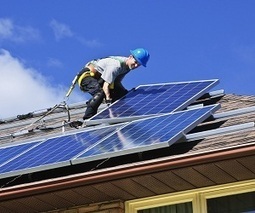
The project is a joint venture between the Korean Smart Grid Institute and the Institute for Sustainable Energy Development, and will involve placing a set of twelve or thirteen 3-kilowatt solar panels, along with a battery system, on the roofs of 100 residential and 100 multifamily buildings. They’ll also all be linked up to an electrical grid boasting smart meters, and once the test run of the system is over the building owners will get to keep the installations, worth $20,000 to $30,000 [each].

The [scenario for Oak Park homeowners] we talk about the most is this idea of collecting the solar energy during the day and storing it in the battery and then having the house run on the battery at night so you’re completely offline at night and the battery provides a phantom load — your clocks, TV.

The [average number of outages] for Oak Park is 45 minutes per year. What the number doesn’t tell you about is the stories I hear when [residents] call up on day three of still not having power. Then I get calls from restaurants. You’re talking about an entire week’s or month’s inventory gone.

See on thinkprogress.org

Biofuels groups downplay ruling’s impact on investment – The Hill’s E2-Wire

See on Scoop.itGreen Energy Technologies & Development

Biofuels groups are downplaying a Friday federal court decision that some believe could cut off investments in advanced green fuels.

Duane Tilden‘s insight:

The rule requires refiners to blend 36 billion gallons of biofuel into traditional transportation fuel by 2022. Of that total, 21 billion gallons must come from cellulosic and “advanced” biofuels, which are made from non-edible feedstock.

But the court said EPA acted in “excess of the agency’s statutory authority” in projecting refiners could blend 10.45 million gallons of cellulosic biofuel in 2012, as only 22,000 gallons were produced.

[…]

In its lawsuit against the EPA, the American Petroleum Institute (API) argued refiners were forced to buy credits to fill the gap in the agency’s projections and actual production levels.

The court sided with API on that point, giving the oil-and-gas lobby its first victory in its full-court press to repeal the biofuel mandate.

API is pushing Congress to tear down the rule and is fighting the rule through the courts. It also has a lawsuit on file challenging EPA’s projections for 2011.

“We are glad the court has put a stop to EPA’s pattern of setting impossible mandates for a biofuel that does not even exist. This absurd mandate acts as a stealth tax on gasoline with no environmental benefit that could have ultimately burdened consumers,” API Group Downstream Director Bob Greco said in a Friday statement.

See on thehill.com

CanSIA 2012-Smart Grid Breakout Session

CanSIA 2012-Smart Grid Breakout Session.

“At CanSIA Solar Canada in Toronto I [Joshua LaForge] attended a breakout session that focused on developing grid technologies for the integration of solar PV and other renewables. The speakers covered a broad range of topics, including weather forecasting for solar load balancing (Rhonda Wright-Hilbig, IESO), economic modelling of renewable penetration (Justin Malecki, Clearsky Advisors), and PV-pilot projects in isolated communities (PJ Fernandex, ABB and Scott Henneberry, Schneider Electric).”

NREL: News – NREL Teams Up on Three ARPA-E Projects to Optimize Electric Vehicle Battery Management and Controls

See on Scoop.itGreen Energy Technologies & Development

Over the next three years, NREL engineers will work with teams led by Utah State University, Washington University, and Eaton Corporation to optimize utilization, life, and cost of lithium-ion (Li-ion) batteries for electric-drive vehicles (EDVs) through improved battery management and controls. The three projects are funded under the AMPED program with more than $7.4 million from DOE’s Advanced Research Projects Agency-Energy (ARPA-E).

Duane Tilden‘s insight:

The ultimate goal of these projects is to make EDVs viable options for a larger and wider population of drivers. The projects for each team are:

Power Management of Large Battery Packs – Utah State University ($3 million)

Objectives:    Reduction in battery size, 20% longer battery pack lifetime or 20% reduction in battery pack energy content and 50% increase in cold temperature charge rate […]
Battery Management System Design – Washington University ($2 million)

Objective:     20% increase in utilization of untapped Li-ion battery capacity at the cell level […]
Predictive Battery Management for Hybrid Vehicles -Eaton Corporation ($2.4 million)

Objective:    50% improvement in fuel economy of heavy-duty HEVs without sacrificing battery life […]

See on www.nrel.gov

Wing Power Energy focuses on micro-wind systems for cell towers, buildings – Boston Business Journal

See on Scoop.itGreen Energy Technologies & Development

While large wind farms like the Cape Wind Project routinely take years to get approval and support, Wing Power Energy is focused on micro-wind systems – small generators that produce less than 10 kilowatts…

Duane Tilden‘s insight:

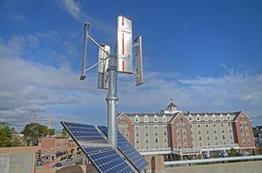
[…]Wing Power Energy’s technology is a vertical, four-blade wind propeller combined with a solar panel, which together can generate as much as 3.5 kilowatt hours of electricity.

Recently, the company put up a live demonstration in the City of Salem, consisting of three hybrid wind/solar turbines on the rooftop of a municipal parking garage powering 4G LTE enabled Verizon wireless equipment, including two video surveillance cameras, one digital signboard and a complete wireless network, completely off grid and running only on the power generated by the turbines. The company now has about 15 systems up and running or in the works around the country.

See on www.bizjournals.com

Photovoltaics vs. Biofuel

See on Scoop.itGreen Energy Technologies & Development

As facility managers and building owners prepare for another year of green pushes and renewable energy options, has research determined a winner in the photovoltaic vs. biofuel energy battle?

Duane Tilden‘s insight:

[…] in a paper titled “Spatially Explicit Life Cycle Assessment of Sun-to-Wheels Transportation Pathways in the U.S.” and published in the Dec. 26 issue of the journal Environmental Science & Technology, showed photovoltaics (PV) to be much more efficient than biomass at turning sunlight into energyto fuel a car.

“PV is orders of magnitude more efficient than biofuels pathways in terms of land use – 30, 50, even 200 times more efficient – depending on the specific crop and local conditions,” says Geyer. “You get the same amount of energy using much less land, and PV doesn’t require farm land.”

The researchers examined three ways of using sunlight to power cars: a) the traditional method of converting corn or other plants to ethanol; b) converting energy crops into electricity for BEVs rather than producing ethanol; and C) using PVs to convert sunlight directly into electricity for BEVs.

… “The cost of solar power is dropping, and our quick calculations suggests that with the federal tax credit, electric vehicles are already competitive.”

What does this mean for the future?

“What it says to me is that by continuing to throw money into biofuels, we’re barking up the wrong tree,” Geyer explains. …

See on www.buildings.com

EU faces fresh calls to strengthen biofuel rules

See on Scoop.itGreen Energy Technologies & Development

Greenpeace-backed report argues EU can meet green transport targets without relying on controversial land-based biofuels

Duane Tilden‘s insight:

NGOs are increasingly fearful that member states’ efforts to meet the targets through an increase in the use of biofuels will have a negligible impact on greenhouse gas emissions and in some cases could lead to increased emissions as companies source biofuels made from food and energy crops that are alleged to have contributed to deforestation and food price inflation.

The EU Commission has acknowledged the risk and last year proposed a new limit on the use of biofuels made from food crops that would ensure such fuels could only count towards half of the 10 per cent target for renewable fuel use.

The proposals have encountered lobbying from some member states who have argued the binding 10 per cent goal cannot be met if limits are placed on the use of biofuels made from food crops.

But the CE Delft report argues the targets can be met through greater investment in fuel efficiency measures, waste and residue-based biofuels, and electric vehicles, alongside tighter rules to phase out the use of biofuels made from land-based food or energy crops.

See on www.businessgreen.com

Could Some Midwest Land Support New Biofuel Refineries?

See on Scoop.itGreen Energy Technologies & Development

Millions of acres of marginal farmland in the Midwest — land that isn’t in good enough condition to grow crops — could be used to produce liquid fuels made from plant material, according to a study in Nature. And those biofuels could, in theory, provide about 25 percent of the advanced biofuels required by a 2007 federal law.

Duane Tilden‘s insight:

But some researchers in the field aren’t convinced the resource is nearly that big. Adam Liska at the University of Nebraska in Lincoln says a lot of this acreage is in the Great Plains, which wouldn’t produce a reliable crop year after year.

“One year you may have high rainfall and high crop yields and be able to sustain your facility, [but] the next year you may have a drought,” Liska says.

Indeed, Brent Erickson […] says nobody has plans just yet to use this kind of plant material to make biofuels. […]

“Every region of the country has some form of biomass — so the Northwest would have sawdust and wood waste; the California area might have rice straw or wheat straw, … Refiners in the Midwest are looking at corn cobs, and a plant that’s actually operating in Florida uses dead citrus trees.”

“As this technology progresses we’re going to see a great diversification of biomass supply,” Erickson predicts.

… Timothy Searchinger, an associate research scholar at Princeton University.

The 27 million acres identified in the latest study would provide less than 0.5 percent of our national energy demand, he says. And the more we try to expand biofuels, the more we risk displacing crops for food, or chopping down forests, which store a huge amount of carbon.

Searchinger says Europe has recently recognized those potential hazards and is scaling back its biofuels ambitions.

“They realize that it was a mistake, and their compromise for the moment is essentially to cap what they’re doing and then they promise by 2020 to phase out all government support for biofuels.”

See on www.opb.org

Renewables Move up the Rankin’s

Renewables Move up the Rankin’s.